• Skip to primary navigation
  • Skip to main content
  • Skip to primary sidebar

  • Basketball Plays
    • Ball Screen Sets
    • Horns Sets
    • Man to Man Post Up
    • Man to Man Isolations
    • Backdoor Plays
    • Man to Man 3 Point Shot Plays
    • 2-3 Zone Attack
    • Baseline Inbound Plays
    • Sideline Inbound Plays
    • Combination Defense Attack
  • Drills
    • Defensive Drills
    • Offensive Drills
    • Competitive Drills
    • Passing Drills
    • Rebounding Drills
    • Shooting and Scoring Drills
    • Toughness Drills
    • Transition & Conversion Drills
    • One on One Drills
  • Blueprint
  • Practice
  • Mental Toughness
  • Skill Development
  • Offense
  • Defense
  • Store

Defense

D1 Defensive Notes

By Brian Williams on December 30, 2015

The Tom Izzo and Bo Ryan Notes below are from Coach Scott Peterman’s eBook Inventory.

This week’s eBook bundle is the Boston Celtics Space, Pace, and Pick and Pop Offense paired with the Michigan State Defense Playbook.
Click here for details on Boston & Michigan State

and, as always email or call/text me at (317) 721-1527 with any questions.

I hope you can at least get some ideas that might fit your needs.

Tom Izzo

These notes are from John Zall’s Michigan State Defensive Playbook

“Hit, Find and Fetch” – this is Michigan State’s rebounding mantra. Tom Izzo preaches stepping towards the player YOU are boxing out and making contact to force them away from the rim. Instead of holding your seal and letting the ball hitthe floor; Michigan State players are taught to go find the basketball and rebound it out of the air.

• Use 2 hands to go after the basketball
• Rebound ball above head = good rebound
• Low man wins when making initial contact
• Sends 4 to the offensive glass (Point Guard gets back). This forces the other team to adjust.
• Must be able to get back behind post player on shot attempt

It is important to contain the basketball. Multiple help rotations lead to players being out of position to rebound.

Defensive teaching point–more turnovers are forced by pressure on the basketball rather than the other 4 defenders.

Must have elbow help and block help.

Mick Cronin, Cincinnati

This first group of notes from Coach Cronin were listed by Zac Boisvert on his site www.pickandpop.net

Offense/Defense Synergy

A major key to your defense is your offense (live ball turnovers will kill your defense)

Control the game with your offense so that teams are forced to 5 on 5 versus your defense

Personnel is everything (Why is this only talked about offensively? Does your defensive scheme fit with your personnel?)

Practice

Majority of team work in practice involves some kind of disadvantage work.
Create drills where you can’t possibly rest.
Playing hard isn’t enough. You need to play smart too.

Stance

Chest in front
Butt to the rim
Make him score over you
Fingers to the sky
Hands in front (forces you to have your head back)
As he picks up his dribble, inch up to his body to take away vision

Difference Between Winning and Losing

Willingness to play team ball
Willingness to be held accountable
Willingness to cover for each other

Just because a player is talented, doesn’t mean you can win with him

Sell your team on why we win and other teams don’t (Make sure they understand it’s often not about talent)

Bo Ryan

These notes are a part of Scott Peterman’s World’s Greatest Coaching Notes Volume 12

Philosophy:

I. Give up fewer shots
– turnovers
– eliminate 2nd & 3rd shots

II. Poorer shots
– shots out of range
– low % shots
– off balance

Whole Method:
– keep ball out of middle
– keep ball out of post
– force catch outside the 3 pt line
– one pass away deny/gap

*shell drill/lane line
-hand up hand down/ mirror ball
-maintain committed side
-one pass away deny (thumbs down) hand in passing lane
-2 passes away weak side- one foot in paint
-in post 1 step cushion

*shell drill/ wing
-ball close out, hand up and down (post pass)
-one pass away in post/DEAD FRONT
-one pass away, jump slightly to ball/hand in passing lane
-two passes away-drop to middle of lane (back to basketball, until ball is put on floor)
-opposite wing-middle of lane (see ball and man).

*shell drill/to other lane line
ball close out
1 pass away/hand in passing lane
2 pass away/1 foot in paint

*shell drill perimeter
-ball close out
-one pass away deny/hand in passing lane
weak side help/middle of floor
post/dead front

*shell drill/post feed
-if post “D” gets caught behind, stay between man and basket
-1 pass away, help and dig up
-RAID the post/be ready for skip pass/close out recover

STANCE
-base wider than shoulder
-sitting position
-back straight
-hands out
-play bigger than you are
-if dribble/dig up

DRILLS
1. shadow drill
2.zig zag
*dead-mirror ball, pass to coach, jump to ball
*charge, and get up quick
3. wipe the floor
* 2 slides open up/square back up/dribble swipe up/shot, yell hot block out, square back
up,/drop, dive,/dead, mirror ball

Wing denial drill
-show in gap
-open in post

Close out drill
-get high hand pressure
-contest pass into post
-quick short steps
-guard against triple threat
-move when ball is in air

Driving line drill
-force offense to baseline
-after ball is dead, make pass to coach go again
Jump to ball drill
-jump to ball/front cutter
-pass to coach, jump to ball, slide, open, secure ball (CHIN UP)
– go 15- 30 sec.

Post “D” drill
-don’t lean or hug post/1 step cushion
-wing pass is made to wing “D” drive leg up and over to dead front
-“O” trying to pin
*Med. To high post
-deny
-go behind
-3/4 front
-IF post dives low-FRONT

Post “D” 1 on 1
-all players work on post “D”
-“D” has to beat post player to spots
-go low to high
*30 sec. to 1 min.

Help and recover wing pent. Drill

*Dribble pent. From wing
-help, stop pent. When dribble is dead/recover
-kick for shot/recover high hand pressure
-block out, rebound, chin, outlet

*Post drop rotation drill
-“D” start in paint
-meet dribble pent. Before paint(help with chest up, hand back, don’t reach)
-rotate recover on shooter
-block out/ chin/outlet

MUST HAVE SYNERGY

NOTES:
1. Defense is hard work
2. guard players like you hate to be guarded
3. 5 on 5
4. Heart and Desire
5. Defense can always hold you in a game
6. Conditioning is a MUST!

This week’s eBook bundle is the Boston Celtics Space, Pace, and Pick and Pop Offense paired with the Michigan State Defense Playbook.
Click here for details on Boston & Michigan State

and, as always email or call/text me at (317) 721-1527 with any questions.

Coaching Basketball: Defensive Non-Negotiables

By Brian Williams on September 11, 2015

This post contains thoughts from two articles from Texas A&M Women’s Assistant Bob Starkey on their defense. His Hoop Thoughts Blog is another great resource for basketball coaches.

I hope these ideas give you some ideas for developing or improving the Defensive Non-negotiables for your program.

Defensive Non-Negotiables

We’ll start with some basic concepts (our why) that guide what and how we do what we do:

WE WANT TO TAKE AWAY THE PAINT AT ALL TIMES

When the ball gets to the paint it creates easy shot opportunities in the paint

When the ball gets to the paint it creates easy perimeter shots

When the ball gets to the paint it creates help and recover situations

When the ball gets to the paint it creates closeout situations

When the ball gets to the paint it creates fouling situations

…taking away the paint starts with transition defense

…stance, head, eyes and footwork are critically important

…team defense — having the ability to help early — is a necessity

WE WANT A HAND ON THE BALL

When the ball handler has the ball and has not dribbled…

…we want to have a hand on the ball — constantly mirroring the ball!

When the ball handler is dribbling…

…we want the defender to have a hand on the ball as it is dribbled!

When the ball handler is attempting to pass…

…we want a hand on the ball as it is passed with the goal of deflecting it!

When the ball handler is attempting to shoot…

…we want a hand on the ball to block or alter the shot!

WE WANT TO TAKE AWAY THE OPPONENT’S STRENGTH

This will come from scouting and game preparation


WE WANT TO HAVE A COMMUNICATIVE DEFENSE

We want to be constantly talking at all times

This will increase out concentration and execution


WE WANT TO DO ALL THE ABOVE WITHOUT FOULING

Do not give your opponent’s easy scores and free throws are easy scores

Don’t bail out bad shots or bad plays

Make our opponent’s make plays

WE WANT TO FINISH WITH A BLOCKOUT AND A REBOUND

Grabbing the rebound is like picking up your paycheck at the end of the work week.

The next portion of this post is from Coach Starkey’s article on Transition Defense

GOOD OFFENSE LEADS TO GOOD TRANSITION DEFENSE

In all successful journeys there is the first step. For each defensive possession, there is transition defense and those teams that stress and excel in this phase are further a long in being good defensively than those teams that don’t.

Ironically, I think when you start the conversation about great transition defensive teams, you must being on the offensive end. Your offense can go along way in setting the table for your transition defense.

Offensive keys that aid in solid transition defense include

1. Floor balance…have proper spacing which allows your offense to be in a position to get back defensively is extremely important.

2. Shot selection…how many times have you seen a bad shot lead to a transition basket? You offense can anticipate transition defense better if they know when, where, and by who in terms of the shot being taken.

3. Value the ball…the hardest thing to convert back on is a turnover. If the turnover is in the open court it can be.

Therefore, teams that shot at a high percentage and take care of the basketball tend to be at the least good defensive teams because they have given their defensive an advantage in terms of conversion.

THE CONDITIONING FACTOR

The other element of transition defense before we go over the guidelines is conditioning — and I believe this is two fold:

1. Physical Conditioning
Teams committed to great transition defense are in great physical condition. They pay the price in fall conditioning and continue to value conditioning through their practice habits. One of the first places a player will take off when conditioning is a factor is in getting back defensively.

2. Mental Conditioning
This is one that must be developed through the structure of your practice. There cannot be a mental “delay switch” for players in terms of getting back. It can’t a be a shot taken and then a one or two-second period where the defense is watching.

“If you think that your half-court defense wins your games, you don’t understand the game. If you take film and break it down, you will find out that only 30% of your points are coming out of your set plays and the other 70% are coming in transition, second shots, and foul shots. So the transition game is what it is all about.”

-Hubie Brown

We tell our players its “one or the other.” Either you are going to the offensive boards or you are sprinting back (unless we are in a full court press).

The setup and execution of your practice will be singular most important thing you do to develop both physical and mental conditioning for transition defense. While certainly all coaches have a series of transition defensive drills they live to utilize, one of the most important things you can do is to always convert during scrimmage situations. And in those conversion situations, stress, teach and coach transition defense.

AGGIE TRANSITION DEFENSE GUIDELINES

SPRINT BACK…STRAIGHT LINES…NO BACK PEDALING
Important to know in transition defense that the first three steps are the most critical…don’t worry about find the ball during those first three steps…get out quickly with long strides and cover as much territory as possible.

TALK & POINT UNTIL EVERYONE IS MATCHED UP
To be successful on a consistent basis, all five players must be engaged in talking and pointing…there will be times when we have to defend someone other than are original assignment but there should never be a situation where we have two players on one offensive player and another player wide open.

“LOAD TO THE BALL” HEAVY HELPSIDE…5/4…5/3…5/2
As we are getting back, if you are not sure immediately who you are picking up, move to the middle of the floor in a help and anticipate position…it will give you a closer angle to pick up someone on the ballside…if end up defending someone opposite the ball then you are in help where you should be any way.

PICK UP THE BALL (ONCE THE HOLE IS COVERED)
We want to pick up the ball as early as possible and funnel it out of the middle…however, we don’t want to leave someone under the basket wide open…once we know we have the rim covered, aggressively and intelligently attack the basketball.

TAKE AWAY THE RIM AND THE BALLSIDE LOW POST
While this is the primarily responsibility of our post players, perimeter players may have to assume this responsibility at times…make sure we don’t allow easy post feeds from the point guard or the wings…if we are mismatched, fight to front the low post until help comes.

POST DEFENDERS: MEET THE OPPOSING POST AT THE ELBOW
We want to be waiting with an extended forearm…the goal is to stop the post or force her to veer one way or another…at no time is it acceptable to allow an opposing post a direct cut to the low post for an immediate post up opportunity.

FIND & PICK UP DEAD 3’S EARLY

At least 3 steps above the arc…giving up an open, rhythm 3 is also unacceptable…Goal #1, take away the touch…Goal #2, force catch further away then where she wants to catch…Goal #3 (last resort), closeout hard to force her to put it on the floor and now allow her a clean rhythm look.

Coaching Basketball: Defending the 3 Point Shot

By Brian Williams on July 22, 2015

This post is a compilation of some analytics information that supports the belief that the best three point defenses limit the number of three point shots that their opponents shoot and essentially are not consistently effective at forcing low three point percentages by their opponents.

These ideas are from Army Men’s Assistant Zak Boisvert’s blog PickandPop.net. I have included a link to the specific article at the bottom of this post.

Whether you agree or disagree with that assertion, it is worth taking a look at some of your team’s stats over the past few years as well as doing some research online. Then, examining how that equates to your defensive philosophy, what practice drills you do to emphasize that philosophy, and your defensive rules.

Ken Pomeroy (www.kenpom.com) studied the correlation in Men’s Division I basketball from the 2010-11 season to the 2011-12 season for the four following categories:

The correlation is based on where each school ranked among all other schools in each category for the two years studied.

(The closer the correlation is .000 there is no relationship–high ranking one year, low the next. If the correlation is 1.00 that means that team would be ranked #1 in that category two years in a row.)

Opponent 3 Point Shooting Made Percentage. .204
Opponent Free Throw Percentage .266
Opponent Two Point Shooting Percentage .558
Opponent Three Point Attempts (Of all Field Goals Attempted) Percentage .575

The Free Throw Percentage “Allowed” had a higher correlation from year to year than did the 3 Point Field Goal Percentage Allowed, indicating that a team’s ability to force low three point percentages varies greatly from season to season and game to game. It also provides evidence that teams can affect their opponent’s two point shooting percentage as well as their percentage of three point attempts to overall field goal attempts more effectively.

Source “The Badgers Defensive Secret” espn.com (Ken Pomeroy)

Pomeroy did another analytical study of three point defense between 2009 and 2012 in men’s NCAA Division I Basketball. He looked at the averages of the worst 20 and best 20 teams in terms of 3 point percentage allowed for games played after December 4 each season.

Again, this is only games after December 4, so the early season non conference games are not included.

Best 20 Worst 20
2012-13 34.8% 32.9%
2011-12 34.6% 33.3%
2010-11 35.4% 34.0%
2009-10 34.3% 34.2%
Avg 34.8% 33.6%

Pomeroy has made the following observations from the data he collected:
Source (http://kenpom.com/blog/index.php/weblog/entry/3_point_defense_should_not_be_defined_by_opponents_3p)

1) Three point percentage allowed is “significantly more noise than skill.” However, it is not accurate to say that the defense has no impact on an opponent’s three point percentage. It is just that the impact is very limited.

2) “When someone discusses three-point defense in terms of three-point percentage, they might as well make the leap to discuss free-throw defense in similar terms. Teams have much more control over how many three’s their opponents shoot than how many they make.”

3) “Both free-throw defense and three-point defense exist, but it’s much better measured in the amount of shots taken and not in the noisy world of the percentage of shots an opponent makes.”

Some of the thoughts I have collected that have influenced my thinking on defending three point shots are:

1) Dick Bennett’s belief that over the course of a game, you can only do two of these three things consistently well– 1) Deny 2) Help 3) Recover. His belief was that if you deny and help, it is difficult to recover to three point shooters. If you want to be able to recover to shooters, you can’t start out in a total denial, but rather in gaps ready to help, then recover.

2) Statistical research has also shown that shooting percentage on challenged shots is lower than shots that are not challenged. Most teams work to get open three point attempts that are not able to be challenged. If we can be in position to recover to shooters (makers) to be able to make an impactful challenge, then we are likely to discourage an attempt in most cases.

3) Like anything else, to do it consistently well in games, it has to be a repeated emphasis in practice. Here is a link to a drill to work on taking away three point shots: 4 on 3 No Threes

4) Teams have the best effective field-goal percentage on shots in the restricted area and on three point shots. If it is difficult to affect three point percentage, we should work on taking away three point shots and forcing two point jump shots.

Coaching Basketball Defense Research Project

By Brian Williams on June 24, 2015

This post was written by Steve Smiley, Men’s Assistant at Weber State. His blog is coachsmiley.blogspot.com where he has posted several really good coaching articles. You can contact him at [email protected] or @coach_smiley on Twitter.

One of the projects that I’ve been working on over the past several weeks is to study some of the top defenses in America, ask several of the same basic philosophical system questions, and see if there are trends that several of the elite defenses are using in college right now. I was blessed to speak with assistant coaches at 4 D1 universities that finished the 2014-15 season in the Top 50 of KenPom.com‘s Adjusted Defense Rating. Here is the link, and the rankings are under the AdjD section (Viriginia is #1, Kentucky #2, etc). http://kenpom.com/index.php?s=RankAdjDE. Advanced stats like those at KenPom are giving all of us more in-depth information than we’ve ever had before. It’s our job as a coach to study and learn the material!

It was interesting to find that no matter the question I asked, usually 3 of every 4, if not 4 of 4 teams, answered the same way. Our goal is to see if we can pull one or two ideas out of the data to help our defense out in the future as well. Here’s a sampling of the question grid with some of the answers:

Questions

Force Middle / Base?

Team 1 Not forcing either way. Guard a yard. 3 ft to left, 3ft to right. Don’t get beat baseline = rule.

Team 3 Square up, shoulder to shoulder.

Team 4 Neither… Evolved into guarding the ball, don’t force either way. Scouting-report based.

How deep gap coverage?

Team 2 Don’t pack line, but sit in the gaps. More based on scouting (how much in the gap).

Team 4 Elbow if ball is on wing, FT-line extended (reference point). Closer to ball than man.

Bluff or rally?
(Rally refers to all out help and rotate to cover helper’s man)

Team 1 Stunt & recover unless it’s a straight line drive, must stop ball.

Team 3 Rally

Guard post, ball on wing?

Team 1 3/4 High side when ball is on wing.

Team 2 Front the Post (keep it out). If can’t front, get 3/4 on high side. Get them off the block as far as possible.

Team 3 3/4 High side if possible. Biggest thing however = “No angles to score” – will slide behind a lot.

Monster Post?
(Double Team the Low Post)

Team 2 Don’t double much…

Team 3 Started doing it late in the year… Attacked off of passer.

Team 4 Yes, do it a lot! Do it vs. great player, or a post that likes to dribble on face-up, also vs. bad posts that will turn it over

Guard POBs?
(Picks on the Ball)

Team 1 Majority time = hard hedge and then X out. Never want to Low-Show, sometimes will Level-Show

Team 3 Switch 1-4… Hard hedge & recover vs. the 5.

What D hurts you on O?

Team 1 Switching everything (including off-ball). Downing the POB wasn’t an issue.

Team 3 Pack line bothered us, dared them to shoot.

Team 4 Good, aggressive hedge on POB’s. Also, teams that switched everything.

What makes your Defense great?

Team 3 Challenge every shot (every where!) – A lot of deflections, active hands on the ball…

Team 4 Keep ball out of middle of floor was a big thing!

The biggest point of emphasis that I can stress right now is that you need to give an honest look at your team and its strengths & weaknesses from the previous season. Regardless of the level that you coach at, from youth to the Pro’s, don’t be afraid to go out on a limb, call some of your peers that you respect and are having success, and pick their brain. While there are still some coaches that don’t want to reveal any part of their program, the majority of coaches are happy to share what makes them great. Continue to study, learn, and prepare for the next season!

Evaluating Individual Defensive Players

By Brian Williams on April 24, 2015

Clinic Notes from:

I hope you might get a couple ideas to help teach and evaluate your individual defensive players. These ideas can be used whether you’re a man-to-man coach or a zone coach.

Rick Torbett from Better Basketball speaking on Better Basketball’s Dynamic Defense

Level 0 footwork

  • For example, rebounding footwork
    Rebounding near the basket is power base on power base.
    DNA “Dadgum Nasty Attitude”
    Rebounding away from the basket defensive rebounder’s shoulders perpendicular to offensive players shoulders. Check the player, arc them, pursue the basketball.
    Rebound like a quarterback with the ball and shoulder. Three points of contact, two hands and shoulder, it to protect the basketball

Level 1 Defender can guard the basketball and keep it out of the middle third of the floor.
Level 2 Defender can guard away from the ball and if a teammate gets beat on the dribble level two defender can help keep the ball out of the middle third of the floor.
Level 3 Defender can guard situations which might include ball screens, switching, rotating, among others
Level 4 defender can help everyone recover back to their original assignments

The middle third of the floor is called the highway.
The outside third of the floor is called the arc alley.
Guarding the ball is a handshake distance-conversation distance.
Close talker is in my space and making the ball uncomfortable. They play inside the offensive player’s bubble.
Teach players to cut off the middle third of the floor with their hips not their head and recover back to the offensive player’s bubble.

Terminology
Forces twilight = player with the ball can half see and half not see.
Noon = player with the ball can see clearly.
Midnight = player with the basketball can’t see the floor at all.

Great Level 1 Defender

  • Is a close talker, takes away the wrist shot drive and pass.
  • Forces midnight=the offense can see the floor.
  • Takes away triple threat position.
  • The offense can’t open at the defensive player’s hips

Good Level 1 Defender

  • Plays at a conversation distance away from the player with the basketball.
  • Bothers shots, but does not take them away.
  • Deflects passes.
  • Stops drives after one dribble.
  • Can arc the ball to the half line and doesn’t need help.

OK Level 1 Defender

  • High talker (needs to play further off the ball than a close talker or a conversation distance
  • Can’t force anything.
  • Put and OK level 1 defender on a catch and shoot only player.

Still completions for level one defenders

  • Arc the ball outside
  • No baseline drives
  • On a dead dribble, eat space
  • Interrupt rhythm dribble pull up shots
  • Dominate 1 on 1 in the highway
  • Draw charges, 4 inch fall in the direction of the drive

Level 2 Defender Responsibilities

  • Level 2 defender plays in space.
  • Intercept passes and recover
  • Establish a position to:
    • Help outside the highway
    • Stop the ball from being shot
    • Meet and greet cutters in the lane
    • Quickly recover to level 1 position when the player you are guarding receive a pass
    • Adjust positions on every pass
  • Goal is to guard 2/3 of the court, keeping the ball from going back into the highway (middle 1/3 of the court), while offensive actions are taking place, without having to switch.
  • Fulfill all responsibilities deep into a long possession
  • Cause skirmishes that create doubt in the ball handler’s mind

Every time there is one closeout, there should be 4 others.
The help behind the closeout is critical

On correcting mismatches or rotations—defense must find and cover the open player before the offense does.

Click here if you are interested in learning more about Coach Torbett’s Dynamic Defense System

Maximizing Talent & Controlling Tempo

By Brian Williams on April 3, 2015

Multiple Zone Defenses–The Key to Maximizing Your Talent and Controlling Tempo

Presented by Will Rey, Head Coach Northridge Prep, Chicago.

His program’s three keys to maximizing your talent and controlling tempo are shot selection, minimizing turnovers, zone defense.

The “Zone Problem” in Basketball

  1. Zone defense is often not respected by coaches
  2. Coaches spend less time on zone attack
  3. Players don’t like to play against it

The “Zone Advantage in Basketball”

He uses these points to sell his players on the effectiveness of what they do.

  1. NBA doesn’t allow zones. The league that is most concerned with scoring points does not allow it which should at least be food for thought as to the effectiveness of zone defense. Editors note from Brian: My interpretation of Coach Rey’s statement is that even thought the NBA does allow zone defenses, they are not true zone defenses due to the defensive three second rule. Coach Rey is a very knowledgeable basketball coach and he does know that zone defenses are legal.
  2. Time. It doesn’t require as much time to teach zone defense because there are less movements and actions that opponents run against zone defense.
  3. Zone Defenses are counterintuitive to the way players see the game and train during individual skill development workouts and drills.
  4. Hard to Simulate it is difficult for opponents to prepare to play against in a few days what we have been working on for four years (seniors), three years (juniors)

Their results show that their multiple zone defenses are difficult to score against and they foul very little–another key to maximizing talent–keeping their players out of foul trouble and in the games.

What You Should Prepare for if you decide to become a “zoner”

When you play zone defense, you need to be prepared to receive criticism and you will get it. You will hear things like:

You are a compromiser
Your teams are soft
You are a “non-purist”
You are not teaching the game

Foundational Stones of their Zone Defenses

They need to work on, drill, and practice these defensive areas each day

  1. They can get to three point shooters.
  2. They have inside position for defensive rebounding.
  3. Good defense begins with good offense–shot selection and minimizing turnovers. The two parts of the game must be compatible within your system.
  4. Their players and coaches are committed to a system of multiple zone defenses.
  5. Northridge does not play zone, they teach it!
  6. If they are going to lose, they want to make the unknowns beat them. They emphasize scouting reports and shot charts for where the opponents individual players are most effective from.
  7. Air is not the enemy, don’t guard air!  Guard the basketball, the box, or the elbow

Zones they play

23 slide
31 (1-3-1)
1-2-2
Combination 1-3 plus a chaser
Triangle and Two

Execution of their defenses

  • Cover the elbows and boxes. If no one is there now, they will be coming.
  • Teaching phrase, “Ball comes, I come”
  • Guarding a skip pass is a three player operation

Teaching the 2-3 Slides

Diagrams created with FastDraw

will-rey2


9 offense, 5 defense, cover 1 pass at a time, then make the next pass.

They bump their forwards as little as possible.


will-rey3
Defend the post 3/4 around on the baseline side.

Fronting the post is an in game adjustment.

X1 is the plug position and plays facing the ball with his back to the top of the key. He is positioned to keep the ball out of the post.

X2 is the wedge and is just above the high post.


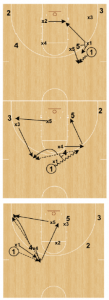
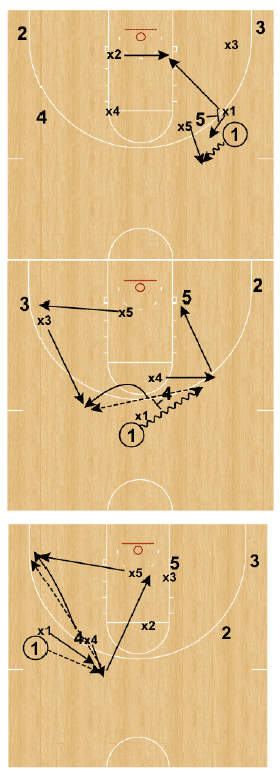
will-rey1
The three players involved in guarding the skip pass in the diagram at the left are:

x5 moving to guard the ball side block
x2 moving to guard the ball side elbow
x4 is the defender closing out on the basketball

They teach to closeout with one hand on the basketball and the other hand in the next passing lane.
The helpside forward must be aggressive and fearless. His focus is on covering the skip pass when it is made and weakside rebounding.  He plays a step off the midline.

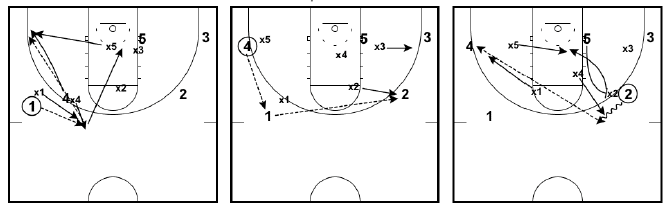
The coverage for when the ball is passed to the corner

will-rey4

Other actions they work to cover every day.

  • Swing-Swing-Corner (perimeter swing pass, perimeter swing pass, then pass to the corner)
  • Swing-Swing-Shot
  • Skip pass-Corner
  • E”merge”ncy (Merge on the basketball when it goes inside or to the elbow)


PGC/Glazier Basketball Clinics is a preferred partner of The Coaching Toolbox

  • « Go to Previous Page
  • Page 1
  • Interim pages omitted …
  • Page 8
  • Page 9
  • Page 10
  • Page 11
  • Page 12
  • Interim pages omitted …
  • Page 15
  • Go to Next Page »

Primary Sidebar

  • Twitter
  • Facebook
  • Linkedin
coachestoolbox
personaldevelopmenttoolbox
basketballplayerstoolbox
basketballtrainer
athleticperformancetoolbox
coachingbasketball

© Copyright 2026 Coaching Toolbox

Privacy Policy