• Skip to primary navigation
  • Skip to main content
  • Skip to primary sidebar

  • Basketball Plays
    • Ball Screen Sets
    • Horns Sets
    • Man to Man Post Up
    • Man to Man Isolations
    • Backdoor Plays
    • Man to Man 3 Point Shot Plays
    • 2-3 Zone Attack
    • Baseline Inbound Plays
    • Sideline Inbound Plays
    • Combination Defense Attack
  • Drills
    • Defensive Drills
    • Offensive Drills
    • Competitive Drills
    • Passing Drills
    • Rebounding Drills
    • Shooting and Scoring Drills
    • Toughness Drills
    • Transition & Conversion Drills
    • One on One Drills
  • Blueprint
  • Practice
  • Mental Toughness
  • Skill Development
  • Offense
  • Defense
  • Store

Defense

Veer Back Pick and Roll Defense

By Brian Williams on April 23, 2017

This post was originally from Zak Boisvert on his basketball Coaching Website: Pick and Pop

His YouTube channel has several videos with various types of man-to-man plays, zone sets, and inbounds plays. You can subscribe to receive an update when he posts a new video Zak Boisvert You Tube Channel

You can follow him on Twitter at this link: @ZakBoisvert

This is how Coach Boisvert described the video:

Embedded below is a video I put together exploring the NBA defensive concept of “Veer-Backs.” Through the first 5 days of the playoffs, you’re seeing a ton of these teams executing veer-backs on a lot of middle pick & rolls.

Make sure that your sound is on and that you are connected to a server that gives you access to YouTube Videos.

The first few clips are using a Veer back

I have also posted some notes below the video from as well as some links to other resources from Pikandpop.net from NBA coaches on defending pick and roll.

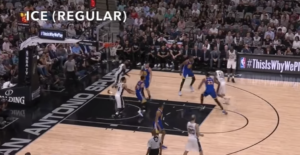
The video includes clips of Veer Back vs. 1) Snake on a Middle Pick and Roll, 2) Pick and Pop 3) Side Pick and Roll 4) Icing a Side Pick and Roll and finishes with a triple switch.

Ron Adams, Golden State Warriors Defensive Guru, FIBA Basketball Coaches Clinic

Diagrams created with FastDraw

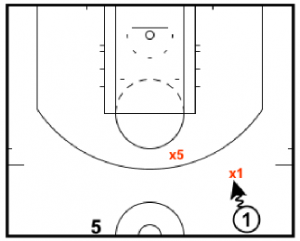
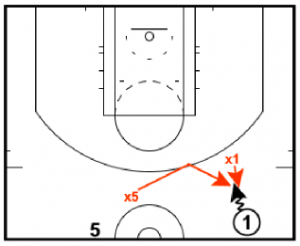
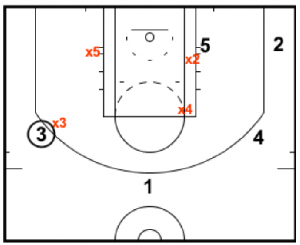
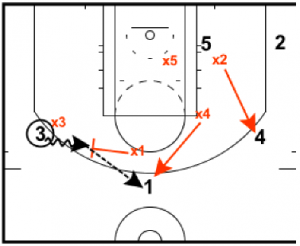
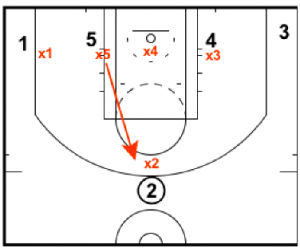
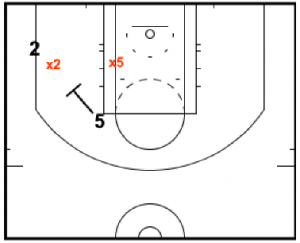
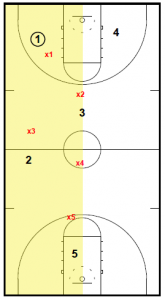
-As soon as the guard hears the “Flat” call by his teammate, he presses into the ball-handler and directs him towards the screen and then he chases the ball over the top of the screen.

-In “Flat,” the screener’s defender slides with the ball. The worse the screener is as a shooter, the deeper the big defender gets on this “Flat” coverage. The shooting ability of the screener dictates the depth of our “Flat” more than the shooting ability of the ball-handler (although against a great shooting point guard, we won’t utilize “Flat” much).

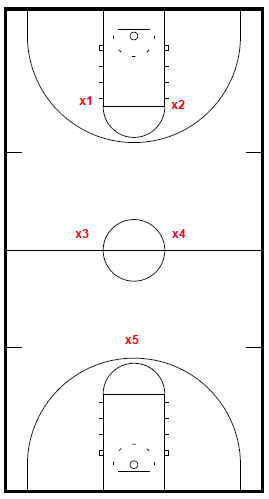
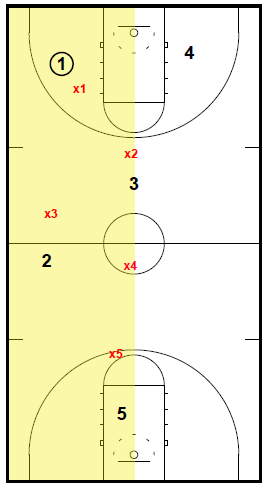
-Veerback: If the ball-handler gets too deep and attacks the big, the guard calls “Veerback” to tell the big (x5) that there’s a switch. X5 will keep 1 in front while x1 veers back and drives his butt into 5 on his roll.

-Big-to-big communication is so vital. They’re playing defense together.

Click for Complete Ron Adams Clinic Notes

Click for Complete Brad Stevens Clinic Notes

Doubling The Low Post and Rotating

By Brian Williams on April 4, 2017

This conversion defense drill was contributed by Mo Dahkil, former video coordinator for the Clippers and Spurs to the FastModel Sports Basketball Plays and Drills Library.

You can also find out more about FastModel Play Diagramming software by clicking this link: FastDraw

These were Coach Dakhil’s comments about the post:

Rotations are extremely difficult to nail down and teams must drill constantly to make sure there is an understanding of who is rotating. The other factor that makes these rotations work is constant communication. The best defenses are constantly talking and communicating with each other. Another note when practicing the rotations, it is important to have all players practice every position in the rotation. It helps them learn what their teammates are doing but situations may occur where they will be in position.

Editors Note from Brian: A point of emphasis on helping or trapping and then rotating from Kevin Eastman is that you want your defense to rotate and not scramble. Rotation implies having an organized system. Scrambling implies disorganized chaos.

With more emphasis being put on “one more pass” from an offensive standpoint, it is even more important that defensive rotations be organized and practiced.

Not to say that this is the exact system you should use, but my hope is that it will give you some ideas to apply if you do double the post and rotate out.

1 enters the ball into the post and then cuts to the WS corner.

X4 can tag the 1 as they cut but should remain at the low HL position.

X1 will go with the 1 and stop at the WS key.

As the 2 will slide over, X2 will become the one responsible for doubling the post.


When X2 goes to double, this forces a few rotations.

X3 will move to the high HL position and is responsible for any pass to the 2.

The X1 will slide and maintain an equal distance between the 3 and 1; they are responsible for any pass out that way.

X4 will remain in the low HL spot.


The defense is willing to concede the pass to the 2 because it is the easiest to recover to.

The second rule defines who is rotating where.

In the previous example X1 rotated to the 1 because he was in between the SS elbow and the sideline.

If the 2 passes the SS elbow then the first example of rotations is intact and X2 will rotate to his man.


The ball is kicked out to the 2, and as the offense swings the ball, X3 takes the 2, X1 takes the 3, and X2 leaves the double team and sprints to the 1 in the corner.

Whoever doubles the post will have the longest distance to cover but should be able to get there as the ball is swung.

An adjustment can be made, and teams could have X4 take the corner and X2 rotates to the 4 if the team is comfortable with the match up.

Jim Boone Defensive Teachings

By Brian Williams on March 9, 2017

These notes came from Bob Starkey’s (Longtime D1 Assistant Coach–currently at Texas A & M) Basketball Coaching Blog, hoopthoughts.blogspot.com.

Jim Boone of Delta State is one of the nation’s foremose teachers of the Pack Line Defense. Below is a list of key teaching points in Jim’s system. At the end of this story is the entire link the comes from his website: http://www.coachjimboone.com

Conversion Defense
• There are two critical areas in regards to being an effective defensive team that you as the coach must be accountable. The first is conversion defense and the second is defending the low-post.

• In our Conversion Defense we are not assigned a specific player necessarily, but rather, we are defending positions on the floor in order to stop the ball and our opponents transition offense.

• Our conversion defense begins as the ball is being shot by our offense. We send two guards back on defense as the shot goes up – we feel that the benefit of having our guards back on defense to STOP the BALL, is of a far greater benefit than any advantage that may be derived by having one or both rebound the offensive glass.

We designate which guard is our “Lane Defender” and which guard is the “Ball Defender”. The lane defender sprints to paint, finds the ball and takes the lane-line on the side that the ball is being entered into play. He positions here in order to take away any cuts into the lane and will closeout to a “Gap Position” or to the ball, as soon as the lane is secured. The ball defender works to contain the ball-handler at half-court, and preferably get the ball out of the middle of the floor. Again, he must contain the ball first and foremost, and of course, his point of pick-up can change due to our opponent’s personnel.

• The remaining three players sprint back to paint as soon as our opponent gains possession of the ball. We teach their first three sprint steps to be with total disregard to vision; turn and sprint three steps, and then locate the ball as they continue to the lane. We will position toward the ball-side as deep as the ball. We cannot express enough the emphasis that we place upon our team of not giving-up transition baskets, NO LAY-UPS!

Pressure on the Ball
• We must place pressure upon the basketball, we cannot allow the ball handler to play comfortably, to easily look over the court. Offenses today will pick your defense apart if you allow them to do what they want to do with the ball. This is a great myth in the Pack Line Pressure Defense, that we do not pressure the ball – that we are all about containment. Yes, we must contain and our players must know their limitations, but we must pressure the ball.

It is much like the football quarterback; the passer that has all the time needed to drop back and throw the ball, any NFL quarterback will pick apart a defense that does not pressure – the same holds true with our game. With this being said, we cannot allow the ball to get into the PACK AREA. Our point of pick-up is at half court, in the play area it is determined by whom you are guarding – your game and his game.

As much as we want and demand pressure on the ball, we must also understand a very important axiom I our defensive game planning; “Sometimes to not guard, is to guard”. In other words, there are players that you are better served to not defend, and therefore, utilize this defender as a helper.
• We do not force the ball in a specific direction. We simply tell our players, “DO NOT GIVE-UP THE BASELINE”. We do not want them to feel that it is OK to force the ball to the middle, we just cannot get beat baseline. We will emphasize that our players must have their baseline foot positioned outside of the offensive player’s baseline foot.

• We will drill a lot of one-on-one in order for our players to learn their limitations, to understand how to keep the ball out of the PACK, and to learn how to force contested jump shots.

• We deny inside the arc and we will work on this more from a whole method standpoint more so than a 1on1 breakdown drill, but we absolutely do not want to allow the ball inside the PACK AREA (17 foot mark).

• Footwork is of paramount importance in our pressuring the ball, we want to Step (point our toe) in the direction that the ball is being dribbled, and Push with our opposite foot. We use the term, “Guarding a Yard” with our players, if we can execute two quick slides, we can arc and defend the ball. Use quick, short, steps without bringing our feet any closer than 12 inches, there is an imaginary ruler between our heels, no Heel Clicking.

• If we can force a Dribble-Used situation, we now leave the PACK area with all of our defenders, in an effort to all-out deny all four offensive players. This is a great opportunity for us to create a panicked, and hopefully a turnover situation for the offense. The player defending the ball must verbalize the dribble used situation by calling out “FIVE – FIVE – FIVE”.

Jumping to the Ball
• We do not jump to the ball per say, our first move is to jump back into the PACK AREA and then move toward the ball to preserve our Ball-You-Man relationship. Therefore, the nature of this position places our defender closer to the ball than the man who passed it.

• We assume a flat triangle position, slightly open and inside the PACK AREA when our man does not have the ball and is one pass away.

Closeouts
• Closing out to the ball is the key to our recovery mode, sprint the first two to three steps, with the last couple being short, choppy, steps. We must accomplish two objectives in our closeout; first we must closeout “Hard & Short” with our weight back prepared to absorb the dribble (we will not get blown away by the dribble), and secondly, we must have High Hands. We teach our players to keep their hands high, with elbows bent, for a 1001 count. We must create the illusion that there is no shot to be had. We cannot allow the offense to have rhythm jump shots.

Gap Defense
• All Non-Ball Defenders are located inside the Pack Line – This is the most critical part of our defense. We do not believe that our defenders can accomplish three things: they cannot Deny, Help, and Recover. Therefore, we have eliminated the denial, and we now focus entirely on the other two factors – Help and Recovery. Because our defenders in the Gap are already positioned in Help, they are now quicker in their recovery to the ball – there is no negative movement, away from their recovery.

• We are constantly “Re-positioning” in the Pack area:

1) Position Up the Line, but Off the Line – slightly closed to the Ball

2) Vision is of the utmost, we must see both Man and Ball

3) Do not Help to Take a Charge, but rather with our Near Arm and Leg, we do not want to become Blind to our Help, by losing sight of our man

4) Bluff help as much as possible, we cannot become sterile in our positioning.

5) We must be Active & Energized in our Gap – We are Zoning the Ball

Flash Post
• We are positioned in a flat triangle with our closest foot to the ball slightly forward, therefore we are in a denial position to begin and better equipped to take away the flash.

• VISION is key, WE MUST SEE BOTH MAN and BALL!

• Upon the offensive players flash cut, we intercept it with our forearm. We teach our defender to use his forearm, to bump or force the offense away from the lane without extending the forearm, which would be a foul, in order to deny.

It is a reality that our defender will momentarily lose sight of the ball, this occurs whenever we are defending a cutter, weather a screen is involved or not.

Defending the Low Post
• You must have a very clear and concise philosophy of defending the low post. How you defend this area dictates everything else you do defensively.

• There are only two areas to be defended; the low post and the perimeter. Everything that occurs in our Post Box (Approximately two steps off the lane and below the first hash mark on the lane) is considered the low post, everything else is the perimeter.

• We ¾ Deny on the High Side of the Post, we tell our players to “Smother” the Low Post. Activity is our biggest key, WE MUST BE ACTIVE!

• We can play ¾ high because we allow no baseline penetration. This also places us in a better position to take away the “High-Low” entry into the low post.

• We must know our slip-point in the low post; it can vary from player to player, depending upon size, length, and quickness. Anytime the ball is on the side and the offense tries to move us up the lane, upon approaching the mid-lane area we must slip behind to the baseline side to avoid being pinned high.

• Anytime a player steps away form the post, we then treat him as a perimeter player and deny inside the PACK AREA.

• There can never be a feed to the low post from the top, no exceptions!

• On a catch, we tell our post that this is our time, not the offensive player’s time, but our time. We must quickly slide behind the post on “air-time” – do not reach or gamble for a steal, but work to immediately position ourselves slightly to the baseline side with a half-step of cushion between our defender and the offensive player, maintaining a position between the post and the basket.

• From our position behind the low post, we will defend the ball in one of three ways:

1) Play the post one-on-one from behind – do not give up a scoring angle forcing the offensive player to score over our defender, not through our him. Our post defender must keep his hands at shoulder height with his fingers pointed upward. We teach our post to employ a one step cut-off in this area, using his chest to level off the dribble, take the hit and force the tough shot.

2) Choke the Post – our perimeter players located on the ball-side will open to the ball as it is passed and give help to the post defender. We can dive in and out to bother the post and choke the post only if he puts the ball on the floor, or we can full-out choke the post, immediately diving to the ball and digging it out, forcing him to throw the ball out to the perimeter. Obviously, if our perimeter defender is defending a dead three or a great scorer, we may determine not to choke with his defender, but only to bluff help.

3) RED THE POST – Double the post Big to Big. This is probably our most often utilized method of defending the post, and our most effective. It is a way in which we can force the ball back out of the scoring area, while creating turnovers.

You can download more of his defensive philosophy here: Jim Boone Pack Line Defense

Chris Holtmann Conversion Defense System

By Brian Williams on January 29, 2017

I am a big believer that half court defense starts full court and that you can’t be a great defensive team without being great in converting to defense to force your opponent to play against your half court defense.

The video is 5 minutes of Ohio State Coach Chris Holtmann going through his Conversion Defense System.

His system utilizes the 3 rebounders to the offensive glass when the shooter lifts for the shot, along with a fullback and halfback. Coach Meyer called the 3 offensive rebounders the “tailbacks”

Coach Holtmann goes into the initial roles for the fullback and halfback.

If you are interested in finding out more about the DVD that the video sample came from, click here:

Chris Holtmann: Stopping the Fast Break – Basketball — Championship Productions, Inc.

Make sure your sound is on as you watch.

The video is a You Tube video.

Click the video to start the presentation.

Brad Stevens Notes

By Brian Williams on January 5, 2017

University of Maine Men’s Assistant Coach Zak Boisvert has assembled some notes from Brad Stevens at the 2016 Brayden Carr Coaches Clinic. The Brayden Carr Foundation is a non-profit charitable organization that works to raise money for children with seizure conditions. The charity was established by Rhode Island assistant coach Jim Carr and his wife Natalie after their son died tragically in May 2011. You can find out more about the charity at this link.

He has an outstanding site with posts on various coaching topics at www.pickandpop.net

His You Tube channel has several videos with various types of man to man plays, zone sets, and inbounds plays. You can subscribe to receive an update when he posts a new video Zak Boisvert You Tube Channel

You can follow him on Twitter at this link: @ZakBoisvert

Brad Stevens, Boston Celtics

-All coaches are bound together. It’s a brotherhood and we should always be looking to help one another.

-I spent 13 years at Butler University in Indianapolis and it was the greatest learning experience I could have ever asked for.

-I went to Butler as a volunteer support staffer and quickly learned that I knew nothing. They taught me so much more than I thought there was to know.

-Look at the things you do and ask why you do it. Is it the best way or the way you’re used to doing it? Are we doing it because it’s the right way or because we think we’re supposed to be doing it that way?

• Adjusted shoot around time because his players liked it more later in the day.

-I learned the importance of running a condensed, efficient practice. He worked so hard to create a practice plan that covered what needed to be covered, but was as concise as possible to be respectful of his players’ time.

• Abraham Lincoln: “I apologize for the length of this letter. I did not have time to write a short one.”
• The importance of rest & recovery: clear mind, fresh legs.

-As a coach, you are what you emphasize.

-Your first meeting with the team is incredibly important.
• What is important to winning?
• Dominate effort plays.
• Get good shots.

-You will make tweaks to your systems. You will run different stuff from year-to year, but there should be a certain amount of absolutes built into your philosophy that you won’t/can’t budge on.

-Vitally important as a coach: Perspective and balance. Your health/family/wellbeing is more important than the next game. I encourage all coaches to read the Urban Meyer piece on Bleacher Report entitled, “I’m Not the Lone Wolf.”

-I love watching football coaches. Their ability to get 100 people on the same page with tempo is astounding.

-Books I recommend:
1. Grit (Angela Duckworth)
2. Legacy (James Kerr)
3. Mindset (Carol Dweck)

-James Kerr (Legacy): Successful leaders look beyond their own field to discover new approaches, learn best practices and push the margins.

-Don’t focus on trophies, focus on getting better.
• Get rid of the emotional roller-coaster that comes with fixating on results.
• Fall in love with the pursuit.

-Our goal is a championship. Anything less would be disrespectful to the organization we represent. While that’s our goal, we’re focused on the process and getting better.

-We crafted our entire defense (& recruiting philosophy) over how we hedged pick & rolls.
• Hard hedged all ball screens.
• The way we taught defense started with the hedge.
• We recruited to the way we defended. We wouldn’t recruit bigs that couldn’t move.

-By the way…If you’re more athletic and can switch everything, throw everything else out. Switch everything and enjoy winning.

-We created chaos with the athleticism of our bigs’ hedging. We were elite defensively when our guards were athletic too (Shawn Vanzant, Ronald Nored) and could get into the ball and direct/impact it.

-The science of the hedge:
• Hand on screener’s back.
• Parallel with the sideline / perpendicular with half court line.
• 2 hard steps up the court.
• Listening for guard’s “Back” call as he moved underneath you.

• Running back to the lane and being directed by the guys positioned in help.

-As we hedge that side pick & roll, the other 3 defenders move into a zone—no longer matched to a person.
• We’re “Muhammad Ali-Ready.” On our toes, ready to pounce.
• Ready to fly out.
• Know who the player you’re closing-out to and what they do. That’s the importance of personnel awareness in scouting. Because of how often we’re zoned up on the weak side, you need to know the strengths of everyone on the other team, not just your match up.

Diagrams created with FastDraw

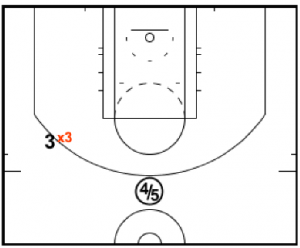
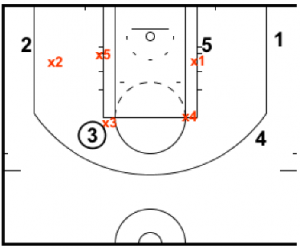
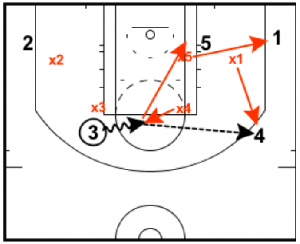
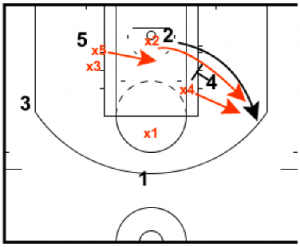
-Versus a spread pick & roll, our “Ultimate Helper” on the roll is the weak side corner defender (rather than the single-side bump guy).

If the single-side bump (x3) gets pulled in on 5’s roll, it’s too easy of a play for the offense to throwback to 3 on a lift.

 “Ultimate Helper” meets the roll in front of the charge circle. In this scenario, x4 would start inching out as the ball is being dribbled at him and would take the first pass to the weakside (either to 2 or 4).


-Will rotate to a great pick & pop on a middle pick & roll


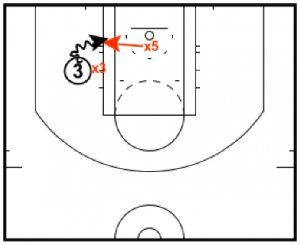
-Versus the shooting 4-man on a side ball screen: “X Switch.”


-Drill: defense x’s the first side ball screen. Offense skips it to the corner off the second ball screen. X1 takes the first pass out.

-“Contain Blitz” concept:
• Guard: don’t get beat corner.
• Both: don’t get split middle.
• On pass, big can leave.
• Make sure the pass out has to be made over outstretched arms.

-At Butler, we wanted to be absolutely chaotic on the ball. We wanted to utilize the athleticism of our bigs.

-Every time in which I thought we were really bad defending the pick & roll at Butler, I would go back and watch the tape and I’d always end with the same conclusion, the two guys on the basketball weren’t good enough/didn’t create enough chaos.

-Weakside nail defender: we don’t want you on the nail (we’re pulled too far over that way). We just want them thinking you’re at the nail.

-The first aspect of a closeout is to do so knowing the tendency of the man you’re closing out to. Is he a shooter? Non-shooter? Baseline rip & go guy?

-We ideally want to hear the pick & roll coverage 3 times by our bigs, but we know it doesn’t always work that way.

-4-on-4 Drill: The four offensive players stationed around the perimeter swing the ball around. The coach calls out one of the defensive players’ names and he sprints to touch half court and sprints to come back into the play. As soon as the coach calls the defensive player’s name, the drill becomes live (offense trying to get a layup).

-In disadvantage situations, what are our priorities?
1. Basket
2. Ball
3. Great Shooter

-Think about who is in your area (that you might be closing out on) in a disadvantage situation. We’re taking away layups and we’re stopping the ball. Ultimately what we want is a jump shot taken by the worst shooter on the court.

-A game great plan can do the job for all 40 minutes in the college game. In the NBA, the great players will expose your game plan, no matter how good it is. You have to have your adjustments and contingency plans.

-Good players will beat good pick & roll defense.

-I cannot stress how important it is to know the opposing team’s personnel. If guys want to call that analytics, sure, I’m into analytics.

-Whose call on “Veer” (late switch)? Out of convenience, it’s the guard’s call. He knows when he’s beat.

ICEing the Pick & Roll

-Because of the extra space inside the 3-point line in the NBA (compared to college), the onus really falls on the guards in your ICE.

-Guards:
• Straddle leg
• Win foot race with the ball
• On dribble pick-up, 2 hands high to deflect or delay the pass.

-Bigs:
• The higher you can be, the better (but only to an accurate level of your mobility).
• BIG inside hand low taking away the pocket pass to the screener rolling versus the ICE.
• Dropping appropriately and returning when pass is made or the guard squares the ball up.

You can read the remainder of the notes and also download a pdf at this link: Pick and Pop Brad Stevens Clinic Notes

10 Commandments of Defense

By Brian Williams on December 29, 2016

This post was written by Micah Hayes and posted with permission from PGCBasketball.

Micah is the owner of ‘The Sweatbox Decatur’ and serves athletes through intense individual & group athletic performance training. Micah is also the strength & conditioning coach at Decatur High School.

It has been said that the cornerstone of defense is not just effort but multiple effort.

I argue that if defense was just about effort then we could pick up anyone off the street, offer the right motivation and they could get the job done. Defense is so much more than that. You have to know how to guard multiple actions and understand angles, assignments and rotations. That being said, every part of the game involves effort. In fact, that is a baseline for participation at any level of play. If you don’t bring your multiple efforts, you won’t be great at defense, and your game won’t be complete.

Knowing that defense isn’t that easy, I want to offer 10 defensive commandments to help sure up that part of your game.

1. BE COMMITTED

Everyone wants to put the ball in the hoop, but few basketball players find that same joy in getting a big stop, holding a great offensive player below their season average or snagging a pivotal rebound that gives their team an extra possession.

The game truly becomes easier when you can experience equal joy on both ends of the court.

2. DON’T TALK, COMMUNICATE

Too often, I hear players call out a term like “help,” “ball,” “dead,” etc. In a vacuum, those terms mean nothing. You could be helping from anywhere, the ball could be doing anything, and what is exactly is “dead?” Instead, I believe players should communicate their position or exactly what they believe the opposing player is going to do on that possession. It would sound more like, “I got your help on the left!” “Shooter right corner!” “Right hand driver, send her my way!”

Don’t waste energy saying the same thing over and over again. Communicate your message loud and clear once or twice. The game happens fast and you need to be ready to communicate your new position and your player’s next move.

3. GUARD YOUR YARD

Your help should typically be about one to two steps away, which is about a yard in either direction. If you can guard your yard, send the ball into your help and keep the ball in front of you. The offense will be forced to take tough, out-of-rhythm, contested shots. Many of those which will be off the bounce (the worst shot in basketball).

Over the course of a game and a season, the percentages will favor your defense and the offense will make fewer shots which will hopefully result in you winning more games.

Sometimes a better player having a great night will hit a tough shot and all you can do is tip your hat and move on to the next play. Keep doing your job, the odds will end up in your favor.

4. HELP THE HELPER

I will guarantee you one thing: you will get beat. An offense player will have an incredible peek fake, explosive first step or dribble move that will beat you, and you will need help. You can’t quit on your play; you have to be ready to assume the next help responsibility.

If someone helps you, it is your job to get your head on a swivel and recognize how you can help them and then get on your horse and make a play. One easy way to remember that is to “see a need and fill the need.”

Special defenders will help as many times as needed whether it is their responsibility or not. They show up BIG with their voice, body language and mentality and get the job done.

5. ANTICIPATE

Basketball is a game of chess, and the ones who get caught playing checkers are routinely beat over and over again. You have to be thinking one step ahead at all times. Is there a screen coming? What kind of screen is it? Is he about to drive or shoot – and from where? Where is my next help responsibility?

Anticipation is a key ingredient to success on either end of the floor. If you can couple anticipation with advanced preparation (you know your player’s tendencies), you will have success guarding them. It will look like you are in two places, but you know that you are just thinking a step ahead.

Basketball is a game of chess; think one step ahead. Don’t get caught playing checkers.

Click To Tweet

6. COVER TWO

One of the easiest ways the offense can score is in transition. It’s your job to get back and stop the offense in its tracks. The two things you need to cover are 1) the ball and  2) the streaking offensive player running to the open lane or rim, trying to gain an advantage in the open court before the help is set.

You and one other teammate need to communicate and decide who is going to stop the ball or get their head in the rim and make a stand until the rest of your teammates get matched up.

It’s not enough to just get back. You have to be ready to make a play and turn sometimes what might be a bad situation into a good one by getting a deflection or funneling the offense away from an open lane.

7. GET F.A.T.

When you are on the court, you want to find yourself constantly faking and threatening the offense.  Make them think you are playing the drive when you are really anticipating a jumper; jab at the ball handler, help early and bait the offense into a bad pass.

Offense isn’t the only place where fakes are useful. If you can use fakes on the defensive end, you will take your game to another level. Threaten the defense by showing up big with your body language and your voice. We all know that noise can be used as a distraction, and you can’t distract anyone showing up small. (If you’ve ever been to a haunted house before, you know it’s always the demonstrative and screaming actor that comes out of nowhere that gets you.)

8. HIT FIRST

When you are boxing out, it’s not enough to hit the offensive player. You have to hit first and get them off balance so you can go and grab a board.

I don’t believe in the idea of holding a box out and letting it hit the floor. There is only so long you can maintain a box out without getting a holding foul called or just getting beat. A good offensive player wants the ball just as bad as you do so hit them first and then attack the rebound with everything you’ve got.

It’s not enough to hit the offensive player, you have to hit FIRST.

Click To Tweet

9. RUN OPPOSITE

Seventy percent of rebounds come off on the opposite side of the rim. That means more than half of the rebounds you go after will have to be run down.

After you hit your box out, get to the opposite side of where the ball was shot and start attacking the glass. You will turn yourself into a rebounding machine and gain extra possessions for your team just by playing the numbers on this one.

10. SOLVE PROBLEMS

Every time the offense comes down the court they are presenting a new problem for you to solve. Which player is going to shoot it? What set are they going to run? Who might get beat?

Each of these is an opportunity for you to show up like one of three players. You can be a Preventer and solve the problem early by making a play on the ball or in help. You can be a Fixer and show up like a repairman and start plugging holes like a teammate getting beat off the bounce or a smaller teammate getting posted up. Or lastly, you can be an Eraser and at the last second take a charge, show up on a rotation and get a steal, or come out of “nowhere” and block a wide open shot or lay-up.

No matter where you are in a defensive possession, there is always a problem to be solved, and you need to be ready to solve it.

I am going to offer up one bonus commandment for defense and that is, “Have Fun.” The best competitors look forward to this end of the floor. They relish the opportunity to beat the offense at their own game of deception, timing and anticipation. It is an opportunity to be disruptive, earn easy possessions and show off your toughness. Take pride in your ability to not only give someone a bucket but also take one away.

To learn more about PGC Basketball, including additional training tips and videos, you can visit their YouTube Channel

  • « Go to Previous Page
  • Page 1
  • Interim pages omitted …
  • Page 6
  • Page 7
  • Page 8
  • Page 9
  • Page 10
  • Interim pages omitted …
  • Page 15
  • Go to Next Page »

Primary Sidebar

  • Twitter
  • Facebook
  • Linkedin
coachestoolbox
personaldevelopmenttoolbox
basketballplayerstoolbox
basketballtrainer
athleticperformancetoolbox
coachingbasketball

© Copyright 2026 Coaching Toolbox

Privacy Policy