• Skip to primary navigation
  • Skip to main content
  • Skip to primary sidebar

  • Basketball Plays
    • Ball Screen Sets
    • Horns Sets
    • Man to Man Post Up
    • Man to Man Isolations
    • Backdoor Plays
    • Man to Man 3 Point Shot Plays
    • 2-3 Zone Attack
    • Baseline Inbound Plays
    • Sideline Inbound Plays
    • Combination Defense Attack
  • Drills
    • Defensive Drills
    • Offensive Drills
    • Competitive Drills
    • Passing Drills
    • Rebounding Drills
    • Shooting and Scoring Drills
    • Toughness Drills
    • Transition & Conversion Drills
    • One on One Drills
  • Blueprint
  • Practice
  • Mental Toughness
  • Skill Development
  • Offense
  • Defense
  • Store

Defense

Numbered Defensive Fast Break

By Brian Williams on April 25, 2014

These thoughts came from Coach Scott Peterman of the Men’s Basketball Hoopscoop Coaching site.

He has put together “The World’s Greatest Collection of Basketball Coaching Clinic Notes.”

You can get a copy of Volumes 6 and 7 along with my eBook with 130 Winning Special Situations at this link: The World’s Greatest Collection of Basketball Coaching Clinic Notes Volumes 6 and 7

If you have any questions about the notebooks, please feel free to email me.

The first requirement to being a great defensive team is to be a great defensive conversion team to 1) Take away easy baskets 2) Force the offense to play against your set half court defense 5 on 5.


by Mike Dunlap Current Coach at Loyola Marymount–former NBA Assistant and Head Coach

1. Fundamental to our success as a basketball team will be in direct relation to the number of easy baskets we allow. I believe defensive transition is paramount in our system.

2. In order to understand sound defensive transition, we first must analyze the fast break.

Made or missed, the fast break team is trying to:

a. Get a quick outlet pass as far up the court as possible.
b. Transfer the ball to a shooter at the other end of the court.
c. Get an uncontested three point shot or lay-up off after the second pass.
d. Immediate ball reversal to the opposite wing and /or trailer as it is very tough for the defense to go from ball side pressure to help side closeout.

3. Numbered Defensive Break

A. Concept

1) Players roles- each player will have a designated lane ( i.e the same lanes as our numbered fast break)
2) Emphasis – pressure the basketball while covering fundamental fast break lanes.

B. Rules

1) Stop the ball-Meet the outlet pass and get the guard to turn as many times as possible- slow the ball down, at least.
2) Sprint the lanes

a) The first three steps are the most important because that is when the break generally takes place.
b) Once players reach the half court line, vision on the ball and man should be a pint of emphasis.
c) The key is to get below the level of the ball.

3) Match Up/ Rotation

a) Match up to the offensive man in your lane.
b) However, if there is not a man in your lane, rotate to the nearest offensive player: at no time should the defensive player be solely responsible for his lane.

4) Help on Penetration

a) The ball and its penetration is the single most important thing to defend. Therefore, the emphasis should be keeping the ball in front of you. Since that does not always happen, immediate rotation to the ball cannot be stressed enough.
b) Two points should be mentioned – first, quick rotation will not occur unless there is proper defensive spacing (“ play up the line,” or to the ball): secondly, whenever a player is beaten by penetration you can double the ball with the chaser as a rule of thumb.

5) Contest all shots

a) Hands are essential in all phases of defense, especially when it comes to defending the shot.
b) It is imperative that all shots be pressured with the hands up on the closeout.

6) Rebounding – Completes All Defensive Series

C. Responsibilities

1. “1”- a free safety

a) Must get to the initial outlet immediately – made or missed (i.e. fast break teams want the ball inbounded / outletted quickly). If you condition your “1” man to jump to the ball instantly it will slow the break down.
b) In situations where the “1” man cannot get to the ball (definitely the exception) , he will fill the “2” or “3” lane, which ever is open

2. “2” – sprints the right sideline lane. In cases where “1” cannot get to the ball quickly enough “2” will assume his responsibilities.
3. “3” – sprints the left sideline lane. Occasionally, he will take the initial outlet pass.
4. “4” – sprints inside lane nearest the “3” man and is responsible for any trailer. Additionally, he we assist on middle penetration should his man be dragging up the court.
5. “5” – sprints to paint and will be responsible for the first cutter through the paint- he protests the paint.

These thoughts came from Coach Scott Peterman of the Men’s Basketball Hoopscoop Coaching site.

He has put together “The World’s Greatest Collection of Basketball Coaching Clinic Notes.”

You can get a copy of Volumes 6 and 7 along with my eBook with 130 Winning Special Situations at this link: The World’s Greatest Collection of Basketball Coaching Clinic Notes Volumes 6 and 7

If you are interested in adding to your Coaching Toolbox take look at what I believe is our best offer.

CLICK HERE to select from a list of more than 70 eBooks.


If you have any questions about the notebooks, please feel free to email me.

Coaching Basketball 4 Levels of Defense

By Brian Williams on March 21, 2014

Today’s post includes a video about Better Basketball’s Dynamic Defensive System. It contains samples from the whole program.

It moves fast and you may have to rewind, pause it, or watch it a second time, but I think there are several ideas to be had from the content. I hope you get some ideas that can be adapted to your program.

You can also see their You Tube channel of several coaching resource videos at: Better Basketball You Tube Channel

My takeaways from the video below

4 levels of defense

0 = Prerequisites Moving Mechanics and Rebounding

3 Types of movements (forward/back, side to side, rotation)

Some ideas for preseason conditioning drills next fall (see exercises on the video)

(Emphasis that rebounding is a prerequisite for playing defense)

Level 1 = on ball defense

Level 2 = guarding away from the ball

Stop the ball from being driven into the lane
Stop the ball from being shot in the lane
Stop the ball from being passed into the lane
Quickly recover to level 1 position on the ball

Level 3 = guarding situations such as baseline drive, ball screens, post feed, failed traps

Level 4 = restore order

Snippets of drills (see the drills in the video)

Terminology

Taking a charge–“no hand bracing” keep hands up when landing to avoid injury to hand/wrist and a drill to work on it.

Skirmish = make the penetrator indecisive by faking help.

The help behind a recovering defender is the most important part of recovery.

If the ball is fed into the post, the post defender has the air time of the pass to recover to guard the ball once it is caught.

To create level 3 defenders, 1) Reduce each principle into specifics that can be measured 2) Turn the principle into repeatable actions that can be drilled

A skill can be acquired if it can be turned into repetitions

3 ways to double team the post 1) Ball is in the air from a pass 2) On the catch 3) On the move by the offense

Having mental toughness does not guarantee a championship, but a lack of mental toughness (not having poise, focus confidence) in the key possessions is guaranteed to cost you a championship.

Championship commitment on defense requires verbal, physical, and emotional commitment.

If you are interested in learning more about this defensive system click the link below.

Better Basketball’s Dynamic Defensive System.

Defending Pick and Roll 5 Options

By Brian Williams on February 6, 2014

This post on defending pick and roll was sent to me by Nate Hill, Assistant Boys Coach at Colonel Crawford High School in North Robinson Ohio. He has coached for 18 years from 7th grade through Varsity Head Coach.

Nate has contributed several articles for the site.

Coach Hill said: I typed this up while preparing for our next opponent who runs lots of ball screens.

These are 5 different ways I’ve seen the pick and roll defended.

Pretty basic stuff, but it helped me out going through the different strengths and weaknesses.

He started a Coaching Newsletter this past Fall. Here is a link to the archives if you are interested.

Next Level Basketball 419

In case you have any questions or comments for Coach Hill, or would like to subscribe to his newsletter, here is his email address:

[email protected]

I posted an article a year ago from retired NBA Coach Del Harris about defending pick and roll. Here is the link: Del Harris defending pick and roll

Diagrams created with FastDraw

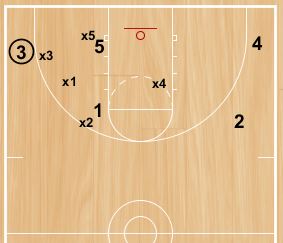
Jam and Under

basketball-defense-pnr1

X5 chests up 5 and tries to JAM screener.

X1 goes UNDER screen.

X3 helps on 1

Give up: pull up jumpers, turning corner on drives

Take away: screener rolling / slips. force ballhandler to shoot off dribble

Hedge and Recover

basketball-defense-pnr2

X5 steps out and HEDGES screen, forcing the ball handler to change direction.

X5 must then sprint back to 5.

X1 fights over top pick and stays in 1 hip pocket.

X3 helps on screener

Give up: passes to roll man, possible guard splitting defenders and driving, pick and pop. Need extra defender
for roll

Take away: guards shooting off dribble, make players make tough “pocket pass”

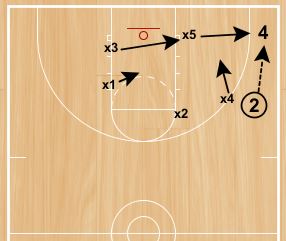
Jump Switch

basketball-defense-pnr3

X5 jumps out in front screen and takes x1, x1 now guarding 5.

X3 helps on 1

Give up: this can create mismatches with guards / posts, slips off screens, and screeners rolling to post and posting up, post players defending guards off dribble.

Take away: open looks off screens. If players can guard in post and perimeter a good option

Blitz/Double Team and Tag

basketball-defense-pnr4

x5 and x1 jump into lane and try to trap 1.

Key is force weak pass or have the ball handler pick up the dribble. x3 helps on screener rolling

Give up: pick and pops, slip pass, passes over top screen with bigger guards, slow rotations. Teams can make a pass out of the trap, and a quick extra pass to open players with good spacing.

Take away: good shooters and drivers, forcing 1 to make solid pass, and 5 to make a shot / play. Forces players to make passes with weak hands.

TAG: closest defender helps out with roll man

Down/Ice

basketball-defense-pnr5

X1 jumps on topside of screen making 1 refuse the ball screen.

X5 helps on the DOWN / ICE call and they can trap or hedge the ballhandler.

X3 helps on the screener. This is very common on side pick and rolls in the NBA.

Give up: Screener rolling to basket / slips, midrange jump shots for screener, passes to ballside corner.

Take away: forces the midrange pullup or jump shot. Can force players to use weak hand. This is not used very much at the high school level.

Again, here is the link I posted a year ago from retired NBA Coach Del Harris about defending pick and roll. Here is the link: Del Harris defending pick and roll

Defending Pick and Roll Del Harris

By Brian Williams on December 4, 2013

This article was posted with the permission of retired NBA Coach Del Harris

Regarding pick and roll defenses:

  1. Avoid “stringing out” too far on showing/hedging from the picker.

It is fine to jump up hard in a position parallel, or virtually so, to the sideline and go a step or even two with the ballhandler as a defensive option.

Continuing to string out with the ball handler forces the team defense has to rotate to your man on any kind of show.

The stringer is in a position too far out to rotate back safely to any man.

Remedy: After a defender shows, he needs to recover quickly “down the line” toward the free throw lane, not out toward the sideline.

  1. When defending elbow area picks, show hard or at the angle to corner but:

If you show hard, your man will roll to the basket and will have to be picked up by a teammate.

Show high, stay high. The defender on the elbow who shows aggressively must be prepared to cover the pop by the picker or, if he rolls, to cover the next player who comes up high—“show high, stay high!”

If you show at a 45 degree angle, then you cannot string out toward the corner more than a step.

Show “down the line” so as to be able to stay in a position whereby you are able to slow down the ball and still make it hard to pass to the roller by staying in the pass lane with active hands.

Weak side help is vital. As in showing at an angle anywhere (covering the turn) on the pick and rolls, the defender goes down the line but still needs help.

  1. To turn the pick/roll down? If you try to mix your pick and roll defenses by “turning it down” here are some suggestions:

First, do not be afraid to try it. But then do not be like many NBA teams and overdo it. It is a good change up, when done right, and a lot of teams do not do a good job of going against it. (But that is changing in the NBA now as teams overuse it.)

The defender on the picker must call it out loud and clear three times, (whatever signal you decide to use) and the ball defender cannot change positions until he hears it, no matter what the game plan is.

The picker defender must get into a strong, athletic position ready to defend any attacker and stay in it. This is crucial.

The picker defender must get into a line between the ball and the basket but ought not to be any further from the picker than an arm’s length plus a step, certainly no more than two steps.

The biggest concerns are:

  1. The ballhandler splitting between him and the picker, leaving the ball defender behind,
  2. And allowing a quick short bounce pass (“pocket pass”) to the picker whereby he can catch and get to the goal or catch/shoot so quickly no one can get to him.

If the ball is penetrated the picker’s defender will try to defend both players as long as he can, by dropping down the line toward the goal.

The ball defender must try to recover back in front, but the help defender must be ready to commit to the ball if he has to (trap or late switch).

The defender on the ball must quickly jump to the high side of the ballhandler, maintaining at least a touch with his man, and be in a position to force him to go to the sideline/baseline instead of penetrating to the middle.

Do not get too high on the top of the ballhandler. Be only slightly higher than parallel with the sideline, not turned too far toward the baseline because it encourages a split.

Note: if you are a zone team. Turn all the pick and rolls on the wing or corner areas down. Usually players can switch the top and elbow pick and rolls.

Basketball Defense Walling Up Drill

By Brian Williams on October 17, 2013

This drill is used by Coach Mike Neighbors.

I have also posted links to other articles from Coach Neighbors at the end of the drill description.

WALLING UP is another vital technique to our PACK LINE DEFENSE

WALLING UP DRILL

Basketball Drills

Coach tosses the ball of the glass to be rebounded by the O player. The X gets her body as close to the rebounder as possible without fouling and without allowing that offensive player to drive around them.


The offensive player continues pivoting, X moves her feet in wall up position until whistle

Build the drill up.

Add the take a charge at the end.
Add offensive player taking a shot and defense contesting/wedging/then rebounding.

Points of Emphasis

It’s my belief that even the very best players have a difficult time scoring over a great contest. And add active bodying to that equation and the percentage of made basket fall even further. TOO many times poorly coached players foul in these situations that bail out the offensive player.

Basketball Drills

Basketball Drills

Walling Up saves us about 10 points a game and at least five fouls on most nights.

Exaggerate players keeping their hands behind their body in this drill so that in games they won’t be tempted to bring their arms down in these situations.

Officials tell us every year that our players do as good of job in this technique as any they officiate. We are easy to officiate around the basket and I can assure you we DO get some benefit of reputation as a result.

Coaching Basketball Chiesa Defensive Concepts

By Brian Williams on October 3, 2013

These defensive concepts were sent to me by Steve Smiley.

They were assembled by former long time NBA Assistant Gordon Chiesa.

He spent 16 seasons with the Jazz and also had a tenure with the Grizzlies.

He also served as a college assistant at Dartmouth and Providence. He was the head coach at both Manhattan and Providence.

He was an assistant with team that reached both the NBA Finals (1997 and 98 with the Jazz) and the NCAA Final Four (1987 with Providence)

The Defender of the Screener on pick/roll defense has to be at the correct angle of the screen to start the coverage. If not, there is no early help!

Technique defenders who can guard the ball one on one without needing early help will unify the team’s defense. Now, the help defense can remain situational!

It’s vital for the team’s main scorers to be engaged on defense without committing frustration fouls and getting in early foul trouble. Savvy discipline!

Steely Interior Defenders will take away the mental “comfort zone” of the Post Scorers, by being physical and forcing out longer catches!

Alert Centers on defense are “engaged talkers.” They’re communicating early the defensive coverage of the Offensive action. The Center is the defensive traffic cop!

Smart baseline switch defenders will eliminate the screener “slipping the screen” by stepping into the screener’s chest to direct movement!

Winning players want to get a defensive stop, no matter who scores the recent basket for the team. Their Defensive effort isn’t driven by, if I just scored!

Good Defensive Teams will win the “floor scoring game,” by limiting 1) lay-ups/Dunks 2) free throws and 3) corner 3’s (NBA corner 3 is shorter). Executing the coverages!

Offensive minded teams that play non aggression defense, for the fear of their scorers getting into early foul trouble, often don’t win big road games!

The winner of the 50/50 loose ball hustle game is the player who is 1st to the floor with force. Now, instincts and toughness are in motion!

Clever Defenders will “show their hands” high to the referees when guarding a cutter. Now, the defense is contesting movement, but w/out holding!

Alert, help defenders will slow down the curling cutler on screening action by “stunting up” the line. on the flight of the pass. Timing!

Savvy perimeter defenders will force terrific catch and shoot players to dribble into a shot, by “crowding up” and taking away a clean look!

The 24/35 sec. shot clock always becomes our “born again” friend, as our defense heats up. The game goal is to force 2 shot clock violations!

Teams that can contain the ball are able 2 defend the 3 point line w/ efficiency. Now, the core D is unified and less in a scrambling mode!

Excessive fouling negates hustle and affects in-game strategy. The team committed the most fouls per game in the NBA at 23.3

Teams that can detend without fouling consistently win. The team in the NBA with the fewest team fouls committed per game at 17.3.

Sharp Defensive Teams play active “Help the Helper” defense. The 1st help defender trusts when he gives help, the 2nd helper is covering up.

Lively Defensive teams will have multiple bodies in front of lane drivers, trying to create steals. Active hands and feet generate gritty baskets!

The Defender of the Screener will “show out” to the Dribbler on Pick/Roll Defense then, recover back to the painted area with both hands high. Sharp!

Bright transition defenders will chase down the lay up shooter and try to block the shot attempt with their opposite hand to avoid body fouling!

United teams, after committing a turnover, will have an urgency of “negating the turnover” by getting a Defensive stop, the next possession. Values!

Teams that trap the low post scorer with another Big, “Big on Big,” will now create a rebounding siz dilemmas for their help defense on the boards!

Defending skilled Bigs, in the lane, is a gritty, emotionally draining ordeal. All that “bodying up” takes a mental toll on the defense. Be strong!

Our “run and surprise” defense is eyes driven. The nearest perimeter defender, randomly, traps the dribbler, in the scoring area to create havoc!

Steadfast defensive teams will consistently contain the ball outside the paint. Now, the help defense can remain “solid” to dominate the defensive boards!

Focused defenders will play “6 degrees of separation” defense by everyone being connected on a string with their fellow protectors. Connectivity!

Sharp one on one defenders will have one hand-in flicking up at the scorer’s dnbble trying to impact the ball. Technique and timing are in play!

Sharp coaches understand when playing against better talent and length, you have to change defenses. Mix and match to force contested shots!

Active off the ball defenders will have their hands out, shoulder width, distorting the look of the passing lanes. The passer now has doubt!

Hard Edge Defenders do not get discouraged when Savvy Scorers are making tough, challenged shots. They’re defending forward to the next play!

Wise defenders realize if the ball is going out of bounds, under their defensive basket, they can’t wildly try to save the ball. Wrong tearn 2 PTS!

Bad teams jog back in transition D; good teams run back and great teams sprint back. Those great teams are determmed 2 get a Def. stop!

Real players will take it “personal” when an opponent scores consecutive baskets on them. Now, technique, urgency and pride arc all in play!

Wise Help Defenders will get the angle, to impact the scorer’s footwork, not his shot delivery, when “digging the ball” out of the lane area!

Winning defenders cherish and execute the mandate of never letting down a teammate by not giving help defense. Each defender is committed to help!

Sharp defenders will play “Help the Helper” defense, by rotating to the nearest open offensive player. They’re helping and not “hugging” their own man!

Alert defenders will not give up open corner 3 looks, from ball side dribble penetration. They’re showing “stunt help” and recovering back!

Good Perimeter Defenders, when guarding a “head/shoulder fake” shooter, will be the 2nd jumper and only jump once. Bad defenders jump twice!

  • « Go to Previous Page
  • Page 1
  • Interim pages omitted …
  • Page 10
  • Page 11
  • Page 12
  • Page 13
  • Page 14
  • Page 15
  • Go to Next Page »

Primary Sidebar

  • Twitter
  • Facebook
  • Linkedin
coachestoolbox
personaldevelopmenttoolbox
basketballplayerstoolbox
basketballtrainer
athleticperformancetoolbox
coachingbasketball

© Copyright 2026 Coaching Toolbox

Privacy Policy