• Skip to primary navigation
  • Skip to main content
  • Skip to primary sidebar

  • Basketball Plays
    • Ball Screen Sets
    • Horns Sets
    • Man to Man Post Up
    • Man to Man Isolations
    • Backdoor Plays
    • Man to Man 3 Point Shot Plays
    • 2-3 Zone Attack
    • Baseline Inbound Plays
    • Sideline Inbound Plays
    • Combination Defense Attack
  • Drills
    • Defensive Drills
    • Offensive Drills
    • Competitive Drills
    • Passing Drills
    • Rebounding Drills
    • Shooting and Scoring Drills
    • Toughness Drills
    • Transition & Conversion Drills
    • One on One Drills
  • Blueprint
  • Practice
  • Mental Toughness
  • Skill Development
  • Offense
  • Defense
  • Store

Offense

Coaching Basketball: Princeton Offense Philosophy

By Brian Williams on September 21, 2016

These statements are from the Princeton Hybrid Offense eBook.

Whether or not they fit your beliefs and players, I hope that they will at least prompt you to clarify in writing what your beliefs are. It will clarify things for everyone in your program and allow you to be more specific and efficient in your planning and use of practice time.

This week’s featured eBook bundle is the Princeton Hybrid Offense eBook along with the Comprehensive Ball Screen Playbook eBook. You can see their descriptions at this Link: Princeton Hybrid Offense and Ball Screen Playbooks

Princeton Offensive Philosophy

We believe that one basic formation in the half court followed by different options will be the most successful style of play for us. The first thing we want to do after a defensive rebound is to push the ball to see if we have an advantage. Anytime we have a good shot in transition, we want to take advantage of our numbers. A good shot for us means a lay-up or an open shot for a very good shooter. We want to get to the foul line through hard drives and cuts because that is where games are won and lost.

Our half court offense is designed to take advantage of the most difficult defense to play against – half court pressure man to man. This type of defense forces most offenses out of what they want do and breaks down most offenses into one on one play. Our offense is superior for the following reasons:

· We are able to use our quickness to get to the basket and the foul line
· From our 2-3 high set we are able to attack any kind of half court trap without adjusting our alignment
· We are difficult to scout because we don’t call out plays
· We move without the ball and force teams to match our physical conditioning
· We have an open attack where anyone can score rather than specific plays for only a few players
· We only have to learn one position and focus on execution instead of remembering set plays
· We will improve as our shooting, passing, and execution improves
· It relies on mental quickness, fundamentals, and shooting – 3 things we can control
· We don’t have a primary PG because anyone of our players can bring the ball up to start the offense

We believe our offensive attack incorporates the following principles of offensive play:
1. Drive to the basket (Fouls)
2. Inside out game (three point shot)
3. Pass/Cut opportunities
4. Penetrate and pitch
5. Single screens
6. Screens on the ball
7. Screens on the screener
8. Slipping screens
9. Backdoor cuts
10. Curl cuts
11. Feeding the post
12. Movement with the ball in the post
13. Offensive rebounding position
14. Taking weakside help away
15. Defensive balance
16. Organized team play

Princeton System of Play

Our core three beliefs in priority are:
1. NO TURNOVERS
2. Great Shot Selection
3. Contain the Basketball

Basic Philosophy of Play

1. If you can pass, dribble, and shoot well, you will always dictate to the defense what they do. If you can’t and are not fundamentally sound, they will dictate what you do.
2. You must be able to dribble, pass and shoot, screen and cut – ON THE MOVE UNDER PRESSURE. The quality of your passing determines the quality of your shots! You must dribble with a purpose and the other four players must read the dribbler.
3. Think change of direction–think five players high. Five players must work together.
4. There is a counter for everything the defense does. Do the opposite of what the defense is doing. Must read the defense–are they playing hard or soft–any denial cut backdoor.
5. Think layups and three point shots in that order.

6. Don’t run to the ball!
7. Hit the cutter with a bounce pass (it is OK to use one hand passes). The offense is about hypnotic cuts, passes and hand offs. Timing and cutting are essential to establishing flow and success for the offense.
8. This offense is more about cutting than screening. Move to open spaces. When you screen don’t just screen, screen- and read each situation.
9. CUT CREDIBLY -look for the ball where you are coming open–then get back outside to perimeter as quickly as possible.
10. STAND JUDICIOUSLY – Float to open spot and occupy your man. Have fingers up and butt down, think ball in air feet in air.
11. Five players must work together. UNSELFISHNESS is more important than brains–must couple this with discipline.

This week’s featured eBook bundle is the Princeton Hybrid Offense eBook along with the Comprehensive Ball Screen Playbook eBook. You can see their descriptions at this Link: Princeton Offense and Ball Screen Playbooks

Post Play Notes

By Brian Williams on July 23, 2016

These notes on post play are from Dennis Hutter, Head Women’s Coach at Mayville State.

Three types of game all teams should have:

  1. Perimeter game
  2. Intermediate game
  3. Lane game – post play

Post Play Thoughts:

-Whether you are a fast paced team or a team that slows the pace down, you have to have the ability to get the ball to the block

-You can have great post play without great size – Posting up guards is an option

-Easiest way to “loosen up” a defense is to consistently make them defend the ball on the block

-A great post player always has the ability to have two defenders defend them

  1. Double team from away from the ball after the catch
  2. Fronted post with backside helpside defenders

-We want our post players shooting 55% from the floor – where they catch the ball and operate their low post game is

a BIG part of this shooting percentage.

-All offenses should be built from the inside/out – that starts with a great “lane game” – Post Play

-Defenses are also built inside/out – Post players have to work even harder because of this concept

-Five characteristics of a great Post Player

  1. Head – The ability to learn – Shows great patience
  2. Heart – The desire to learn – Plays with great energy and toughness, not afraid of contact
  3. Hands – Ball Security is number one thing when ball is passed into the post
  4. Feet – Always fighting with their feet – footwork is the key to a great seal
  5. Ability to Score the Ball – finishes well around rim with both hands, can make FTs

-Post players need to E.A.T. every day – Effort, Attitude, Toughness

-Great post players sometimes need to show great patience – They let the ball find them, instead of always looking to find the ball

-Play SLOW in the post before and after receiving the ball – USE YOUR HEAD AND READ DEFENDER

-Great perimeter players make great post players – Dean Lockwood

-Play BIG in the post

-Not tall – But Wide & Strong

-Not High, Higher, Highest – But Low, Lower, Lowest

Four Keys to Being a Great Post Player:

  1. Getting Open –Proper Post Stance

-There are two types of offensive post players:  Stationary Post Players & Mobile Post Players

-There are a few different ways that you can get open in the post – you always want to try and get open in your scoring area. A few ways you can get open in your scoring area are as follows:

  1. Seal In – Proper Post Up – seal the defense into the lane
  2. Seal Out – Seal defender out of the lane for a “hi/lo” post feed
  3. Set Up for the Lob – Against a fronting defender
  4. Cutting – Cutting into an area to receive ball
  5. Rim Runs – Post Player runs the middle of the floor in transition offense
  6. Offensive Rebounding – Treat very shot like a pass and “go get the rebound”

-Focus on a Proper Post Stance when trying to get open:

-Post up in an athletic stance – with bent knees and bent elbows

-Wide Base, Low Hips & High Hands

-“Lower and Wider is Better” – The player that wins, is the player that is lower and wider

-Wide enough base that you have great balance, but are still quick

-“Sit Into Your Game”

-Great Balance – Keep head back and in between knees – Keep a still head (baseball hitter)

-DEMAND the ball with your voice and also with your position

-Make contact with defender and move them back a step – “Own your spot on the floor”

-Two ways to create and make contact with your defender

  1. Step over the top of defender
  2. Pin & Spin Technique

-Push hands out, so you can see the backs of your hands

-Take up as much space as you can in the post –take up space with your base and your wide hand placement

  1. Staying Open

-Keep your feet between your defender and the ball

-Stay light on your feet –Boxer Mentality

-Fight with your feet all the time

-Constantly show your #’s to the ball – Don’t turn your body and become “skinny”

-If the ball can’t see your numbers, you are not open

-Make and MAINTAIN contact through the entire seal – LOSE THE CONTACT/LOSE THE SEAL

-Keep your hands high – limits offensive foul calls and also allows to be ready to receive ball

-“Talk to the ball” – Where do you want the ball fed from????

-Great post players are always thinking one pass ahead – set up defender to seal to the ball

-One defender should not keep you from receiving the ball

-Always try to get both paint and angles when sealing in the post

-Four reasons to release your seal of the defender:

  1. Go catch a pass
  2. Up against a 3 seconds in the lane call
  3. If you get out of your scoring area
  4. On any dribble penetration
  1. Receive the Ball Safely

-Catch the Ball with your eyes, feet and hands

-Ball security is number one thing when ball is passed into the post – Catch the ball!!!!

-Catch, Chin & Look Middle – Play Slow in the Post

-Exception to this is if you have a direct angle to rim on post catch

-Block & Tuck Concept on every catch – Block the ball and quickly tuck the ball under your chin

-Catch the ball with a “piece of the paint”

-Catch with two feet in the post – Jump stop as you catch the ball

-Allows you the ability to use either foot as your pivot foot

  1. Scoring Simply

– A great post player is efficient with BOTH HANDS around the rim

-Try to score with limited amounts of dribbles – no dribble moves are the best “Sweet”

-Get the ball up on all shots – contact on the shot, shortens your shot

-Three Point Plays are the ultimate goal – Absorb the contact and score the ball – TOUGHNESS

-“Scoring Simply” means getting all of your work done before the ball arrives – just like a great shooter

-“Less is More” in the post

-Too many post moves = too little production in the post

-You should have one “go to” move and one “counter” move in the post

-Great post players have one signature move in the post

-Finish closer to the rim, than where you caught the ball

-Shot Fakes in the Post:

-2 Inch vertical shot fake – no elongated shot fakes – short quick fakes

-“Take it up, Keep it up” – Don’t bring ball back down after shot fake – CHIN

Attacking Switching Defenses

By Brian Williams on June 6, 2016

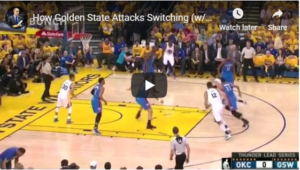
Army Men’s Assistant Zak Boisvert has assembled some of the ways that the Golden State attacks defensive switches.

Coach Boisvert has posted several videos of some of the better schemes he has seen. His You Tube channel is: Zak Boisvert You Tube Channel

He also is also very active on Twitter: @ZakBoisvert

He has an outstanding resource site for coaches. You can access it here: PickandPop.net

Coach Boisvert has also diagrammed the plays from the video and has provided a download link to the pdf. You can download the pdf here.

The voice over that you hear is Coach Boisvert


How Golden State Attacks Switching

Defensive Pressure: It’s All In Your Head

By Brian Williams on April 11, 2016

This post was written by John Carrier and originally posted on his Coaching Basketball Blog

Lately I’ve been reading bits and pieces of Stuff Good Players Should Know by Dick Devenzio. It’s a great book and I would encourage you all to get it. This is especially true if you are a coach who really strives to be a teacher of the game. As a preview, you can read some of the notes from an old blog post by Eric Musselman.

One of the things that Coach Devenzio talks about in his book is the idea that defensive pressure in basketball is only an illusion. Think about what a novel concept that really is! How many times have you seen players (and even coaches) panic when a team presses, traps, or just plays hard pressure man? It happens all the time and costs teams victories on a regular basis.

So what is pressure in basketball? It’s not like football where pressure can mean bodily injury. It’s more of a mindset that leads the team being pressured to panic. If you don’t panic however, now what? You will find that good teams relax when they are pressured. When you relax you are able to see more clearly and actually put the team that is pressuring at a disadvantage by playing smart, principled basketball.

It’s easy enough to preach to our players that they need to handle pressure, but we know talking a good game means nothing. How do you teach it then!? I was blessed this spring to work with a great group of athletes out at St. Croix Prep High School in Stillwater (MN). Our main focus for the development sessions focused on basketball IQ and understanding the game. They play in a conference and a section with teams that love to trap and pressure so we decided that we would spend some time teaching them how to handle that pressure. The following is what worked for us as we increased their ability to handle pressure.

  • Sold the Idea that Pressure is a Myth
    • This may have been the biggest, and hardest piece. They need to understand that pressure doesn’t matter. We even went as simple as having a defender pressure them while they just stood there. This made them realize that the defender wasn’t going to do anything to them – they were just waving their hands, not swords. Once they got used to the idea that being pressured wasn’t going to result in loss of limb or life, the rest was much easier. They started to relax and see the action much better.
    • The more comfortable they are with pressure (the less scared) the less pressure affects their ability to make decisions.
    • In order to be comfortable they need to experience pressure over and over again for this to happen. It’s like riding a roller coaster, the first time might be scary but by the second or third ride it isn’t nearly as bad. So we had them ride the roller coaster quite often during our session and experience hta tpressure.
  •  Taught Them How to Handle Pressure
    • As always, it’s important to teach the game.
    • What we did was showed them basic concepts to use when being pressured:
      • Backcut when denied
      • Cut at two speeds in two directions to get open
      • Don’t make the same cut to get open each time
      • GO-GO: get open or get out
      • Take your space on the catch – DO NOT go backwards
        • When you catch against pressure, take a tep forward, rip through hard, and take your space.
        • Makes it easier to pivot and pass as well as see the floor
        • This might be the most important one.
      • Eyes up
      • Pivot hard and rip hard with big elbows\
      • Don’t hold the ball above your head
      • Stay low and strong
      • Rip to the hip
      • Rip below the knees and above the head, not across the belly button
      • Take a deep breath and slow down
      • Take a five second call over a live ball turnover – just be patient
    • Drills should be a progression where you learn the technique first and then do it under pressure.
      • For example, you work on catching and ripping
    •  After learning technique drills should simulate game situations
    • After technique, drills should incorporate more pressure than you see in games with pieces such as extra defenders.
  • Drilled Them on Technique
    • Used a number of simple drills to teach the mechanics of how to handle pressure.
      • Staying low, ripping and pivoting, taking space, etc.
  • Let Them Learn in Small Sided Games
    • If you have not read Brian McCormick yet, do so now. He is huge on small sided teaching games and he is onto something, they work!
    • Small sided games are games of 1 on 1, 2 on 2, 3 on 3, or 4 on 4 that emphasize the skill you are working on while still playing.
      • So in the game you would emphasize being strong with the ball in this case.
    • Small sided games are great teaching tools because they put players in game like situations and allows players to teach themselves through experience.
    • You can create rules to overload the small sided game to make it harder than a real game. 
      • Example – 2 on 2 no dribble allows the defense to pressure and deny harder than in a game, also no dribbling forces players to be strong with the ball.
    • 1 on 1, 2 on 2, 3 on 3, or even 4 on 4 allows players more touches than a typical 5 on 5 game.
    • Small sided games allow players to apply the skill in a game situation and work on truly learning the skill in a trial and error environment.

 Drills and Progressions

The following is an example of a drill progression that we use to teach toughness with the ball. I believe in progressions because in my experience (although limited) progressions yield a better understanding of the skill. Players learn to apply it faster as opposed to just drilling it. For me a progression starts with a skeleton drill (no defense) to work on the technical aspects of the skill, then we add defense to a drill, then we make the drill game like, and then we play a small sided game. Sometimes the last two steps are blended into 1. Also, as the year goes on we spend less time with the drill and more time on small sided games.

As always, it’s not what drill you do it’s how you do it and what you  teach and emphasize within the drill.

Rip Throughs (Skeleton drill)This may be the most boring drill, but I always tell the players that if they go hard that we will do the drill for 2-3 minutes tops. If they don’t go hard we will do it all day.

Players move out around the floor, spin the ball out, catch it with two hands and two feet. Right as they catch they rip forward to take their space. Then they rip 3-4 more times hard with big elbows. They should rip to the hip. As they rip the ball should go below their knees or above their head. Once they are done they spin out and repeat.

Boss Drill (With defense)
Now we add some defense to the situation. In this drill you partner up with one ball. The defense starts with the ball about 2 feet from the offense. The defense throws the ball to the offense and comes up and really gets into them – hacking at the ball, pressuring them body to body,  and slapping their arms to try and force them to lose the ball. The offense can’t dribble and rips through hard with big elbows and tries to keep the defender off for 5 rip and pivots. Make sure we are emphasizing proper footwork in this drill. Players don’t try to hurt each other, but the drill should be overly aggressive with no fouls – making it harder than the game. If you can keep the ball against this type of pressure, whatever you get in a game. Unless, of course, it’s on the road and the coaches brother is the official! Even then you have prepared for the situation with this drill.

2 on 2 10 Pass Drill (With defense and closer to a game)
In this drill we now introduce something else to worry about outside of being strong with the ball. In this drill we add passing and moving to the equation. The drills has one ball with groups of four – 2 defense and 2 offense.

The offense has an entire 1/2 court (or 1/4 if you want to make it harder) to move around and they have to successfully complete 10 passes in a row. The offense cannot dribble or shoot. This means the defense pressures really close on the ball and denies the players off the ball hard. If they dribble or turn it over they have 10 pushups. If they successfully complete 10 passes the defense has 10 pushups. Defense and offense switch each time. This drill is great because again it puts your playres in a situation that is harder than a game, the offense now has to work harder to get open, make better passes, and still be strong with the ball on the catch while being mauled.

3 on 3 (or 4 on 4) No Dribble
Now we add in the small sided game. Players play 3 on 3 and try to score but cannot dribble the ball. Again, this creates a situation that is harder than the game.  Also another rule for the game is that if they are not strong with the ball it’s an automatic turnover. It is an automatic turnover if a player catches and doesn’t rip forward to take space take space, if they don’t rip and pivot, if they hold the ball over their head, or if they don’t rip to the hip. On a turnover the offense goes out and a the defense goes to offense.

Play the game to a set number of points or for a set time. You can also play it cutthroat style with 3-4 teams on one court. There is a dribble allowance if the player catches the ball cutting to the hoop and has to take a dribble to finish the layup (either that or you get some crazy – no game like shots).

As you can see, this is where the learning takes place. It’s easy for players to remember to use the skill in a drill where that’s all they have to focus on, but now they have to handle defensive pressure, other players cutting and moving, trying to score, trying to make passes, etc. If they can remember to be strong with the ball here they are going to have a better chance of doing it in a game. There is a much higher probability of carry over because in small sided games they are building habits.

 In Closing

Handling pressure is much more mental than physical. I’ve seen 5-5, spindly, weak players handle pressure better than 6-6 wings who weigh 230. It’s more about training their minds to do the little things (take space, big elbows, rip and pivot) than it is training their bodies. Hopefully the ideas above, although a little jumbled, will help you work with your players on better handling pressure. The more you can do drills and games that make it harder than the real game, the better your players will be. Lastly, teaching in a progression such as the one above is the very best way for players to learn how to be tough with the ball.

Bob Knight Man to Man Offense Concepts

By Brian Williams on March 1, 2016

This post contains three videos with Coach Bob Knight showing some of his ideas for attacking man to man defense.

Make sure your sound is on as you watch.

All videos are You Tube videos.

Make sure that you are on a server that allows You Tube access.

An idea for a 3 in offense.

If you are interested in finding out more about the DVD that this video sample came from, click here: Bob Knight: Advanced Tactics & Techniques for Man-to-Man Offense

Triangle Drill

If you are interested in finding out more about the DVD that this video sample came from, click here: Bob Knight: Advanced Tactics & Techniques for Man-to-Man Offense

No Dribble Drill Philosophy

If you want to learn more about the DVD that this sample came from, click here: Advantage/Disadvantage Drills and Motion Offense Drills & Skills

If you want to learn more about the DVD that this sample came from, click here: Advantage/Disadvantage Drills and Motion Offense Drills & Skills

No Dribble Drill

If you want to learn more about the DVD that this sample came from, click here: Essential Drills for Building a Championship Program

If you want to learn more about the DVD that this sample came from, click here: Essential Drills for Building a Championship Program

11 Ways to Beat Ice Ball Screen Coverage

By Brian Williams on February 22, 2016

University of Maine Men’s Assistant Coach Zak Boisvert has assembled some of his favorite ways to beat Ice ball screen coverage.

He has an outstanding site with posts on various coaching topics at www.pickandpop.net

His You Tube channel has several videos with various types of man to man plays, zone sets, and inbounds plays. You can subscribe to receive an update when he posts a new video Zak Boisvert You Tube Channel

You can follow him on Twitter at this link: @ZakBoisvert

You aren’t going to be able to use all of these, but I hope that you can find one or two that fit your player’s abilities.

The 11 Ways he has assembled in this video are:

Reverse into Down Screen
Reverse and Follow
Throwback and Follow
DHO (Dribble Hand Off)
Backdoor
Snake the Twist
Dive the stunt defender
Reject and misdirection
Short Roll into the gap
Weakside flare and skip
Stunt Weakside lob (to player being guarded by stunting defender)

Click play to see the video

This is a You Tube video, so you will need to be on a server that allows you You Tube access.

  • « Go to Previous Page
  • Page 1
  • Interim pages omitted …
  • Page 6
  • Page 7
  • Page 8
  • Page 9
  • Page 10
  • Interim pages omitted …
  • Page 13
  • Go to Next Page »

Primary Sidebar

  • Twitter
  • Facebook
  • Linkedin
coachestoolbox
personaldevelopmenttoolbox
basketballplayerstoolbox
basketballtrainer
athleticperformancetoolbox
coachingbasketball

© Copyright 2026 Coaching Toolbox

Privacy Policy