• Skip to primary navigation
  • Skip to main content
  • Skip to primary sidebar

  • Basketball Plays
    • Ball Screen Sets
    • Horns Sets
    • Man to Man Post Up
    • Man to Man Isolations
    • Backdoor Plays
    • Man to Man 3 Point Shot Plays
    • 2-3 Zone Attack
    • Baseline Inbound Plays
    • Sideline Inbound Plays
    • Combination Defense Attack
  • Drills
    • Defensive Drills
    • Offensive Drills
    • Competitive Drills
    • Passing Drills
    • Rebounding Drills
    • Shooting and Scoring Drills
    • Toughness Drills
    • Transition & Conversion Drills
    • One on One Drills
  • Blueprint
  • Practice
  • Mental Toughness
  • Skill Development
  • Offense
  • Defense
  • Store

Offense

Culture of Passing

By Brian Williams on May 21, 2018

This post was written by Bob Starkey and shared on his Basketball Coaching Blog, HoopThoughts

Editor’s Note #1 from Brian. When this article was originally posted, the Warriors were one of the top teams in the league. In 2019-2020, they have the worst winning percentage. I don’t believe we should or shouldn’t adopt ideas for our programs just because of where we get them. If counting passes is something you feel will help your ball movement, teamwork, and lessen dribbling, then you should consider if or how you can adapt it to your team.

Editor’s Note #2 from Brian.  I am not saying that every college and high school team should set 300 passes per game as your standard for passing like one of the premier NBA teams does. I am offering this as a resource to think about ways to improve the ball movement for your team.  Maybe in a 50 possession high school game, you can set 200 passes as a goal.  If you do like this idea, you will need to determine the number of passes that is right for your program.

There was an outstanding article in the USA Today this week written by Sam Amick on the value of passing the ball for Golden State and it’s incredible value to the culture of the Warriors.  You can (and should) read the entire article here.

I’ve long spoke about how you play being a big part of your culture.  Your system of play and it’s level of execution says a lot about who you are as a coach and in turn your team as a unit.

The first part of that piece is practice.  The make up and execution of practice impacts players and how they feel about playing and their level of belief in how prepared they are going into a game.  On the collegiate level, recruiting often comes down in part of how a team plays.  On the professional level, free-agents will at times gravitate to a style of play.

In an era that becomes increasingly difficult to promote team play, to have one of the best teams in the NBA base their success on number of passes gives all of us coaches hope.

A few excerpts include the following:

“Ball movement will forever be superior.”

-Shaun Livingston

Ever since Kerr made the move from TNT analyst to the Warriors bench, when he saw the glaring lack of ball movement in that final season under former coach Mark Jackson and told the team’s ownership how he would fix it, this has been their ethos. So much so, in fact, that it all started with a magic number: 300.

Pass the ball at least that many times during the course of a game, he told them, and the offense will hum. For Kerr, who won five titles while playing for San Antonio’s Gregg Popovich and then-Chicago coach Phil Jackson, these were the lessons learned that he had to pass on.

“If you have shooting — if you have great shooting — then the more ball movement the better, because you have guys coming off screens and … you want to make the defense have to defend for long stretches rather than just one pass and a shot,” Kerr explained to USA TODAY Sports recently. “So we looked at the passing totals, and … (300) was a really key number for us.

“I just said I want the ball to move. That’s always how I’ve seen the game, and if you have Steph (Curry) and Klay (Thompson) on your team and the ball is moving, it’s fairly obvious that it’s going to be hard to defend. So we just kind of came up with that number.”

Amick backed his story up with the following facts:

◄After ranking last in passes per game (243.8) during the regular season before Kerr’s hiring and finishing 12th in offensive rating despite already having three of their four current All-Stars in Curry, Thompson and Draymond Green, they have had the league’s best offense in three of the past four seasons while finishing second in offensive rating once. During that span, the Warriors’ passes-per-game mark has ranged from 306.6 to 323.5.

◄The Warriors’ only two losses this postseason have come in the only games in which they passed the ball fewer than 300 times (256 against San Antonio in Game 4 of the first round; 295 against New Orleans in Game 3 of the second round). In all, they lead all playoff teams in passing (323.2; Rockets 15th at 227.5).

◄Green and Curry have been first and second among the Warriors, respectively, in passes made for the past three regular seasons.

As Green is quick to point out, passing alone is not enough. The Warriors at their best are like a basketball version of the Blue Angels, with players darting to and fro while stopping only briefly to set a few screens along the way. But when you combine the movement with the passing and some of the best scorers the game has ever seen, then push the tempo, it’s the kind of thing even Kerr couldn’t have dreamt of when he put this program into place.

Man to Man Offense Building Blocks

By Brian Williams on March 15, 2018

These two PowerPoint outlines were submitted by Coach John Kimble, retired high school and college coach CoachJohnKimble.com

Follow him on Twitter @CoachJohnKimble

Building Blocks for Your Man to Man Offense

This is a 4 slide PowerPoint. You can advance the slide by clicking in the frame. There is no sound with the presentation. There is also a download link below the presentation.

Loader Loading...
EAD Logo Taking too long?

Reload Reload document
| Open Open in new tab

Download [93.57 KB]

Multi-Phase Offensive System

This is a 2 slide PowerPoint. You can advance the slide by clicking in the frame. There is no sound with the presentation. There is also a download link below the presentation.

Loader Loading...
EAD Logo Taking too long?

Reload Reload document
| Open Open in new tab

Download [60.54 KB]

4 Up Press Offense

By Brian Williams on February 22, 2018

This press attack was contributed to the FastModel Sports Basketball Plays and Drills Library by Rory Hamilton of Norman North High School.

You can also find out more about FastModel Play Diagramming software by clicking this link: FastDraw

This is what Coach Hamilton had to say about the press attack.

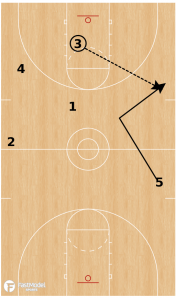
Press Break Alignment is with 3 man taking ball out-of-bounds and the 1 and 2 are at the elbows. The post players 4 and 5 are at half court. We use 4-up press break vs. any on the ball zone presses (1-2-2, 1-2-1-1, etc).

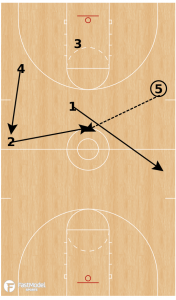
It starts with our ball side post flashing to the FT line extended to receive a pass. On the catch, our point guard 1 screens away for the 2. After screening for the 2 the 1 sits in the middle of the floor and the inbounder steps in for ball reversal. Again the concepts are the same as we look to attack sideline, middle, and a throw over.

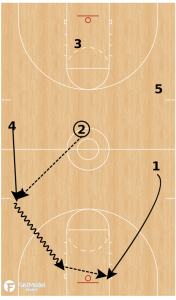
On ball reversal back to the inbounder our press break slides are : middle flashes sideline and the sideline flashes middle. The 4 man sprints wide and looks to space the floor and be a deep threat.

If the ball is passed middle, the receiver immediately looks to pass it opposite for a potential (2 vs. 1) against the defense.

Press Break Alignment is with 3 man taking ball out of bounds and the 1 and 2 are al the elbows.

The post players 4 and 5 are at half court. We use 4-up press break vs. any “on the ball” zone presses (1-2-2, 1-2-1-1, etc).

It starts with our ball side post flashing to the FT line extended to receive a pass. On the catch, our point guard 1 screens away for the 2.


After screening for the 2 the 1 sits in the middle of the floor and the inbounder steps in for ball reversal.

Again the concepts are the same as we look to attack sideline, middle, and a throw over.


Ball is reversed back to the inbounder.


Middle flashes sideline and the sideline flashes middle.


The 4 man sprints wide and looks to space the floor and be a deep threat.


2-3 Zone Attack Concepts

By Brian Williams on January 2, 2018

Army Assistant Men’s Basketball Coach Zak Boisvert has put together some short clips with some concepts for attacking a 2-3 zone defense.

Coach Boisvert has posted several videos of some of the better schemes he has seen. His YouTube channel is: Zak Boisvert You Tube Channel

He also is also very active on Twitter: @ZakBoisvert

He has an outstanding resource site for coaches. You can access it here: PickandPop.net


The videos are YouTube videos, so please make sure that you are on a network that allows YouTube access.

Some school networks may block YouTube access.

Click the play arrow to watch the videos.

Please make sure that your sound is on as Coach Boisvert has narration to go along with the video clips.

Knife Drive to Attack a 2-3 Zone

Side Ball Screens to Attack a 2-3 Zone

Eight Principles for Sound Offense

By Brian Williams on September 14, 2017

By Alan Peel

Assistant Varsity/Junior Varsity Boys’ Basketball Coach, Bishop Miege High School

Owner/Operator, www.coachpeelbasketball.com

A major part of success in offensive basketball is having sound offensive principles that allow your team to maximize the efficiency of their possessions.  Legendary coach Dean Smith said, “The objective of any basketball offense is to score as often as possible on each possession.”

Much has been said about analytics and its use in basketball.  When analytics are applied to team play in basketball, especially offense, there are eight principles for sound offense that are proven to be effective.

In presenting these eight principles for sound offense, I will ask questions.  The reason being is to get you to think about your team’s own offense.  I have also provided some additional thoughts of my own to help you think about each question.

I should note that each of these eight principles for sound offense came from legendary coach Tex Winter, the inventor of the famed Triangle Offense.  While your team might not run the Triangle Offense, the principles are sound and can be applied to just about any offense.

  1. Penetration:  Does the offense penetrate the defense?

The most important thing that your offense can do is to attack the free throw lane.  It has been statistically proven that teams that have an offensive possession with the ball getting into the lane see increases in field goal percentage, trips to the free throw line, fewer turnovers, and better overall offensive efficiency.

Whether you are using the dribble or the pass to penetrate the lane, the ball should enter the paint at least once every offensive possession.  Defenses always collapse on lane penetration.  Teams that react slowly give up easy shots at the rim.  Defenses that react quickly to penetration are ripe for shots from behind the three-point line.

  1. Spacing:  Does your offense have good spacing?

A well-spaced offense has the ability to make quick passes from player to player while also being able to keep from being trapped by the defense.  A spaced-out defense becomes less effective than a defense that is able to stay close with help close to the ball.

If a pass has to be made with extra air under it, you are too far apart.  If two or more defensive players can easily guard one player, chances are you are too close together.

The ideal spacing for any offense is 15 to 18 feet.

  1. Offensive flow:  How seamlessly do you flow from defense to offense?

When your team’s defensive possession ends, how easily do you go from defense to offense?  Teams that utilize the fast break have the best opportunity to score more points, shoot a higher percentage, get to the free throw line more often, and are much more efficient than teams that don’t run.

An ideal offense flows from defense to offense instantly and is able to get up the floor quickly.  A team with a well-organized break is able to score quickly and get high-percentage shots.

  1. Ball and player movement:  Does the ball and do your players move with purpose?

The two worst kinds of movement are no movement and movement for the sake of movement.  The first one is obvious while the second one accomplishes nothing.

Players who don’t move are easier to guard.  A ball that does not move gives the defense a break and allows them to get properly set or stay set.

Players who move without purpose do nothing to help the offense score.  Passes, dribbles, and cuts merely for the sake of aimless movement accomplish nothing.

Teams that have players who move with a purpose create opportunities for themselves and their teammates to score.  Teams that are able to move the ball with the pass or dribble with a purpose are the ones that score more points and break down defenses more easily.

Effective passing is accomplished with good spacing and movement.  Teams that change sides of the floor at least twice in a possession have dramatically better offensive numbers than teams that don’t.  Teams that pass the ball into the post are better offensive teams than those that do not.

Dribbling is becoming a more-utilized offensive weapon thanks to the growing popularity of the dribble-drive motion offense.  However, players still tend to dribble in the same spot as soon as they catch the basketball.  This bad habit must be broken early in the season and ball toughness must be developed.

Generally speaking, the dribble should only be used under the following circumstances: to attack the basket, to improve a passing angle, or to avoid a closely-guarded five second count.  It should NEVER be used to dribble in the same spot repeatedly while waiting for pass or scoring options to develop.

  1. Multiple options:  Does any player with the ball have multiple options?

As someone who has a background in scouting, a player who has only one option on a play is part of an offense that can be easily scouted.  Players who are able to use more than one option make their offense more difficult to scout.

Every offense should have three main options for it to be effective: shot, post feed, ball reversal.

  1. Offensive rebounding and defensive balance:  Do you have the ability rebound AND get back on defense to stop transition baskets?

When the shot goes up, there should be players ready to rebound the basketball and players ready to get back on defense to stop a potential fast break.  Offensive rebounds provide an opportunity for greater scoring chances.  On second and third shots, scoring efficiency and shooting percentages improve.

Likewise, good transition defense takes away scoring chances from opponents.  Teams that are forced to play half-court offense are not as efficient in scoring as teams that have the opportunity to fast break.

To accomplish this, you need to determine which of your players should crash the offensive glass while also determining who needs to get back on defense to prevent a transition basket.  Against teams that like to run, you might find yourself sending two to the boards and dropping back three.  Against teams that are not inclined to run a fast break, sending three to the boards and dropping two might be more ideal.

  1. Versatility for players:  Does your offense give your players the opportunity to play more than one position?

In today’s era, positionless basketball is becoming more and more prevalent.  Teams are trying to find ways to position post players facing the basket out on the perimeter while also looking to post up guards.  This kind of versatility is something that puts defenses in a bind.

If an offense has players that can interchange positions, you have the ability to get a defensive mismatch.  Typically, guards do not guard players in the post while bigs do not tend to guard on the perimeter.  Offensive inversion of this kind creates headaches for players and opposing coaches alike.

  1. Talent utilization:  Does your offense utilize the talents of individual players?

Not every team has an offensive player the likes of Michael Jordan, Magic Johnson, Larry Bird, LeBron James, James Harden, Russell Westbrook, Kevin Durant, or Stephen Curry.  However, what if you had an outstanding player on your team?  How would you utilize this player?

The offense must fit your personnel and your personnel must fit your offense.  With individual players who have unique skill sets, you have to find a way to maximize their abilities within your offense or find an offense that works better for them.

Likewise, players who do not have the skill set or the talent to play in your offense must also have adjustments made for them.  They might not be the best scorers, rebounders, or passers, but they can find something to do that can help your team on offense.

To make this work best, start by figuring out what they do best first.  Once you establish that, get them to do that in your team’s offense before trying to find ways to expand their game to do more.

Conclusion

For those coaches who answer “yes” to all eight of these questions, you have something special with your offense.  If there is something missing, you might want to address it and see if you can add it into your offense without sacrificing the other eight principles for sound offense.

6 Zone Offense Actions

By Brian Williams on August 19, 2017

These 6 actions for attacking a zone defense are presented by Aaron Garrett, Head Coach at Amber-Pocasset (Oklahoma) High School.

There is sound with the video, so please make sure that your sound is on.

The video is hosted on YouTube, so you will need to be on a network that allows you to access that site.

The videos are from the Championship Productions You Tube Channel..

You don’t have to run the plays in their entirety.

You can take parts of them and incorporate into what you do. In my opinion, all ideas you get from others should be modified to your needs.

You might have to put in some work to get something out of this and watch the video several times to be able to imagine how the zone will shift to cover these movements.

Click the play arrow to play the video with his thoughts.

If you are interested in learning more about the Championship Productions Basketball Coaching Video (available in both DVD and Instant Video Format) that this drill came from, you can click the following link: The Break Point Offense: The All-Encompassing Offensive System

  • « Go to Previous Page
  • Page 1
  • Interim pages omitted …
  • Page 4
  • Page 5
  • Page 6
  • Page 7
  • Page 8
  • Interim pages omitted …
  • Page 13
  • Go to Next Page »

Primary Sidebar

  • Twitter
  • Facebook
  • Linkedin
coachestoolbox
personaldevelopmenttoolbox
basketballplayerstoolbox
basketballtrainer
athleticperformancetoolbox
coachingbasketball

© Copyright 2026 Coaching Toolbox

Privacy Policy