• Skip to primary navigation
  • Skip to main content
  • Skip to primary sidebar

  • Basketball Plays
    • Ball Screen Sets
    • Horns Sets
    • Man to Man Post Up
    • Man to Man Isolations
    • Backdoor Plays
    • Man to Man 3 Point Shot Plays
    • 2-3 Zone Attack
    • Baseline Inbound Plays
    • Sideline Inbound Plays
    • Combination Defense Attack
  • Drills
    • Defensive Drills
    • Offensive Drills
    • Competitive Drills
    • Passing Drills
    • Rebounding Drills
    • Shooting and Scoring Drills
    • Toughness Drills
    • Transition & Conversion Drills
    • One on One Drills
  • Blueprint
  • Practice
  • Mental Toughness
  • Skill Development
  • Offense
  • Defense
  • Store

Offense

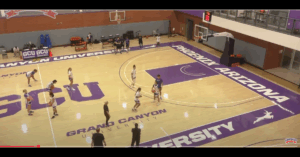
8 Man-to-Man Sets for Playing with 2 Bigs

By Brian Williams on August 27, 2026

Van Green, Asst Men’s Basketball Coach, Oral Roberts

This video is a segment from one of the 120 Videos in Glazier Drive Basketball.

Explore coaching clinic replays, practice plans, skill development videos, and more.  Click here to see all that’s included.

The full video that this clip came from is available on Glazier Drive:  Playing With 2 Bigs & Creating an Offense Catered to Your Personnel

KNOW YOUR PERSONNEL

The core coaching philosophy driving every set: understand which players can shoot and which can’t before deciding their role. A non-shooter should cut hard rather than stand and space; a shooter should stay spaced even if it means a “good” big doesn’t get to show off his own scoring. Every action should be built around what your specific roster can actually execute, not just what looks good on paper.

BALL SCREEN “POP” WRINKLE

A quick second-half set where the screener pops to the wing instead of rolling. If the man being screened for is a non-shooter, teach “follow the help” — cut hard behind whichever defender helps off him. This puts pressure on the defense to decide whether to tag the roller/popper or stay attached to a primary scorer, and a good screener can spring a big man for a rim finish off the miscommunication.

SCREEN-THE-SCREENER / HANDOFF ACTIONS

Sets built around a pin down into a potential handoff, with a cross screen for a big cutting to the block, plus a shooter releasing off the same action. These “screen off a screen” concepts (referenced as Duke-style actions) give the offense two or three options off one read, and reward a big who consistently sets a great initial screen even when the finish doesn’t fall.

SCOUTING AND FILM STUDY

At the college level, film study covers best/worst offensive and defensive performances to build a full identity on the opponent. Key things to identify: does the opponent hard-hedge or show on ball screens, do they switch everything, or do they play a “goalie” (a low man who camps in the paint because he knows your five can’t shoot)? Once you know the coverage, design actions that specifically punish it, especially valuable for quick-hit plays out of timeouts when there isn’t time for a full walkthrough.

QUICK-SHOW COUNTER (MICHIGAN/GOLDEN STATE EXAMPLE)

When a defense is scouted to quick-show on ball screens, a shooter should stay spaced at the three-point line to punish the show with a catch-and-shoot; a non-shooter in the same spot should instead follow the helper for an easy dump-off dunk. Same read, different personnel-based answer.

HORNS SETS

Horns offense (two bigs at the elbows) is described as extremely hard to scout because of the sheer number of variations — horns flare, empty-side action for a downhill guard, DHOs, reversals into up screens, etc. With enough wrinkles off the same alignment, the defense can’t predict which action is coming. It’s also a good structure for playing two bigs together while maintaining paint spacing.

READING THE DEFENSE / BROKEN PLAY SOLUTIONS

When the initial set doesn’t work, players need answers: a heavy right-hand driver can be manipulated into space against the weaker on-ball defender; bigs should have clear roles (one dives, one spaces) based on whether the paint is loaded; a shooter should be trusted to stay in the corner rather than help. The emphasis is giving players a built-in “if this doesn’t work, then do this” rule rather than leaving them to freelance.

PUNISHING AGGRESSIVE COVERAGES (HOUSTON/PURDUE EXAMPLE)

Against an aggressive, physical coverage team, ball handlers should get into the defender’s body on drives to draw a second defender, then kick out for an open shot — using the defense’s own aggression against them. A big who rolls hard after the pass is released gets excellent offensive rebounding position even if the shot doesn’t fall.

GIVING PLAYERS OPTIONS, NOT JUST FREEDOM

Sets with layered reads (flare screen into a pin down) should give the ball handler a clear first, second, and third option rather than “just go figure it out.” This creates structure and accountability while still allowing reaction to what the defense gives.

FLOPPY ACTION

A simple floppy set (action on both sides of the floor) used to get a shooter a quick catch off a duck-in or curl — a staple, easy-to-teach scoring action.

BALL SCREEN CONTINUITY (LOW VS. HIGH)

Two main styles discussed:

  • Low continuity (Arizona-style): the screener ducks into the post to stay low and prevent help on the roll, cycling through reversals, DHOs, and ball screens.
  • High continuity: the screener trails/lifts first to see how the defense reacts before advancing into the next action; if the big overcommits high, the offense should immediately look to exploit the vacated role.

The larger point: teams with strong ball screen continuity give players a repeatable structure and clear responsibilities, and disciplined teams will bypass broken actions to fall back into their base principles rather than improvising blindly.

OVERALL TAKEAWAY

Every set shown is a vehicle for the same message: tailor actions to personnel, scout the opponent’s tendencies (coverage type, weak defenders, non-shooters), and give players simple, layered reads so they always have an answer when the first option isn’t there.


Ball Screen Offense Counters: Flip Screens

By Brian Williams on July 30, 2026

Myles Rasnick, Asst Men’s Basketball Coach, Maryville College

This video is a segment from one of the 120 Videos in Glazier Drive Basketball.

Explore coaching clinic replays, practice plans, skill development videos, and more.  Click here to see all that’s included.

The full video that this clip came from is available on Glazier Drive:  Ball Screen Offense: Reads, Counters & Teaching Progressions

OVERVIEW

This clip covers counters to the ball screen offense — ways to change how screens are set rather than adding entirely new plays. The presenter’s core philosophy: keep it simple by varying the style of the screen itself, and teach players to read the screen rather than memorizing a pile of new actions.

FLIP SCREENS

The main counter discussed. A flip screen quickly switches the screen to the opposite side, which disorients the screener’s defender — he’s set up to help/hedge on one side, then the ball handler attacks the other side, effectively removing that defender from the play.

  • Vs. hard hedge: Flipping the screen pulls the hedging defender out of position, letting the guard attack his hip and get downhill for an open look.
  • Vs. switching defenses: Defenders anticipating a switch get caught leaning the wrong way when the screen flips, taking two defenders out of the play at once — since the on-ball defender expects help that never comes on that side.

The presenter references an Iowa–Illinois game and their own matchup against Wisconsin–Oshkosh as examples where flip screens caused real defensive breakdowns, including confusion on switches and cut-out bigs leading to easy driving lanes/layups.

OTHER COUNTERS MENTIONED (BRIEFLY)

  • Flat and high screens
  • Go screens
  • Grenades (also called “dribble ups” by other coaches)

These are named as additional counter categories but not broken down in detail in this excerpt.

COACHING TAKEAWAY

The emphasis throughout is that ball-screen counters don’t need to be complicated — teaching multiple ways to set the same screen (angle, timing, flip) is often more effective than installing new sets, especially against teams that hard-hedge or switch aggressively.

Ball Screen Rocket Concept

By Brian Williams on April 29, 2026

Ryan Kapustka, Asst Men’s Basketball Coach, Dartmouth

This video is a segment from one of the 120 Videos in Glazier Drive Basketball.  Explore coaching clinic replays, practice plans, skill development videos, and more.  Click here to see all that’s included.

The full video that this clip came from is available on Glazier Drive:  Pick & Roll Offensive Concept

A transcript of the video is shown below.

ROCKETS: SIMPLIFYING BALL SCREEN READS FOR LIMITED BALL HANDLERS

The “Rocket” is a ball screen variation designed for players who struggle with handling, reading, or executing traditional ball screens. Instead of the guard dribbling into a screen, they make an early pass (“hit”) to the big man, immediately reducing dribbling and simplifying decision-making.

WHY IT WORKS

By cutting out the dribble and hitting the forward early, the ball handler only needs to read one simple reaction from the defender — making the concept much easier to execute for less skilled players. It’s also particularly effective for elite shooters who benefit from early ball movement.

THE KEY READ

  • Defender goes under → shooter has an open look
  • Defender goes over → ball handler attacks downhill, kicks back, or executes a back cut for an easy basket

CORNELL AS A MODEL

Cornell’s offense is cited as a prime example — they consistently use this concept by hitting the forward early and flowing into either back cuts or catch-and-shoot opportunities rather than relying on traditional ball screen actions.

ADDING A COUNTER

Once the defense begins anticipating the rocket action, teams can layer in a “snake” (referred to as an “oh no”) as a counter, keeping the defense honest — especially when forwards are capable ball handlers.

BOTTOM LINE

Rockets reduce reads, reduce dribbling, and create the same advantages as a ball screen with far less complexity — a practical tool for coaches working with players still developing their pick-and-roll IQ.

Modern Motion Offense Series: 4-Out 1-In Transition Concepts

By Brian Williams on November 14, 2025

Jenna Kotas, Assoc Head Women’s Basketball Coach, Ashland

This video is a segment from one of the 120 Videos in Glazier Drive Basketball.  Explore coaching clinic replays, practice plans, skill development videos, and more.  Click here to see all that’s included.

Full video on Glazier Drive: Building a Modern Motion Offense & Transition Offense Concepts

BASKETBALL TRANSITION OFFENSE BREAKDOWN FOR COACHES

This coaching presentation covers a comprehensive transition offense system broken down into four main components: spacing, principles, reads/options, and practice drills.

TRANSITION SPACING

The system uses no designated spots for positions 1-4 (guards). Players fill four key areas: the rail, wing, window, and corner as they sprint down the court. The 5 (post player) either runs ahead of the point guard to the rail position or trails behind to set a ball screen if no early pass is available.

FIVE OFFENSIVE OPTIONS

Corner Rim Run: The primary option where a player sprints to the corner and cuts to the rim while defenders are not yet set, creating easy layup opportunities.

Second Spray: If the first rim runner is covered, the next player behind them on the opposite side becomes the secondary option for a pass and attack.

Point Guard Attack: The ball handler cuts the court and attacks in ISO mode, particularly effective when the opposing post player doesn’t protect the rim in transition.

Same Side Spray Ahead: Passing to the same side where the ball is being pushed, allowing for direct rim attacks when the post isn’t clogging the paint, or early post touches if the big has beaten everyone down court.

Trail Screen: When the post player trails the ball, they come up to set a ball screen for guards who can shoot pull-up threes, drive to the rim, or create other scoring opportunities.

KEY PRINCIPLES

On missed shots, all guards (1-4) can push the ball up either sideline – not just the right side. This creates faster transition opportunities. The 5 must outlet to the nearest guard on either side of the court.

On made baskets, the 4 player takes the ball out of bounds while the 1 (point guard) is the primary outlet. This ensures quick inbounds to initiate either transition, half-court offense, or quick hitters.

The post player (5) should sprint for early post position, but if a guard is attacking downhill, they must clear out to the short corner or slow down to avoid clogging the lane.

COACHING EMPHASIS

The system requires labeling three specific positions: point guard (1), the 4 player, and the 5 player, as they have distinct responsibilities on made versus missed shots. The goal is to create scoring opportunities within the first five seconds by exploiting defensive mismatches and lack of rim protection before the defense can set up.

Pistol Offense Breakdown Drills

By Brian Williams on October 9, 2025

 
In this video Coach Molly Miller demostrates some Pistol Offense Breakdown Dills.

In this clip she is breaking down the options in what she calls Pistol Up.

In the drill the wing breaks up above the 3pt line to receive a pass from the guard.

In the first option the guard sprints to the players that received the pass , takes the handoff and drives to the basket and finishes.

In the second read the guard takes the handoff and the pass to the wing player and passes the ball back to the wing player who has received a flare screen from the player at the point.

This great action for a quick 3pt shot.

The final option in Pistol Up is for the guard to receove the handoff and pass to the players that has slipped the flare screen.

The drill is a great example of how to breakdown your offense into the parts that make it work.

This clip was taken from Coach Miller full clinic presentation. To gain access to the full clinic click the following link Camp Buckets’ – Learning the Pistol Offense – Post/Perimeter Breakdown Drills, Actions, Decision-Making & More!

Chin and Chest Actions in the Princeton Offense

By Brian Williams on June 28, 2023

In the video clip below Coach Quinn McDowell breaks down both the Chin and Chest Action in the Princeton Offense.

This clip is just a small sample from Coach McDowell’s comprehensive video course. To gain access to that course click the following link:   7 Basic Actions of the Princeton Offense

Coach McDowell has also produced a three-hour online course to help you learn everything about the Princeton Offense.

Click the following link to learn more about that course: Mastering the Princeton Offense

  • Page 1
  • Page 2
  • Page 3
  • Interim pages omitted …
  • Page 13
  • Go to Next Page »

Primary Sidebar

  • Twitter
  • Facebook
  • Linkedin
coachestoolbox
personaldevelopmenttoolbox
basketballplayerstoolbox
basketballtrainer
athleticperformancetoolbox
coachingbasketball

© Copyright 2026 Coaching Toolbox

Privacy Policy