• Skip to primary navigation
  • Skip to main content
  • Skip to primary sidebar

  • Basketball Plays
    • Ball Screen Sets
    • Horns Sets
    • Man to Man Post Up
    • Man to Man Isolations
    • Backdoor Plays
    • Man to Man 3 Point Shot Plays
    • 2-3 Zone Attack
    • Baseline Inbound Plays
    • Sideline Inbound Plays
    • Combination Defense Attack
  • Drills
    • Defensive Drills
    • Offensive Drills
    • Competitive Drills
    • Passing Drills
    • Rebounding Drills
    • Shooting and Scoring Drills
    • Toughness Drills
    • Transition & Conversion Drills
    • One on One Drills
  • Blueprint
  • Practice
  • Mental Toughness
  • Skill Development
  • Offense
  • Defense
  • Store

Offense

Basketball Coaching Kevin Eastman Offensive Thinking

By Brian Williams on October 8, 2014

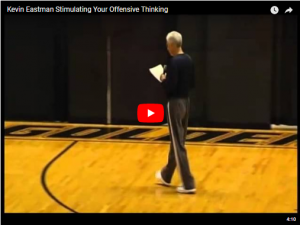
I have been fortunate to partner with Kevin Eastman to provide some sample videos from has basketball coaching DVDs. This video is a segment from his “Stimulating your Offensive Thinking DVD.” It is a part of his 8 DVD set which includes High Intensity Skill Development, NBA Drills for All Levels, Stimulate Your Offensive Thinking, Defensive Strategies and Teaching Points, Strategies and Philosophy for Coaching Success, Stimulate Your Defensive Thinking, Defending the Pick and Roll the NBA Way, A Champion’s DNA.

This link is to a previous video that I posted with: 3 Drills from Kevin Eastman.

You can also see another 5 minute video from Coach Eastman by clicking on this link: Keys to Quality Skill Development.

Click here for detailed information about purchasing the DVDs at a special price If you need any assistance, email me at [email protected] or call or text (317) 721-1527.

Former D1 Head Coach and Long Time Doc Rivers Assistant NBA Coach Kevin Eastman provides some principles to apply to your offensive attack as well as a little about your team culture.

Techniques to Get the Ball Inside

By Brian Williams on May 6, 2014

The techniques originated with Mike McNeill

In addition to the two that I have posted here, he also has included:

Post Triangle
High Low Down Screen
Down Screen to Post Up
Duck In
and Flex Duck In

The following are three of tactics that can be used to get the ball inside.

Whether they are a part of a play your team runs, or they are part of the concepts you teach players, all teams must have several strategies to get the ball inside.

Diagrams created with FastDraw

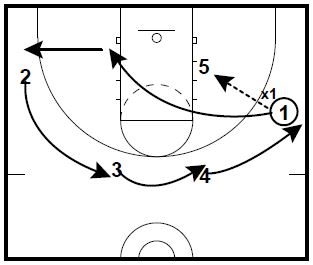
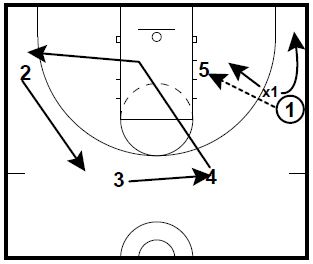
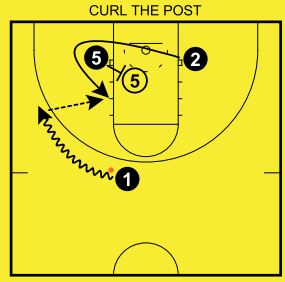
Curl the Post:

curl-the-post

This tactic is extremely effective when the post defender bumps curl cuts by offensive players.

The ball starts at the high elbow above the post. The cutter cuts across the lane below the post and then curls very tight around the post to the middle of the lane.

As the cutter comes across the lane the post defender must momentarily help on the curl, if the post does not help, the pass should go to the cutter. As the defender is helping on the curl the passer brings the ball towards the wing to improve his/her angle and the post steps into the post defender to establish position.

Once the cutter’s defender clears the passing lane is usually open. In many cases the cutter may set an incidental screen. by running into the post defender as he/she completes their cut. If the cutter’s defender attempts to go over top of the screen then the post should step higher and the cutter should fade to the corner.

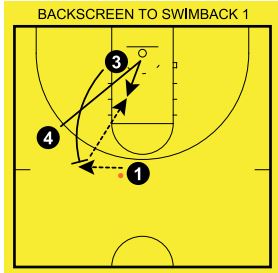
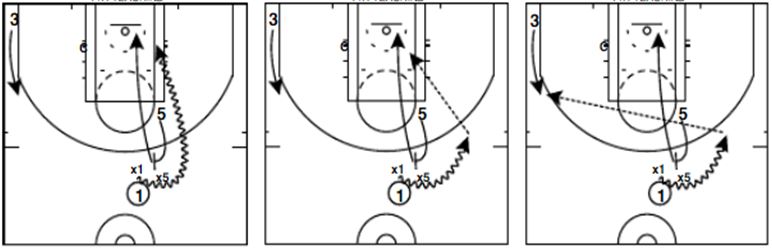
Back Screen to Swim Back:

backscreen-to-swimback1

This tactic serves two purposes:

1) to get the ball inside and
2) serve as a pressure release.

A small to big back screen is a very effective way to relieve denial pressure because, unless the defense switches, the small defender will have to help momentarily as the offensive post player comes off the screen to the basket.

If the small defender does not help they may give up a lay-up.

The screener (the small) steps out of the post and sets a back screen for the post to go to the basket.

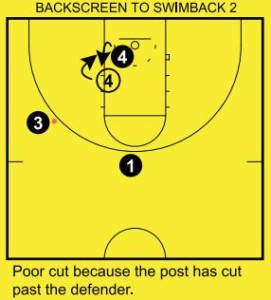
backscreen-to-swimback2

The screener then quickly steps out to the 3 pt. line and receives a pass from the top.


There are three critical points on the post’s cut to the basket:

1) He must come tight off the screener’s shoulder to force the small defender to help momentarily,

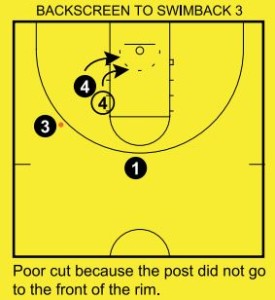
2) He must take the cut towards the front of the rim to force the defender higher (above the line of deployment)

3) He must not cut past the defender and allow the defender to easily get over top and front or side front.

backscreen-to-swimback3

To execute a good post up the post must swim back by taking their baseline arm aggressively over top and in front of the post defender and, with their baseline foot, step across the top foot of the defender.

The passer may be able to pass directly in to the post or may need to take a dribble to the baseline to improve the passing angle.


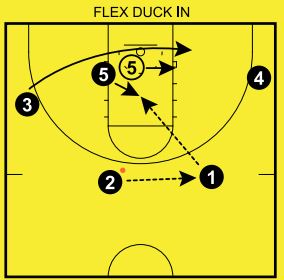
Flex Duck-In

basketball-plays-flex-duck-in

This tactic has the same principle of curling the post: the post defender must defend a cut by another offensive player. The cutter will flex cut low off the post and force the post to help momentarily.

As the post defender helps the offensive player ducks in right in front of the post defender. As in all flex action the ball wil be at the opposite high elbow. The post should not step outside the lane to set a screen for the cutter because it makes the distance too far to get back in and post up. The flex screen should be set with the posfs back to the basket.

Then to execute the duck-in properly the post wil drop step towards the bal with hislher top foot and then slide quickly in front of the defender. The ball may be passed into the post high or low depending on the post defenders recovery. Similar to the regular duck-in, the post should go back in the direction he/she came from to score, because there should not be any back-side defenders to help. This is done by completing a drop step with the foot furthest from the passer. The finish can be either a lay-up or a power move.

Closing Thoughts:

These tactics are team concepts because they will involve more than one player. When concepts are taught to players they must learn to read the defenders because the position of the defenders will determine where the ball should be passed. In the case of getting the ball inside the first step is to teach the players to see the position of the post defender. So begin teaching these tactics with only a post defender and initially instruct the defender on where to play. Then you can allow the defender to be live. The next step is to add defenders on the passers. This will now force the passers to use their skills while also reading the post defender. The final step is use the tactic within the context of a 5 on 5 environment, so the passers must recognize the help defenders.

With all offensive play, spacing is a critical element. It is important to emphasize spacing throughout the teaching of these tactics to ensure the post player is not crowded when he/she receives the pass. Proper spacing will help prevent the quick double-team on the post and will open passing in and out of the post.

The last aspect is timing. The anxious post player will often get into position before the pass is ready to be delivered. The post often ducks-in too early or posts-up before the ball is at the wing; which either results in a 3 second call or allows the defender time to get around the post. It is important for the post player to be patient and allow the play to develop.

All teams need to have an inside threat. Whether you simply teach the tactic or concept, or incorporate them as part of a play, these are steadfast methods which wil usually be effective when executed properly. While there are many ways to get the ball inside these are some of the most effective and popular ways.

Teaching Basketball Pick and Roll Decision Making

By Brian Williams on March 28, 2014

By Mike Dunlap (former Charlotte Bobcats Head Coach and current Loyola Marymount Head Coach) and currently Men’s Basketball Coach at Colorado Mesa.

The development and decision making process of the pick and roll game covers a lot of ground.

I will give you a couple ideas and leave it there.

One of the most important points that I can make is teaching to the advantage of the drill.

For example. play 3 offense versus 2 defenders. You can guard the ball and the screen, while putting a coach on the replace or fill man.

The coach is there to instruct only while giving the ballhandler different verbal cues as he takes his second dribble off the screener, like pass to replace man using the verbal “3” ….or making a bounce pass to the roll man using the verbal “5” or calling out “1” which means the ballhandler attacks rim or shoots a pull up jumper.

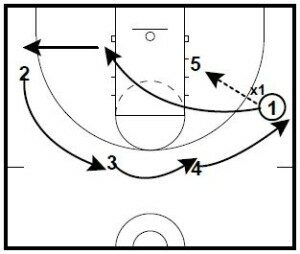
Diagram of the 3 scenarios just described

The set would be: ballhandler in middle alley, screener on either elbow, and replace man in the corner opposite side ballhandler dribbles for throwback pass. The idea here is to give all 3 offensive players verbal cues and use different types of situations so they must read and react.

pnrteaching

Offensive basketball is nothing more than move and countermove. We teach different situations or types of pick and roll defenses and show the offense how to attack that particular scheme. For instance, if the defense is using a traditional hard hedge against the hallhandler, we tell him use at least 2/3 dribbles to get separation from screener so that passing windows are much bigger.

Additionally, we tell the point guard that there is an order to our progressions: “you attack rim first, look for roll man second, and find replace man third.” We also know that people remember things in threes so we tell the ballhandler to be aware of the 3 S’s: start point, set up (fake opposite the screen) and the separation rule of at least 2 dribbles before passing the ball.

The biggest problem I continually see with the p/r game is that the ballhandler leaves before the screener gets to his defender…WAIT…fake away….and once the ballhandler hears both feet of the screener hit the ground, he takes off…..The next most prevalent mistake lies with the screener because he does not sprint into his pick….sprint. sit, separate….there it is again, the 3 Ss…

Coaching Basketball Don Meyer Fundamentals

By Brian Williams on March 26, 2014

Passing & Receiving Ideas

from Don Meyer

  • There aren’t many great passers anymore. Most perimeter players are able to dribble, and some can shoot, but not many can pass. It is quickly becoming a lost art.
  • Great passing teams are happy teams.
  • Players must understand who they are passing to and the current situation. It does no good to throw a pass to a great 3-point shooter inside the 3-point arc, and it does no good to pass to a post man that can’t dribble on the break when he will have to put the ball on the floor to get to the rim.
  • The bounce pass is used in tight quarters (penetrating guard using the bounce pass to the post) and can be used on cuts to the rim (example: back cut on the wing). We don’t want any bounce passes on the perimeter, and a general rule of thumb is no bounce passes anytime the player is moving away from the basket.
  • We like to use the chest pass in the open court (transition) or when our guards are spaced on the perimeter (much quicker than the one-handed flick pass). The legs must be used for velocity.
  • We tell our players that if they can’t successfully make solid, catchable passes to the post, they can’t play. We work on post feeds a lot. On the baseline post feed, we want our players to dribble down to get the proper angle, and then we teach our players to step across with the inside foot to shield the pass from their defender (one of the only times we violate our concept of permanent pivot foot)
  • On all bounce passes (including post feeds), we want the ball to hit 2/3 of the distance from the passer to the receiver. We also want the passer to turn the wrist from inwards to outwards so that the ball digs into the floor and spins into the receiver.
  • On all catches, we want the following: “Ball in the Air, Feet in the Air” so that we can catch with two feet and then use our permanent pivot foot.
  • On all catches, we want the receiver to meet the ball (shorten the pass). Most passes are intercepted when the receiver doesn’t shorten the pass, allowing the defense to shoot through the passing lane.
  • “Every pass is a shot” Perimeters must believe that their pass will lead to the success or failure of the shot. A good pass in the shooting pocket will lead to a rhythm shot, whereas a pass too low or too high will get the shooter out of his rhythm, and may take the shot opportunity away (defense has time to react).

Transition Game Ideas

  • In the primary 2v1 break, we teach our ballhandling guard that they must attack the defense with the intent to score. They only make the pass to the receiver when the defense fully commits to their penetration.
  • In the 2v1 break, we want our offensive players to split the floor into 1/3’s, approximately one yard outside of the free throw lane. As they get closer to the hoop, they will progressively get closer to each other. We want the ball in the inside hand of the ball-handler (better angle to make the bounce pass to the finisher).
  • In the 3v2 break, we want our ball-handler to go towards our best shooter and away from our best finisher at the rim (ball-handler must immediately recognize the strength of his teammates). The ball-handler must attack the first line of defense and occupy that defender. At that point in time, the defense must make a decision to guard the hoop or cheat to guard the best shooter. If the bottom defender protects the hoop, the shooter will have an open look, and if the bottom defender cheats to guard the shooter, the finisher will have an open look at the rim. The key is to occupy the top defender and be able to make a quick read on the bottom defender (requires a point guard with a high skill level).
  • We want our point guard to receive the outlet as deep as safely possible. On the catch, we want his body opened up to the middle of the floor, or if he has to catch facing the opposing basket, we want him to pivoand turn to the middle of the floor. We prefer the catch to be wide (near the sidelines) so that the angle is good to make the pitch-ahead pass to the near-side wing, or the point-to-post “lob” pass to a post running the rim. If the guard catches in the middle of the floor, there is typically a lot of traffic and passing angles diminish.
  • We want our wings (2s and 3a) to run the wings as wide as possible. In fact, in practice, we have them run near the sideline or even run out of bounds to emphasize running wide. Once the rebound is secured, they must immediately begin to sprint the lane.
  • Point guards are looking to pitch ahead to the near side wing, go point-to-post to the streaking post man (typically must pass before the ball gets to the half court line), or look for the diagonal pass to the opposite wing (aim the pass to the far corner).
  • Point guards can also “cross main street” by using the 4 man who is trailing as a moving screen. This is a great way to get a quick ball reversal, which forces the defense to rotate.
  • If the point guard has no options to pass the ball ahead to a teammate, we want our point guards to look to penetrate in secondary transition. We tell our point guards to “crack the shell” of the defense. It is crucial that the near side wing is wide & low enough, and that the trailer stays well behind the 3-point line to space the floor and discourage help-side defense. On the penetration, the low-post must drop into an alley near or behind the hoop to give the guard room to get to the rim or passing angles on any post help.
  • If the point guard is a great shooter, we work on the pull-up 3 in transition, especially in a 2v1 or 3v2 setting. This shot is very difficult to make, but it is almost impossible to defend, without giving up an easy lay-up (especially in 2v1).

Basketball Plays from 2013 NCAA Tourney

By Brian Williams on March 25, 2014

A great idea this time of year is to either set your DVR for the men’s and women’s NCAA, NIT, and high school basketball tournament games that are on TV. That way you can go back any time this spring or summer to pick up some great man to man, zone, and inbounds plays. I also like to look for sideline, under out, and on ball screen sets in the upcoming NBA playoffs.

This video is a compilation video with some of the favorite man to man sets, zone sets, and baseline inbound plays from last year’s NCAA Men’s Tournament of Zak Boisvert.

He is an Assistant Men’s Coach at Army.

I have previously posted some of the You Tube videos His You Tube channel is: Zak Boisvert You Tube Channel

If you are interested in subscribing.

He also is also very active on Twitter:
@ZakBoisvert

Coaching Basketball Don Meyer on Using the Dribble

By Brian Williams on March 14, 2014

Dribbling Ideas / Live Ball Moves / Penetration Ideas

from Don Meyer

  • Dribble vs. Drive. We want our players to drive, but we don’t want them to dribble for no particular reason.
  • We always ask our ball-handlers: “If the ball had eyes, would it be able to see when you had it?”
  • On all dribbling drills (and as a general rule of thumb): Start slow, get a rhythm, go fast enough to make a mistake.
  • Versus pressure in the full court, we teach our players to attack the defense at a 45 degree angle–very hard to guard.
  • A good player needs no more than 1 or 2 dribbles to get from the wing to the rim. In all our breakdown drills, we don’t allow our players to use more than 2 dribbles to get to the rim, unless they are using a hesitation move, back dribble, etc. 
  • We want our players to drive in straight lines to the rim. We don’t want them veering out. Our goal is to make contact with the defense (make contact with the man guarding you and contact with the 2nd line of defense). We want to put our shoulder into the defensive man’s hip on all drives (put a body on first).
  • We want 60% of the weight on the permanent pivot foot on all moves (reduces traveling)
  • Play against your opponent’s momentum–Drive the front hand
  • We want to go from a medium center of gravity to a low center of gravity
  • “Be ball quick” and have eyes on the rim for vision 
  • Use the dribble to get out of trouble, not into trouble
  • Never pick up your dribble without a pass or a shot
  • The back dribble is the most important dribble in the game of basketball, but it is also probably the most rarely used, and it may be the most difficult dribble to master. The key points for the back dribble are:
    1) To Keep eyes on the rim
    2) 
    Have an “arm-bar” with the weak hand to shield the defense.
    3) 
    Point the back toe, dribble near or behind that toe, and get out of trouble as fast as possible.
    4) 
    The back dribble is a great time to get the defense attacking you–perfect opportunity to use a hesitation move to the rim (in the half court). 
  • The middle drive is the drive of preference in our offensive system. We believe that getting middle drives forces defensive help from defenders above the drive (great opportunity for crack-backs to 3 or dives to the rim) and from defenders (typically post men) below the drive (opportunity for bounce passes to our post men for easy lay-ups).
  • The only reasons to dribble are:
    1) 
    To advance the ball up the floor
    2) To improve passing angles (especially feeding the post)
    3) To get out of trouble
    4) To get to the rim
  • Great players typically only have 2 moves with the dribble; the Go-To move, and the Counter move.
    1) T
    he Go-To Move is the move everybody in the gym knows you’re going to make, and they still can’t guard you.
    2) The Counter Move is the move that you make when the defense is trying to take away your Go-To Move at all costs.
    3) Example: Go-To Move is the left-to-right crossover move, and the Counter Move is the In-n-Out (Fake Crossover) with the left hand. It works best if the Go-To & Counter Moves compliment each other. 
  • When driving baseline, players have to know what their options are if they can’t get all the way to the rim. In our Drive & Space scheme, on any baseline penetration, the weakside wing will “drift” to the corner, the strong-side guard will “crack-back” behind the penetration, we will have a low-post ready for a feed, and we will have one more shooter in the opposite guard / wing spot looking for the 3-point shot.
  • We allow our players to use either a “step-plant” or a “quick-stop” to go into the pull-up game. We typically teach and encourage player’s to use the 2-footed quick-stop, because it is easier to teach and it allows our player to keep his permanent pivot foot on passes in traffic, but we also will allow a step-plant if the player can prove to us that they are comfortable with that move. The step-plant does have benefits, most notably that it is “quicker” and it creates more separation between the offense and defense.
  • When a player penetrates and gets too deep into the lane to shoot a traditional pull-up, we teach the player to shoot a one-handed floater over the defender (we also have the shooter use the strong hand on the floater).
  • « Go to Previous Page
  • Page 1
  • Interim pages omitted …
  • Page 8
  • Page 9
  • Page 10
  • Page 11
  • Page 12
  • Page 13
  • Go to Next Page »

Primary Sidebar

  • Twitter
  • Facebook
  • Linkedin
coachestoolbox
personaldevelopmenttoolbox
basketballplayerstoolbox
basketballtrainer
athleticperformancetoolbox
coachingbasketball

© Copyright 2026 Coaching Toolbox

Privacy Policy