• Skip to primary navigation
  • Skip to main content
  • Skip to primary sidebar

  • Basketball Plays
    • Ball Screen Sets
    • Horns Sets
    • Man to Man Post Up
    • Man to Man Isolations
    • Backdoor Plays
    • Man to Man 3 Point Shot Plays
    • 2-3 Zone Attack
    • Baseline Inbound Plays
    • Sideline Inbound Plays
    • Combination Defense Attack
  • Drills
    • Defensive Drills
    • Offensive Drills
    • Competitive Drills
    • Passing Drills
    • Rebounding Drills
    • Shooting and Scoring Drills
    • Toughness Drills
    • Transition & Conversion Drills
    • One on One Drills
  • Blueprint
  • Practice
  • Mental Toughness
  • Skill Development
  • Offense
  • Defense
  • Store

Blog

Basketball Shooting Drills

By Brian Williams on May 23, 2011

These two shooting drills came from Coach Creighton Burns’ Newsletter

Knight SHOOTING DRILL”

*How to do the drill:
1. You need three players (shooter, passer, rebounder)
2. Two balls
3. One Minute on the clock

Goal to make 15 shots out of 25 attempts

  1. The passer can only pass. The rebounder can only rebound and then pass to the passer. (I know you realize the passer passes to the shooter.)
  2. The Rebounder counts the shots attempted.
  3. The Passer counts the shots made.
  4. The drill starts with the shooter having a ball and the passer having a ball.
  5.  

  6. The shooter will move from Elbow to Elbow in the drill. (Must HUSTLE!)
  7. Their should be some type of punishment if the shooter does not get the25 attempts or the 15 makes.

*Change up to the drill. You can have the shooter go from elbow to the wing and back to the elbow. S/he should move about 12′. You may need to put a mark with chalk on the floor so the shooter will know where to shoot from. (All the other rules are the same.) (This is great for taking shots at game speed.)

________________________________________________________________

UT SHOOTING DRILL

*The Explanation is below the diagram
________________________
l                l
l      2        l
l                l
_________

1               3

“Three Man-Two Ball Shooting Three Pointing Shooting Drill”

1. 1 has a ball ready to shoot
2. 2 has a ball under the basket
3. 3 is spotted up behind the arc

*Procedure

1. The drill begins with 1 taking a shot and 2 under the basket will make a pass to 3 for a three point shot.
2. The passer (2) sprints outside anywhere behind the three point line.
3. The first shooter (1) follows his shot, rebounds, and passes to a player spotted up behind the arc.
4. The drill continues for 1 minute and each player has to make 6 three point shots. (They count their
own made shots.) (Penalty if they don’t reach 18 total makes)

*Remember this and you can do the drill. After you shoot follow your shot rebound it (missed or made) and pass to a player behind the three point line. Do not stay under the goal after you rebound your shot just sprint behind the three point line and you will get a pass from another player who has just rebounded his/her shot.

*You can shoot from the corners, wings or point area.   *If there are three players and two balls someone has to be open for a pass after you follow your shot and get the rebound.

The Coaching Toolbox has hundreds of resources for coaching basketball including basketball practice, basketball plays, basketball drills, basketball quotes, basketball workouts, basketball poems, and more!
Point Per Pass Basketball Drill

By Brian Williams on May 10, 2011

We started using this drill to improve our 3 on 3 games in our summer youth clinics, but found that it also works well in season as a practice drill or five on five drill at various grade levels in our program–including the varsity.

The drill has several objectives:

  1. Keep 3 on 3 games at lower levels from being a dribbler and 2 watchers.
  2. It emphasizes the give and go.
  3. Requires players to get open to receive a pass
  4. De-emphasize dribbling
  5. Encourages team play on offense
  6. Makes the defense play harder to stop the points for passes and guard the basket cutter.
  7. It can be used to practice a delay game offense and defending against a delay game if you don’t set a limit for the number of passes.
  8.  

Rules:

  1. Regular scoring for two and three point baskets.
  2. Every completed pass followed by a basket cut is worth one point for the offense.    It is important that only a pass followed by a basket cut counts as a point to promote cutting in our motion offense.  Pass and stand is not a point.  If we use it with our high school teams, then a pass and screen is also worth a point.
  3. (Optional) You can set a limit of no more than 7 points from passes if there is lack of attempting to get a shot.

In addition, you can teach passing to the outside hand away from the defense, meeting the pass, and other areas you want and that are appropriate for the age of the player that you are working with.

After a few days of doing this with your elementary and middle school teams, it starts to look like basketball!

The Coaching Toolbox has hundreds of resources for coaching basketball including basketball practice, basketball plays, basketball drills, basketball quotes, basketball workouts, basketball poems, and more!
Kevin Eastman Basketball Coaching Points Part 2

By Brian Williams on April 29, 2011

This is the second part of Kevin Eastman’s Coaching points. Kevin is the LA Clippers VP of Basketball Operations, former NBA Assistant and D1 Head Coach Coach Kevin Eastman. Many of the notes deal with post play.

Here is a link to the first: Eastman Part 1

I received this collection of coaching points that have been tweeted by LA Clippers Assistant VP of Basketball Operations Kevin Eastman from Phil Beckner. Coach Beckner is now an assistant at Nebraska.

I also have a sample five minute video of Coach Eastman discussing his views on skill development. Click this link to see it.

If interested, you can follow Coach Eastman on Twitter @kevineastman

********


The best in the NBA have a laser like focus & commitment to winning that also carries over to their off season improvement-it’s very serious

Skill development is a process-the player & coach have to be committed to it-both need focus & enthusiasm the entire way-development takes time

The ultimate team is a group of self motivated players that turns into a player coached team; with the structure & guidance from the staff

You get new jobs because of who people think you are; you keep that job because of who you really are; make sure you are as prepared as you can be.

Success is a process; a winning season is a process; winning teams do not get bored with the process; it’s long & requires disciplined focus

Proper form and a strong work ethic plus preparation and repetition is the formula that makes a great shooter

Being the best gets harder as time goes on so the special ones continue to work on their game. Working at your game at every opportunity is what makes a player great

Champions do not become champions on the court. They become recognized on the court.  They become champions because of their daily routine and commitment to excellence. Players do not decide their future; they decide their habits and their habits decide their future!

Being the best requires 100’s of sacrifices the public will never see-that’s why players who r in for the limelight will never be successful

It’s not easy being one of the best in a given field; it does require hard work and sacrifice; you have to earn “best”; earn “championships”

When a strong purpose teams up with great passion there’s no telling how far a group or individual can go!

Success does not come to those who merely have great dreams. Success comes to those who have great dreams and who follow through on them

Also keep in mind that we are not God’s gift 2 basketball; rather basketball is God’s gift 2 you; we are not entitled 2 this job-keep earning it

Practice habits become your game habits-your players have to be consistent w/ this if want to win-there are no “on/off switches with the best teams

Great way for players to learn about the “next level” is to listen to their current coaches & read about what players do at that next level-

All coaches – especially assistants – must be on a constant journey to learn and improve; do not allow yourself to stand still! Take action!

You can’t expect to be great if you are a part time player. Are you a 9am-5pm player or a 5am-9pm player? Guess which Kobe and LeBron are?

The only important shot is the next one; because no matter how hard you try, that is the only one you can still have an effect on!

Post players need to understand that upon catch-many times-it’s best to “pause for poise” before making a move; let the area clear & read 1st

As a coach it is important to hold yourself every bit as accountable as you hold your players; what can you do better? How can you help more?

Voices & choices; who are u listening to? These are your choices that will have an impact on your present & future; get around people who stretch you

It takes coaches many years to become experts on basketball strategies and techniques, but we expect players to master these right away?

The best way to lead is by example; players see the actions & actions often do speak louder than words; what you do will have a greater impact!

The best players do their jobs & most importantly do their jobs completely! They understand the value of executing every part of their role

Passion can overcome many shortcomings one may have on their job; but continuing to have the passion for improvement of them is most important

What makes one person’s career seem to advance further than anothers? You have to become so valuable that it’s hard not to hire you!

You advance in your career by how thorough you know and understand your craft and who you associate with; associate with people who challenge you!

“A little more” often produces a lot more; a little more focus; a little more effort; a little more sacrifice; doing a “little more”=winning.

Kevin Eastman Basketball Coaching Points

By Brian Williams on April 27, 2011

This is the first part of Kevin Eastman’s Coaching points. Here is a link to the second: Eastman Part 2

I received this collection of coaching points that have been tweeted by retired NBA Executive and Assistant Coach for the Clippers and Celtics Kevin Eastman from Phil Beckner. Kevin Eastman spent several years as an assistant to Doc Rivers with both the Celtics and the Clippers. Coach Beckner is now an assistant with Boise State.

I also have a sample five minute video of Coach Eastman discussing his views on skill development. Click this link to see it.

If interested, you can follow Coach Eastman on Twitter @kevineastman

********

Intent is great if followed by action; intent is personally debilitating if left alone as it slowly erodes confidence & the will to advance!”


What do I want and what will it take to get it? Answer these 1st. Then ask yourself: am I TRULY willing to pay that price?

One statistic all teams should keep is being “first to the floor”; when the time calls for a loose ball to be picked up–who gets there 1st?

Observation from All Star game: “the best” have insatiable need to compete and succeed! Work ethic is off the charts!

To all asst’s in any line of work: it’s not about YOU–it is about what YOU DO 2 help YOUR BOSS. Help them b successful!

Do your job and do your job completely.

People always ask me about KG–my response is always the same: he wants to be the best & do the best that he can every day! Practices & Games!

“It takes three things to be a “special” player: talent, character, and competitive fire.”

Some are satisfied with who they are. Others are consumed with who they can become. I call this group “THE BEST”

Coaching is making players do what they don’t want to do so they can become the player they want to become

“The Best” have to pay a new price every year because everyone is always trying to beat them; the best are the best because they pay this price!

Culture is 7 days a week, 24 hrs a day

The best shooters in the NBA are consumed with the fundamentals of their shot; every day-every shot; the details are there

Vets at all levels have responsibility to maintain program’s culture every day. From work ethic to off the floor decisions.

Our focus should be more on solutions then problems; problems are easy to point out; solutions are what can solve the problem; be big on solutions.

Good question to ask yourself; are you one that makes promises or commitments? Promises often are what you might do; commitments are what you will do!

Spending time working on your game is spending time working for your team

All great players are on a never ending journey to stay at the top; it’s the pride of greatness! They refuse to settle!”

The best teammates build up-not tear down; they encourage-not discourage; they help–not hinder; they walk with-not in front of teammates!

Once someone can do what you do and one more thing, you are replaceable

What you “bring” to each workout (energy, enthusiasm, effort, patience, etc.) is more important than what you “know.”

To truly get to the level you are seeking you have to give others permission to hold you accountable! It’s good to have to prove yourself!”

We all procrastinate. But remember: procrastination is one of the single biggest killers of our goals and dreams & ultimately our success!

Improvement has to be worked on every day; it can’t stay in the “wish for – hope for” stage; keep working on what moves you ahead.

Summer-3 great months. to have goals of: read 1 book/month; read 1 coaching/leadership article/day; have a “thoughts journal”-fill it with ideas

Success has a price but also a choice: the price is what it takes to earn it–it shouldn’t be easy! The choice: are you willing to pay the price?

Becoming successful is an everyday endeavor; never allow yourself to coast; discipline yourself to consistently work on becoming more

Finish–a very powerful word-must b staple of your vocabulary; not just finish plays-finish EVERYTHING YOU START in your life-never quit on yourself

Learn from the past; produce in the present; and get  to the future first; this is one of the most important keys to effective leadership!

“WILL TO WIN”: all about getting yourself to another level through sheer determination; overcoming the urge to say this is too hard/I can’t do this

Here is a link to the second part of this post: Eastman Part 2

The Coaching Toolbox has hundreds of resources for coaching basketball including basketball practice, basketball plays, basketball drills, basketball quotes, basketball workouts, basketball poems, and more!
Pete Gillen on Attacking Match-up Zones

By Brian Williams on March 25, 2011

From a clinic presentation by Pete Gillen

Match up is a zone with man to man principles.  The man is as important as the ball.  The defense will take the shape of the offensive set.

The purpose of a matchup is to get you confused, indecisive, and out of sync.  Attacking it is 80% mental.  We are going to run the offense that we want to run and act rather than react.

Our ten Principles for attacking the matchup.

1.  Attack the zone with the fast break.  The fast break is the toughest thing to defend in basketball.

2.  Send cutters through.  Cutters cause confusion as to who is guarding the cutter.  If you just stand, you are doing the matchup a favor.


3.  Attack the baseline and then reverse the ball to the other side’s baseline.  When the ball is on the baseline, all zones become 2-3s.

4.  Dribble penetration.  I asked Don Casey, who was a great zone coach, what hurt his zones the most.  His answer was dribble penetration.  You must work at dribble penetration against a zone in practice.   You need to use the dribble after several passes that stretch the zone first.  Our rule is that anytime we catch the ball at the point from the wing, that player must penetrate as deep as he can and look to pass to the post or wing.

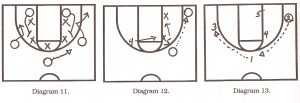
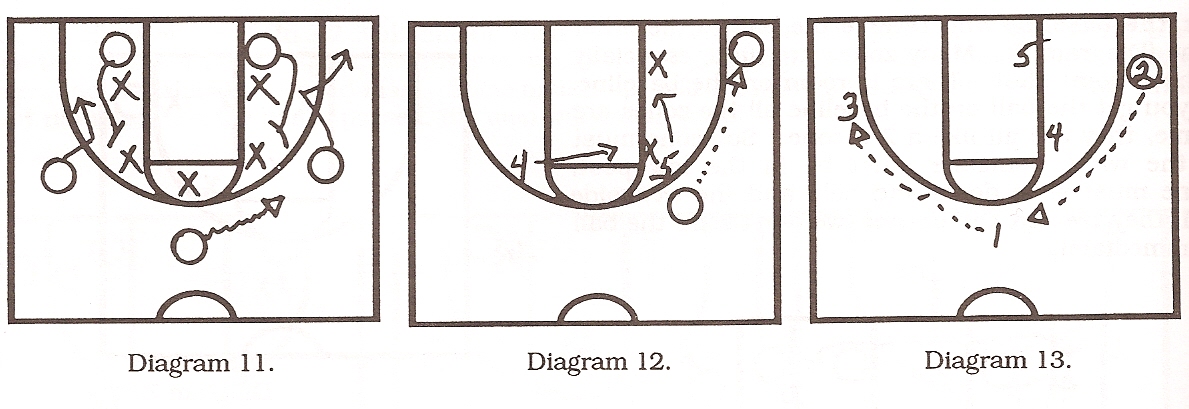
5.  Screen the wings.  (Diagram 11) The point guard must dribble at our wing players.  Those wing players fade to the corner.  That puts pressure on the back man in the zone.  Does he stay in our play the man in the corner?

(Diagram 12) If we make the pass to the corner, 5 rolls to the basket and 4 fills the high post, so we have a quick 2 on 1 on the back of the zone with the corner and 5

(Diagram 13) If the corner passes back to the point, the ball is reversed to 3

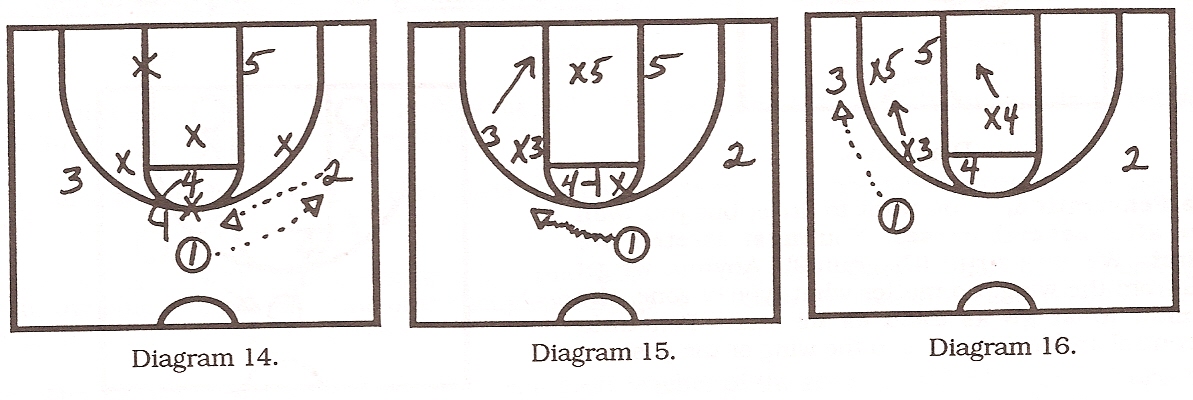
6.  Screen the point.  (Diagram 14).  1 passes to 2 and 4 screens the point.  Diagram 15 shows the ball being passed back to the point.  We run a screen and roll with 4 and 1.  3 fades to the baseline.  1 can take the jumper, dribble into the gut of the zone and pass to 3, if X3 comes up to stop the drive. Or, he can pass to 5 as shown in diagram 16.  If we pass to 3 in the corner, X5 must cover him, so 5 comes across the lane.  X3 is coming to 3.  X5 must either play 5 or 4 because of the high/low situation.

Basketball Plays

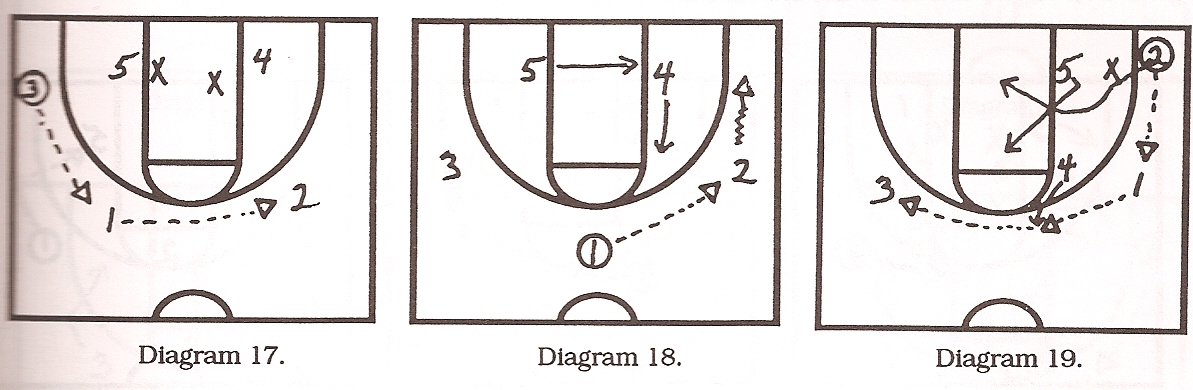
7.  We also like to screen in the block area (Diagram 17)  The defense is matched up, but when the ball is reversed, 4 screens the back of thd zone.  Then 4 ducks in.  Don’t flash to the ball unless you screen first (Diagram 18).  Have the wing dribble to the corner.  Who takes him?  4 comes up the lane.  5 comes behind in diagram 19.  Now, we have a box overload.  We back-pick with 5 as we step out the 4 and reverse the ball.  We send 2 across, but are really looking for 5 ducking in after the screen.  Ball goes 2-1-3-2-5.

Basketball Plays

8. Skip pass after a ball fake.  Stretch the zone.  You can’t telegraph it, you must freeze the zone.

9.  We send four men to the offensive boards because it is difficult for a zone to block out .

10.  Duck in and seal back move.  1 to 2 back to 1.  5 ducks in and 1 looks to get the ball to 5.  5 moves the defense by moving several steps along the baseline before ducking in.  If we can’t pass to 5, pass to 3.  3 dribbles hard to the baseline and 5 moves outside the lane to receive a bounce pass from 3.  The ball goes 1-2-1-3-5.

The Coaching Toolbox has hundreds of resources for coaching basketball including basketball practice, basketball plays, basketball drills, basketball quotes, basketball workouts, basketball poems, and more!
Michigan State Rebounding Concepts

By Brian Williams on March 22, 2011

This handout is posted on Coach Steve Smiley’s site www.snsbasketball.com

Michigan State Basketball Rebounding Concepts & Philosophy

Mike Garland


1. In the Michigan State Basketball program, rebounding, without question is a top priority.  From the seasons’ beginning until its end, rebounding is a big point of emphasis each day throughout the entire duration of our practice sessions.  Everything we do either begins or ends with the rebound or attempt to rebound the chance (made shot).

2.  We coach rebounding on every shot taken in practice. One of our staff members and sometimes two assigned to coach rebounding only during practice.  Which phase of rebounding he will coach is usually determined before practice and will change in accordance to what we are working on during a particular drill or scrimmage situation offensively or defensively.

3.  Important point- we grade our players rebounding performance on effort not the number of rebounds they get in a game session.

  • Offensive rebounding-we chart the number of times a player makes an all-out effort to get to the offensive boards (attempts) against the number of chances he actually had to go to the boards.  The percentage basis calculated by dividing the number of chances to go to boards into the number of times a player attempted to get to the boards.
  • We also do the same collectively as a team the same way.
  • Ours is to be 90% or above in our effort.
  • We want to get back 50% or better of our missed shots

Defensive rebounding- we chart defensive rebounds in a similar manner except we calculate the number of chances to cutout (block out) by the number of time a player individually or our team collectively actually did cut out his offensive player when show was taken.

  • Our goal is 90 %
  • We don’t ever penalize a player for not making an unnecessary cut out (we actually discourage the unnecessary cut out.)

Offensive Rebounding

1. At Michigan State we believe the missed shot is our best offensive play.

2. We tell our players to always assume the miss when the shot is taken either offensively or defensively.

  • We tell our players to pursue the ball
  • Don’t go to a back-avoid contact
  • Keep hands above the shoulders (don’t get arms pinned down)
  • IF you can’t get the rebound try to tip it to someone else or keep the ball alive- get a hand on the ball or a finger-whatever-keep the ball alive- we do a better job of this that nay team in the country (War Drill)

The remainder of the notes are from John Zall’s Michigan State Defensive Playbook. It is combined with his NBA Playoffs Playbook as this week’s eBook Bundle. You can find out more here:

101 NBA Playoff Sets with Michigan State Defensive Playbook

Principles:
“Hit, Find and Fetch” – this is Michigan State’s rebounding mantra.

Tom Izzo preaches stepping towards the player are boxing out and making contact to force them away from the rim.

Instead of holding your seal and letting the ball hit the floor; Michigan State players are taught to go find th
basketball and rebound it out of the air.

• Use 2 hands to go after the basketball
• Rebound ball above head = good rebound
• Low man wins when making initial contact

• Sends 4 t0 the offensive glass (Point Guard gets back). This forces the other team to adjust.
• Must be able to get back behind post player on shot attempt

Teaching Points
7O% of rebounds go in opposite direction from where they are shot
Important to contain basketball. Multiple help rotations lead to players being out of position to rebound
Weight lifting is a big part of rebounding.

Capture


Michigan State War Rebounding Drill

Diagrams created with FastDraw

Coach will shoot the ball to initiate the rebounding hit, find, and fetch.

  • « Go to Previous Page
  • Page 1
  • Interim pages omitted …
  • Page 6
  • Page 7
  • Page 8
  • Page 9
  • Page 10
  • Interim pages omitted …
  • Page 25
  • Go to Next Page »

Primary Sidebar

  • Twitter
  • Facebook
  • Linkedin
coachestoolbox
personaldevelopmenttoolbox
basketballplayerstoolbox
basketballtrainer
athleticperformancetoolbox
coachingbasketball

© Copyright 2026 Coaching Toolbox

Privacy Policy