• Skip to primary navigation
  • Skip to main content
  • Skip to primary sidebar

  • Basketball Plays
    • Ball Screen Sets
    • Horns Sets
    • Man to Man Post Up
    • Man to Man Isolations
    • Backdoor Plays
    • Man to Man 3 Point Shot Plays
    • 2-3 Zone Attack
    • Baseline Inbound Plays
    • Sideline Inbound Plays
    • Combination Defense Attack
  • Drills
    • Defensive Drills
    • Offensive Drills
    • Competitive Drills
    • Passing Drills
    • Rebounding Drills
    • Shooting and Scoring Drills
    • Toughness Drills
    • Transition & Conversion Drills
    • One on One Drills
  • Blueprint
  • Practice
  • Mental Toughness
  • Skill Development
  • Offense
  • Defense
  • Store

Blog

Great Basketball Players

By Brian Williams on October 13, 2011

This is a follow up to the Great Basketball Coaches Post from Alan Stein of www.puresweatbasketball.com.

Recently I posted a hurricane of Tweets on what great basketball players do. Here is the entire list… plus a ton of additional ones submitted by my followers:

  1. Great players… go after every rebound on both ends of the floor – they are crafty and aggressive.
  2. Great players… run the floor as fast as possible on fast breaks AND defensive transition.
  3. Great players… are defensive stoppers – they stop their man as well as help teammates. They do the things offensive players HATE!
  4. Great players… contest all shots. They don’t go for ball fakes or shot fakes. They deflect passes, bump cutters, and take charges.
  5. Great players… don’t gamble on offensive or defensive. They aim to make the RIGHT play; not the HIGHLIGHT play.
  6. Great players… are strong with the ball. They rip through hard on offense, ‘chin’ all rebounds, and don’t expose the ball when dribbling.
  7. Great players… play under control and play at different speeds. They know that playing slow can be VERY effective.
  8. Great players… practice just as hard as they play in games. They don’t have an ‘on and off switch’ – they are ALWAYS on!
  9. Great players… allow themselves to be coached. They make eye contact, listen, and welcome coaching. They crave getting better.
  10. Great players… are great teammates. They are supportive, high energy, and make their enthusiasm contagious.
  11. Great players… ‘Play Present.’ They focus on the process, not the outcome. They focus on what they can control. They don’t get distracted.
  12. Great players… take advantage of every opportunity to get better. Every workout, every practice, and every game is a chance to improve!
  13. Great players… are mentally and physically tough. They are comfortable being uncomfortable.
  14. Great players… can pivot both ways off of either foot and can dribble, pass, and finish around the basket with either hand. They don’t have a ‘weak’ hand.
  15. Great players… love and respect the game of basketball. They don’t play for money or fame; they play for love.
  16. Great players… are unselfish passers. They hit open teammates. They know the goal is to get THE best shot; not THEIR best shot.
  17. Great players… don’t commit stupid fouls.  They know their greatness is eliminated if they are on the bench in foul trouble.
  18. Great players… are students of the game. They watch film. They study opponents. They study themselves.
  19. Great players… value every possession.  They aren’t careless with ball.  They make smart passes and take high percentage shots.
  20. Great players… don’t wait for the workout or practice or game to start… they prepare for it! They prepare mentally and physically.
  21. Great players… are super competitive. They hate losing more than they enjoy winning. They compete in everything they do!
  22. Great players… always know the time and score. They know how many time-outs they have as well as who is in foul trouble on both teams.
  23. Great players… log the game in the mind. At any point in time, they can tell you exactly what happened, on both ends of the floor, the last 3 possessions.
  24. Great players… are assertive with the ball, welcome contact when driving to the cup, and get to the free throw line.
  25. Great players… immediately think ‘Next Play.’  They don’t dwell on mistakes (missed shot or TO)… they make up for it on the other end.
  26. Great players… make plays, not excuses. They don’t care if the refs suck, if the floor is slippery, or if they have a cold. They get it done.
  27. Great players… are the first ones in the gym… and the last ones to leave EVERY day.
  28. Great players… don’t worry about getting exposure.  They focus more on never getting exposed!
  29. Great players… elevate their teammates to become great players too!
  30. Great players… know that their legacy will be judged on their ability to win championships.
  31. Great players… would rather play ball than anything else.  They truly love to play.
  32. Great players… are well rounded and have a complete game.  They can ‘hurt’ you in a variety of ways.
  33. Great players… are top notch communicators.  They talk with a presence on both ends of the floor.
  34. Great players… want the ball in their hands when the game is on the line because they know they have put in the work to DESERVE success.
  35. Great players… train with a purpose. Their workouts are focused, intense, and progressive.  Nothing they do on the court is casual.
  36. Great players… give back to their program and are humble and grateful for what basketball has done for them.
  37. Great players… are responsible for tone and effort of the entire team… every workout, practice, and game.
  38. Great players… are always thinking two plays ahead.
  39. Great players… hold themselves, their teammates, and their coaches accountable. They believe in collective responsibility.
  40. Great players… play in straight lines and sharp angles. They make hard basket cuts and set solid screens.
  41. Great players… love playing and competing against other great players.
  42. Great players… know that no detail is too small and that the smallest of details can make them even better.
  43. Great players…have high values. They value their teammates, winning, and self improvement.
  44. Great players… are never content and never complacent.

You know my favorite part about this list? Nearly every trait on this list is 100% controllable! They are characteristics you choose to have! It doesn’t say, ‘great players… are 6’8”’ or ‘great players… can jump out of the gym’ – it lists things that you can make the conscious choice to work on and improve.

Are you up for the challenge? Are you ready to be a great player?

Alan Stein

www.puresweatbasketball.com/

www.Twitter.com/PureSweat

www.Facebook.com/puresweat

The Coaching Toolbox has hundreds of resources for coaching basketball including basketball practice, basketball plays, basketball drills, basketball quotes, basketball workouts, basketball poems, and more!
Roy Williams on Transition Offense

By Brian Williams on October 3, 2011

These notes on the Carolina Transition Offense came from Creighton Burns’ newsletter who found it on the Xs and Os of basketball.

Idea is to play 94 feet of offense. Why? Unlike the perception that running teams play without discipline, you as the coach has control if you practice the right way every day. Transition offense is a great recruiting tool obviously, its easy to sell players on it. Finally, a quick scoring offense prevents teams from pressing you full court.

Teaching Points
– Always outlet ball side because its faster.
– Players should catch the ball on the run and run their lanes as wide as possible.
– Reverse the ball, get it going side-to-side as much as possible.
– Bigs should run rim to rim with the trailing big looking to hit the other big on the run or on early post-up.
– If there are 2 or less defenders, try to score in 2 or less passes. Run the secondary break if more than 2 defenders.

Secondary Break Rules
– Minimum of 3 passes unless you have an open layup
– Move from side to side
– Shoulder to hip coming of all screens
– Get the ball into the post

Secondary Break For Hansbrough and 3-pointers:

This past season, the Tar Heels did one of 2 things. They got the ball into Tyler Hansbrough early; and they hit a ton of early 3-pointers. They accomplished this mostly through their secondary break and early offense.

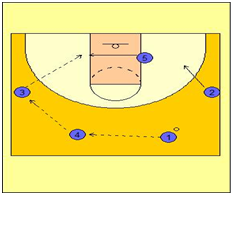
They start the offense in the most vanilla of ways. Ty Lawson dribbles up one side of the floor. The ball is reversed to the opposite site and Hansbrough who attempts to seal his defender to shoot his little turn and shoot 2-footer off the glass.

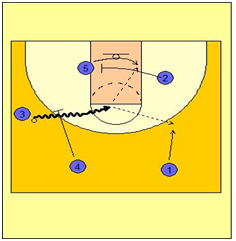
Basketball PlaysIf they are unable to get the ball into Hansbrough because of a fronting defense or so, O4 comes to set a ball screen for O3 on the wing (O4 usually isn’t so high after the ball reversal). O2 sets a cross screen for O5 who goes under the screen while O3 comes off the ball screen shoulder to hip. If O3 can shoot the 3-pointer, he does so. Otherwise, O3 should drive into the middle of the floor, Hansbrough should be right underneath the basket if X5 goes to help on penetration. O1 has shuffled to a spot on the top of the key, this is also where a lot of 3-pointers happen as the defense collapses on the penetration.

Basketball Plays

Finally, if O3 is unable to do any of the above, they go with a screen the screener action with O4 setting a down screen for O2 coming up to the wing. O3 can hit O2 for the 3-pointer (usually Ellington). O3 cuts opposite wing-corner. If all else fails, O3 passes back to O1 and then UNC runs their true motion offense.


The UNC secondary break is exceptionally simple, yet when executed properly, it is very hard to stop as we’ve seen the past several years with UNC. Getting the ball into the post early on, and shooting well from the perimeter are obviously crucial.


The Coaching Toolbox has hundreds of resources for coaching basketball including basketball practice, basketball plays, basketball drills, basketball quotes, basketball workouts, basketball poems, and more!
Great Coaches

By Brian Williams on September 28, 2011

This list is reprinted with permission from Alan Stein. Alan is now with Pure Sweat Basketball and is still a great giver to the coaching profession.

    1. Great coaches… promote shared ownership and internal leadership of the team. They create a ‘team’ attitude.
    2. Great coaches… have their players keep a notebook with plays, motivational quotes, and facts about the program’s history.
    3. Great coaches… are teachers of the game at their most fundamental level.  They teach basketball; they teach life lessons.
    4. Great coaches… love the game; respect the game.
    5. Great coaches… work on their craft every day. They work on the X’s & O’s, strategy as well as on leadership.
    6. Great coaches… establish roles on the team.  They clearly define these roles to everyone in the program.
    7. Great coaches… objectively analyze a player’s strengths & weaknesses and find ways to utilize their strengths and minimize their weaknesses.
    8. Great coaches… have high character.  They know they are in the business of leading by example and developing young men & women for life.
    9. Great coaches… praise the behavior they want to see repeated and discipline the behavior the want to see eliminated.
    10. Great coaches… don’t have ‘favorites.’ They care about all of their players and are objective when deciding roles and playing time.
    11. Great coaches… treat every player fairly, but not equally. They know some players ‘need’ more than others.
    12. Great coaches… get everyone on the team to accept their role and fulfill it to the best of their ability.
    13. Great coaches… are always prepared. They study film, scouting reports, and design practice plans accordingly.
    14. Great coaches… listen to their assistant coaches and to their players.  They don’t feel threatened and they welcome suggestions.
    15. Great coaches… don’t over coach. They don’t talk to hear themselves talk, they talk to make a point, to teach, and to motivate.
    16. Great coaches… coach in ‘bullet points’ during practice – they keep the action flowing! They keep instructions short and sweet.
    17. Great coaches… coach players; not a system. They know it’s not what you run, but how well you run it that matters.
    18. Great coaches… know that basketball isn’t just about offense and defense. It’s also about effort and execution.
    19. Great coaches… pay attention to detail. They know that everything regarding their program is important. Everything makes a difference.
    20. Great coaches… make sure everything done in practice has a purpose. Every drill has value.
    21. Great coaches… delegate to their assistant coaches and let them share the responsibility (and joy) of running a team.
    22. Great coaches… compliment their players and assistants often and with sincerity (but only when deserved; not to ‘blow smoke’).
    23. Great coaches… are THE hardest workers in their program. They set the tone. They don’t let any player/coach outwork them.
    24. Great coaches… are a spark of energy and enthusiasm.  They raise the level of everyone in their program, every day.
    25. Great coaches… are mentally tough. They don’t get flustered.  They know their mental toughness trickles down to the entire program.
    26. Great coaches… challenge their players and assistants… every day!  They don’t allow complacency.
    27. Great coaches… are the face of their program. They welcome this and represent with pride and class.
    28. Great coaches… have a clear, precise vision of what they want their team to become and accomplish.
    29. Great coaches… learn what motivates each player on the team.  They find ways to light each player’s internal fire.
    30. Great coaches… give trust and respect… and by doing so they earn trust and respect from everyone in their program.
    31. Great coaches… are 100%, absolutely, positively committed to their team in every way possible.
    32. Great coaches… create standards of excellence and hold their players and staff accountable.
    33. Great coaches… know that you can’t win every game… but you can prepare (and try) to win every game.
    34. Great coaches… set realistic, attainable goals and get everyone in the program to buy in and achieve them.
    35. Great coaches… admit when they are wrong or make a mistake.  They are humble.
    36. Great coaches… love to coach and have fun coaching… it is who they are!
    37. Great coaches… are confident without being arrogant.  They believe in their team and in their preparation; but never assume they will win.
    38. Great coaches… don’t worry so much about what their opponent is going to do; but instead focuses more on what their team is going to do.
    39. Great coaches… know… ‘it ain’t about me; it’s about them.’ (referring to their players)
    40. Great coaches… don’t coach for money or fame.  They may achieve money and fame; but that is not why they coach.
    41. Great coaches… constantly make adjustments. They go into every practice and game with a plan and then adjust accordingly.
    42. Great coaches… criticize the behavior or the play; not the person.  It’s never personal.
    43. Great coaches… will help a player they coached decades ago.  Every former player is a part of their team.
    44. Great coaches… lead by example and are excellent role models in every since of the word; on and off the court.
    45. Great coaches… coach the players on their team they way they would want someone to coach their own son or daughter.
    46. Great coaches… teach the fundamentals of the game… even at the highest of levels.
    47. Great coaches… are active during practice and games. They don’t stand in one spot with their arms folded. They are fully engaged!
    48. Great coaches… are authentic to who they are and to their own personality. They don’t try to coach like someone else.
    49. Great coaches… are lifelong learners and true students of the game.  They read, watch, and listen to anything that will help them get better.
    50. Great coaches… coach what they know and what works for their program.  They seek to learn what they don’t know.
    51. Great coaches… know ‘it ain’t what I say that matters… it’s what they hear. ’ (referring to their players)
    52. Great coaches… listen for things they don’t want to hear and look for things they don’t want to see.
    53. Great coaches… coach their current team to the best of their ability. They aren’t ever looking ahead to next year.
    54. Great coaches… don’t allow themselves, their staff, or their players to get satisfied… no matter how successful they are.
    55. Great coaches… call each player by name within the first 10 minutes of every practice.
    56. Great coaches… know they get what they emphasize. They make sure they emphasize the right things!
    57. Great coaches… impact and influence lives far behind the game of basketball. Basketball just happens to be their vehicle.
    58. Great coaches… promote communication, toughness, and competitiveness in addition to fundamentals, X’s & O’s, and game strategy.
    59. Great coaches… get the absolute maximum out of every player on their team and every assistant on their staff.
    60. Great coaches… are innovators. They don’t just do things because ‘that’s how they’ve always been done.’ They create!

     
    Being a great coach takes the commitment to ‘work on your craft’ (the things on this list) every day.

    I am eternally thankful to have learned from (and continue to learn from) so many great coaches. I am honored to be a part of the coaching fraternity!

    The Coaching Toolbox has hundreds of resources for coaching basketball including basketball practice, basketball plays, basketball drills, basketball quotes, basketball workouts, basketball poems, and more!
Energy Givers

By Brian Williams on August 26, 2011

The following post was written by Coach Alan Stein on his Stronger Team Blog (Click the link to visit the blog).  It would make a great handout for your players.

You are probably aware of Alan’s work in our profession as he is one of the top basketball specific strength and conditioning coaches.  He has produced several videos and is in high demand as a clinician.  He has given me permission to put his posts and videos on the Coaching Toolbox.

Energy Givers

Every time you interact with another human being… you either give them energy (‘fill their bucket’) or you take their energy (‘drain their bucket.’).  In every instance you are either an energygiver or an energy taker.

If you want to be successful in life, you need to not only be an energy giver… you need to surround yourself with energy givers.

Energy givers make those around them better.  9 out of 10 people adamantly admit they are more productive when they are around positive people (aka ‘energy givers’).


It’s pretty simple… if every member of your program (coaches and players) is an energy giver during a workout… the workout becomes more intense and more productive by default.  Nothing else is possible!  Obviously, if you have productive workouts on a consistent basis, you will make progress.

Not everyone can be 7 feet tall. Not everyone can jump out of the gym.  But everyone can be an energy giver.  Being an energy giver is a conscious choice.  It is an attitude.

Energy givers raise the confidence of everyone they come in contact with.  Energy givers improve morale, chemistry, and performance.  Coaches and teammates covet players who areenergy givers.

Are you an energy giver?

During your off-season workouts, do you give energy by listening and being coachable? By being a supportive teammate? By being enthusiastic? By working as hard as you possibly can?

Or do you drain energy by loafing, arguing, and complaining?

If you want to stand out at your summer league games, AAU games, and camps… and really have coaches take notice… then you need to be an energy giver!

Energy givers thank their teammates for a good pass.

Energy givers help their teammates up after they take a charge or dive for a loose ball.

Energy givers cheer their teammates on when they are not in the game.

Energy givers listen to their coach with their ears and their eyes.

Energy givers communicate on defense.

Energy givers show up early and are prepared to workout, practice or play.

Energy givers always give that little extra.  And it goes a long way.

Make a conscious effort to be an energy giver… it will pay off… trust me.

The Coaching Toolbox has hundreds of resources for coaching basketball including basketball practice, basketball plays, basketball drills, basketball quotes, basketball workouts, basketball poems, and more!
Basketball Practice Checklist

By Brian Williams on August 23, 2011

Here is a list of some ideas that I have gathered from various sources to use to plan, execute, and evaluate our practices.  The list is not intended to be all inclusive for every situation, but just what has fit our programs over the years.  Feel free to add a comment below if you have ideas to add or something that you disagree with.  The list is not in order of importance.  It is helpful to me to have these types of  checklists in my planner to review both while planning and evaluating practice.

I have added in some commentary to make my checklist easier to follow.

Every Practice Checklist

1.  Every day our coaches need to be teaching our players and setting standards in a way that will make them better and tougher both as individuals and as players.

2. Our goal is to practice every day with the technique, intensity, toughness, and togetherness of a state champion.  We have that as a sign in our locker room.  I can’t say that we are even close to perfect, but I want to set our standards high.  And, I think that it makes it clear in our players’ minds that an average or ordinary effort is not what we are after and not something that we will accept.

3.  Spend 30 minutes in individual skill development every day.

4.  No purposeless possessions, drills, discussions.  If we expect that in a game, we cannot accept less in practice.

5.  Establish and make clear to the players a standard, score, or accountability measure for each practice activity.  Examples:  If it is a pre-practice meeting, the players must look the speaker in the eye, if it is a warmup layup drill, establish how many makes in a row they need to complete the drill.   Make as many drills that we can make competitive against a team record, personal record, a team standard, or another player or players.

6.  Put our players in as many situations as we can that are harder in practice than in games.  Examples two ball dribbling, 2 on 1, 4 defenders guarding 5 offense, run our offense with no dribble, second team gets double the points for each made shot are just a few ways to do that.    Our starters and others in our rotation will be playing against much better competition on game night than in practice.  Players and coaches find ways to overcome this discrepancy.  Play at a disadvantage each night.

7.  We videotape the practice and have managers keep stats that  are significant such as turnovers per quarter or defensive points per possession.

8.  Provide repetition with variety.  We want to practice our system and skills, but vary up the drills so that things don’t become stale.

9.  Evaluate–Is everything we do contributing to our team goals for this year?  Our goals are: daily improvement, being the toughest team on our schedule, making the year the most rewarding of each player’s basketball experience.

10.   The emphasis should be on what’s important. 20% of the activities bring about 80% of the results.  Take into account what the individuals and the team needs to improve on and what we need to keep sharp.

11. We emphasize communication in everything.

12.  I do not want a practice with purpose, not one that moves so fast that we are are not making any improvement.  I want one where teaching and learning is constantly taking place.  The process must be one where the players learn and then can react quickly and properly in games.

13. Players slap five at the end of practice and shake coaches hands before leaving the floor.

14. Huddle up to start and end practice

15. Play and teach basketball, don’t just run drills

16. Play until the whistle in everything

17. Conditioning (psychological and physical)

18. Experiment with new ideas, drills, sets, etc.. a couple of times each week.

19. Practice is about Skill Schemes, Conditioning/Toughness (Mental and Physical), Our Program’s Way.

20. End on a positive note. Players slap 5 and shake hands before leaving the floor.

Click here for  information on the complete (and to download the first chapter for free) basketball practice e-book
“130 Great Ideas to Get a Lot More Accomplished in Practice”

The Coaching Toolbox has hundreds of resources for coaching basketball including basketball practice, basketball plays, basketball drills, basketball quotes, basketball workouts, basketball poems, and more!

Kevin Eastman Notes

By Brian Williams on August 5, 2011

Kevin Eastman Clinic Notes – sent from Luke Wicks at U San Fran

I received these from Steve Smiley.

Sneakers Squeak on 5 on 0 Offense
-No such thing as Dummy Offense

Fist Fight to get Open – Foot Fight to Score

Offensive Post Teaching Point – On the Block/Off the Block I agree
– Pause for Poise
– Let the Crap Clear
– Always Add Free Throws to Post Work!


Cutters:
– Cutters Over the Top = Touch Elbow, Touch Rim, Open to See and Get Out to Spacing
– See Ball All the Way to the Rim
– Cutters: Eyes Make Lay Ups….Feet Make Jumpers
– Shooting Teaching Points: Coach the Beginning (Footwork) and End (Follow Thru)

Running Team
– Fast Break or Sprint Break?  Sprint is Faster

Do U Look at the Ball or Do you See the Game?

Main Keys to Shooting
– Shot Selection
– Being Ready on the Catch
– Game is played Low to High

The Floor Shrinks with each Level!
– Speed, Quickness and Length cause this.
– Got to go by your Defender…not around him
– Must Introduce Players to their Feet – Pete Carill

Ball Screen Offense
– Ball Handler: Feel Him (Defender) – See His (Show Defender) – Read Help

Best Offensive Players have ball in hand as long as they need to…not as long as you want to.

Post Players: Only Give up Position for Possession.
– Dead Dribble = Post Player Bring Baseline Foot Up to Create Passing Angle

Shooters on Pin Down – Point Fist at the Passer
– Stop and Go
– Step on Foot

Don’t Post Up….Post Across
– Mini Lane!  Post Up in Mini Lane (We have to tape it on the Court)

The Best Post Players Own the Mid Line

Ball Screener
– Goal is to Arrive without your Defender

Shooting Turnovers = Bad Decision Shots

What Happened the Last 3 Possessions?
– Good Ones Love the Game and KNOW!
– Boston Charts Touches!

The Play may be Yours….but the Shot may not!!

Rebounding Logic…more u go after…more you get.
– Coaches never yell at you for being selfish with ur rebounding.

What 3 Things do we have to do to win this game
– PG’s
– Wing’s
– Posts

Vs. Great Shot Blocker!
– Follow the Penetration when the Shot Blocker Goes after it.

Best Shooters: Ten Toes to the Rim!

Screening Rules
– Don’t Screen Air
– Unless they are Switching….don’t screen ur own man
– Don’t screen ur own teammate.

Touch Right Shoulders (Both) – 2 guys coming off Floppy

A Scorer has a Great Responsibility to make Great Decisions

Vs. Switches
– Cut with Speed

When in Doubt…Spread Out
– Smalls get outside the 3
– Bigs: Home Base = Short Corner? High Post?  Where are they comfortable?

Go To Guys can’t turn into Force It Guys!

Direct Correlation to Ball Reversals and Defensive Breakdowns.

No Dancing!  Is Isolation And 1 Mix Tape BH…Have to Stress “We Want Direct Drives!!!”

Someone Violates Culture
– Winning – Personal Sacrifice – Accountability
– Any Violation must be addressed IMMEDIATELY

Championship Teams have Truth!
Truth = Live it, Tell it, Take It

BC always emphasizes: Best Position to Score….the Weakside of the Floor!

Force teams to be in Constant Closeouts!

Best place to back door…the Corners!

Read the Head…Read the Depth (Corner Back Door Cut)

Double Bury Him – Post Players

Green Light….really a Lime Light.

Cutter’s Responsibility is to get Open…Screener’s Responsibility is to get Cutter Open!

Design you offense based on Skill Set.

The Coaching Toolbox has hundreds of resources for coaching basketball including basketball practice, basketball plays, basketball drills, basketball quotes, basketball workouts, basketball poems, and more!

  • « Go to Previous Page
  • Page 1
  • Interim pages omitted …
  • Page 4
  • Page 5
  • Page 6
  • Page 7
  • Page 8
  • Interim pages omitted …
  • Page 25
  • Go to Next Page »

Primary Sidebar

  • Twitter
  • Facebook
  • Linkedin
coachestoolbox
personaldevelopmenttoolbox
basketballplayerstoolbox
basketballtrainer
athleticperformancetoolbox
coachingbasketball

© Copyright 2026 Coaching Toolbox

Privacy Policy