
• Skip to primary navigation
  • Skip to main content
  • Skip to primary sidebar

  • Basketball Plays
    • Ball Screen Sets
    • Horns Sets
    • Man to Man Post Up
    • Man to Man Isolations
    • Backdoor Plays
    • Man to Man 3 Point Shot Plays
    • 2-3 Zone Attack
    • Baseline Inbound Plays
    • Sideline Inbound Plays
    • Combination Defense Attack
  • Drills
    • Defensive Drills
    • Offensive Drills
    • Competitive Drills
    • Passing Drills
    • Rebounding Drills
    • Shooting and Scoring Drills
    • Toughness Drills
    • Transition & Conversion Drills
    • One on One Drills
  • Blueprint
  • Practice
  • Mental Toughness
  • Skill Development
  • Offense
  • Defense
  • Store

Filing Cabinet

Coaching Basketball: 5 Signs of Toxic Leadership

By Brian Williams on December 3, 2014

This article was submitted by Quinn McDowell, founder of Arete Hoops. Quinn played basketball at Archbishop Moeller High School (Cincinnati, OH), 4 years at the College of William and Mary, 1 season in the NBA D-League, and 2 years as a professional in Australia.

Arete Hoops is dedicated to helping people of various ages, backgrounds, skill levels, and athletic goals pursue excellence in and through the game of Basketball.

You can read more of his articles at this link: AreteHoops

I hope you can use some of these thoughts as a different voice to share with your players.

5 Signs of Toxic Leadership

The well known author John Maxwell defines leadership as nothing more than one person influencing another. This definition gives us a singular focus when thinking about leadership in the context of a team dynamic. The idea that leadership is primarily influence, forces us to accept the notion that no one is exempt from the responsibilities that leadership requires.

Although certain players will exert more influence than others, every person on a team contributes to the culture of their program. If the entire team buys into a common vision of leadership that exerts a positive influence on those around them, the results can be amazing. On the other hand, if players decide to use their influence for selfish ends, the results can be toxic. Bad leadership spreads quickly and has devastating potential; but if you recognize the warning signs early enough, you can help save your team from self-destruction. Leadership is contagious whether positive or negative, so here are 5 signs that your team could be experiencing a turn for the worse…

1. Gossip

Gossip destroys trust and undermines team cohesiveness and togetherness. One of the most important strengths of great teams is their ability to insulate themselves against negativity. The only way teams shield themselves from outside influences is draw close and lean on each other during the inevitable ups and downs of a season. This “drawing close” process becomes difficult when players gossip about fellow teammates or coaching decisions. If a player has a problem with another player or is unsure of their role on the team, the mature way to handle these kind of doubts is to speak directly with the coach. Once the coach is involved, everyone can get on the same page and figure out a solution. Gossip is the cowardly way to handle tough situations and gossip destroys team chemistry.

2. Pouting

One of the signs of great leaders is their ability to celebrate team success despite how they perform individually. Of course it is easy to be happy about a victory when you score a lot of points, grab a bunch of rebounds, or dish out a number of assists. But the true test of great leadership is the ability to be genuinely excited about team accomplishments when you didn’t have your best game. Toxic leadership can start in the locker room after a big win when a player starts to pout because of a poor individual performance. This kind of pouting sends the message that MY
performance on the floor is what really matters and team success is secondary.

3. Poor Body Language

Your non-verbal communication as a leader is incredibly important. It communicates you’re feelings and shows the value of your priorities. For example, poor body language on the court after a teammate makes a mistake communicates a message of disgust and annoyance with that person. You are essentially telling that teammate, “I wish I had another player on the court with me who could play the right way”. This kind of communication coming from a prominent leader makes other teammates feel insecure and unsure of themselves on the court. Uncertainty leads to hesitancy which compounds mistakes and leads to poor team chemistry.

4. Negative Reaction to Adversity

There will come a point in every season when your team will have to respond to adversity. How these moments are handled by your leaders will set the tone for how the rest of the team responds in difficult circumstances. Your team might be losing to an inferior opponent and your leaders will have a choice to either blame the poor performance on someone (usually a coach or teammate), or take responsibility and figure out a way to improve the situation. Another example could be when the coach subs out a player during a tense moment in the game; how that player reacts to the coaches decision is important. The player can either sulk to the end of the bench consumed with selfish thoughts, or they can turn their frustration into positive energy and cheer their teammates on. Both reactions communicate specific messages to teammates and coaches. Toxic leaders tend to be consumed with their own predicaments are prone to have negative reactions to adversity.

5. Martyr Complex

The last sign of toxic leadership, is when players start believing (and telling anyone else who will listen) they are martyrs or victims. Whether it is coaching decisions, bad calls by the referees, unfair playing time, injuries, or incompetent teammates, leaders that adopt the martyr complex bring a dangerous presence to team dynamics. If players start to believe that someone else is the primary source of their problems, this creates a culture of entitlement and laziness. Rather than looking in the mirror and figuring out how to improve, martyrs look at their circumstances and blame others. Martyrs will never put up a fight in the heated battles of competition; but instead will take the path of least resistance.

You can read more articles by Quinn McDowell at this link: AreteHoops
33 Basketball Coaching Points from Bob Knight

By Brian Williams on November 25, 2014

These bullet points from Coach Bob Knight are a part of Alan Stein’s 12 pdf Basketball Coaching Nuggets Collection.

No matter what your opinion of Coach Knight or of these points, (Or any coach for that matter), there are still some good points you can adapt and make your own. Certainly there are some points that you don’t agree with, but hopefully some you can use!

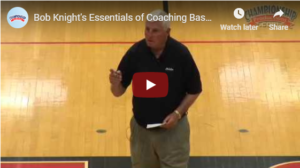
Also included in the list is a short video of Coach Knight giving an explanation of one of his points on timeouts.

  1. “The single most important aspect of coaching is running effective practices.”
  2. “The goal is to make practice more difficult, physically and mentally, than anything your players will face during a game.”
  3. “I always designed my practice plans the night before and then made tweaks a few hours before
    practice began.”
  4. “I never let a player shoot by themselves; they had to have a rebounder. Shooting by yourself is not
    game specific.”
  5. “I hate casual shooting. EVERY shot must be preceded by working to get open and catch and shoot
    under game like conditions.”
  6. “Everything in my practices were designed for advantage vs. disadvantage. Putting players in a
    disadvantage forces them to communicate and concentrate.
  7. “I began every practice for 40 years with simple 4 corner passing drill that required absolute
    concentration.”
  8. Coach Knight to player, “Son, if you can’t listen and follow instructions then you can’t play.”
  9. “My practices were not set up to be easy or enjoyed.”
  10. “The shot fake is the least used skill on offense. Why would you ever shoot under pressure? An
    effective shot fake creates an offensive advantage.”
  11. “We did partner shot fake drills for a few minutes every practice.”
  12. “Offensively, stay away from the baseline. The baseline is the best defender in the game!”
  13. “What is the best thing you can do in a close game? DRIVE to the basket and put pressure on the defense! Not jack up jump shots.”
  14. “Driving to the basket creates easier shots, better passing angles, and puts the other team in foul trouble.”
  15. “90% of all defensive fouls are committed with the hands. We do several drills every practice with the
    players’ hands behind their backs.”
  16. “Defense should be played with your feet and your brain, not your hands.”
  17. “Every drill we do involves full court transition. Even if we are working on half court offense, the defense will go in transition after a rebound or made shot.”
  18. “Basketball is a full court game, so every drill must be done full court.”
  19. “At any point during practice, call a timeout. Huddle the players and give them 4 or 5 specific
    instructions. Then send them back on the court. Wait 15 seconds and then ask them to write down the
    4 or 5 things you asked them to do. It is scary how little they will recall.”
  20. Click the play arrow and make sure your sound is on to watch the video. If you are interested in learning more about the basketball coaching DVD that this sample came from, click this link: The Essentials of Coaching Basketball

  21. “Players must be able to carry out simple instructions from the bench to the court. If they can’t, then
    they can’t play.”
  22. Defense 101: “When the ball hits the floor, defensive help is mandatory.”
  23. “Shoot FT’s at scheduled intervals during practice, not before/after. Do it when they are tired. Add
    pressure to every FT (run sprints, etc.).”
  24. “First stat I look at after the game–did we make more FT’s than our opponent shot? If so, we usually
    won.”
  25. “Every halftime, find something the team needs to improve. Also acknowledge something they did well.”
  26. “From October to Christmas break, our practices were 2 hrs and 15 min. Every practice after that was 1 hr 15 or 1 hr and 30 min tops.”
  27. Offense 101: “Move the ball against the zone. Move players against man to man.”
  28. Offense 101: “Passing is your best weapon against man to man. Dribble penetration is your best weapon against zone.”
  29. “When playing vs. man to man, the defense decides who guards who. When playing against zone, the offense decides who guards who.”
  30. “Pass fakes make the zone move. Use them!”
  31. “Screening is the most underutilized, yet most effective weapon an offense has.
  32. “The toughest offense to guard is one that has 5 players constantly moving. 5 players that must be guarded.”
  33. “Don’t complicate winning.”
  34. “More games are lost my dumb than are won by smart.”

BD-04483-Geno-Auriemma-and-Bob-Knight-Learn-from-the-Legends-Series-653

You can see find more information about the Learn from the Legends Basketball Coaching Series featuring Bob Knight and Geno Auriemma DVDs by clicking this link: Learn from the Legends. The entire series consists of 6 DVDs and can be purchased at a special bundle price at this link” Learn from the Legends

Coaching Basketball True Shooting Percentage

By Brian Williams on November 14, 2014

This article on True Shooting Percentage (also known as True Scoring Percentage)  is a follow up to the Effective Field Goal Percentage Post from a few weeks ago.

With it being clear that the most efficient ways to score in order are:
(I would define “efficient” as the highest probability of scoring from each of these opportunities)

  1. Free Throws
  2. At the basket–restricted area in college and pros, same area in high school even if not marked
  3. 3 point shot
  4. Midrange two point shot

Yes, you have to play to your strengths,  But if you can’t find ways to get to the free throw line, score at the basket either in transition, through driving the ball to the basket, cutting to the basket, or via a low post game, and make a competitive percentage of 3 point shots for the level your team plays, you probably won’t win a lot of games.

Effective Field Goal Percentage takes that 2 point 3 point imbalance into account.

However, if in one game:

Player A makes 2 for 2 from the line, and has an Effective Field Goal Percentage of 58%.

Player B makes 2 for 6 from the line, and has an Effective Field Goal Percentage of 58%.

True Shooting Percentage (TS%) is a measure of a player’s individual points per shooting possession, which would distinguish between the two players in the above example. It takes into account scoring efficiency by combining three point shots, two point shots, and free throws. It effectively measures a player’s scoring productiveness based on opportunities to score.

It does not account for times the player turned the ball over. Adding turnovers into the formula gives you a way to look at individual points per possession completed. I have detailed that later in this article.

This is not to say that a player’s overall value at the offensive end can be measured by this formula. Certainly there is value for players who are the primary ball handlers, get other players open through screening and spacing, are offensive rebounders, and hockey assisters.

True Shooting Percentage merely gives you data on which players are the most efficient producers of points for your team when they shoot the basketball either from 3, 2, or the free throw line.

The battle we face is balancing between obtaining stats that are actually significant and at the same time are easy to calculate. Points per shot is easy to calculate, but does not correlate to an efficient offensive performance. True Shooting Percentage is difficult to calculate, but it is the best way to determine who your most efficient scorers are because it accounts for free throw efficiency as well. TS% is actually more of a scoring efficiency ratio rather than a percentage because it measures points produced compared to the number of possessions that player used to score those points.

The formula for True Scoring Percentage is

TS% = (Points/2) / [FGA + (0.44 * FTA)]  Each of these numbers is included in your post game statistical summary and could easily be put into a spreadsheet.

FGA = Total Field Goal Attempts including 2 point shots and 3 point attempts
FTA = Free Throw Attempts

The formula in words is:

Take the points a player scored and divide it by two and get a number.

Multiply the Free Throw Attempts by .44 and add it to the total field goal attempts (2s and 3s) and get second number.

Divide the first number by the second to calculate true shooting percentage.

The rationale in dividing the points by two is that by doing so, it effectively makes each three point shot made worth 1.5 points.  Dividing by two also makes each two free throws made equal to one two point basket made.

One free throw attempted is basically half a field goal attempt, so initially multiplying the Free Throws Attempted by .5 seems to make sense.  The reason that .44 is used instead is that statistical research has taken into account the old fashioned three point play of a basket and a foul where there is a field goal attempt and a free throw attempt in the same scoring possession.

Here is an example:

Player A makes 2 for 5 on 3 point shots, 3 for 7 on two point shots and 7 for 9 on free throws for a total of 19 points on 10 Field Goal Attempts.

To calculate the TS%, take the total number of points scored (19 points in this example) and divide by 2. Which is 9.5 for “the first number.”

Now, for “the second number,” take the Free Throw Attempts times .44 which is 9 * .44 or 3.96. Next add that product to the overall Field Goal Attempts (12 for the example). Your second number is 15.96.

For the Ts% divide 9.5 (The first number) by 15.96 (The second number) which yields: .595. That is an outstanding TS%. You will need to do some crunching to see what is good for your team and level of coaching, but .5 or better is usually very good and near .6 is a great offensive game. As a reference, the NBA/ABA lifetime leader is Cedric “Cornbread” Maxwell with a lifetime TS% mark of .6294 for his 11 season NBA career.

I do realize that the stat will be a little off if the player does not have a 3 point play, but I still feel it is a much more accurate assessment to use to determine how efficiently your scorers are performing that Points per Shot or using Two Point Field Goal Percentage, Three Point Field Goal Percentage, or Overall Field Goal Percentage. Our most valuable scorers both get to the line and make their free throws in addition to shooting a high percentage from the field. TS% corrects that flaw in the other metrics.

Individual Points Per 100 Possessions (aka Scoring Efficiency)

Another way to look at offensive scoring productivity is to consider using individual points per possession.   Most of us look at Offensive and Defensive points per possession as one way to measure team efficiency.  I believe that individual points per possession (or per 100 possessions, however you look at it) is a way to measure a players scoring contribution.

I am not in any way saying that scoring is the only way to measure every player’s offensive contribution.   There is absolute contribution in passing, screening, cutting, spacing, offensive rebounding, and sureness with the basketball.  All of those skills are critical, but only serve to create opportunities to score.

What I do believe is that total points scored is not the best way to measure a player’s scoring contribution.  For every turnover made and every shot and free throw a player misses, that is taking an opportunity away from someone else to score.  While it is true that you can’t score if you don’t shoot, it is also true that you won’t score enough to win unless your best scorers are getting the most opportunities to score.  This is a way to consider as using as one tool when you make that evaluation.

In place of or in addition to the formula above, consider determining the number of possessions that a player ended for your team as:

The number of shots they took, plus the number of trips (not free throw attemps) to the free throw line, plus the number of turnovers to determine the number of possessions that each player finished.

Take the number of points divided by the number of possessions for each player

In my opinion, a player with a lower than 1.0 ratio is hurting the team at the offensive end unless there is absolutely no one else on the team that has scoring skills.  So, for example, in most instances, even a 29 point game would not be a good performance for the team, if it required 30 possessions to attain.  Something such as 19 shots, 7 trips to the line, and 4 turnovers (or any other combination of 30

No one metric or opinion should be the sole deciding factor of how to play.  It takes a staff and as many meaningful pieces of data as you can get.  These ideas are submitted as ideas to consider using as more pieces of information as you work to develop your and evaluate your offensive system.


Establishing Player Roles and Soliciting “Buy in”

By Brian Williams on October 28, 2014

These articles were written and submitted by retired High School Basketball Coach Dave Millhollin.

Coach Millhollin is known throughout the Sacramento area for his Boys Varsity teams’ fundamental soundness, discipline, unselfishness, team defense and overachievement. Dave Coached for 27 seasons and compiled 391 wins. I have included more information about his coaching career at the end of the article.

If you would like to contact Coach Millhollin, email me and I will put you in touch with him.

Article #1 Loyalty and leadership

Two types of loyalty; (one genuine, one obligatory):

Freely given type (genuine loyalty):

This kind of loyalty is given to a caring authority by members of the group based on trust.  The authority figure expects results for the benefit of the institution as well as the group and all of its members. Group members are valued and recognized for exceptional performance. This creates an environment where group members want to produce expected results; they feel like they are working with their leaders.  A culture of shared accountability exists and leaders are respected.

Demanded type (obligatory loyalty):

This kind of loyalty is taken from members of the group by a demanding authority using intimidation and manipulation based on creating fear.  The authority figure expects results for institutional or selfish reasons.  The purpose of the group’s members is to serve the authority and the institution. Group members are taken for granted, they feel like they are working for their leaders and they are afraid of consequences for sub-standard performance. A culture of top down authority based accountability exists and leaders are often resented.

Which kind of loyalty do you want for your program?

What kind of leader and authority figure do you want to be?

Article #2 Establishing Players Roles and Soliciting “Buy-in”

First of all remember you as the head coach will decide what players make your team each year and what role each player will be assigned.

During the “off season” (spring through fall) when playing off season games is legal (make sure you are not breaking any rules) try to expose your players to as much philosophy and technique stuff as you can. Use this time to INDOCTRINATE your team. Let them know what your standards and expectations are and try to solicit as much “buy in” and acceptance as possible.

GET TO KNOW YOUR PLAYERS: Observe, scrutinize and evaluate each player during this time while trying to develop a rapport and healthy player/coach relationship with each of them at the same time.

Then, either during summer team camp or sometime in the fall or at the beginning of your season, go through the following process:

Your first priority is to identify the potential “cancers” on your team and the players you can’t trust. Any prospective players that are like this that you do not think will be able to change – should not make (or be near) your team.

Secondly identify your “leaders” and your “workers”.

You should select the team based on each player’s ability to trust and be trusted, real desire to win, willingness to work and take direction and UNSELFISHNESS.

Once you have your group identified (you do not have to have your final cuts made, but you should basically know who you want on your team) by now you should know what each player can do and what basic roles you think each player should have, but………Don’t hand out or discuss roles just yet.

At this point turn the attention of your players toward the things they (as a team) want to accomplish during the upcoming season and ask them to consider what reputation and identity they want to have.

With your guidance and manipulation, make, edit and finalize two lists with the group;

  1. A list of what the team wants to accomplish (goals) and be known for (reputation or identity)
  2. A list of what is going to be necessary to accomplish the goals and establish the stated reputation

Each player gets a final copy of both lists

The next step is to have each individual make a list of three things they are willing to individually sacrifice in order to help the team achieve its goals.

As the coach, you know what you need each player to do –individually— and you know what role you need each player to have in order for your team to be successful.

So it is after all this and in the context of the “team” that you get down to distributing individual player roles. Each player role is going to be predicated on affecting the goals of the team (winning).

Visit with each player individually, have them bring the goals and what’s necessary lists as well as their individual sacrifice list to the meeting (three lists).

Look over and discuss the individual sacrifice list with each player, then make the statement something like this: “In order for us to accomplish our goals this season; this is what we need you to do…….This is what we need your role to be…….   Take the time to thoroughly go over each player’s role with them, answer their questions, make any necessary adjustments and be very clear what the expectations are and how important it is for the team that their role is carried out to the best of their ability. After you are satisfied that the player understands and is committed to his/her role – ask for another list of three things that he/she is willing to commit to that will help their team achieve its goals. Let them know that each of their teammates will see and hold them accountable to their list.

This list gets printed up and distributed to each player. All players must understand and appreciate not only their own role, but the roles of each of their teammates as well. They can hold one another accountable.

You want to create an environment where it is not the comparison of roles that is important, but the execution of each role. Each player’s value should not be defined by the role they get but rather on how well they perform their roles. Everyone gives and receives credit and criticism as necessary and the goal is accomplishing the team goals (winning).

Individual accomplishment and recognition is accomplished in the context of unselfishly committing to the goals of the team. Each player aligns his personal goals to the goals of the team.

About the author of this article, Coach Dave Millhollin In fourteen years at Ponderosa High School, Coach Dave’s teams won 260 games (.665). From 2000 through 2009 Ponderosa won 207 games over a ten year stretch which included four SVC Conference Championships and two CIF Section final four appearances. Over his 27 year Boys Varsity Coaching career, Coach Dave posted 391 wins, produced 20 college basketball players and was named SVC Coach of the Year four times. At Ponderosa, Coach Dave’s teams were #1 in California in team defense five times and in 2008 Ponderosa was the top defensive team in the Nation among shot clock states. Over Coach Millhollin’s last five seasons (2005-6 through 2009-2010; 136 games) Ponderosa averaged a composite 50% total field goal percentage, 58% two point field goal percentage and 32% three point field goal percentage. Since retiring from High School coaching in 2010, Coach Dave has been actively involved in coaching Jr High level School and AAU teams as well as and running instructional basketball clinics from the primary grades through the College level.

Effective Field Goal Percentage

By Brian Williams on October 15, 2014

Brian Williams, The Coaching Toolbox.

Statistical analytics is playing a much bigger role in basketball at all levels and I think is going to continue to play a bigger and bigger role in how coaches evaluate their teams in both games and practices, how they develop their systems of play, and how they scout and prepare for upcoming opponents.  Here is one thought on having a more useful statistic than straight shooting percentage.

I used to look at a player’s scoring effectiveness as being ineffective if they did not score at least one point for each field goal attempted.  Defensively, we felt that if we held the other team’s top scorers to less than a point a shot, we had a great chance to win.  That also meant that we were not fouling and they were not getting to the line.  One of our player’s (who is now a coach by the way) said that when using this method of evaluation, free throws made were “extra credit” because they didn’t count against the shots taken..

However, that criterion was not very effective in evaluating our team’s performance.  If a player that was not one of our top scorers, or one who didn’t get a lot of playing time, took 4 field goal attempts, he needed to score at least 4 points to not be a negative for our offense.

But, I didn’t like it to measure our leading scorers. If our leading scorer took 18 shots and scored 17 points, that met the criteria that he wasn’t “hurting the team”, but that performance was not going to win against quality opponents.

Here is one stat that I have found to be much more useful in evaluating who are our most efficient scorers from the field.

EFFECTIVE FIELD GOAL PERCENTAGE

I first read about Effective Field Goal Percentage in Dean Oliver’s Book “Basketball on Paper: Rules and Tools for Performance Analysis”

In my opinion, when looking at statistics, Overall Field Goal Percentage is not a useful statistic to judge your player’s shooting efficiency since it combines both two and three point shots to calculate the percentage.  Individual two point percentage and individual three point percentage will tell you how a player does at both ranges separately.  But, to get a comparison of how effective a player is who shoots mainly twos compared to a player who shoots mainly threes is the old apples to oranges comparison.

What you really want to know is: Who is producing the most points for your team for each shot that they take.

To accomplish that, Effective Field Goal Percentage is a more useful statistic than Overall Field Goal Percentage to use.  Effective Field Goal Percentage counts every three point shot made as one and a half makes since each three point shot scores one and a half times the number of points that a two point shot does.  It provides for a more level comparison for which players are scoring the most efficiently from the field. 

It gives you a scoring percentage as opposed to a “shots made” percentage.

The formula for effective field goal percentage is:

eFG% = (2FGM + 1.5*3PFGM)/FGA

2FGM = Two point field goals made
3FGM = Three point field goals made
FGA = Total field goals attempted (including both two and three point attempts)

In words, multiply the 3 point field goals made by 1.5. Then add the two point field goals made.  Take that total and divide it by the total number of field goals attempted (both 2s and 3s) to determine the Effective Field Goal Percentage.

Again, The reasoning used for multiplying three point shots made by 1.5 is that each one counts as one and a half as many points as does a two point shot.

Here is an example.  A player is 4 for 9 on 3 point attempts and 5 for 10 on 2 point shots.

4 three point shots made * 1.5 = 6.  Then, add 5 for the two point shots made which gives us a total of 11.  Divide that by the total number of field goal attempts which was 19.  The Effective Field Goal Percentage is 11/19 = 57.9%.

The player’s Overall Field Goal Percentage is 9 shots made on 19 attempts which is 47.4%.  In my opinion, that percentage is deceiving as to how much that player really helped your team from the field.

A  player shooting only two point shots and no threes would have to shoot 58% to be more “effective” from the field than the player in the example.

The first few times I looked at Effective Field Goal Percentage (EFGP), it was a little confusing (and my undergrad degree is in math J ), But after looking at it closely, it made more sense as a measure than the traditional overall field goal percentage.  It allowed me to compare how well we were scoring from the field and which players were the most effective from the field.

I will have another post soon that will detail “True Scoring Percentage” which is a stat that takes into account a player’s ability to get to the line and score, combined with scoring efficiency from the field.

Coaching Basketball Choosing Your Team

By Brian Williams on October 7, 2014

This article was written and submitted by retired High School Basketball Coach Dave Millhollin.

Coach Millhollin is known throughout the Sacramento area for his Boys Varsity teams’ fundamental soundness, discipline, unselfishness, team defense and overachievement. Dave Coached for 27 seasons and compiled 391 wins. I have included more information about his coaching career at the end of the article.

If you would like to contact Coach Millhollin, email me and I will put you in touch with him.

Things to consider when choosing your team

The two most important questions you have to answer:

  1. What do I want our team to accomplish this season?
  2. How is who I keep and how many guys I keep going to affect what our team accomplishes this season?

The next two most important questions are:

  1. What players do I keep?
  2. How many players do I keep?

Questions to consider in deciding who makes the team and how many guys to keep;

What guys can I count on when things get difficult; when we hit a losing skid or when we have to get “tough” with our players? If I do not want them in the “foxhole” with me, I do not want them on my team!

What players will keep “team business” from leaving the locker room?; What players can I trust?

What guys will be best able to “buy in” to the team concept and commit to our team’s goals?

What number of players should I keep that will most likely insure that we have complete player “buy in” to our team’s goals? and; what # is too many?

Would I rather have a player and his parents disappointed at the beginning of the season over not making the team or upset throughout the season because he is (or they are) not happy with his role and playing time? Remember; disappointed players and selfish players are not able to “buy in” to the team concept or the team’s goals and disappointed people always find one another!

What players will be able to accept their roles as “role players”?

What players are going to make the best “practice players”?

How many guys am I going to realistically be able to play each game?

How am I going to feel in late January about who I kept and how many I kept?

Do I want to spend my time this season figuring out how to win games, teaching my team how to win and on player and team improvement…..

Or

Do I want to spend my time trying to figure out how to divide up the playing time in order to satisfy individual desires of players and parents?

Most coaches first select 7 or 8 guys they believe are going to play the most. Then they figure out how many guys they want on their roster (normally 5 or 4 more guys). Then they decide which “depth players” are going to make the team, “Depth players” are critically important!

The parents who drive coaches away or get them fired are almost always parents of “depth players”.

If your “Depth players” and their parents are sincerely supportive, you will probably have a good season!

Team selection will be the single most important decision you make each year.

© Dave Millhollin

Editors note from Brian at the Coaching Toolbox:  I developed a document to use during tryouts to help clarify each prospect’s thinking on what their role will most likely be for the upcoming season.  I check where I have the prospect rated and then ask him to check what he would be happy accepting.  I use it as a tool to select the squad and then as documentation if needed later in the season.  You can download it here: Coaching Toolbox Prospect Sheet

Also, here is a link from Quinn McDowell of Arete Hoops that you might consider sharing with your prospects on being prepared for a basketball tryout: 10 Tips for Your Next Basketball Tryout

About the author of this article, Coach Dave Millhollin In fourteen years at Ponderosa High School, Coach Dave’s teams won 260 games (.665). From 2000 through 2009 Ponderosa won 207 games over a ten year stretch which included four SVC Conference Championships and two CIF Section final four appearances. Over his 27 year Boys Varsity Coaching career, Coach Dave posted 391 wins, produced 20 college basketball players and was named SVC Coach of the Year four times. At Ponderosa, Coach Dave’s teams were #1 in California in team defense five times and in 2008 Ponderosa was the top defensive team in the Nation among shot clock states. Over Coach Millhollin’s last five seasons (2005-6 through 2009-2010; 136 games) Ponderosa averaged a composite 50% total field goal percentage, 58% two point field goal percentage and 32% three point field goal percentage. Since retiring from High School coaching in 2010, Coach Dave has been actively involved in coaching Jr High level School and AAU teams as well as and running instructional basketball clinics from the primary grades through the College level.

  • « Go to Previous Page
  • Page 1
  • Interim pages omitted …
  • Page 6
  • Page 7
  • Page 8
  • Page 9
  • Page 10
  • Interim pages omitted …
  • Page 25
  • Go to Next Page »

Primary Sidebar

  • Twitter
  • Facebook
  • Linkedin
coachestoolbox
personaldevelopmenttoolbox
basketballplayerstoolbox
basketballtrainer
athleticperformancetoolbox
coachingbasketball

© Copyright 2026 Coaching Toolbox

Privacy Policy