• Skip to primary navigation
  • Skip to main content
  • Skip to primary sidebar

  • Basketball Plays
    • Ball Screen Sets
    • Horns Sets
    • Man to Man Post Up
    • Man to Man Isolations
    • Backdoor Plays
    • Man to Man 3 Point Shot Plays
    • 2-3 Zone Attack
    • Baseline Inbound Plays
    • Sideline Inbound Plays
    • Combination Defense Attack
  • Drills
    • Defensive Drills
    • Offensive Drills
    • Competitive Drills
    • Passing Drills
    • Rebounding Drills
    • Shooting and Scoring Drills
    • Toughness Drills
    • Transition & Conversion Drills
    • One on One Drills
  • Blueprint
  • Practice
  • Mental Toughness
  • Skill Development
  • Offense
  • Defense
  • Store

Filing Cabinet

10 Thoughts for Beginning Coaches

By Brian Williams on April 15, 2015

I found this on Alan Stein’s Stronger Team Blog. It was originally written by Coach Jim Burson (www.JimBurson.com).

Preface: Having coached for 40 years and looking back to those beginning times, I wish that I had had an article that would warn me of some of the pitfalls that were ahead of me.

However, at the time, I am pretty sure I wouldn‘t have read it and if I did, I would have thought that none of it applied to me.

However, I think these thoughts can be useful for any coach.

1. Not every player will be interested in every practice.

No matter how much experience you have or how great you are at teaching, you will encounter times in the gym when players are just not interested. Don‘t give in to the temptation to scold or yell. Instead, try changing your tone of voice. Try moving around. Try both. You can even switch from talking to a physical activity, like a scrimmage. The process of the scrimmage may increase the players‘ understanding and, possibly, their level of interest. Teach them anyway.

2. If a practice is going badly, stop and regroup.

Even if you have planned a detailed practice and have a clear goal in mind, if your approach is not working – for whatever reason – stop! Regroup and start over with a different approach, or abandon your planned practice entirely and go on to something else. Afterward, be honest with yourself as you examine what went wrong and make plans for the next day. Do it. Do it right. Do it right now.

3. Coaching will get better.

Maybe not tomorrow or even next week, but at some point, as you keep at it, your job will get easier.

Do you remember your very first practice? Were you nervous? Of course. So was I. See how much your coaching has already improved? By next year you will be able to look back on today and be amazed at how much you have learned and how much more easily you do your job. The dawn alleviates.

4. You do not have to say yes to everything.

Do not feel that you must say yes each time you are asked to participate. Know your limits. Practice saying, ―Thank you for thinking of me, but I do not have the time to do a good job with another commitment right now. Of course, you must accept your responsibility as a professional and do your fair share, but remember to be realistic about your time. Learn to say no.

5. Not every player or parent will love you.

And you will not love every one of them, either. Those feelings are perfectly acceptable. We coaches are not hired to love players and their parents. Our job is to teach players and, at times, their parents as well. Players do not need you to be their buddy. They need a facilitator, a guide, mentor, a role model for learning and for character. Give them what they need.

6. You cannot be creative every day.

When those times happen, turn to outside resources for help. Coaching books, teaching guides, clinics, professional organizations such as high school associations and the NABC are designed to support you in generating well-developed practices. When you come up with your own effective and meaningful practices—and you will – be sure to share your ideas with other coaches, both veterans and newcomers to the profession. Sit at the feet of Masters.

7. No one can manage classes, students, players, recruiting, media and – oh, yes, coaching – all at the same time and stay sane.

A little multi-tasking can be good, but you must know your limits. Beware of burnout. Remember #4.
A little learning is a dangerous thing – drink deep.

8. Some days you will cry, but the good news is that some days you will laugh.

Learn to laugh with your players and with yourself. Patience is a great virtue.

9. You will make mistakes. That’s life, and that’s how you learn.

You cannot undo your mistakes, but berating yourself for them is counterproductive. If the mistake requires an apology, make it and move on. Mistakes are life. Life is not a game. No one is keeping score. Put down the beating stick.

10. This is the best job on earth.

Stand up straight. Hold your head high. Look people in the eye and proudly announce, ― I am a basketball coach. You make a difference.

Alan Stein
Hardwood Hustle Blog
http://www.About.me/AlanStein

Being a Great Teammate

By Brian Williams on March 18, 2015

This post was originally posted on Coach Starkey’s Coaching Blog Hoop Thoughts.  It was one of the first sites that I began reading regularly.  I started corresponding with him soon after starting The Coaching Toolbox and finally met him in person last spring.  He is a great mentor for all coaches!  His Twitter account is definitely worth looking at and following: @TAMCoachStarkey

WE CAN ALL BE GREAT TEAMMATES

Bob Starkey, Assistant Coach Texas A&M Women.

I started off addressing the teams telling them that as basketball players they have both potential and limitations. Few if any will be good enough to play in the WNBA. A handful will be able to make the jump to play collegiately. You may not achieve a status of All-State or All-Conference. Some of you may not be able to make your team’s starting line-up.

But you can ALL be a great teammate. And great teammates effect teams in a special way!

BEGIN WITH THE END IN MIND

This is the second of Stephen Covey’s 7 Habits of Highly Effective People. We must first create the mental vision of what we want to physically become. What do you want to “see” when it’s over? Stephen Covey spoke of an exercise of picturing yourself at your own funeral, floating around and listening to what people were saying about you. What would you want to hear? Are you living the life you need to live for people to feel that way about you? Would your teammates come back for your funeral? What would they say?

I spoke about attending the two memorial services for Coach Don Meyer — on in Aberdeen, South Dakota in the area at Northern State University and one in Nashville, Tennessee in the arena in Lipscomb University. I spoke about the staggering number of players that return to pay their respects to Coach Meyer and the amazing things that were said about him. You can tell a lot about a person at the Memorial Services. Coach Meyer was a “great teammate.”

In fact, Coach Meyer always spoke about the importance of being a great teammate. He would tell the story of Mickey Mantle who with all his accomplishments prided himself most on being a great teammate. In fact, it prominent lettering, that is what is written at the top of his monument at Yankee Stadium — above all the other accomplishments.

So the first journey of becoming a great teammate is wanting to be a great teammate.

CHALLENGE OF BEING A TEAMMATE

The problem with being a great teammate, as with anything else special and important, is there are going to be inherited challenges and struggles along the way. We spoke to the teams about some of those challenges.

Being a great teammate is a full-time job!

You can’t be considered a great teammate if you are only fulfilling that role on a part-time basis. It is easy to be a great teammate when things are going your way — you are in the starting line-up…your shots are falling…coaching is calling your number. But can you be a great teammate when you are playing poorly? You can’t let frustrations and emotions effect how you handle your responsibilities of being a great teammate. What if you are a role player or coming of the bench? This has absolutely no bearing on your ability to be a great teammate.

It was at this point that we showed them this short video clip of Emmitt Smith speaking at his induction into the National Football League Hall of Fame.

After viewing the video we spoke about what we saw and heard. What we heard was one of the greatest running backs in the history of professional football get emotional talking about his teammate Daryl Johnston.

Think about some of the things Emmitt had to say about his teammate:

“You took care of me as if you were taking care of your little brother.”

 “Without you, I know today would not have been possible.”

Daryl Johnston wasn’t scoring touchdowns…he wasn’t getting headlines in the newspaper…they were showing highlights of him blocking on ESPN.

But it is incredibly obvious the impact he made on Emmitt Smith by being a great teammate — and in turn that impacted the Dallas Cowboys to greatness.

But the other part of that is that on his special day, when Emmitt would have been justified in talking about his own accomplishments, he had Daryl Johnston standup and then told the entire world the way he affected him and his teammates.

Emmitt Smith too, was obviously a great teammate.

You have to be a great teammate to everyone!

This is not friendship. You can’t just pick and choose who you want to be friends with in terms of being a great teammate. Remember, the first part of the word — TEAMmate. In fact, it is incredibly important that you are a great teammate especially to those who may not deserve because they need one the most. This will be challenging a lot of times — but it is essential in being a great teammate.

You have to be a great teammate everywhere!
It is not enough to be a great teammate on the basketball court at practice or during games — though great teammates always shine through during adverse situations on the court.

I’ll tell you where great teammates are needed — in the locker room. I fully believe that more championships are won and lost in the locker room than many realize. Coach Meyer would always ask the question: Do you know who is running your locker room? It’s a special place that is owned and operated by the players. Rarely are coaches there. After a rough practice or tough game who are the leaders and what direction are they leading? Do you have quality teammates in the locker room to keep the team focused?

You also have to be a great teammate away from the gym. The axiom that coaches should understand is that “they don’t care how much you know until they know how much you care.” Great teammates understand this as well.

I gave the example of Temeka Johnson, a point guard I had the privilege of coaching at LSU. She was a great leader and great teammate.  The day before our firstofficial practice, she would take the incoming freshman out to dinner. She would then proceed to tell them what practice was going to be about…what was difficult about it…what did the coaches expect…what did their teammates expect.

No one told Meek to do this. I didn’t even find out about this ritual until after she graduated from one of those players she took to dinner. That’s a great teammate.

KEYS TO BEING A TEAMMATE

We then spoke to the teams about three key ingredients of being a great teammate.

#1 Listening
We talked about listening with the intent to understand. Be a detective when you listen — search out clues in which you can help a teammate or file something away for later.

#2 Vision
You should be looking for what you can do to help. A big part of being a great teammate is “Servant Leadership” — look for opportunities to serve.

#3 Sacrifice
We talked about how Tim Duncan had took a pay cut to help the front office sign some better players to make the team better. Lebron James and Dwayne Wade has done the same as well. All three are wearing championship rings because of that sacrifice. Peyton Manning has done the same in football at both Indianapolis and Denver.

But it doesn’t have to be about money. I told the story about when I was coaching Shaquille O’Neal and he came to meet with the coaches and volunteered to move to the bench to allow one his teammates to start. He thought it would help his teammate’s confidence which would lead to him playing better which would lead to our team being better. Shaq said, “Don’t worry about me Coach, I’ll give you the same thing whether I come off the bench or start.”

I then asked the teams if they would be willing to do that. Would they care enough about their teammate and the success of their team to give up their starting spot? I asked them, “What if your coach came asked you to come off the bench? What if he said ‘you’re playing great but if we start Sally it might get her jump started and then you would give us great energy when you came into the game.’” Would you respond by saying “Coach, whatever is best for the team,” and then enthusiastically except your role or would you say “Coach, whatever is best for the team,” and then mope and complain to anyone that will listen.

BENEFITS

The benefits of a culture of a great teammates is success for the team first and foremost. But there is always reciprocal benefits that individuals achieve. Tim Duncan sacrifice part of his salary to make his team better. And he was rewarded with a championship and bonus money. Awards go in large part to teams that win.

We did not have time to show Kevin Durrant’s MVP acceptance speech but what an amazing example of being a great teammate. He made it sound like the entire team had won the MVP (which in true teams is the way it happens).

To quote Bill Parcells: “Individuals play the game…teams win championships.”

We also spoke of the UNBUNTU — a phrase that was a rallying cry utilized by Nelson Mandela as a rallying cry for South Africa as they battle apartheid.  Doc Rivers made it a team mantra when leading the Boston Celtics to a World Championship.The phrase means simply: “I am because we are.”

It takes maturity for an individual to understand this. “I am because we are.” There are no individual champions. Even in individual sports there are coaches, mentors, parents, supporters, strength coaches, etc.

As John Wooden would say, “it takes 10 hands to make a basket.”

CULTURE

Are you a teammate or just on the team? That’s the question you need to ask. A team full of teammates is special. They play are certain way. As Coach Don Meyer would say: “Even when they lose, they win.”

At this point, we showed the teams the following video on the San Antonio Spurs. We told them you are doing to see some great passing…some excellent shooting…you’ll even so a few great dunks. But pay attention to the intangibles. Watch their body language. Watch how the talk to each other — touch each other — interact with each other. Notice their eye contact with each other.

When the video was completed we asked some questions.

How close knit do you think this team was? Could see how that transferred to the court and how they played?

But then we made sure that they understood this — the Spurs don’t always get along. They are a family. They have arguments and disagreements — just like everybody. But because they care about each other, because they have a culture of being great teammates, they can quickly find solutions, put things behind them and move forward for the betterment of the team.

I then closed by simply reminding them that they all had the power to choose to be a great teammate and if they can become one it becomes contagious and others will follow. Then when you have a team of great teammates, special things can happen.

Leadership in Your Basketball Program

By Brian Williams on February 27, 2015

Clinic Notes from:

These are some of the notes that I took at a PGC/Glazier Basketball Coaching Clinic.

The topic of this post is leadership ideas for your program.

Bob Starkey-Asst. Women’s Coach LSU

    • There are many different ways to coach, but it boils down to teaching and relationships
    • It doesn’t matter where you coach and who you coach, it matters why
    • Coaching today is more about influencing and mentoring
    • Have the rule in your program that no one comes to the head coach with a problem if they don’t also have a suggestion for a solution
    • Constantly ask yourself, what are we doing with our team to bond this week


    • One good way to build solid relationships with your players is by coaching the pre-practice skill work every day of your season–October through March
    • Establish an identity that makes your program significant to your players that is above and beyond basketball. Don’t let somebody else dictate the culture of your program.
    • With everything that happens in your program, you’re either teaching it, or you’re tolerating it.
    • Value and teach that focusing on each process is more important than worrying about what the product will be
    • Do you want the roots or the fruits? Let your players set team goals.
    • Those goals should include process goals that can be measured daily


  • The best daily practice team he ever coached was a group that set their own goal being the best practice team in the country every day and requested that the coaches hold them accountable ever day. Teammates worked to hold each other accountable and it also reduced the friction when the coaches held the players to that standard. (Maybe there is something our staff can do to encourage those types of goals from the players!)
  • As a coach, you can additionally impact the goals set by the players by having an emphasis of the day ever day.
  • Leadership involves daily maintenance of and attention to culture, goals, and all relationships within your program.
  • Taking the time to develop a player’s notebook is a game changer for the culture of your program.  It gives players a resource and improves their retention of what you are teaching.

These next few leadership ideas were presented by Tyler Coston, a full-time course director and clinician with PGC

  • There is a difference between what isn’t now and what isn’t yet.  Our job as coaches in all areas of our program is to move our players to the latter.
  • Players want to know 1) Can you help me? 2) Do you care about me? 3) Can I trust you?
  • Step 1 when mentoring team leaders: I do, you watch, we talk
  • Step 2: You do, I watch, we talk
  • Step 3  You do, we talk
  • Your job as a team leader–energy and noise in practice, repeat my coaching points, hustle in and out of practice.
  • Give attention and praise to the things your players do that you want to see repeated.
  • Leadership resource books, The Go Giver (Bob Burg), Captain’s Leadership Manual (Jeff Janssen), Runnin’ the Show (Dick Devenzio)

Also since it will soon be time to get your players “Improvement Season” going, here are some notes on individual workouts to implement in your planning

    • Use different drills during your April through September improvement season than you use during in-season practices so that players don’t see it as boring. (Tom Richardson–Vanderbilt men’s assitant)
    • Incorporate agility, balance, conditioning, quickness, and speed work in addition to the skill work.  1/3 of basketball is played with lateral movments (Richardson)
    • Use resistance in ball handling drills with a defender pushing on the dribbler’s shoulders (Richardson)
    • Great shooters develop through PRACTICE (Preparation, Repetition, Attitude, Technique, Intensity, Conditioning, and Expectations (Rick Torbett–Better Basketball)
    • When teaching shooting, have players hold their finishing pose so that you can correct bad habits after the shot has been taken.  Have them correct their finishing post before the next shot is taken.


  • On the finishing pose, shooter should be able to see the rim between their wrists. Their fingers should be above the square (in their sight) and the guide hand frames the goal. (Torbett)
  • Work on shooting at all 7 eyelets. (Torbett)
  • Finish workouts with a toughness drill–one of our favorites is 4 minutes to make 100 shots (Tom Kelsey–LSU men’s assistant)
  • Want to make out of season open gyms more competitive?  Experiment with a layup counting five points (no cherry picking–no intentional/hard fouls to stop a layup).  It forces the offense to take good shots, take care of the basketball, and hustle back to defense.  It also encourages the offense to run as well as attack the basket in the half court.

Basketball Coaching Mistakes Part 2

By Brian Williams on February 20, 2015

This post is the second part of an article that Arkansas women’s coach working on to detail his move from assistant coach to head coach. The article is entitled “418 Mistakes Later” and he is still adding to it.

I know that he is much harder on himself than he should be, but the points he makes are lessons to consider for all coaches, not just head coaches.

Here is a link to the first part of the article:

Coaching Mistakes We All Make Part 1

I WAS AFRAID TO DO WHAT I THOUGHT BEST

For 14 years as an assistant coach, I never had a bad idea exposed. Although many of my suggestions were unsuccessful, there was never one time I was asked to comment on it by a reporter. My name was never attached on a message board when one of my scouts wasn’t spot on or when my breakdowns didn’t actually prepare us for the big game. But the second you move into that new chair in the new office, that all changes.

Now all eyes are on you. It’s your call. And that’s scary.

I allowed that fear to keep me from trying some things. I think we all have our mentors that we bounce ideas off of. Problem with that practice is that those people usually care deeply for us but have no actual knowledge of our situation. They offer great advice based on similar experiences they might have encountered. They are there to talk us out of bad ideas and into better ones. But at some point, to be successful, you have to trust YOU!!

I spent my first three or four months on the job too worried that what we were doing around our program was the “way it should look.” I’d seen Gary Blair lead teams to the Final Four. I’d seen Kathy McConnell-Miller resurrect a once dormant program into a tournament team. Witness Coach Gardner battle in the nation’s toughest conference with less than most had. And then sit next to Kevin McGuff lead a small, mid-major to within a lay-up of the Final 4 before moving to Washington to start our rebuild. I knew what IT looked like. But it wasn’t my plan. I was just a part of it. Those first 120 days were a continually situation of me asking myself, “What would (insert one of their names) do in this situation?” And each and every time it was usually a combination of what I thought I should do and what I thought they would do. None of the decisions led to disaster and many of them were successful to some extent.

It really had more to do with having the guts to do something that I thought one of them would do differently.

I was worried that I would try something that would so drastically fail that one of them would call me up in disbelief and disappointment that I had not learned better from them. I didn’t want to let them down. I didn’t want to be that “rookie’ coach that was in over his head. I didn’t want to be that first-year coach that people were making fun of around the profession.

It finally came to a head for me on a plane ride home from Christmas break with my family. Our team was off to an okay start. 8-4 overall but the problem was, we weren’t getting better.

We had a depleted roster due to some injuries and for the first two months of the season our practices were disjointed. Three of our players had injuries that allowed them to practice for 20-30 minutes and still be available for games. Another couple needed extra days off all together. While we were able to field a team come game time, we weren’t improving as a team and my healthy players were actually digressing…

For the first time as a head coach, I made a decision without consulting anyone. I came up with a plan and implemented it.

Since we were entering PAC12 play, our calendar was set. Our routine could be defined for the remainder of the season.

I mapped out this weekly plan:

Monday: OFF day. Take care of studies and ‘life’. If you have no training room stipulations you can workout out voluntarily, but if you have modifications you spend any extra time in re-hab not on the court

Tuesday: SKILL DAY. Players with no injuries worked with position coaches on Skill. Players with injuries again spent the day in the training room receiving treatment.

Wednesday: PRACTICE. If you couldn’t practice full this day (after two off days) then you would be unavailable for the games that weekend.

Thursday: PREP DAY 1… we prepared for our Friday opponent. Scouting, film, walk thru, shooting, offensive breakdowns.
Friday: GAME 1

Saturday: PREP DAY 2… same as Thursday but possibly lighter and maybe in sweats

Sunday: GAME 2

We would follow this plan the rest of the season. Once I implemented it with my team, I finally shared it with some of my confidants. They told me I was crazy, it was a bad message to send, I might get fired if word got out, and some that I can’t share in PG format!!

Now I was more scared than before. It was like the scene from Moneyball when Brad Pitt tells the Jonah Hill character, “This had better work!!!”

From the implementation, we saw improvement. The uninjured players said they felt better than all year because we had focused on their skills, we had maximized our time together as a team, and they felt fresh.

A couple of weeks in, we went on the road and won for the first time in PAC 12 history at USC and at UCLA. We came home and lost a close game to #12 Cal before upsetting #3 Stanford. Needless to say the ‘believe in’ and turned to ‘buy-in’.

We saw reduced injuries and need for re-hab.

We saw more energy in games than our opponents.

We saw more concentration and execution of the scout than when had spent more court time covering.

We saw a spike in our team GPA with extra time available for study.

We saw a surge of team togetherness.

Needless to say, it helped salvage our season that ended with 20 wins and a trip to Final 8 of the WNIT.

More importantly it taught me a lesson to trust my instincts. What I learned was that all those experiences of watching other coaches do their things what was the most important was they did what THEY believed in. It was them knowing their team better than any-one. It was them listening to the input, looking at all the information, and trusting themselves to do what is best.

That BIG decision made it much easier to pull the string on less high profile, but equally as important decisions.

It’s your team. You will be held accountable for the actions of your team. So, you better do what YOU think is best and that YOU can put your head on the pillow at night feeling good about.

I EXHAUSTED DAILY DECISION ENERGY ON STUFF THAT DIDN’T AFFECT WINNING

Ever wonder why the POTUS (President of the United States) doesn’t choose his daily suit and tie? It’s not because we are wasting tax payer dollars on needless things. It’s not because he is fashion challenged. It IS because it has been proven that we only have so much ability and energy to make decisions. That energy can be diminished and ultimately exhausted on a daily, weekly, monthly, yearly basis. When you consider the sheer number of important decisions a day the POTUS makes, then you see why simply taking away the task of deciding which tie matches which suit and goes better with the back ground of the set and won’t offend someone watching and, and, and… you quickly see why taking this decision away can pay big dividends as the President is deciding whether to give the “GO” order to attack Bin Laden!! Okay, maybe I have watched Zero Dark Thirty one too many times.

When making the move from assistant coach to head coach you will quickly realize you also go from making suggestions to making decisions. I am sure making suggestions would eventually become exhaustive, but I never reached that number as an assistant!!! I could suggest this and that and another and another and so on and so on and… never got tired of it.

When you are on the other end of those suggestions, people are looking to you for decisions. Correctly making them can mean the difference in the success of your first year and ultimately your success going forward. YOU ARE BEING PAID TO BE RIGHT… Great advice I got from Vic Schaefer at the Final 4 when he spoke about the transition. When you need to be RIGHT, you will find yourself agonizing over every detail and every decision you must make.
So, what do you do about it?

First… Let go of some of the “what tie am I wearing decisions”… in other words delegate decisions to don’t affect winning to other people on your staff you TRUST. You hired em, so let ‘em work. Does what travel suit you order from Nike really affect winning? Does where/when you eat a meal on off days affect winning? Does where you put recruiting files in the office really affect winning? Does the background color of your business card really affect winning? Even if you think some of those do affect winning, then educate someone on your staff what you want and let them make the decisions. This allows you to have a clear head when you get that call from across campus that a player is in academic distress or if you have to choose a tournament to play in over Christmas break.

Second… Understand you need to make decisions that DO affecting winning are made at your energy peak. We can all look back on bad decisions we’ve made. I would bet the vast majority of them were made when you weren’t at your best in one way or another… sad, depressed, discouraged, angry… On the flip side, the best decisions probably were made when you were in a “good place.”

Third… Learn what affects winning and what doesn’t. This is the hard part because experience is a great teacher. But it’s a must do. You have to understand that because YOU think it is important, your players and your staff may not. And in the grand scheme that makes a difference. Your pulse on your program will be your greatest guide. This is where this mistake overlaps with some we have previously discussed about listening to advice and being afraid to do your own thing. Use your energy determining this more than choosing your tie or your pre-game meal locale.

Papa Neighbors always told me to makes decisions about myself with my head and decisions about others with my heart. That advice is always part of my checklist when dealing with discipline issues that arise.

There is also a great book by the popular author, Malcom Gladwell, title BLINK. Highly recommend it to anyone in a decision making position. It will teach you how to ‘thin slice’ and ‘chunk’ which in turn helps you BE RIGHT more often than you are wrong without the exhausting agonizing that we put ourselves through during the process.

This is not to say there aren’t days you’re going to finally crawl into bed exhausted. We all know that is part of being a coach. What I am trying to say is that you won’t crawl in there exhausted from making decisions.

In the first 100 days on the job, everyone will naturally be looking to you to make decisions. As the new Head of the program everyone will be aiming to please you and do things in a manner you approve of. The quicker you delegate duties and responsibilities to others, the quicker you can point everyone in the proper direction.

I made various people HEAD COACHES in area’s of responsibility. I then made a table which I distributed to everyone connected to our program with a COMMUNICATION CARD. For example, I put Adia Barnes in charge of community service. From that point on, every time someone reached out to our campus for a player to read to an elementary school, Adia was contacted. She reached out to our players. She arranged for them to participate. It didn’t take more than a month of people reaching out to me and me referring them to their table of duties to know who to contact.

The little extra work on the front end is worth it.

If I had to do it all over again, that table and card would have been in effect from Day 1 instead of day 201!!

I obviously continued making some bad decisions throughout the year, but it wasn’t because I had exhausted my energy.

I STOPPED CONFRONTING THINGS THAT NEEDED TO BE CONFRONTED

This one occurred as a result of combining other mistakes… getting out of shape, exhausting my daily decision making energy on meaningless stuff, trying to do too much stuff. Those mistakes left me exhausted when issues that needed to be confronted arose. I had wasted my energy on things that didn’t matter that I simply ignored areas that needed the most attention.

Some examples to help explain… poor body language during practice, staff missing “deadlines” on things that needed to be done, off the court actions that threatened our standards, cliques forming on team as result of long season together, sleeping/eating habits, studying hall and class absences… etc.

I would be have exhausted my natural body allotment of energy on things that didn’t matter by noon and a matter come up after lunch that I didn’t confront but should have.

It takes A LOT of energy to consistently CONFRONT. It is emotionally draining to talk to players about roles and role acceptance. It is excruciating to talk about and explain playing time. Many coaches simply refuse to do it as a result. And I believe that is a huge mistake too for coaches to make and could write up another full piece on that, but it’s NOT one of the mistakes I made last year. I learned that one back as a high school head coach. You HAVE to talk to players (and their parent’s) about playing time.

Back to topic…

When you stop confronting, you start allowing—Papa Neighbors.

Heard it said many times at clinics by many great coaches… you are either coaching it, or tolerating it!!

And if your players think you are tolerating the wrong things, you will lose them. You will lose your GOOD ONES. They see you allowing a player to exhibit poor habits, you lose their respect and run the danger of them doing it as well.

Feed your Eagles, starve your turkeys… another Papa Neighbors illustration right there. If you feed your “turkeys” you lose your EAGLES and none of us as coaches can afford to lose our few EAGLES.

So, you better keep your energy up. You do this by conserving your energy in wasteful areas and having the experience to know what to confront and what to tolerate.

You have to know what you will tolerate and what you won’t… Know Your No’s… That was a great topic that Kevin Eastman once covered. You need to make your list out. You need to KNOW your NO’s… How can you expect your players to know if you don’t even know yourself!!

You can’t take Pat Summits Daily Dozen, or Coach K’s Gold Standards, or Bob Knight’s this, or Geno’s that. It HAS to be yours.

You are the person that knows you best. And you should also be the person that knows your team better than anyone.
Get the list… Confront any of your NO’s

Keep your energy up by staying in shape, eating/sleeping the best you can as a coach, use your decision making energy wisely, and delegate things that don’t pertain directly to winning and losing.

This mistake probably cost us a couple of games and without a doubt led to me not having our team peaked at the right time. I won’t go into a ton of detail in this written piece, but grab me at a Clinic or the Final 4 and we can talk about it in more depth.

Of all the mistakes we have covered so far, this is the one that I HAVE NOT MADE in YEAR 2!!

I still don’t eat like I should all the time. I am in better shape but not great shape. I still am afraid to try some things. I still don’t always delegate well.

BUT… I DO CONFRONT!!!

A book that really helped me was CRUCIAL CONVERSATIONS by Paterson-Grenny-McMillian-Switzer.

To read part 3, click here

10 Ways to Improve Using Stats

By Brian Williams on February 18, 2015

Brian Williams, The Coaching Toolbox

Statistical data and advanced analytics are tools that help coaches to make better decisions on how to bring out the best in their individual players and to develop offensive and defensive systems that give your players the best chance to succeed.

They are certainly not the only tool coaches should use. It will always be true that some things that make a difference in winning and losing are difficult, if not impossible, to measure. However, I do believe that improvement as a coach involves finding more sound coaching tools. I also believe that the use of simple data as well as advanced metrics, and more importantly analyzing what they tell us, will play increasing important roles in the next few years at all levels of basketball.

I am a firm believer that what gets measured (with the results being consistently communicated to our players) will improve because it will become an area of concentration. I also believe that by setting goals or targets, measuring progress, and giving specific concrete feedback to your players that they will find ways to self correct and work towards those goals in addition to the coaching that your staff provides.

Here are 10 ideas for ways to improve your program through the use of some simple statistics and also some more advanced analytics. I am not suggesting that you can use all of these, but to pick a few that will have the biggest impact in your program.

  1. Use possessions to set and measure your team’s statistical performance goals. In my opinion, the best way to define a possession is when the ball changes hands from one team to the other. So, by my definition, an offensive rebound is not a new “possession,” but rather an extension of the same possession that resulted in the initial shot. Use points per possession to evaluate your offensive and defensive efficiency rather than points per game. That removes the tempo aspect and is a more true statistical evaluation of your effectiveness.
  1. Keep as much data as you can in your off-season workouts on how many shots your players shoot, where they shoot from, how many they shoot from game spots at game pace, and how many they make. Establish benchmarks to hold them accountable for both quantity and quality. The benchmarks don’t have to be the same for all players. A returning starter should have higher goals than an incoming freshman in order to keep both of them motivated.
  1. Develop your own four factors to winning and plan your in season practices and improvement season workouts around them. Dean Oliver’s statistical research and analysis is that the following four factors have the biggest influence on the outcome of a basketball game (The number in parentheses is the weight each one yields) Effective Field Goal Percentage (40%), Turnovers Per Possession (25%), Rebounding Percentage (20%), Getting to the Free Throw Line (15%) The measurement he uses is FTA/FGA. They apply to both your offensive play and defensive play, so really 8 factors.

    Regardless of whether you agree or disagree with those factors and the weights given to each, develop your own beliefs as to what is most important for your team to win games.Spend the majority of all of your activities both during your games season and in the spring, summer, and fall improvement seasons working in the ratio of what you need to be able to do well to win.For example, If you do agree that effective shooting percentage has a 40% impact on winning, then 40% of your practice and workout time should involve working on getting and making shots that you your offense and players’ skills will be able to get and make in games under game pressures. And, your defensive work should have the objective of keeping the opponent from getting easy shots and the shots that they want to take and can make. This data will help to hold your players accountable.

  1. Find a way to quantify two or three things that are important to your team’s performance. Have an assistant or capable manager chart the one or two statistics that are critical to your team’s success that aren’t a part of a normal box score. Things like first to the floor on a loose ball, shot selection, post touches, post feeds, number of passes/reverals, block out percentage, challenged shots, deflections, going to your offensive rebound positions, time from offense to half court for transition defense to measure who is loafing and who is sprinting can be tracked in game and using video. You can’t do all of them, but you can do what you need to do to hold your players accountable. In addition to holding players accountable, it also gives you a way to reward your role and glue players by recognizing their contributions.Some defensive factors you can measure are defensive transition, easy baskets, help and recover, and charges taken.
  1. Strongly Consider using effective field goal percentage or true scoring percentage in place of traditional field goal percentages. The links are to more information about both in previous articles that I have posted.  They provide more accurate measurements of your team’s scoring efficiency per shot and per scoring opportunity.
  1. Determine your offensive and defensive efficiency (Points per possession) for various sets that you run, against various defenses that you face, when you get the ball into the lane and when you don’t before shooting, and what you allow for varying types of defenses that you play.
  1. Measure your player’s effective field goal percentages from specific distances. Measure catch and shoot vs. shooting off the dribble. This link to the bulls page shows how they shoot as a team from various distances and with various types of shots. http://stats.nba.com/team/#!/1610612741/stats/shooting/ Being able to give specific details about what shots your individual players shoot best helps you determine what shots to work at getting and what are and are not good shots for your players.  For post players, determine their field goal percentages on each scoring move they use and on both sides of the basket.
  1. Just as you develop plans for your players to improve themselves in their improvement season workouts, develop a plan for yourself to learn more about the use of analytics in the NBA and major college levels. There is more information published online Do some research online by visiting sites like kenpom.com, statsheet.com, basketballanalyticsbook.com, and the stats.nba.com for ideas that you can apply to your team.As a part of your plan, take some time in the spring and summer to go back and look at this past season’s game videos and stat sheets through the lens of the new analytics that you are focusing on.
  1. Time your possessions to determine your Points Per Possession for Transition (Less than 5 seconds), and varying lengths of possession in the half court. At times, I have been able to use that data with our teams to stress the importance of ball movement, reversals, and breaking the defense down to create scoring opportunities.
  1. As much as your resources allow you to, keep the same stats in practices that you use in games.  If you use statistical goals to measure performance in games, placing an emphasis on metrics in practice that you use in games is another way to make your practices more like your games.

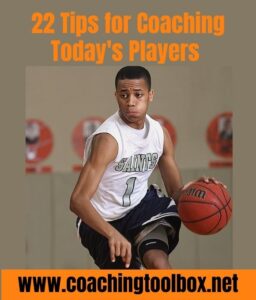
22 Tips for Coaching Today’s Players

By Brian Williams on February 4, 2015

This post was written by Alan Stein, Pure Sweat Basketball

As Notorious B.I.G. once said, ‘Things done changed.’

Players today are different than they were when I was growing up… and I’m not even that old. I know every generation says that… but it’s true.

One of the biggest changes to our society as a whole has been technology… more specifically the internet… and even more specifically… mobile smartphones and social media.

What does that have to do with basketball?

Everything.

Basketball has always been and will always be an interpersonal activity that requires human connection and communication.

Coaching is all about building quality relationships. As they say, ‘it ain’t about the X’s and O’s… it’s about the Jimmy’s and Joe’s.’

But because of things like social media and the ‘everyone gets a trophy’ mentality, the Jimmy’s and Joe’s of 2015 are not the same as they were in 1995.

And even though we can’t stop the waves… we can all learn to surf.

Here are 22 tips for coaching today’s players…

  1. Find out how to truly connect with your players. Find out what makes them tick, what motivates them and what is the best way to coach them (in front of their peers and behind closed doors).
  1. Embrace social media and technology… it’s not going anywhere. It’s important to your players, so it needs to be important to you.
  1. Learn to speak their language (I am not referring to profanity). The top 2 ways players communicate today is through text message and social media (particularly Instagram and Twitter). Learn to use those platforms.
  1. Understand this: consistency breeds excellence – excellence breeds trust – trust breeds loyalty – loyalty builds a strong program. Be consistent with everything you do. Players won’t respect you if you don’t.
  1. Encourage this 3-step mistake policy with your players – Admit it. Fix it. Don’t repeat it! The first time it is a mistake. The second time it is a decision.
  1. Coach attitude and effort before X’s and O’s. Without proper attitude and effort the X’s and O’s don’t matter.
  1. Clearly articulate your core values, principles and each player’s role. These are non-negotiable. They make up your program’s culture.

  1. Players want to know the why behind everything. So tell them! Explain why you do what you do, why you believe what you believe, and why you expect ABC from them. The higher the perceived relevance, the higher the buy-in. And at the end of the day, a coach’s #1 job is to get buy-in from every member of the program.
  1. Social media has created an abundance of superficial ‘friends’ – make sure your players know you truly care about them (on and off the court). That you have their back.
  1. Don’t try to be ‘friends’ with your players. If you are too close to them personally you can’t hold them accountable. You should be a role model, a teacher and a mentor… but not a buddy.
  1. Players all learn differently. Make sure you can effectively teach each type of learner (audio, visual, intrapersonal).
  1. Players want to show their individuality (shoes, haircuts and especially with pre-game starting line-up announcement antics and routines). Don’t fight it. Have some leniency within your program rules. Respectfully, today’s idols and role models (LeBron, Melo, etc.) are a lot different than MJ and Bird.
  1. Create a climate and culture that values people over productivity. Your players must know you care about them as a human being first and a player second.
  1. If you want to know if you are a good coach…ask your worst player.
  1. You’re either coaching it or you are allowing it to happen. You either accept it or correct it.
  1. Replace ‘but’ with ‘now’ when instructing a player. For example, “I like your release, now try to get your elbow over your knee.” This minor change will make a huge impact.
  1. Focus on what your players can be… not what they are.
  1. Science shows that most people have a pretty firm definition of what is right and wrong by age 13. Hold them accountable. Ignorance is not an excuse. However, learn to choose your battles. Kids will be kids. If a players posts something stupid on social media… don’t condemn them for life. Use it to teach a life lesson. Hold them accountable, but use it to teach.
  1. Players actually want to be held accountable. It shows them that you care and are invested in their success.
  1. Most of the players today have grown up in the ‘trophy generation’ – which has created an immense sense of entitlement. Players need to learn another ‘E’ word… earn. Create a system where players have to earn
  1. Players today want to play immediately. They don’t understand the concept of ‘right of passage.’ Freshman want to play varsity. Young players want to play serious minutes. Learn to channel this desire but keep them focused on the process and the long term.
  1. One of the biggest changes between the players of 1995 and 2015 is with the parents. Parents are much more involved and much more vocal (especially on social media). Parents can be a tremendous support system… or they can be a total thorn.
    I’m honored to be in the coaching fraternity.

    Alan Stein

    Hardwood Hustle Blog
    http://www.About.me/AlanStein
  • « Go to Previous Page
  • Page 1
  • Interim pages omitted …
  • Page 4
  • Page 5
  • Page 6
  • Page 7
  • Page 8
  • Interim pages omitted …
  • Page 25
  • Go to Next Page »

Primary Sidebar

  • Twitter
  • Facebook
  • Linkedin
coachestoolbox
personaldevelopmenttoolbox
basketballplayerstoolbox
basketballtrainer
athleticperformancetoolbox
coachingbasketball

© Copyright 2026 Coaching Toolbox

Privacy Policy