• Skip to primary navigation
  • Skip to main content
  • Skip to primary sidebar

  • Basketball Plays
    • Ball Screen Sets
    • Horns Sets
    • Man to Man Post Up
    • Man to Man Isolations
    • Backdoor Plays
    • Man to Man 3 Point Shot Plays
    • 2-3 Zone Attack
    • Baseline Inbound Plays
    • Sideline Inbound Plays
    • Combination Defense Attack
  • Drills
    • Defensive Drills
    • Offensive Drills
    • Competitive Drills
    • Passing Drills
    • Rebounding Drills
    • Shooting and Scoring Drills
    • Toughness Drills
    • Transition & Conversion Drills
    • One on One Drills
  • Blueprint
  • Practice
  • Mental Toughness
  • Skill Development
  • Offense
  • Defense
  • Store

Defense

Coaching Basketball Team Defense

By Brian Williams on October 4, 2012

These are some questions for your coaching staff to use to plan the upcoming basketball season. You can use to develop a defensive system and to tweak the system so that it fits your changes in personnel and the changes in your opponents’ personnel from year to year

Philosophy

  • Defensive Adjustments for a team or an Individual?
  • Scouting or System?
  • Do we want to have any “junk” in our system?
  • What are the strengths of our players and how can we best utilize those strengths while hiding their weaknesses?
  • What is the optimal number of possessions per game for this group?
  • Can we defend for that number of possessions at that pace?
  • How is our ability compared to the best teams in our region of the state tournament? our conference? our area?
  • How do we need to play to advance as far as possible in the state tournament?
  • What is our depth like?
  • How does our depth affect our style and pace of play?
  • What will our substitution pattern be?

Conversion Defense

  • How many players are we going to send to the offensive glass?
  • Do we need to add any rules that will improve our conversion?
  • Do we like the drills we have to teach conversion defense?

 
Man Defense

  • What hurt us most last year defensively?
  • How do we defend dribble penetration better?
  • What screening actions created problems for us?
  • Where do we want to pick up the dribbler?
  • How do we want to defend the post?
  • How do we want to defend ball screens?

Zone Defense

  • How much zone do we want to play?
  • Would it help us to have an even front and odd front zone so we can attack them both offensively during practice?
  • Do we want to be able to trap out of our zone defenses?
  • How do we best teach rebounding out of our zone?

1/2 Court Trap

  • How much do we want to play it?
  • How big are our trappers?
  • How do we want to rotate out of the trap?
  • Do we want to stay in the trap or go “one and done”?
  • When do we want to look to play it – dead balls, FT’s, end of half…
  • Do we have a better trapping line-up than others?

Presses

  • How much do we want to use the press?
  • When do we want to press?
  • How aggressive do we want to be with our press?
  • Do we have a better pressing line-up than others? Who are our best trappers?
  • Do we deny the point guard back once they pass out of the trap?

Inbound Defense

  • Do we want to play strictly man?
  • Do we want to trap the inbound pass?
  • How do we want our inbound defender to play UOOB and SOOB?

Special Situations

  • Who would be our best denial defender?
  • Does any team on our schedule potentially warrant a special defensive tactic?

55 Defense

By Brian Williams on September 25, 2012

These notes were sent to me by Steve Smiley. The notes were taken by Jim Ponchak.

Our Defense Never Rests!

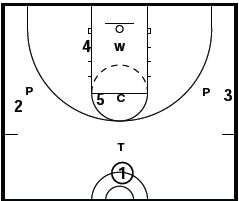
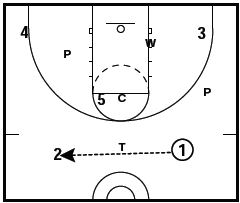
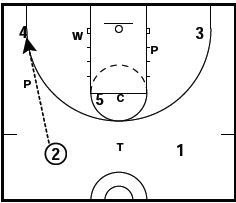
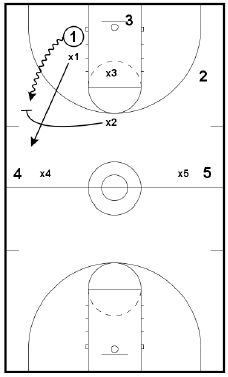
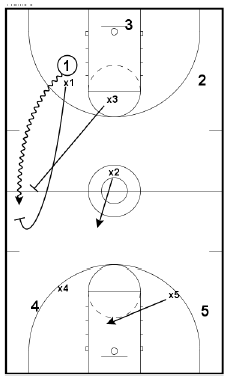
55 Defense is a full-court half zone, half man press

• On ball side it is man with a hard denial
• On weak side it is a zone
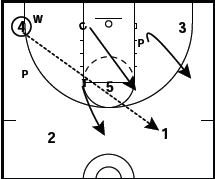
• All traps are on the sideline
• You never trap in the middle


Skills

◦ Influence the ball from side to side
◦ Trap – need 45 degree angles
◦ High level of conditioning – players can usually only handle playing 5 to 6 minutes at a time

• The 2 and the 3 are assigned a side of the court that they stay on
• If their men switch sides of the court, the 2 and 3 release them to the other side and stay on their side
• Running 55 forces the other team to prepare for you

• Not concerned with lateral passes

• The 1 can never trap. 1 is a safety, great anticipator, the thief, always in the ball lane, 1 never gets in front of 2 or 3

• 4 relieves the 1, watch ball as you get back

• 5 is the hardest worker, traps all over the floor, willing to run, hands are up touching on top as he covers the inbounder, wants the ball to be lobbed, bounce passed, or deflected

 

• 2 is on the man side of the zone (ball side), picks up the 1st pass to the left of the 5, responsible for trapping and tracking in his lane

• If the 2 winds up on the weak side, he is in the middle behind the trap

• 3 is the same as 2 on the other side of the floor except he starts out in zone on the weak side, responsible for the 1st pass to the right of 5

• 5 makes a C move to trap the inbounds pass

• Players in the middle read eyes and feet of the man with the ball

• Don’t trap in the middle

• Traps are always on the side

• If the 2 gets beat up the sideline, he c moves to track down the player in his lane
• “House on fire!” – ball beats the defense

◦ 5 picks up the post player on the weak side of the floor

◦ 4 picks up the post player on the ball side of the floor
◦ 1 runs to the top of the key
◦ 2 and 3 run to the ball if it is in their lane or the top of the key if it is on the weak side
◦ 1 should call for a switch if he sees that 2 or 3 is beat
◦ Players chasing the ball down from behind should slap up at it with their inside hand

Drills

◦ 5-on-5 Full-Court
▪ Have all 10 players run in a tight circle in the lane
▪ Coach drops the ball and yells, “Shot!”
▪ The offense picks the ball up and inbounds it, it is now live 5-on-5
▪ The 2 must create contact on the ball side
• Hit the cutter with an arm bar
• See the ball, feel the man
▪ Check 3’s positioning to make sure he can’t get beat deep
▪ 3 gets closer to his man as his man gets closer to the ball
▪ If 1’s man cuts to the ball, 1 yells cutter and passes man off to 3
▪ If the inbounder runs the baseline, 3 denies in man and 2 becomes the zone defender as the ball side and weak side get switched
▪ 5 C moves to the 1st pass and uses short choppy steps to slow down as approaches for the trap
▪ If 4’s man cuts, he calls cutter and passes him off to 1
▪ 1 lets 4 know he has made the switch
▪ 4 drops back on deep man
▪ Emphasize talk and contact with arm bar
▪ Defense needs to get their arm over the offense’s arm so the offense cannot bring their arms together

Diagrams of Drills

Basketball Defense Beliefs Philosophy

By Brian Williams on August 21, 2012

Defensive Beliefs

These are some of my beliefs about playing a pack style defense.

Regardless of the style of defense that you play, I hope these thoughts might help you to define and refine your defense.

When you try to stop everything, you stop nothing.

The number one goal of our defense is to allow a low defensive field goal percentage.

Control the dribbler. Determined to keep him out of lane.

Keep the ball out of the lane by gapping (that keeps us from having to rotate and miss block outs).

Gapping is more important than gambling for steals.

Be a high energy defensive team every night and outlast the opponent every possession

Make them shoot contested shots 18’ and out, then block out, pursue the ball, and chin the rebound

Defense involves continually performing one responsibility after another, until we have the ball.

Players who do not play defense as hard as possible do not play.

Any player with desire and determination can learn to be an adequate defensive player.

Playing hard will make up for a lot of defense mistakes.

We use both our defense and our offense to control the tempo of the game and the number of possessions.

Individual concentration, awareness, anticipation, recovery, and communication are vital.

Defense is successful when each player concentrates each possession on recognizing, anticipating, and executing.

A defensive attitude is essential. The players need to feel that they are difficult to score against and must take pride in the defensive aspect of the game.

Great defensive teams cover up mistakes.

You recover as soon the ball is picked up. Help as far outside the lane as possible. Same on screens.

Teams don’t get beat the help they get beat on better recovery—so we must practice and stress recovery.

Ball is more important—talk the switch—no penetration.

STANCE knees bent—feet wide) Tail down, Weight on balls of feet. Heels slightly up.

POSITION Do not go for a steal and take yourself out of a play. That is false hustle and it hurts our team.

VISION AND AWARENESS (see the ball and man—sink to see). Be ready to help on the ball.

Trace the ball with other hand. Hands off. Don’t foul the game away or put yourself on the bench with foul trouble.

Know the man’s strengths and play the appropriate gap. Our scouting report will make what that exactly is clear to the players.

FORCE OUTSIDE. When the man with the ball spins, or turns his back we trap him.

When the dribble is picked up, we apply pressure—“Up” is our call so everyone knows the ball is up. Make the ball uncomfortable.

Forward pivots, hands above shoulders on block outs.

You can only do two of the three from: deny, help, recover. We choose to not deny and place our defenders in the help gap to begin with.

Foul only for profit. Switch for profit.

Great defensive teams take charges and don’t reach or swing.

Take the charge in front of the basket, in the lane, and on the baseline. It is impossible to get a charge call in the middle of the floor.

Help across and down—never from the basket out.

Guard two places at once by using defensive fakes.

Give quick help with early recovery. Helper sees own man.

When we recover, we recover to the ball or to a gap, not to a man (unless he has the ball or is in the post)

Don’t deny past the level of the ball.

Basketball Pressure Defense

By Brian Williams on August 14, 2012

These rules that Coach Don Showalter uses for his pressure defense came from Creighton Burns’ newsletter

Creighton also credits Championship Productions.

If you are interested in subscribing to Creighton’s newsletter, email me and I will forward it on to Creighon.

Coach Showalter’s teams start out and press regardless of personnel. Here are some ideas, rules, and tips for how you can implement this system effectively with your team.

Deflections Are Huge – Chart deflections in practices and games. It doesn’t have to be a steal, just a deflection (even if it’s with a fingernail). Aim for 20 deflections or more in a game. This number will tell you whether or not the press is working pretty well. For Coach Showalter, deflections are more important than steals. While your team may not have a ton of steals one game, they may get a lot of deflections. This tells you that the other team has been thrown off a bit.

Ball Pressure is Crucial – “Press” means ball pressure. Be Patient – The press may work for long or short spurts, but it will work. You must be patient with it and if you are, kids will understand that they won’t get out of it. If your team thinks they will be getting out of a press as soon as a basket is given up, then they are done. You can’t press with that team. Coach Showalter’s teams are going to press regardless of what happens. Overall, they will play harder and adjust.

Stay With It – If ball pressure is constant all game long, you’ll have many intangibles in your favor if you stick with it. For instance, the constant pressure forces your kids to play hard. So how exactly do you get them to play hard? Well, they are pressing, and if they don’t play hard, they will get embarrassed.

Set Good Traps and Don’t Reach – Remember, you aren’t going to steal the ball on the trap, but rather out of your trap. The players who are trapping are often not the ones going to steal it. Also, keep in mind that fouling negates hustle. Therefore, keep your hands up and don’t reach. Always run to your teammate when trapping and sprint to the trap (hands up, hands off).

You Must Sprint Out of Traps – Turn the shoulders and hips to the area where you want to run to. It’s not as simple as it sounds, so coaches must watch their players to ensure they are doing this effectively.

Look to Tip From Behind – You can get 3 or 4 baskets a game just from doing this.

Anticipate the Next Move of the Opponent
– Don’t let the offensive team break the press the same way two times in a row. This should be your mindset. Keep the opposition off balance and uncomfortable.

Be Aware – This is said a ton in practice. Be aware of where your man is and what’s going to happen.

Make Opponents Take Jump Shots – Be there when they shoot it and be there when they miss it.

Scramble Defense

By Brian Williams on March 30, 2011

Scramble Halfcourt Defense–Thumbs Down

Jim Larranaga, Men’s Basketball Coach Miami (Florida)

I received the notes from Coach Creighton Burns

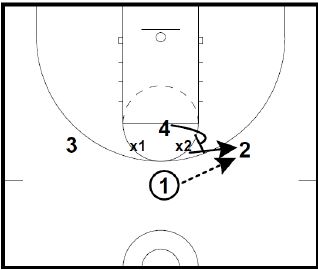
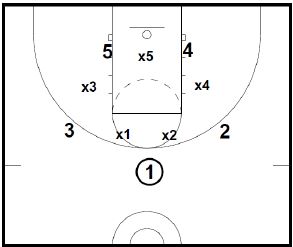
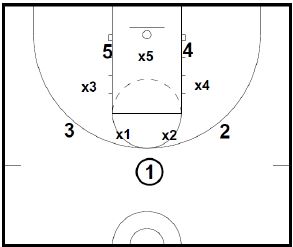
a) Thumbs down – trap the receiver of the first pass in the front court (trap down).

B) Thumbs up – trap the dribbler on the first dribble over the center line.

There are two trappers, two interceptors and a goaltender.
 

Thumbs down:

Basketball Defense

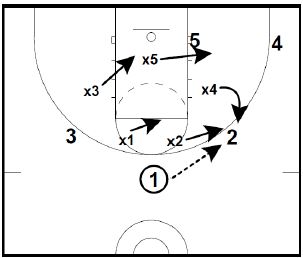
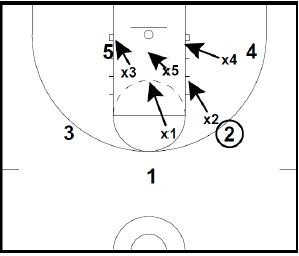
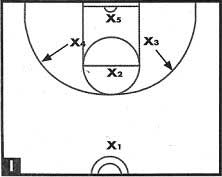
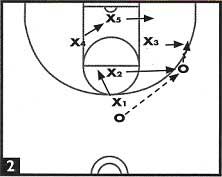
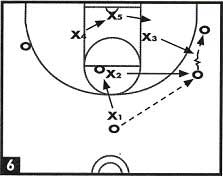
X1 follows the pass to 2 and traps down with X2.

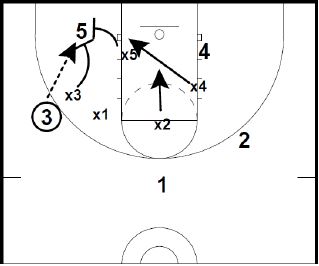
Weak side X3 rotates up top to take away ball reversal, is the reversal interceptor (RI).

Weak side

X5 moves up to the high-post area (the next most likely pass), becomes the high-post interceptor.

(HPI, often a big). X4 is the goaltender (GT), he fronts 4. Any post-to-post screen is an automatic switch.

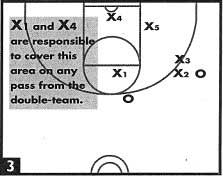
Get "3 to the ball" on every trap, the two trappers must have their three teammates get ball side and in the action, working together. Positions are the same after trapping on the wing regardless of the attacking set.

Basketball Defense

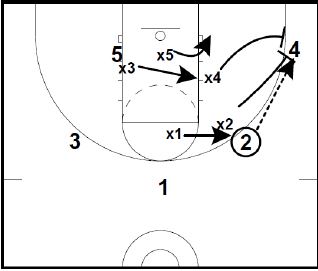
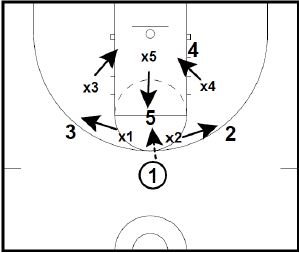
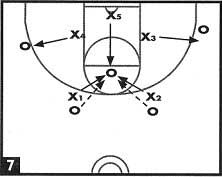
On a reversal pass it’s one trap and out. If you leave your man to go trap, you must run out of the trap to find the open man, and run to where your help comes from.

X1 rotates out to find the open man. If X5 decides to take 3 because he is closer, then X1 would go where his help came from and take 5.

Basketball Defense

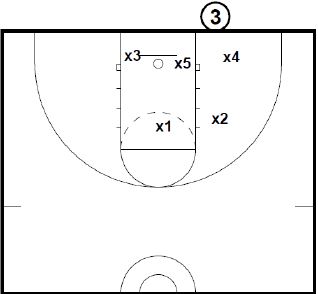
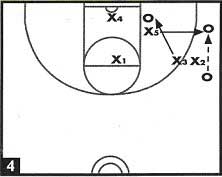
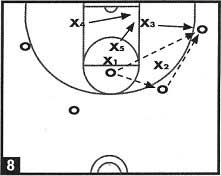
However, if the other team continues to attack with a pass to the corner, trap again. X2 leaves to trap (his man made the pass). X1 is RI, X3 is still HPI, and X5 is still GT.

Basketball Defense

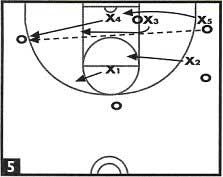
Trailer Trap (Thumbs Down)

On a secondary break, teams are usually looking to reverse the ball, not make a wing-entry pass.

Trailer trap is normally called after a time-out. X4 becomes the first trapper.

  • « Go to Previous Page
  • Page 1
  • Interim pages omitted …
  • Page 13
  • Page 14
  • Page 15

Primary Sidebar

  • Twitter
  • Facebook
  • Linkedin
coachestoolbox
personaldevelopmenttoolbox
basketballplayerstoolbox
basketballtrainer
athleticperformancetoolbox
coachingbasketball

© Copyright 2026 Coaching Toolbox

Privacy Policy