• Skip to primary navigation
  • Skip to main content
  • Skip to primary sidebar

  • Basketball Plays
    • Ball Screen Sets
    • Horns Sets
    • Man to Man Post Up
    • Man to Man Isolations
    • Backdoor Plays
    • Man to Man 3 Point Shot Plays
    • 2-3 Zone Attack
    • Baseline Inbound Plays
    • Sideline Inbound Plays
    • Combination Defense Attack
  • Drills
    • Defensive Drills
    • Offensive Drills
    • Competitive Drills
    • Passing Drills
    • Rebounding Drills
    • Shooting and Scoring Drills
    • Toughness Drills
    • Transition & Conversion Drills
    • One on One Drills
  • Blueprint
  • Practice
  • Mental Toughness
  • Skill Development
  • Offense
  • Defense
  • Store

Defense

Basketball Coaching Combination Defenses

By Brian Williams on August 23, 2013

This article was written by Coach Will Rey

These are nice to have in your back pocket.

Why use one?

– Change tempo
– Dictates who takes the shots
– Uses zone principles
– Keeps the ball out of the hands of the opponent’s best player
– Offense often doesn’t know which offense to run

When to use?

– Can use the entire game or after timeouts
– To stop a run or to change momentum
– Use it until they score twice

Diamond and one
Advantages:

– Good when you are trying to take away one player
– Need to ask, “Do we want to take away their best player, shooter, or playmaker?”
– Most effective versus a perimeter player but will work versus a post player.

Defender is in total denial, he does not have to help. His only responsibility is to make sure his man has no catches.

He should force his man into the pack (the other 4 men are playing a zone) see the ball

Defender concepts

We have 4, they have 4. There should not be an open man.

X1 is at the top and covers everything from elbow to elbow
X4 and X3 are on the wings and cover from the elbow to the block
X5 stays on a straight line between the ball and the basket.

If the offense gets in a 1 guard front, line up your defense in a 1-3 with the 5 man staying in a straight line between the ball and the hoop.

If the offense is in a 2 guard front, the wing on that side will step up. Remember, we have 4 they have 4.

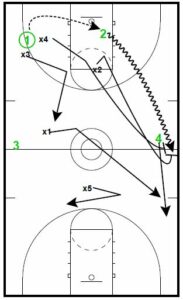
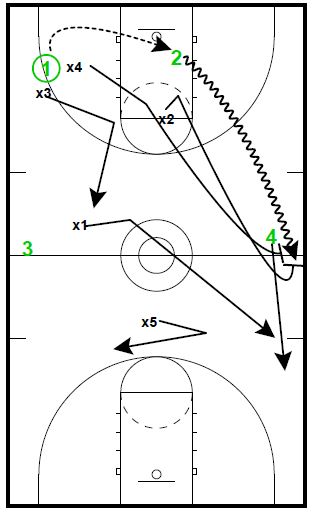
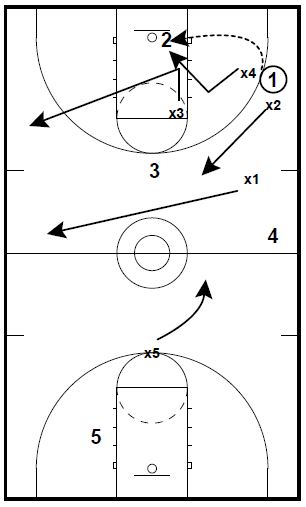
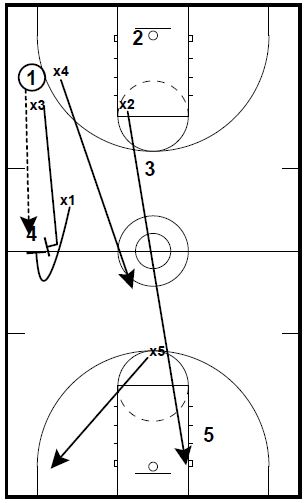
Pass coverage: On a pass to the wing and then a basket cut by the passer, X1 will take the cutter to the lane line and then X4 will absorb him.

If the pass goes from the wing to the corner, X5 can show but X4 should slide down to bump X5 back to his original position.

People in the diamond must know who the shooters are.

Remember we have 4 and they have 4. There should be no open cutters.

Diamond and one- Bump cutters

A counter often used for this defense is a lot of screening to free the man up for a shot.

To stop this, the guy covering the star player must stay right on the star’s butt so that they are almost 1 person.

The other 4 guys should bump the star player as he goes through.

Once the star gets under the basket, never give him a choice of direction. Don’t play on top, take away one of his options. Send him to a side where the wing defender can extend the defense a little more.

Bump cutter or extend on any screen. We want to force an outside shot.

A defender in this defense should not have to go from on the ball to on the ball.

Yell “shot” every time a shot goes up. We need to do this so we can find someone to block out.

Don’t want the zone to get stretched out too far so that offense can get it into the high post.

X1 should cover top of the key to the free throw line. Once the ball is passed to the wing,
X1 should drop to take away the high post.

Can’t let the pass be thrown behind X1 to the heart of the zone.

If a pass is thrown to the player we are trying to stop, force him into the pack. We can’t let the star get easy catches.

Triangle and Two– Good if a team has 2 good players and 3 average to below average players.

Advantages:

– Flexible because you can take 2 players out of the offense
– Forces non-scorers into scoring roles. We will play this against the 2 best scorers or versus the point guard and the scorer.
– Can upset the offense’s chemistry

We are completely denying 2 players
The other 3 defenders are in a triangle.

The 2 players being denied are not allowed to catch the ball. They are in full denial all over the floor.

If these 2 guys cross screen for each other, switch.

Scouting is essential to this. Make the other 3 beat you. Better still… no open looks. Remember, we have 3 and they have 3.

Put your most athletic person at the top of the triangle. He should also be crafty. He should never have 2 feet on the 3-point line. He covers elbow to elbow.

X2 and X3 have their respective wing areas.

If they bring someone else up such as O2 or O3, we’ll bring someone else up too.

Make them take a contested jump shot. In theory their guy is at best their 3rd best shooter so we are fine with this.

We can’t get beat off the dribble

Once the ball is passed, we jump to a help and support position

Talk, talk, talk. Tell each other where their help is.

No shots for 2 best players. No lay ups

If they overload this and put the 2 guarded guys away from the triangle, fine. Move the triangle to the side.

Don’t deny pass to the corner. We want them to shoot contested jump shots

No lay ups or any baskets close to the hoop. We are making them shoot contested jump shots

Post defense concepts– on a pass to the post X1 will trap down with one of the wing defenders to force the ball back out. If they want to go inside out and shoot the jumper, that is fine.

Trap from the top-down

Again, the guarded guys can’t catch the ball

If he does catch it in a scoring position, we must run and trap with the top of the triangle.

If he throws it out, we close out to force the jump shot.

If he isn’t in a scoring position, X1 should stay back in the triangle. We will never leave the basket unattended.

Ball screens

If an unguarded player screens for a guarded player, we trap it or string it out and let him fight over it.

If 2 guarded guys screen for each other, we switch it.

If they come into a scoring area, the point guy on the triangle helps or traps.

If a shot is taken they must yell “Shot!” Penalize players if they don’t do it in practice

Why is it so imperative to do this with the box and one or the triangle and 2? Because the guys in full denial may not see the shot going up.

We immediately go to 5 guys boxing out. It should be a good defense to rebound out of.
Why? Because we are always near shooters. The triangle guys never have 2 feet outside the 3-point line so we can have them close to the hoop.

The triangle men must constantly talk. They must appear bigger than they are. Hands up in the triangle, active hands.

2 guys must be in full denial and see the ball. If they cross screen or screen switch. Force them into the triangle. If we get lost, go to the rim and work your way out.

They may have a 3rd player who is a good shooter. We will have to keep track of him. Talk, talk, talk!

4 on 4 Diamond and 1 drill
4 offense guard 4 defense. Don’t let the defense get stretched out too far.

Stay big and talk. Only guard to the 3-point line. Don’t get stretched out too far.

When the ball is skipped to the other side of the floor, the closest man takes it.

We do not want any of our defenders in the diamond to have both feet outside the lane.

Once the shot goes up, the 4 have man to man responsibilities and must block out.

1 on 1 Diamond and one drill
Stop the offensive player from catching the ball. Can work in a shot to get them used to boxing out.

Force the offense back into the pack. We want to force back door passes and back door cuts.

3 on 3 Triangle and 2 Drill

Offense can do whatever they want. When ball goes into the post, the top of the triangle comes down and traps and then rotates out on the pass back out.

When the shot goes up, yell “Shot!” and box out.

If they screen on the ball, unguarded for unguarded, you switch and go on the inside.

2 on 2 Triangle and 2 Drill

Now work on the guarded players. Full denial

If they screen for each other, switch.

Then put someone with a blocking dummy. Do not go over the top, trail and closeout.

Then add a 2nd screener. Try to get 35 seconds without a touch. Only backdoor passes are o.k. Coach will just fake that pass and the drill will continue.

Will has more than 30 years of basketball coaching experience at college and high school level. He has produced 6 coaching DVDs and is a frequent clinic lecturer. He is currently the Head Coach at Northridge Prep in Chicago. Coach Rey has been a Division 1 Head Coach at Loyola and has served as an assistant at Evansville and Wright State. In 2005 he was inducted into the Five-star Basketball Hall of Fame for his work over 20 years as a resident coach, lecturer, and administrator at Five-Star camps.

Undervalued Keys to Great Defense

By Brian Williams on August 7, 2013

I received this article from Coach Steve Smiley.

These defensive concepts were written by Coach Kevin Eastman.

He was an assistant with Doc Rivers for the Boston Celtics and on the Clippers’ coaching staff.

His area is player development. He also speaks and writes on leadership.

Coach Eastman is a partner in the Coaching U program.

Here is a link to the website: Coaching U

He is a really good follow on Twitter: @KevinEastman

10 Undervalued Keys to Great Defense

By Kevin Eastman

Most of us agree that defense is critical to team success and championship play. Here are some things to think about as you go about your defensive work. You can apply these no matter what defense you play.

  1. FIRST 3 STEPS: The key to all great defenses is getting back in transition and setting your defense so the opponent has to play against your “set defense” all night. The first 3 steps must be an all-out sprint.
  1. LOAD TO THE BALL: It’s vitally important to make sure that the great perimeter players in today’s game don’t see any seams in your defense in transition. Guards today are so good that they will take advantage of any little gap they see while you’re getting back. Pull your defense over to take away these seams, but also be aware of your man.
  1. LOW MAN WINS: Simply put, the lower man between the offensive player and the defensive player usually wins that possession. The lower man has the advantage of the leverage game, the reaction game, and the relative quickness game. Get down and be in a stance, ready to move and adjust.
  1. GET YOUR ANTENNAE UP: Players must be alert to what’s going on around them. Alertness is a trait all the great defensive teams share. This demands readiness in your eyes, your feet, your hands, and your mind.
  1. SNIFFING THINGS OUT: Knowing what’s likely to happen next is an ingredient to all great defensive teams and players. To be able to “sniff things out,” you have to study the game and listen intently during scouting reports.
  1. PLUGGING HOLES: Offenses are very good as well, so they will create problems and find holes in the defense. The great defensive teams are always ready to plug that hole and players have a trust that someone will have their back.
  1. TALK INTIMIDATES: Teams that talk always seem to play with more energy and intensity. Talking lets the opponent know that you see everything they’re doing and that you know their stuff every bit as much as they do. Talking teams also always seem to be the more aggressive teams.
  1. FIRST TO THE FLOOR: There will be a number of possessions in a game that come down to “who wants it more.” Being first to the floor is very important, as is being first to the long rebound. We call this the 50-50 game; we want to win the 50-50 game every night.FINISH YOUR
  1. DEFENSE: How many times have we had a great possession and the opponent gets an offensive rebound? It’s a killer. Finish all slides, finish getting over screens, and finish every possession with a block out and rebound. We never want to start something that we won’t finish.
  1. *TRUST: I’ve saved this for last because it’s the most important component of all great defenseive teams. It’s so important for players to know they can be intelligently aggressive. Players who know they have someone behind them to cover their backs can defend with intelligent abandon (NOT careless adandon). Turst actually makes your defense quicker and more alert because there’s no hesitation; a hesitant athlete is a non-athlete.

Basketball Coaching Defensive Stoppers

By Brian Williams on July 17, 2013

This article was written by Brian Anglim. Brian has coached basketball at both the high school and college levels. He has several articles on The Coaching Toolbox

Basketball Defensive Stoppers

by Coach Brian Anglim

Finding and developing a defensive stopper should be a priority item for a coach. Having a player that can limit a star player is invaluable and this player has a tremendous effect on developing the intensity and focus to becoming a championship level defense.

  • Don’t be confused with athletic ability. A long/athletic player who has a lot of activity might seem like a good defender, but how effective is he one-on-one versus a top offensive player. Great athletes often get in bad positions because they don’t know how to use their quickness effectively, they often overcommit.
  • Get a buy in from the player. Let him know that he is special, he/she can do things his teammates do not have the ability and toughness to accomplish.  They require more praise than any other player because their contributions aren’t apparent.
  • If you can get that buy in then you need to give this player individual time, great man defense is a skill. Learn and teach all the nuances of the arm bar, closeouts, expanding and closing gaps with hop steps, holding, pushing to weak hands, etc. Give them extra time in the scouting report. It should be a sense of pride when in your scouting report. It should be a point in your pre-game speech that they are going to face a key defensive challenge.
  • Fouling is a sin – some players see it as a badge of their physical nature. They need to see it as a mistake and strive to correct it.
  • Teach them to be physical while being subtle in his/her approach. A term I got from Better Basketball’s Dynamic Defense was ESP – External Signs of Passivity.
  • A stopper needs to be able to concentrate the entire possession, demand it. How often do you see a defender fall asleep when his man passes the ball or doesn’t make that last slide to cut off the baseline. The conditioning level of a stopper must be at the highest level, he needs to relish in wearing out his opponent mentally and physically.
  • They understand the game within the game, they love seeing the frustration level in their opponent.
  • They must be tough mentally and physically. It is great to have athletic ability but with concentration, toughness, and intensity it will be wasted.

A final defensive thought to leave you with, if you have an offensive player you can’t control don’t waste your best defender on him.

Put your worst defender on him and have your best defenders in position to help and control him when he/she penetrates.

Basketball Defense 1-3-1

By Brian Williams on May 28, 2013

These notes and diagrams on playing a 1-3-1 zone defense were provided by Cecil Kegans.

The notes were from Coach Kegans files of watching when John Beilein played a 1-3-1 defense.

I know that there are different versions of a 1-3-1 zone and that Coach Beilein played various styles as he adjusted to fit his personnel. I also know that Coach Beilein finished his college coaching career with teams that played outstanding man to man defense.

I am presenting these notes so that if you feel these rules would help your team, then experiment in practice to see if you are right.

Maybe there is only an idea or two that you can use. Maybe this post stimulates your thinking or discussion among your staff about your defense.

I am merely presenting this idea for your use as you do or do not see fit. I am not suggesting that you take this and incorporate as is.

Basketball 1-3-1 Defense

T (Thief/Top) – Is always halfway direct line of the person with the ball and the guard on the opposite side . He is always facing the ball never flat
C (Clogger/Center) – Is always between the ball and the rim. Always has it’s hands wide to take away high post pass

P (Pushers/Wing) – Always in direct line of the ball and the
corner pass strong or weakside

W (Warrior/Bottom) – Is always matched up with the ball. If a post is down there will play on outside to run the corner pass

Basketball 1-3-1 Defense

As you notice here when the ball is one side of the floor the opposite wing must drop to take weak side skip becuase the warrior has to follow the ball.


Basketball Defense

On a corner pass:

T- Must take high post

C- Must take the block( Always between ball and basket)

P- Turn around and perform same action

W- Takes the corner pass. The Warrior must closeout on the basline side as he never ants to give up baseline

1-3-1 Defense

On a skip pass

T- Will run to a direct line halfway between the ball and the guard on other sIde. Must be wide and facing the ball

C- Will run directly between the ball and the basket and hand wide to eflect high post pass

P- Baliside pusher will run in direct line of ball and corner pass. Weakside take away weakside corner pass

Basketball 1-3-1 Defense

On penetration

T- Will move towards the ball attempting to tip away.

C- Staying between ball and rim

P- Job is to push up and make them retreat out of scoring area

W- Aiways matched up with ball

Basketball 1-3-1 Defense

Once the dribbler has retreated, the defense returns to regular rules.


Basketball 1-3-1 Defense

Dribbling in the Funnel

T Must stunt and play with ballhandler’s ball

P Must stunt and play with ball

C Stay between ball and basket

W Matched up with ball

Basketball Defense 2-3 Zone Part 2

By Brian Williams on April 15, 2013

These notes and diagrams On Jim Boeheim’s 2-3 Zone defense are a follow up to an earlier post I made about the Syracuses zone.

Here is the link to the original post: Syracuse 2-3 zone

The source of these notes is Coach Mike Neighbors newsletter. Email me if you would like me to pass your email address along to Coach Neighbors to add to his newsletter.

Most teams don’t play zone, so it is harder to prepare for in a short time frame.

It is tough for teams to get off a good shot against a zone with 10 seconds left.


2-3 Screening Drill

Basketball Defense

More teams are setting screens against the zone.

Guards at one end of the floor for this drill.

3 offensive players on the perimeter, 1 in the high post.

Post screens for the guards

Defense fights over the screen if it is a shooter, under the screen if it is a non shooter.

2-3 Short Corner Trap

Basketball Defense

X5 steps out

X3 doubles with X5

X4 comes across to the block

X2 drops


2-3 Corner Trap

Basketball Defense

X4 and X5 trap corner

X1 takes away the wing

X5 takes away the block

X3 takes away the midpost

Teams only make high post shot 20% of the time and we are in good rebounding position.

Baseline Inbounds Plays

Basketball Defense

Forwards can’t let the ball go to the corner

Guards take away the high post


Syracuse stays in the zone even when they are down 8 to 10 points.

They will go full court press and try to trap more.

If they are down 15 or more they will look to go man to man

If a team hits a couple of threes against you early, stay with the zone. If a team did that against you and you were playing man to man, you would take timeout and tell them to play better man to man. You wouldn’t change your defense.

Zone’s impact on Syracuse offense:

Players are in better position for transition game

Guards don’t get caught underneath

Basketball Defense Syracuse 2-3 Zone

By Brian Williams on April 8, 2013

These notes and diagrams On Jim Boeheim’s 2-3 Zone defense came from Mike Neighbors newsletter. Email me if you would like me to pass your email address along to Coach Neighbors to add to his newsletter.

Here is a link to the second part of this post with some trapping ideas

Syracuse 2-3 zone Part 2

If a team is shooting 42% from 3, what would your assistants tell you to play?

They will tell you to play man. The opponent is shooting 42% against man to man, so they figured out how to get good shots against man to man, not necessarily against a zone.


2-3 Initial Alignment

Basketball Defense

5 defenders should be moving guards try to keep the ball out of the high post

On the perimeter, play 3 players with 2 guards and help from forwards

The top 2 guys must be close enough to touch hands.

2-3 Rotation on Pass to the Wing

Basketball Defense

Take away the 3 point shot–pressure shooters, get them off their spots.

Designate who to stop and all 5 guys are responsible for stopping him. Match up with him, no matter where he is.

The forward rule is if a man is open in front of you, pick him up.

First forward must close out on outside lane.

Forward bumps back into passing lane once guard gets there.

Center rotates to ballside block.

Helpside forward goes ot helpside block.

Helpside guard drops to foul line.

2-3 Rotation on Pass to High Post

Basketball Defense

If the ball goes to the high post, the center is responsible for playing the ball.

X3 and X4 drop to blocks.

X5 hesitates while the forwards drop to the blocks,then picks up the ball.

 
X1 and X2 go to the wings to take away the shooters.

If the ball is up top, the guard is up top against a shooter, but gives space against a penetrator or passer.

2-3 Rebounding Responsibilities

Basketball Defense

Weak side forward is alone on the weak side

If a team plays 4 out, they will not be as strong rebounding

There is no block out on the weak side, the weak side forward gets position on the edge

If the offense crashes the boards hard, Syracuse looks to run.

X5 gets position in the middle of the lane,

Ball side forward gets to the ball side block

The guard in the high post gets to the middle.

Ball side guard gets to the lane line.

Start teaching the zone with:

5 guys on the perimeter

Offense passes the ball for 25 to 30 seconds (this is how
long most teams take to attack the zone)

Defense moves on every pass.

Then, add two offensive players in the post and
play 5 defense on 7 offense

Here is a link to the second part of this post with some trapping ideas Syracuse 2-3 zone Part 2

  • « Go to Previous Page
  • Page 1
  • Interim pages omitted …
  • Page 11
  • Page 12
  • Page 13
  • Page 14
  • Page 15
  • Go to Next Page »

Primary Sidebar

  • Twitter
  • Facebook
  • Linkedin
coachestoolbox
personaldevelopmenttoolbox
basketballplayerstoolbox
basketballtrainer
athleticperformancetoolbox
coachingbasketball

© Copyright 2026 Coaching Toolbox

Privacy Policy