• Skip to primary navigation
  • Skip to main content
  • Skip to primary sidebar

  • Basketball Plays
    • Ball Screen Sets
    • Horns Sets
    • Man to Man Post Up
    • Man to Man Isolations
    • Backdoor Plays
    • Man to Man 3 Point Shot Plays
    • 2-3 Zone Attack
    • Baseline Inbound Plays
    • Sideline Inbound Plays
    • Combination Defense Attack
  • Drills
    • Defensive Drills
    • Offensive Drills
    • Competitive Drills
    • Passing Drills
    • Rebounding Drills
    • Shooting and Scoring Drills
    • Toughness Drills
    • Transition & Conversion Drills
    • One on One Drills
  • Blueprint
  • Practice
  • Mental Toughness
  • Skill Development
  • Offense
  • Defense
  • Store

Basketball Drills

Basketball Drills Quick Strike Transition Drill

By Brian Williams on February 11, 2014

The name of the drill is Quick Strike and its purpose is to work on both transition offense and conversion defense.

The drill is from Arkansas’ Mike Neighbors.

I heard him speak at a clinic and he said that if he were allowed to use only 2 drills, this would be one of them.

The description below the video is a slightly different version of the drill that he used to run.

Like all of our drills, this one has evolved and improved over time.

The video of this rebounding drill is hosted on You Tube.

You will need to be on a network that allows you to access You Tube.

Click the play arrow to view the video.

There is narration with the video, so please make sure that your sound is on.

Quick strike emphasizes both transition offense and defense. It also reinforces shot selection, decision making. and eliminating turnovers.

The drill is about the scoring and teaching opportunities that it presents as you try to teach transition offense and defense.

You must have a score clock (shot clock is best) or a stop watch that counts down.

Divide players into two-colored teams all on one end of the floor. Begin the drill by tossing the ball to the white team putting them into transition attack mode and blue team into transition defense.

The clock starts at 15 seconds since we are emphasizing transition offense and a quick attack.

If blue scores they are awarded points based on how much time has elapsed from the 15 second clock… For example, if they push the ball up quickly and score with 10 seconds left they get 10 points. The action never stops and White now attacks in transition as Blue defends.

No points are scored if the team does not score. You will need to decide how you score points for fouls. One way would be to award all 15 points to the offense if the defense fouls, regardless of how much time remains on the clock.

Again the clock is re-set as they begin their attack. This continues for a set # of possessions, to a certain score, or a set amount of time…

Quick Strike Basketball Transition Drill

You can imagine the importance this places on communication and decision making.

LOTS of teaching points for your transition.

“Milk the Clock” using the Quick Strike Basketball Transition Drill

You can also use it as a drill to teach and rehearse milking the shot clock if you have a lead. Even if you are a high school coach in a state without a shot clock, you can use this drill to have your players practice running clock at the end of the game without going into an actual stall.

To practice milking the clock, run the same drill, but the team scores for how much time they took off the clock when they score. For example, if you have a 30 second shot clock or want to practice running 30 seconds off before you score without a shot clock.

An example would be: Put 30 seconds on the clock and give one team the basketball. Stop the clock when the ball goes in the basket. If it goes in at 8 seconds left on the clock, they score 22 points. If it goes in at 5 seconds left on the clock, they get 25 points. When there is a change of possession, either on a made basket, a defensive rebound, or a turnover, start the clock again at 30 seconds for the other team.

[thrive_leads id=’17277′]

Defending Pick and Roll 5 Options

By Brian Williams on February 6, 2014

This post on defending pick and roll was sent to me by Nate Hill, Assistant Boys Coach at Colonel Crawford High School in North Robinson Ohio. He has coached for 18 years from 7th grade through Varsity Head Coach.

Nate has contributed several articles for the site.

Coach Hill said: I typed this up while preparing for our next opponent who runs lots of ball screens.

These are 5 different ways I’ve seen the pick and roll defended.

Pretty basic stuff, but it helped me out going through the different strengths and weaknesses.

He started a Coaching Newsletter this past Fall. Here is a link to the archives if you are interested.

Next Level Basketball 419

In case you have any questions or comments for Coach Hill, or would like to subscribe to his newsletter, here is his email address:

[email protected]

I posted an article a year ago from retired NBA Coach Del Harris about defending pick and roll. Here is the link: Del Harris defending pick and roll

Diagrams created with FastDraw

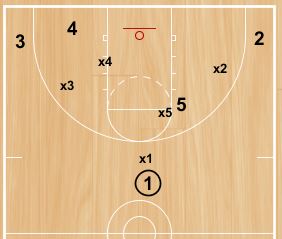
Jam and Under

basketball-defense-pnr1

X5 chests up 5 and tries to JAM screener.

X1 goes UNDER screen.

X3 helps on 1

Give up: pull up jumpers, turning corner on drives

Take away: screener rolling / slips. force ballhandler to shoot off dribble

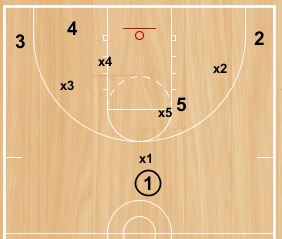
Hedge and Recover

basketball-defense-pnr2

X5 steps out and HEDGES screen, forcing the ball handler to change direction.

X5 must then sprint back to 5.

X1 fights over top pick and stays in 1 hip pocket.

X3 helps on screener

Give up: passes to roll man, possible guard splitting defenders and driving, pick and pop. Need extra defender
for roll

Take away: guards shooting off dribble, make players make tough “pocket pass”

Jump Switch

basketball-defense-pnr3

X5 jumps out in front screen and takes x1, x1 now guarding 5.

X3 helps on 1

Give up: this can create mismatches with guards / posts, slips off screens, and screeners rolling to post and posting up, post players defending guards off dribble.

Take away: open looks off screens. If players can guard in post and perimeter a good option

Blitz/Double Team and Tag

basketball-defense-pnr4

x5 and x1 jump into lane and try to trap 1.

Key is force weak pass or have the ball handler pick up the dribble. x3 helps on screener rolling

Give up: pick and pops, slip pass, passes over top screen with bigger guards, slow rotations. Teams can make a pass out of the trap, and a quick extra pass to open players with good spacing.

Take away: good shooters and drivers, forcing 1 to make solid pass, and 5 to make a shot / play. Forces players to make passes with weak hands.

TAG: closest defender helps out with roll man

Down/Ice

basketball-defense-pnr5

X1 jumps on topside of screen making 1 refuse the ball screen.

X5 helps on the DOWN / ICE call and they can trap or hedge the ballhandler.

X3 helps on the screener. This is very common on side pick and rolls in the NBA.

Give up: Screener rolling to basket / slips, midrange jump shots for screener, passes to ballside corner.

Take away: forces the midrange pullup or jump shot. Can force players to use weak hand. This is not used very much at the high school level.

Again, here is the link I posted a year ago from retired NBA Coach Del Harris about defending pick and roll. Here is the link: Del Harris defending pick and roll

Basketball Drills Defending Low Post

By Brian Williams on January 31, 2014

I like the shell drill to teach and rehearse most of the movements we have to defend.

These two drills are ways that you might experiment with on defending the post in your shell.

If they fit your defensive objectives in that drill, you can experiment with them 5 on 5 in practice before deciding whether or not they are something that will be effective in a game.

These defensive drills are from a collection put together by Nate Hill, Assistant Boys Coach at Colonel Crawford High School in North Robinson Ohio. He has coached for 18 years from 7th grade through Varsity Head Coach.

He has also started a basketball coaching newsletter.

You can see his first edition as well as subscribe to the Newsletter at this link: Next Level 419 Coaching Newsletter

In case you have any questions or comments for Coach Hill, here is his email address: [email protected]

Shell Drill LA

basketball-drills-shell1

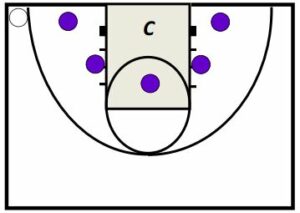
LA is when the ball is entered and you choose one man to double the post.

It is the worst offensive player or the PG.

This is called in practice and games.
 

basketball-drills-shell2

If 1 is worst offensive player, we double team the post with his man.

The double-teamer must have his hands high and make the post use his arms to throw a weak pass.


Shell Drill Duke

basketball-drills-shell3

Bob Hurley uses different calls out of his shell defense.

Duke is when the ball is entered and all 5 guys collapse with their hands raised around post, then return to their man.


basketball-drills-shell4

All 5 players collapse on the ball with their hands up, making the big man throw the ball out using all arms.

Look for bad pass, and steals or tips. Used 2 – 3 times a game to stop big men.


Basketball Drills Hit Ahead Scoring Series

By Brian Williams on January 24, 2014

This is a drill to work on several moves and ways to score.

It was posted in the Fast Model Drills and Plays Library by Fabian McKenzie, Head Women’s Basketball Coach Sydney, Nova Scotia, Canada.

Coach McKenzie has been a head coach at the university level for 15 years, and has been involved as a coach at this level for 20 years.

He has been involved with the Canadian Women’s National team program for the past 6 years.

The Fast Model library has hundreds of plays and drills from coaches all over the world and from various levels of coaching. You can check it out here: Fast Model Plays and Drills Library


You can use this basic structure and incorporate other scoring moves that your players use like floaters or step back shots.

Basketball Drills Hit Ahead Scoring Series

basletball drills

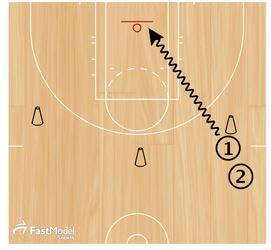
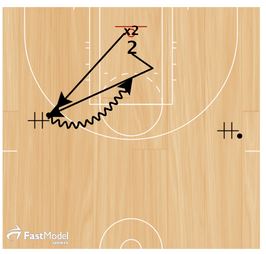
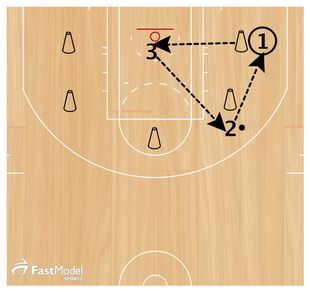
Sprint up court. Toss ball ahead of you simulating a catch at the 3 pt. line.

6 moves at each spot.

Moves are:

1. Spot up – catch and shoot


2. 1 dribble finish with layup – extend and reach to get there.

3. 2 dribble Power Layup -shoulders must be parallel to board on finish.

4. Rip and Go Opposite for layup on opposite side of rim – baby hook

5. One Dribble Pull Up Jumper

6. One Dribble Pull Up Jumper opposite direction

After shooting sprint back to half court and do the next move. You could also do one move at each spot then the next move, then the next, etc.

Coaching Basketball Finding a Way to Win

By Brian Williams on January 23, 2014

Here are some of my coaching takeaways for building a basketball program from Bill Parcells’ book “Finding a Way to Win.”

  • When an organization stays the course and holds fast to their philosophy, through good times and bad, they work from a firm foundation. They gain an identity. They stand for something.
  • Every organization, whether it’s floundering or ruling the roost, needs a calm, clear vision. Only people inside the group can chart its course; outside voices must be kept in their place.
  • Division from within is the most dangerous factor that can ruin any organization.
  • When selfishness is tolerated, the entire organization is in jeopardy.
  • The chances my team takes are calculated – only fools gamble at random. But you can’t play safe and pursue your vision: you can’t shrink from risk and expect others to follow you.
  • Explain what you’re trying to accomplish…when people understand the point of the risk, they’re more likely to give their all, in the effort, and less likely to second-guess afterward.
  • It’s one thing to hate failure; it’s another to fear it.
  • When you fail to give your staff meaningful tasks and input, you wind up with robots and yes-men. You stop getting quality advice and innovative ideas.
  • Every way isn’t my way. The challenge is to find the best way, and then collectively commit to it.
  • Confidence is only born of demonstrated ability.
  • You can’t build an accountable organization without leaders who take full responsibility.
  • Coaches should be judged on three things:
    Do players have a design that allows them to function on game day?
    Are the players prepared to deal with contingencies that may confront them?
    Do the players behave the way the coach wants them to?
  •  A competent coach should be able to field a team that is strategically sound, that plays with discipline, that doesn’t beat itself.
  • Leadership is the most visible thing there is – because if it’s not visible, there is no leadership.
  • No Excuses – excuses and alibis are the main enemies of accountability. On my team we simply don’t accept excuses for failure.
  • Nobody cares what you’re up against. The sooner you put those issues out of your mind, the sooner you can direct your focus toward the real issue: pushing your team toward victory.
  • Establish clear expectations – people can’t become accountable unless they understand exactly what you want.
  • Never blame a game on a player.
  • Be Hard on Yourself–Confident leaders freely admit their own mistakes. And by doing it publicly, they set an example for others to take responsibility.
  • Without new ideas, your organization will stagnate.
  • Coaching is an act of communication – of explaining what you want of people in a way that allows them to do it.
  • I consider preparation the most enjoyable part of my work, and the most challenging. To the extent my teams have succeeded, I’d say that solid preparation – not talent or strategy – was the primary factor.
  • The more you prepare beforehand, the more relaxed and creative and effective you’ll be when it counts.\
  • We don’t want our players to think during a game we want them to react – thinking takes too long. Have the correct moves ingrained in practice so instinct guides them to the right place at the right time.
  • A team’s practices will predict its performance just about every time.
  • Whenever I send my team into a game with some new wrinkle or adjustment they aren’t fully prepared for, it blows up in my face more often than not.
  • Well-prepared leaders plan ahead for all contingencies, including the ones they consider unlikely or distasteful.
  • Good Preparation begins with Organization:Before my staff meets with our players, we have to budget our time for the week, set our priorities. We decide which points we’ll emphasize in depth, what we’ll go through quickly, and what we’ll skip altogether.
  • People perform most reliably when they’re sure they can handle the task at hand-and that sureness comes only with specific preparation.
  • When leading a group toward important achievement, don’t compromise your standards based on people’s complaints or conventional workloads.
  • You’re constantly balancing mental preparation against physical wear and tear. As the old saying goes, you want to work smarter, but not always harder.
  • I emphasize the obvious all the time, especially with a younger team, because it’s the obvious things that beat you if they’re not taken care of.
  • The road to execution is paved by repetition.
  • Be a Teacher, Not a Drill Sergeant
  • To teach you have to listen as well as talk. When we experiment with something new in practice, our players’ feedback is invaluable.
  • Trial and error is part of the process; it’s rarely fatal to try something and fail. The greater danger lies in hiding behind tradition while the world keeps turning. Resourceful managers tinker and adapt until they find the winning formula.
  • There are always problems on a football team, as in any other business. And there are coaches, and managers, who can sit around indefinitely expounding upon those problems. Those people will not help you find a way to win.
  • Resourcefulness is simply resilience – a refusal to quit or give in, even when all seems bleak.
  • You’re not truly successful until you’re challenged at the top level of your ability – and you consistently marshal your best effort.
  • The main threats, the ones that tear you down, are all internal: complacency, distraction, all the petty jealousies that come with the distribution of credit.
  • In a competitive environment, to remain the same is to regress.
  • Measure Excellence by Performance, not Reputation.
    • I wouldn’t ask a player to do something I wouldn’t do with my own kids. I don’t want them to think that I would ever compromise them.
    • The team that makes fewer mistakes will generally get the opportunity to win, even when the opposition has more talent.
    • The disciplined team has to get beat by somebody; it refuses to beat itself.
    • There is always a way to compete, even against superior forces, but it requires strict adherence to a calculated plan.
    • Mental errors reflect poor concentration or inadequate preparation.
    • A Physical error can also result from poor concentration, but physical errors are typically caused by an athletic mismatch, where you’re up against someone whose ability is greater than yours.
    • What sets disciplined people apart?
      The capacity to get past distractions
      Focus on the task at hand.
      The willingness to condition mind and body for the task at hand
      An ill-disciplined body makes for a weak mind.
      The ability to keep your poise when those around you are losing theirs.
    • Organizations can’t improve without setting the highest standards. But they also need to measure achievement against their real potential at a given time.
  • What the quick-fix guys miss is that there’s a process at work here – there are steps you need to take to build a successful organization, and if you try to skip one you’ll trip.
  • The disciplined course isn’t always the daring course or the exciting course. It’s the course that gives your organization the best chance to prevail.

If you are interested in reading some samples from inside the book or purchasing the book on Amazon, you can either click the link below or click the image of the book cover.

Finding A Way

Basketball Drills Wichita State 1 on 1 Defense

By Brian Williams on January 22, 2014

This is a 3 minute and 30 second video of former Wichita State Head Basketball Coach Gregg Marshall going through a one on one defensive drill during a Wichita State practice.

Make sure your sound is on as you watch.

If you are interested in learning more about the entire DVD that this sample came, click this link. Anyone who purchases anything from the store receives one of my basketball coaching eBooks as a bonus. Just email me and let me know which one you would like to receive!


Make sure your sound is on.

If you are interested in learning more about the entire DVD that this sample came, click this link. Anyone who purchases anything from the store receives one of my basketball coaching eBooks as a bonus. Just email me and let me know which one you would like to receive!

  • « Go to Previous Page
  • Page 1
  • Interim pages omitted …
  • Page 76
  • Page 77
  • Page 78
  • Page 79
  • Page 80
  • Interim pages omitted …
  • Page 96
  • Go to Next Page »

Primary Sidebar

  • Twitter
  • Facebook
  • Linkedin
coachestoolbox
personaldevelopmenttoolbox
basketballplayerstoolbox
basketballtrainer
athleticperformancetoolbox
coachingbasketball

© Copyright 2026 Coaching Toolbox

Privacy Policy