• Skip to primary navigation
  • Skip to main content
  • Skip to primary sidebar

  • Basketball Plays
    • Ball Screen Sets
    • Horns Sets
    • Man to Man Post Up
    • Man to Man Isolations
    • Backdoor Plays
    • Man to Man 3 Point Shot Plays
    • 2-3 Zone Attack
    • Baseline Inbound Plays
    • Sideline Inbound Plays
    • Combination Defense Attack
  • Drills
    • Defensive Drills
    • Offensive Drills
    • Competitive Drills
    • Passing Drills
    • Rebounding Drills
    • Shooting and Scoring Drills
    • Toughness Drills
    • Transition & Conversion Drills
    • One on One Drills
  • Blueprint
  • Practice
  • Mental Toughness
  • Skill Development
  • Offense
  • Defense
  • Store

Basketball Drills

Basketball Drills Convert to Defense

By Brian Williams on January 21, 2014

Our teams convert to defense after almost every offensive possession-other than dead ball turnovers.

It is also much tougher to score against our set half court defense.

That makes it important that we work at being very good in our conversion defense.

These 3 drills are conversion defense drills from the previous post:

Another aspect of conversion defense that I never practiced enough was converting after we miss (or make) a free throw. It happens a lot in games, but isn’t practiced enough, in my opinion.

“Things Basketball Teams Do a Lot” You Can view that post by clicking here: “Things Basketball Teams Do a Lot”

All of this information came from Coach Mike Neighbors, Arkansas women’s head coach.

Tip Drill

tip-drill

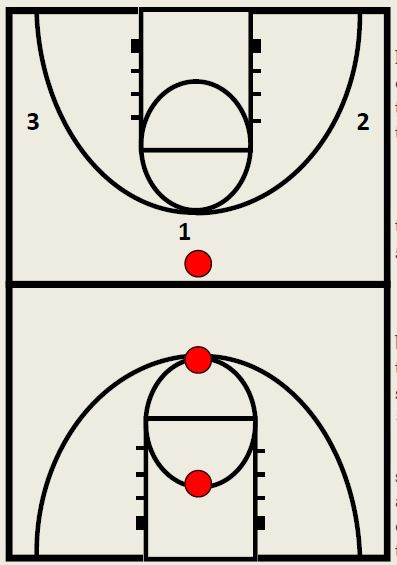
Drill begins with teams divided into two colors… Purple and White for the Huskies.

They are lined up alternating colors in a line stretching toward half court. Allow two players from the defensive team to start near half court to simulate our FULLBACK and HALFBACK transition responsibilities.

On the whistle the ball is tipped onto the glass with tipper going to back of line and next player keeping the tip going. When the ball is in hands of the offense coach blows whistle again (or yells shot). The offense goes in transition as the defense retreats.

We go until we get transition stopped. As the season progresses allow offense to flow into action that you must defend as well. Change what you allow as the season goes to create variation and emphasis.

We make the drill competitive by putting 4:00 on the clock. The clock runs during the time the ball is being tipped off the glass and is in live play. If the defense is successful in their efforts the clock stays on the time when the ball is stopped. For example, after first tipping it might be at 3:38. If the defense however is unsuccessful the clock is re-set to 4:00. This builds toughness.

** Once the team gets the time into the 2:00s you reset to 3:00 rather than 4:00. Once the get into the 1:00s you reset to 2:00 and so on until the clock reads 0:00…

Get Back Drill

basketball-drills-get-back

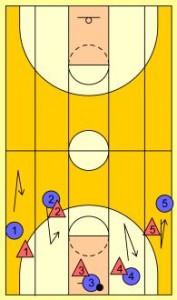
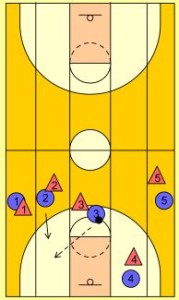
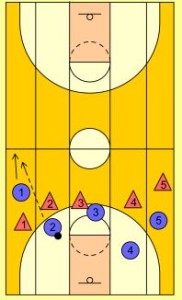
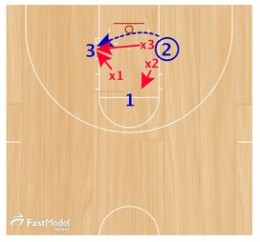
Players 1 and 2 are on defense. Players 3 and 4 are defenders. Coach has the ball. Tosses the ball to 3 or 4. 1 turns and SPRINTS back as the FULLBACK. 2 then must SPRINT back to get AHEAD of the BALL and try to slow the attack.

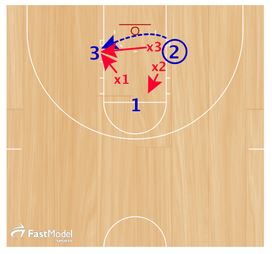
In diagram 2, we have added player 5 on offense and player 6 on defense to simulate 3-on-3 play.

We will slowly begin to add players and manipulate the number of defenders to get the advantage/disadvantage situations in which we drill.

To add to fun of the drill, after the coach passes the ball to the offense we will turn and using a blocking pad try to impede the progress of the last defender.

Progressive Fast Break

basketball-drills-progressive-fast-break

Great drill for teaching transition offense and defense simultaneously. Also stresses importance of making FT’s, taking advantage of “numbers” situations.

Divide team into two colors. Try to get even number of guards and forwards if possible but not critical. We score the drill as a normal game with 1s, 2s, and 3s.

White team player a White team player attempts a FT. Two Blue defenders play the make/miss. The white player converts to defense.


basketball-drills-progressive-fast-break2


Once the possession is complete without stopping the action, two additional white team players come from the baseline to join the original white team player as they attack the two blue team players who are retreating into a 3‐on‐2 advantage/disadvantage situation. Complete
this possession then without stopping add TWO blue team players and they attack in a 4‐on‐3 situation… this continues until you have built it into a 5‐on‐5 situation. At the completion of the 5‐on‐5, start again with BLUE team player attempting a FT.


Coaching Basketball: Free Throw Attack

By Brian Williams on January 16, 2014

This post is an edited summary of a series of posts that Coach Brian Anglim made regarding ways of being intentional about getting to the free throw line.

A big movement in the basketball world has been the usage of advanced analytics. Author’s such as John Hollinger and Dean Oliver have offered great insight into how games are won and lost. I first got into statistical analysis when I read the book “Basketball on Paper” by Dean Oliver. A big concept in this book is offensive efficiency, which is measured by calculating the number of points a team would score over a period of 100 possessions. It is a great way to measure how effective a team’s offense is disregarding the pace of the game. For example, watching Georgetown might seem like a great offense but they don’t seem to score much? The reality is they are a very efficient offense but they don’t score a lot of points because they use so much clock they get a limited number of possessions. These types of advanced stats allow a coach to go beyond the scoreboard.

Digging deeper into these numbers we can hope to discover what factors create a great offense. Some interesting insights that I got from Vance Walberg, is the point value of different types of shots. For example:

  • Inside Shots: teams shoot 60 percent on these shots; being worth two points per successful attempt you get 1.2 points per attempt
  • 3 Point Shots: teams shoot 35 percent on these shots, but being worth three points per successful attempt, you get 1.05 points per possession.
  • Free Throws: teams shoot .70 per free throw, when you calculate the value of two attempts you get 1.4 points per 2 shots
  •  

  • Mid-Range Shots: The percentage on these is barely higher than that off three point attempt. Let’s say for this example our team shoots 43 percent from the mid range (which is high number), on a per possession basis they would score .86 points per possession.

Going through this exercise we can develop a hierarchy of the type of shots we are looking for from our offense. Free throws are by far the most efficient shot. So, it would stand to reason that should be the shot you are striving for. What types of shots are you trying to get out of your offense? The standard answer is open shots, but what type of open shots? Layups, threes, mid-range shots, or shots that give you a chance to get to the free throw line? We should be designing our plays, offenses, and teach fundamentals skills that lead to the three most advantageous shots – free throws, shots in the interior (which often lead to free throws), and threes.

Getting fouled is a mistake made by the defense, but there are a number of things that you can do to encourage teams to make this mistake. Not only by its points-per-possession value are free throws efficient but it puts teams in foul trouble, gets them into the bonus sooner, and also gives you a chance to score a three point play.

Here are some considerations when designing your offense to get to the free throw line:

1. Isolation actions
2. Low Post Attack
3. Driving Game
4. Transition Attack
5. Cutters
6. Offensive Rebounding

No single shot statistically has a greater effect on on-court offensive success than the free throw. Offensive efficiency needs to be seen not only in field goal percentage but in fouls drawn from the opponent.

Many coaches see the “foul line game” won with post play. I think this is a limited view as there are multiple ways to get the ball in the post/paint area. An idea I got from Don Meyer was to chart paint touches and how you got those touches. These could be from post touches, penetration, cuts, screens (curl cuts need to be an attacking cut), transition, and offensive rebounding. Big guys own that low box game but to have a balanced attack you need to also work on your penetrating “foul line attack”.

Finishing Skills

The most basic layup is the speed layup. This is the classic inside foot, high jump off of one foot shot that players need to be able to execute full speed. It’s the uncontested layup that we often see on the fast break. However most half court layups are contested and these are the type of layups that lead to three point players. You need your players to hunger for three point plays rather than settle for two.

Below I will list six different types of layups that will improve your player’s ability to make contested finishes.

With all of these attacking finishes, the player needs to “finish strong”. In my mind, “finishing strong” means that we are looking for contact so that we might play off of it. It means that we are going to have a strong grip on the ball, maintain a strong posture to handle the contact, and most importantly to concentrate solely on that finish and not even think about the hit we might take. Our players need to know what it is and practice being that type of player.

1. Reverse Layup – this is where we extend the ball to the other side of the rim, to protect against the shot blocker. We once again encourage the player to get a shoulder or hip into the defender and then extend to the other side of the rim. Players need to be able to make this shot with either the inside or outside hand depending on the defenses position. A big key to this layup is to extend up and outward in your jump. For speed layups we talk about taking off like a rocket, for a reverse layup we want to take off like a jet.

2. European Step – the European game has definitely invaded America. The “Euro Step” has become a staple of any advanced player. The European step is a direct step at a defender followed by a lateral step to avoid that defender. You get the defender thinking you are going right at him and then step laterally to avoid him and finish the play. Despite attempting to avoid contact I am constantly seeing players get fouled on this move, the the defender will often hip check the player.

3. Extended Layups – this is the layup where we extend our layup hand outward away from the defense. This is something we might do if a player is riding us on our hip and we need to move the ball away to make that finish. In this type of finish, we crave contact as it allows us to pin a player to one side of our body and use the extended hand to keep away from the defense. A great term I heard was to “lay the ball up with long limbs”.

4. Power Layup – this is the where we get the shoulder of the offensive player into the middle of the chest of the defensive player. If we can achieve this position, the defender will have to go across the body of the offensive player to get to the ball. This is a great way to get fouled.

5. Inside Hand Layup – the “fundamental” way we teach layups is always with the outside hand, but sometimes we have the defender on our outside shoulder. Going through the fundamentals way would expose the ball. In this instance, an inside hand finish would be most appropriate, you see “Princeton” offense teams master this type of layup as there back cuts often lead to it.

6. Wide Layup – this is another finisher that doesn’t lead to many fouls, but is a necessity to prevent defenders from drawing a charge. In this move we take a driving angle toward the post box instead of at the rim, this angle forces the shooter to extend his layup into a hook like shot. This was a type of finish that I first heard about from Hubie Brown, he referred to it as a running hook. The key to this type of finish is that we drop the shoulder so we can really extend the ball up. Here is a great video of the shot and how to drill it. He has some other interesting finishes as well.

Basketball Drills Closeouts

By Brian Williams on January 15, 2014

These 3 drills to work on keeping the ball out of the lane are a follow up to the article I posted from Coach Mike Neighbors entitled:

“Things Basketball Teams Do a Lot” You Can view that post by clicking here: “Things Basketball Teams Do a Lot”

One of those things that the article discusses as something that basketball teams do a lot is closeout.

These three basketball drills are designed to give you some variety as you drill closing out.

All of this information came from Coach Neighbors weekly basketball coaching email newsletter. If you are interested in being added to his list, let me know and I will forward your email address on to Coach Neighbors.

I will post the remainder of the drills next week.

Again, these drills are attributed to University of Washington Women’s Head Coach, Mike Neighbors.

basketball-drills-sideline-closeouts

Sideline Closeouts

Position 3 chairs along each sideline. We place a ball in the seat of each to simulate that chair as a player being a ball handler.

Coach on each side between the chairs.

Three defensive players at “on the ball”, three defensive players start along the mid‐line in “help”

Coach with ball passes across court to other coach.

Defensive players that were in “help” sprint to close‐out to the chairs on the AIR TIME of the pass.

POINTS OF EMPHASIS

Key Elements to a great close out:

1) Move on the Air Time of the ball: a great defender moves from position to position while the ball is in the air.

2) Start with sprint end with a chop: the first two steps are a dead sprint while the ball is in the air and ends with feet chopping as they approach the offense player

3) High Hands/Low Shoulders: as the feet are chopping, the hips/butt go down as the hands go high. The low hips/butt defend against the drive and the high hands take away vision
for pass or shot.

The ability of each offense player effects each defenders close out. If we are closing out to a player who can stroke the 3 but can’t score off the bounce, we will close out a little tighter. If the opposite is true, the hands will still be high to take away a quick post pass but the close out with shorter to take away catch and go drives.

Storm Closeouts

Another good way to work on the all important technique of closing out on defense. Also simulates good transition defense and places premium on talking and communicating.

basketball-drills-storm-closeouts

Another good way to work on the all important technique of closing out on defense. Also simulates good transition defense and places premium on talking and communicating.

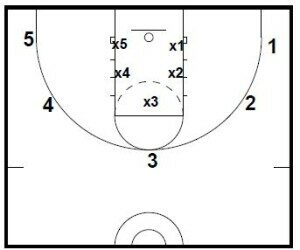
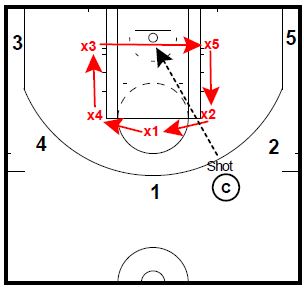
Three X defenders in triangle around basket. Coach initiates action with pass to the wing.

All defensive players close out and we play moving the ball from side to side then coach takes a shot. Defense has three on two advantage so we hope to get every rebound.

basketball-drills-storm-closeouts2

On the rebound and or a steal before the shot goes up, the three X players become offense and go in transition 3 on 2 against the O players minus the coach.

You can make this competitive by scoring the offense and splitting into two teams. Teach the techniques you teach on closeouts, defending on ball, and rebounding.

Brooklyn Closeouts

basketball-drills-brooklyn-closeouts1

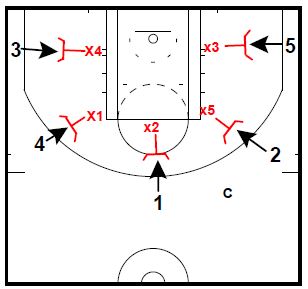
Defensive players begin in GAPS

Coach bounces the ball to initiate drill. On the bounce the defense slides to touch hands then back to their GAP.

basketball-drills-brooklyn-closeouts2

Coach makes a pass. Player closes out and others jump to GAP. Each time the ball returns to the Coach…

Once coach is satisfied with the drill, bounce the ball again…

All 4 defensive players sprint to paint to celebrate Volleyball style (you know how they all come together after a good or bad play!!)

Basketball Drills Team Fire

By Brian Williams on January 14, 2014

This is a short video of a tweak to the 3 on 2 continuous full court transition drill that can be used as a toughness drill.

Make sure your sound is on as you watch.

The drill starts out as “no dribble” and then the players are allowed one dribble at about the 3 minute mark.

My other takeaway from this drill is calling “other way.” I believe it is important to tell players why you are giving possession to the other team, but it is a great way to emphasize your teaching points.

Players don’t pay attention to your fundamental areas of emphasis, so they lose the ball in practice, just like they will in a game when they don’t pay attention to details.

The drill is a sample from the All Access Practice DVD with California State Junior College Championship Coach Ed Madec. Click the link for more information about the DVD. All Access Basketball Practice with Ed Madec

Click the play arrow to see the video.

https://coachingtoolbox.net/wp-content/uploads/2014/01/BD-04246_2.mp4

Basketball Drills Defend the Lane Drills

By Brian Williams on January 10, 2014

These 3 drills to work on keeping the ball out of the lane are a follow up to the article I posted from Coach Mike Neighbors entitled:

“Things Basketball Teams Do a Lot” You Can view that post by clicking here: “Things Basketball Teams Do a Lot”

One of those things that the article lists is keeping the ball out of the lane.

These three basketball drills are designed to help your team work on that.

All of this information came from Coach Neighbors weekly basketball coaching email newsletter. If you are interested in being added to his list, let me know and I will forward your email address on to Coach Neighbors.

I will post the remainder of the drills next week. I was hoping to have them all up today, but ran into some weather related difficulty.

Again, these drills are attributed to University of Washington Women’s Head Coach, Mike Neighbors.

30 Second Shot Clock

This is one of our best half court drills to work on 5 on 5 team defense.

If you play without a shot clock, you could change the name of the drill to reflect the last possession of the game.

The idea is to instill in your defense the importance of playing good team defense repeatedly in the most adverse situations.

Rules

The clock begins when the offense initiates the ball with pass or dribble. The possession is played out.

The clock remains at the time it is if the defense is able to come up with a defensive stop. The offense then resets with
the clock showing the new time. So basically the defense will need to play perfect defense until the clock reads 00:00

But if at any point the offense scores, gets an offensive rebound, or an uncontested shot the clock is reset to :30

During the possession if the defense deflects and pass or creates a turnover, three seconds are run off the remaining time. If they
are able to take a charge there is a five second run‐off.

Additional things to add as you get the hang of the drill:

Reset on post player catching it two feet in the paint
Reset on getting beat to the outside off the bounce
Reset for not communicating on defense
Offensive rebounds

This drill gets intense and must be officiated or it will get ugly.

We try to complete this drill twice in 8 to 10 minutes…

N the Paint

basketball-drills-defend-the-paint

Defensive players begin in BALL and GAP positions.

:30 seconds on the shot clock

Use the area we tape down for every practice to simulate our POST and our RACK ZONE as the target zone for the offense. (See Diagrams Above)

The offense is attempting to drive the ball into the taped down area. Every time they can get a foot into that area, they earn a point.

The offensive players without the ball must stay beyond the three point line but can move in relation to penetrations.

As the season progresses we will allow them to screen and cut, but to begin they can only SPACE.

The offense uses the entire :30 to earn as many points as possible.

If the defense can force a turnover, it does complete the possession.

They will quickly learn they had better get the steal if they gamble. If they don’t get it, the offense will rack up point after point.

We will flip over after each :30

We usually play to 15 or for a set number of possessions.

This drill can get sloppy when the offense takes too many chances.

So we will also implement our TURNOVER RACK to discourage out of control play

(Turnover Rack is a rack of balls visible during our practices. Once the ball gets empty, we condition)

STOP-SCORE-STOP

basketball-drills-score-stop-score

This drill is best introduced as a 3‐on‐3 situation. As the sequence of a STOP‐SCORE-STOP is repeated and as the season progresses making it a 4‐on‐4 and ultimately a 5‐on‐5‐on‐5 situation will maximize the time and also create the most game like scenario possible.

With a large team you can have this going on both ends with winning teams advancing to play each other as needed.

Divide into two 3‐on‐3 colored teams.

Blue starts on offense. White on defense.

The main idea to communicate is that each possession either finishes in a STOP or a SCORE.

When a team comes up with a STOP they then must follow that with a SCORE to keep their sequence going. If that team completes the next possession with a defensive STOP they EARN a point.

We will either play this drill to a certain number of points or for a set amount of time.

This is another drill that works both offense and defense simultaneously.

DEFENSE: Teaches the importance of finishing possessions either with rebounds or steals or tying up loose balls. It teaches great communication. It teaches your players how quickly momentum can swing.

Things Basketball Teams Do a Lot

By Brian Williams on January 9, 2014

This article is from University of Arkansas women’s head basketball coach Mike Neighbors and one of his Newsletters. Coach Neighbors has an outstanding newsletter. If you are interested in subscribing, email me and I will pass along your interest and your email address to him.

“Be good at the things you do a lot”

from Coach Mike Neighbors

This article was written while he was coaching at Washington.

While John Wooden’s record for NCAA Championships may never be broken, I believe the greatest coaching feat of my lifetime has been Pete Carril winning 500 games, earning 11 NCAA tourney berths WITHOUT a scholarship player!!!

I can still remember watching the back-door cut his Princeton Tigers ran to beat the defending National Champions, UCLA, in 1996.

And while I am not nearly smart enough to teach the Princeton offense, I have studied almost every other aspect of this great coach and his career.

Of all his great teaching points, the one that I have used the most is this:

“Be good at the things you do a lot”

Maybe it’s the simplistic side of me, but to me that is just about the most brilliant, simple thought ever.

So… what things do you have to do a lot to be a good basketball coach, a good basketball player, and a good basketball team.

Today, I will share with you the FIVE things that I have done myself, with our teams, and with our players over the last 35 years.

THINGS WE DO A LOT AS COACHES WITH OUR TEAM

1) LEAD: All eyes are on you…always. You are actively and inactively doing this at all times with your team. Your words and your actions are heard, observed, and emulated. There are literally 1000s of books to help you with ideas but ultimately you must develop your own style and your own tactics. Email me for my favorites at [email protected]

2) LISTEN: Hearing and listening are two completely separate things. You must listen to your staff, your players, your managers, your athletic trainers, your administration… You surround yourself with good people. So, listen to their ideas, their critiques, their problems. This builds TRUST and TRUST builds championship cultures and identities.

3) COMMUNICATE: Your ability to do this as a coach has direct reflection on quality of your program and the quality of the people associated with it. In the iY Generation there is still no better way to make someone feel special than a handwritten note. A face to face encounter shows importance. Don’t totally discount the value of the technology we all have access to. Text message, face book, Twitter, and Instagram should all be resources in your arsenal. Follow me @coachneighbors on twitter or “nabes22” on instagram for examples on how I connected with people.

4) MAKE DECISIONS: “The Village Idiot can do 95% of your job, boy. It’s the 5% of the things you have to do that separate you from them.”- Papa Neighbors. I grew up with that advice in my ear from a young age no matter what I was doing. As a coach it couldn’t be more true. You must make the decisions that will mold your team and your program. You get paid to be right more often than you are wrong. It takes experience. If you don’t have experience…READ!! Email me for faves on this.

5) PRACTICE: Over the course of a full calendar year, you practice at least 5 times more often as you play a game. You must be good at planning and executing a practice. Every effective practice I have ever planned took at least twice as long to plan than it does to execute.

THINGS WE DO A LOT AS COACHES WITH OUR TEAM/PLAYERS

1) REBOUND: Over the course of a game, we have 550-600 rebound chances…

a) Get 1, Get 2, Get 3 Rebounding
b) High/Low Rebounding
c) Triangle Rebounding

All three of these drills are posted below.

2) CLOSE OUT: No matter what defense you play, you will do this A LOT!!

a) Sideline Closeout
b) Storm Closeouts
c) Brooklyn Closeouts

Here is a link to the closeout drills

3) TRANSITION DEFENSE: % wise you are in transition D more than 1/2 court

a) Tip Drill
b) Get Back
c) Progressive Fastbreak

Click here to see the conversion defense drills

4) DEFEND PENETRATION: Every offense relies on ability to break you down

a) 30 Second Shot Clock
b) N the Paint
c) Stop Score Stop

Click here to see these three drills

5) DEFEND BALL SCREENS: Few games pass without having to defend these

Click here to download the Washington Pack Line Defense

THINGS YOU NEED TO DO A LOT TO IMPROVE YOURSELF

1) READ: “The man who chooses not to read is no different from the man who can NOT read”. You MUST make time to read. It’s the only way to gain experience. It’s the only way you will catch up to coaches who have more experience than you!!

2) WRITE: When you put your thoughts on paper and in ink, they become yours. Your words become your philosophy. If you have everything “in your head” it’s not stated. And until you STATE them, it’s simply not yours. Choose a simple topic… Rebounding… Write out your thoughts. You will be surprised how much thinking you will do on it before you are willing to share with someone else!!

3) OBSERVE: Go to clinics. Attend practices. Watch DVD’s. Go on-line and use YOUTUBE or VIMEO. You can spend hours on hours. I have been watching NBA TV Training Camp and getting new ideas every hour. Again you are making the choice to or NOT to learn from others. If you already KNOW IT ALL, let me know so I can come observe YOU!!

4) REACH OUT: There are so many resources out there. If you aren’t reaching out to others, you are losing ground to those who do. There are coaches all over the country willing to share. There are blogs. There are Newsletters. There are YOUTUBE channels. All with coaches willing to give back what others have shared with them. As Don Meyer shares “collect all the good ideas whether you use them OR not”.

University of Washington Hi/Low Rebounding

uw-rebounding-drills1

Divide teams into two colors. Each team will have a player at the elbow, the block, and the wing behind the 3‐point arc.

Coach will pass ball to the player beyond the arc to initiate the action.

White team elbow player sets a legal screen on the blue team player sprinting from elbow to contest the shot. White team block player fights for space against blue team player crashing from opposite block.

White team player who receives pass from coach attempts a shot against the contest of player fighting through the screen. Blue team player from elbow sprints to fight for position against the white team player who just set the screen.

Action is repeated with Blue team receiving the pass from the coach.

We will play to a certain score or a certain amount of time, then move the shooters to the corners. This forces the defensive player
from the block to sprint to contest.

Keys to this drill:

1) as coach you can control the amount of physical contact you allow
2) you can also vary the amount you allow the screens to be moved.
3) The crispness of your pass will determine how much time your shooters have to get their shot off

University of Washington Get One, Get Two, Get Three Rebounding

uw-rebounding-drills2

We use our men’s practice team as the offensive rebounder in this drill. If you don’t have a full team of men’s players, borrow a JV player from them for a drill. Worst case scenario pick your own best offensive rebounder (or two) and incentivize the drill for them somehow.

Line up the rest of your team.

The offensive rebounder has a football blocking pad in one hand. The defender will HIT the pad. The defensive rebounder must keep the offensive player from rebounding the miss. If the offensive player can get the ball with a pad in one hand the defensive player must go again.

We have ten players, so we put 8:00 on the clock. The entire team must get a rebound versus the offense to complete the GET ONE.

After we complete GET ONE, we add a 2nd offensive rebounder. Now your team must GET TWO in a row before we rotate. Again, we go through the entire team.

Then we add a 3rd… Now we must GET 3 in a row to complete the drill.

If we can do that in 8:00 we have done a pretty good job

Keys to this drill:

1) Create realistic misses
2) Demand HIT/GIT techniques
3) Create atmosphere of toughness

Once you consistently GET THREE, try to GET 4… We have yet to accomplish it in 8:00 but creates a ceiling to shoot for after the GET 3 becomes routine.

University of Washington Triangle Rebounding

uw-rebounding-drills3

White team players have blocking pads. Coach has ball. Coach starts dribbling the ball and blue team players begin rotating clockwise HITTING the pads of each player as the do. HIT should be quick and forceful.

When coach picks up dribble to shoot, players call shot and HIT the pad they are closest to then GIT the rebound.

We do this until each of the players have gotten a rebound, then we flip it over. We also do until the group gets a set number as a team before flipping. Always focusing on the TECHNIQUE as we are developing TOUGHNESS.

Variations:

Drop the pads and allow the offense to go live to simulate true game situations and also work on your offensive rebound.

Move coaches shots around to various spots

  • « Go to Previous Page
  • Page 1
  • Interim pages omitted …
  • Page 77
  • Page 78
  • Page 79
  • Page 80
  • Page 81
  • Interim pages omitted …
  • Page 96
  • Go to Next Page »

Primary Sidebar

  • Twitter
  • Facebook
  • Linkedin
coachestoolbox
personaldevelopmenttoolbox
basketballplayerstoolbox
basketballtrainer
athleticperformancetoolbox
coachingbasketball

© Copyright 2026 Coaching Toolbox

Privacy Policy