• Skip to primary navigation
  • Skip to main content
  • Skip to primary sidebar

  • Basketball Plays
    • Ball Screen Sets
    • Horns Sets
    • Man to Man Post Up
    • Man to Man Isolations
    • Backdoor Plays
    • Man to Man 3 Point Shot Plays
    • 2-3 Zone Attack
    • Baseline Inbound Plays
    • Sideline Inbound Plays
    • Combination Defense Attack
  • Drills
    • Defensive Drills
    • Offensive Drills
    • Competitive Drills
    • Passing Drills
    • Rebounding Drills
    • Shooting and Scoring Drills
    • Toughness Drills
    • Transition & Conversion Drills
    • One on One Drills
  • Blueprint
  • Practice
  • Mental Toughness
  • Skill Development
  • Offense
  • Defense
  • Store

Basketball Drills

Basketball Drills Toughness

By Brian Williams on November 14, 2012

I found these toughness drills on the Xavier Men’s Basketball Newsletter Site.

If you are interested in seeing other issues of the newsletter, click here:

Xavier Newsletter

I hope that these drills give you some ideas that you can modify and adapt to fit your program.


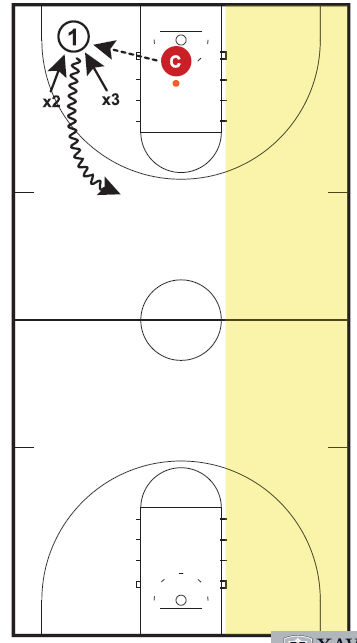
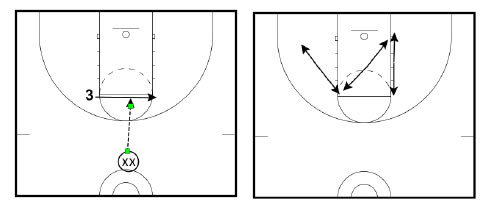
Full Court Guard Toughness

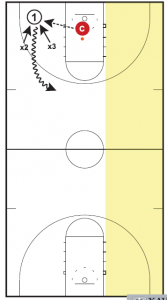
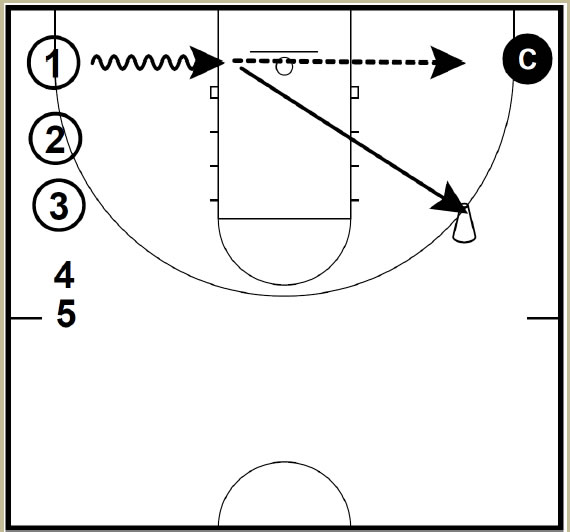
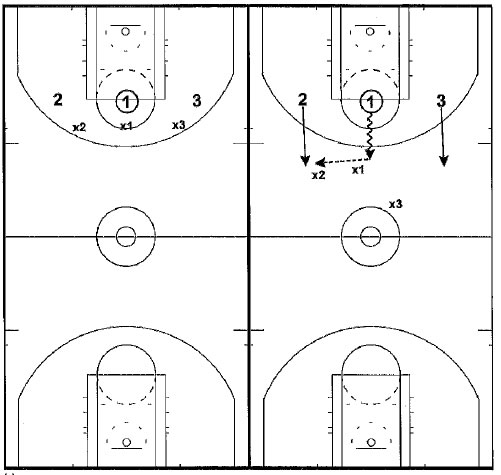
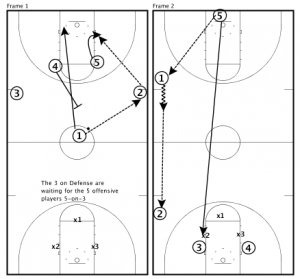
1 guard attempts to advance the ball against 2 defenders

Either split the defenders or attack the slower of the two

Cannot use the shaded area of the floor

Make sure that players understand that this is an overload toughness drill. If players are double teamed in a game, look to pass the ball.

I like to make the drill competitive and use the following scoring system. Each individual in the group of three is competing by him or herself against the score of the other two individuals.

4 points if the offense draws a foul (We don’t want the defense to foul when trapping) or scores a basket

3 points if the offense beats the 10 second count and can keep the dribble alive (without a five count) for a total of 15 seconds without a turnover.

2 points if the offensive player crosses half court and has to pick up the dribble, but holds the ball without being stripped, tied up, or getting a five count.

1 point for the offense for a 10 second or 5 second turnover (we don’t want to lose the ball in live turnover

0- points for losing a live ball. If the defense scores that lost ball, each defender receives 2 points.

[thrive_leads id=’17313′]

Straight Line Toughness

Basketball Drills

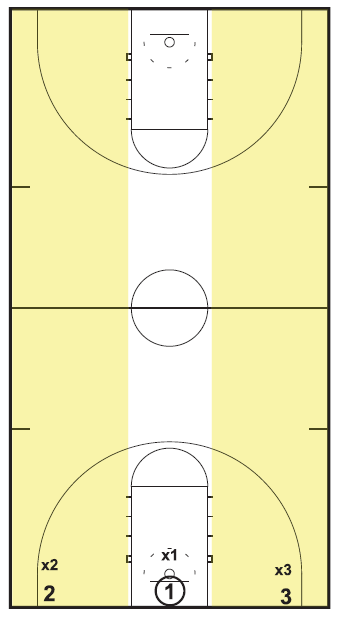
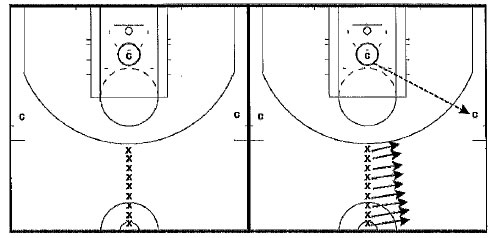
The goal is to advance the ball up the floor. Offense gets 1 dribble. Defense needs to stop the ball from being advanced.

Players on offense must stay in their designated lane.

Offense must make game cuts to get open. Look to beat the defense deep using north and south dribbles.

Option: You can make a rule that the ball always has to go to to the middle player.

To make this competitive, time the offense to get to the opposite endline, or give the offense a point per pass. They stay on offense until the defense deflects a pass or creates any kind of turnover or violation including traveling.


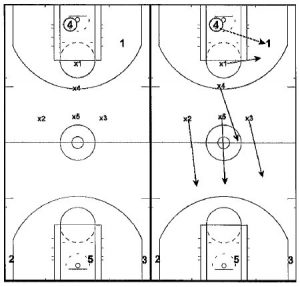
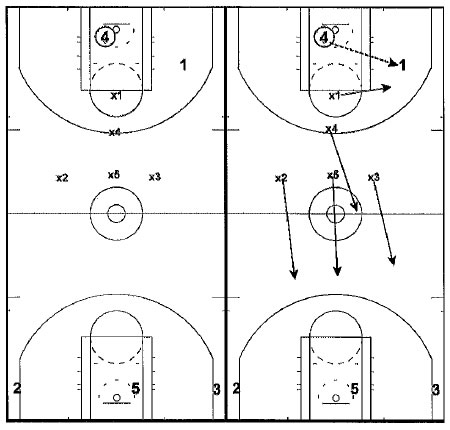
3 on 2 Fullcourt Toughness

Basketball Drills

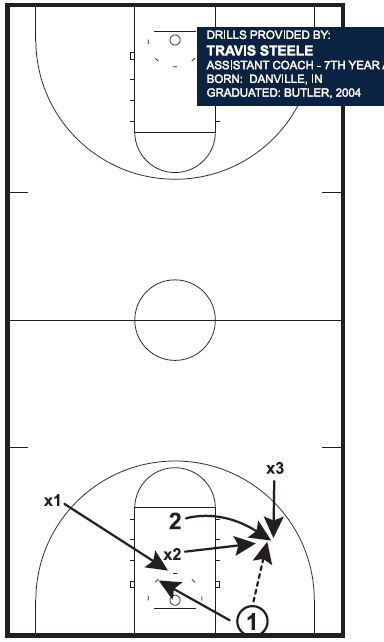
Offense gets two dribbles.

Defense traps and rotates.

When in a trap, don’t shift weight back.

Determine a scoring system that fits the purpose of the drill for your program. Put players in teams of 3 with one offensive player out for each possession,

If you are a trapping and pressing team, give the defense points for deflections and turnovers caused. If your purpose is to work on being strong and tough with the ball, use a scoring system similar to the one above for 2 on 1 offense.
Always fit the scoring system of your drills to reward playing the style you need to play to win and reward the fundamentals and techniques that you emphasize and teach.

Basketball Shooting Drills Baseline Drift Shot

By Brian Williams on November 9, 2012

This shooting drill is from the September St. Edward’s University Men’s Basketball Newsletter.  I hope that you can use it to add to and to compliment your basketball shooting drills.

Scroll down for a diagram of this basketball drill

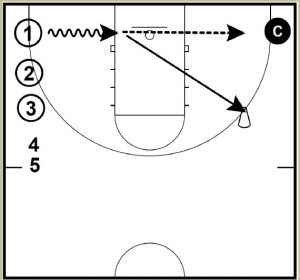
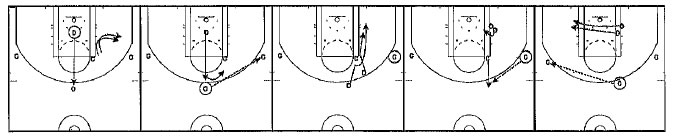
This drill is designed to work on the baseline drive and drift with guards and wings.

Player (1) will attack off the dribble from the corner. Player (1) will rip, dribble baseline, and pass the ball to the coach in the corner.

Player (1) must hit the coach in the hands. If the ball is delivered right into the coach’s hands, Player (1) will be rewarded with a shot on the ball side wing.

The description is continued below the diagram

Basketball Drills

If the pass is not on target, the coach will drop the pass.

Recommendation: Do this drill for two minutes at two different hoops.

Have two groups compete against one another for the highest score. The team that losses will run.

Basketball Drills Post Play

By Brian Williams on October 26, 2012

These basketball drills for post players are from a clinic given by Coach Kevin Eastman.

Coach Eastman was an assistant with the Boston Celtics and LA Clippers specializing in player development.

He became the Clippers VP of Basketball Operations and has since retired from the NBA.

He now is a professional speaker for coaches, teams, as well as business organizations.

He is one of my favorite coaches to learn from.


Follow Your Pass

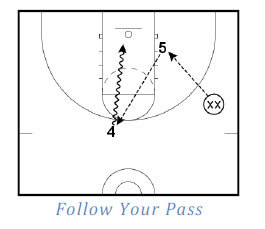
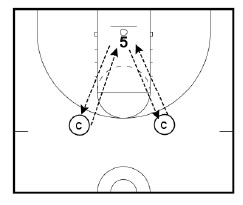
Coach feeds the post
Post catches with one hand and
throws a one hand push pass to 4
# 4 catches and rips thru to a left hand lay up
Rotation is follow your pass
 

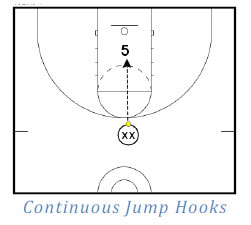
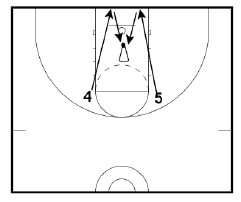
Continuous Jump Hooks

Alternate right and left hand
Can also call in the air “right” or “left”, and that must be the direction that he turns


Circle One on One- Slide in circle, when coach passes, second guy is on defense (no diagram)


Shoot for Fouls- Don’t let the defender into your shooting hand


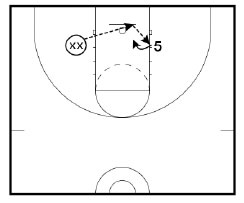
Clifford Ray Drill- Offensive players slides elbow to elbow. When the coach passes to the player, he will execute various post moves.
 

2 Ball Rapid Fire Passing- Catch with one hand, and pass back with that hand.


1 on 1 Baseline Touch- Whoever gets there first picks the ball up and you play 1 on 1. You get open
on the baseline, and work your way back to the ball.


Basketball Drills Full Court Shooting

By Brian Williams on October 17, 2012

This shooting along with conditioning drill was posted on the FastModel Sports Basketball Plays and Drills Library.

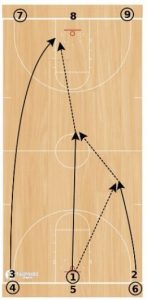
5 Minute Full Court Shooting

This drill was contributed by Wes Kosel.

This is what he said about the drill:

This is another great drill to get your players running the length of the floor and shooting a bunch of shots at the beginning of practice.

Editor’s Note: You could also use it as a competition/conditioner at the end of practice.


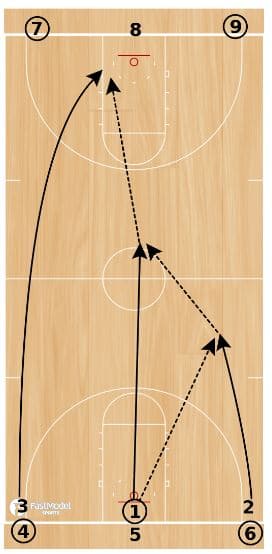
5-minute-full-court-shooting-drill1


Players 1, 2, and 3 start the drill. Players should not dribble during the drill.

Player 1 passes to 2 running up the floor. 1 and 3 moves up the floor as well. 2 passes back to 1 who passes to 3 for a lay-up.

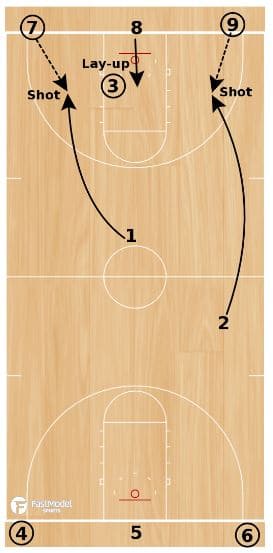
1 moves behind 3 and receives a pass from 7 for a shot. 2 receives a pass from 9 for a shot.


5-minute-full-court-shooting-drill2


Players 1 and 3 rebound their shot and fill the lines left vacant by 7 and 9.

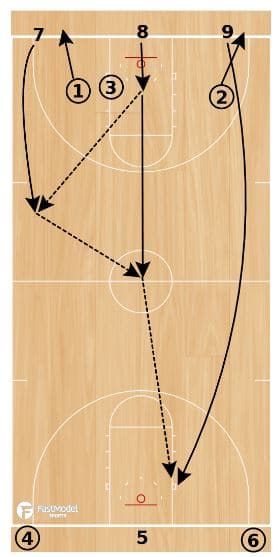
8 takes the ball out of the net and picks a side to pass to first.


5-minute-full-court-shooting-drill3


8 passes to 7. 7 passes back to 8 running up the floor.

8 then passes to 9 for a lay-up.


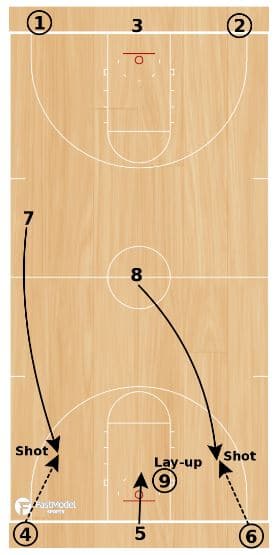
5-minute-full-court-shooting-drill4


4 passes to 7.

6 passes to 8.

7 and 8 then take a shot, and the drill continues with 4, 5, and 6 running up the floor.


Basketball Drills Butler

By Brian Williams on September 11, 2012

These basketball drills are from Butler Men’s Coach Brad Stevens.

They were sent to me by Coach Steve Smiley as a part of some notes from the Florida Basketball Coaches Clinic.

These drills go with notes from our blog post that contains the outline of Coach Steven’s presentation: Butler Defense Notes

3 plus 2 on 2 plus 3

Goals for the drill and for transition defense:

Stay in front of the ball
Protect the basket
Pick up the ball
Find good shooters

Basketball Drills

3 on 3 Free Throw Line to Free Throw Line

1 ball is being moved among the three offensive players. The defense is either:

Guarding the ball
1 pass away (faking at the ballhandler)
2 passes away (lower and ready to give help)

Basketball Drills

Jump to the Ball Drill

All players line up in the middle of the floor.
Coaches (under the basket and two on the sidelines) move the ball and all thirteen guys jump to the ball on every pass.
Simple and easy, but a great way to build and reinforce good habits.

Basketball Drills

Jump to the Ball Series

  • Defense starts with the ball under the basket. The offense is at the top of the key. Three coaches are on the floor (two on the wings and one on the elbow).
  • Defender throws the ball out to the offensive player and closes out.
  • Offensive player throws to the coach on the right wing (defender jumps to the ball)
  • Offensive player runs off a UCLA screen (defender stays on the top side and does not allow a face cut)
  • Offensive player posts up (defender plays post defense. Butler fronts the post “post up the post player.” But, you can play the post however you teach post defense.)
  • Coach on the wing passes the ball to the coach at the top of the key. (defender jumps to the ball)
  • Coach at the top passes the ball to the coach on the opposite wing (defender jumps to the ball)
  • Offensive player follows the ball and looks to post on the ball side block (defender battles him for the position; trying to make him post off the block)

Basketball Drills

Basketball Drills Full Court 3 on 3

By Brian Williams on September 5, 2012

From the Xavier Basketball Newsletter

By Mike Dunlap, Loyola Marymount.

We use the 3 on 3 full court game to tell us who can play and who cannot. It gives us a truthful look into our future because this game exposes players in a meaningful way. Moreover, the coaching staff and players can see who is fit and knows how to win!

The game also improves cardiovascular fitness quicker than any track specific work that I know. Why? Because we are doing anaerobic and aerobic work without the players really having to look at it as conditioning”. In other words, we get to sing while we work, or should I say “play.”

The players like this game mostly because it emulates the game itself.

We use heart monitors during this game. This is an objective measurement. Our players heart rates are normally above 190 beats per minute. Ouch. We want to be as objective as possible when evaluating our players. This takes the guess work out of what you are doing. The more criteria/tests we can use the better. Yet, we do not want the players to think it is all an exam. If you asked me what one competition/game we use to assess our players, 3 on 3 full court is the game- the best of the best.

1) The accurate measurement;
2) The easy evaluation of the who (i.e. which players and combinations know how to win by charting each win/loss);
3) The ability to see who can pass, cut, and score by eliminating the dribble completely;
4) The elimination of the dribble also creates “team first as the 3 players must assist each other to get the ball up the floor; this immediate adversity pushes the players toward each other;
5) The coaches can see which players want to play defense, and actually know to move;
6) The games are played to 2 points (i.e. one point/basket) because this allows you to quickly observe who knows how to win and play under pressure
either offensively or defensively.

I do not know any salient disadvantages to this game. While the players do not like 3 on 3 full court without the dribble initially, they eventually ask to play this game. You can add the dribble by saying that this will be a 1, 2, or 3 dribble day: you will be a hero–enjoy.

The Rules

1. No Dribble

Forces players to pass the ball
Cut-and-replace action by necessity
Fitness level improved
Footwork improved by necessity
Quick ball movement required

How? Tell players there will be no dribble until they learn that this is a team game.

2. Game played to 2 points

Quick games
Coaching staff can evaluate wins and losses
Who makes frequent game winning passes/shots under real game pressure
Who can get stops and/or defensive rebounds
Who is mentally/physically tough

3. Fouling

Defense calls fouls
The second foul by defensive team on the same possession results in a loss by that team.
Keeps the games moving and does not let games get out of hand.

4. Taking a charge

If defense takes a charge the game is won by that team.
Puts emphasis on taking the charge.

5. The long outlet

When the winners court has a team win they call over the team leading or who has won from the losers court. If there is a tie on That court then next point scored determines the winner.
The winning team may set up under the basket to inbound the ball with the other two players al half court ready to go as the winners. From the losers court sprint over to play. The winners may outlet the ball to half court but not over the half court line. This allows the other team time to get set. However, the winners from the losers court must sprint over and once the first playlr has entered the court the ball may be thrown to half court, but not over. This really keeps the game moving.

6. No cherry picking

Serves no real purpose.

Once the ball has crossed half court, either with pass or dribble, all three players on the offensive team must cross half cort as the ball is scored–period.

7. Ball must be picked up by three quarters court

Allows coaches to see who can play defense.
Exposes the individual and the team.
Exposes players and ultimately assists players to improve their fitness level.

If the defensive team does not pick up at three quarters court, they lose a point and, if it happens a second time, they lose the game.

Structure

1. Winners Court/Loser’s Court

Emphasize the “King of the mountain” cocept. You win and your team stays on the winner’s court. Hence, every team is looking to beat you as the wins accumulate.
Call it what it is–winner’s court and loser’s court
All teams waiting to play come here from the loser’s court. There is never an overflow on the winner’s court.
If the winners from the loser’s court finish before the winner’s court has completed their game, they will wait until the winner’s game is decided, and this happens very rarely.
The losers from the winner’s court goes immediately to the loser’s court to play. They do not go to the end of the line and wait to play.

2. Running Time

Put 20:00 on the clock for the first week you play this game.
The game will exhaust you players. You can add 5:00 per week. You wil see you players physically adjusing quality vs. quantity.

3. Changing Rules and Empahsis

You can add the dribble as time passes.
You can change certain rules per session or weeks. For example, the ball must go inside befoer it is shot. Or, we want one screen and roll before the bal is shot.
This allows the coach to see things and foces players to incorporate different situations.

In conclusion, the “try it, you’ll like it,” statement applies here. The 3 on 3 winner’s/losers’s court game is on the best instructional games we do in our pre-season. This game allows you to objectively evaluate your team.

  • « Go to Previous Page
  • Page 1
  • Interim pages omitted …
  • Page 94
  • Page 95
  • Page 96
  • Page 97
  • Go to Next Page »

Primary Sidebar

  • Twitter
  • Facebook
  • Linkedin
coachestoolbox
personaldevelopmenttoolbox
basketballplayerstoolbox
basketballtrainer
athleticperformancetoolbox
coachingbasketball

© Copyright 2026 Coaching Toolbox

Privacy Policy