• Skip to primary navigation
  • Skip to main content
  • Skip to primary sidebar

  • Basketball Plays
    • Ball Screen Sets
    • Horns Sets
    • Man to Man Post Up
    • Man to Man Isolations
    • Backdoor Plays
    • Man to Man 3 Point Shot Plays
    • 2-3 Zone Attack
    • Baseline Inbound Plays
    • Sideline Inbound Plays
    • Combination Defense Attack
  • Drills
    • Defensive Drills
    • Offensive Drills
    • Competitive Drills
    • Passing Drills
    • Rebounding Drills
    • Shooting and Scoring Drills
    • Toughness Drills
    • Transition & Conversion Drills
    • One on One Drills
  • Blueprint
  • Practice
  • Mental Toughness
  • Skill Development
  • Offense
  • Defense
  • Store

Basketball Drills

Teaching Ball Screen Reads

By Brian Williams on March 11, 2015

Today’s post is an idea for a system that you can adapt to your practices to help your players develop decision making skills when coming off on ball screens.

These ideas were posted by Coach Greg White in the FastModel Sports Basketball Plays and Drills Library

The site has thousands of drills and plays that have been submitted by basketball coaches from around the world.

You can also find out more about FastModel Play Diagramming software by clicking this link: FastDraw

I am not suggesting that this is exactly how you will teach your decision making reads or tree, but I hope it gives you some food for thought to do some sustained thinking and develop your own that fits your offensive philosophy.

That will also help you to improve the drills that you are currently using to teach players to read the play in the manner that you want.

 Wing Ball Screen Reads

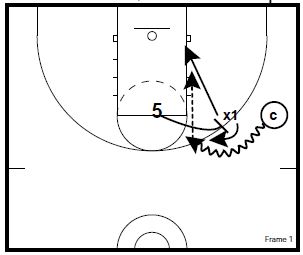
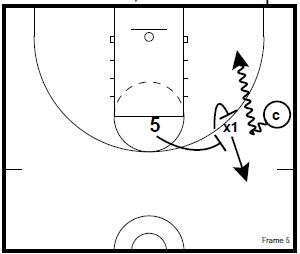
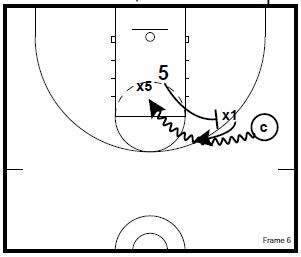
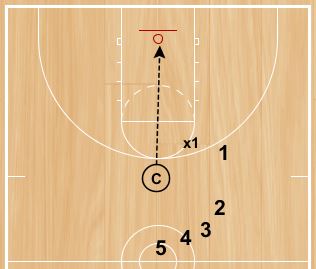
ballscreenreads1This is the tool we use when teaching guards how to use a ball screen on the wing. This chart, accompanied with breakdown drills creates a great understanding of the play.


Read 1

  1. Can I reject AND Get to the block?
  2. What am I hearing? (Trap, Switch, etc)

Read 2

  1. Where is the Screener’s defender?
  2. Can I split?
  3. Where are his hands (bounce pass or chest pass)
  4. Where is the help defender?

Read 3

  1. Is the Roll still there?
  2. Preparing for Elbow Jumper
  3. Looking at Opposite Post
  4. Find the Open Shooter. pass

Read 4

  1. Finish
  2. Pass to Corner 3

Slot Ball Screen Reads

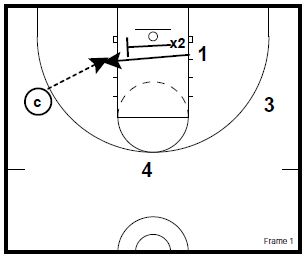
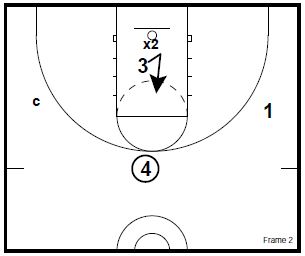
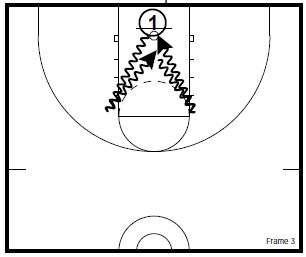
ballscreenreads2Read 1

  1. Do I see the Hedge?
  2. What am I hearing? (Trap, Switch, etc)

Read 2

  1. Did They Switch?
  2. Did the Hedge stay with me?
  3. Can I see the rim?
  4. Who is the help defender?

Read 3

  1. Is the Shooter open?

Read 4

  1. Finish
  2. Pass to Post
  3. Pass to Corner

Small Side Game

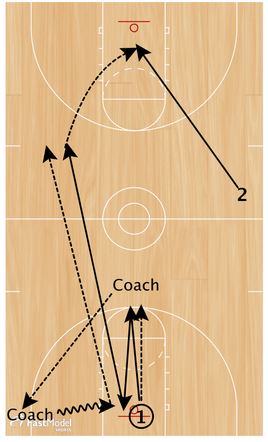
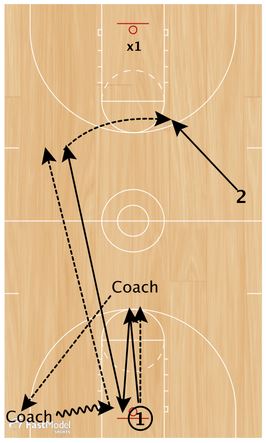
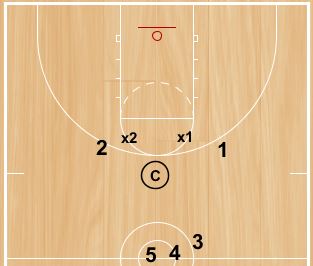
Here is a Small Side Game to use to teach the Slot Reads. This focuses on the spacing, reads and actions of the players involved.

You can come up with similar games or drills to teach the reads that you use in your system.

ballscreenreads3

1 comes off the slot screen and reads:

The hedge – did it stay?

The switch – Wait for Dive

The Help – Pitch to 2 for the shot


Coaching Basketball: Assistant Coach Qualities

By Brian Williams on March 10, 2015

These articles were written by Alan Stein on his Stronger Team Blog.

Assistant Coaches Code:

  1. Your #1 job is to make your head coach’s job easier. Be a servant leader. Find what your head coach needs you to do and do it!
  2. Act as if it is your team. You will have your own team one day. Act like it now.
  3. Do what you can, with what you have, where you are. No excuses.
  4. Add value to everything you do, every single day… on and off the court.
  5. Enforce the team’s culture and standards at all times. Protect the locker room.
  6. When you find a problem… find a solution. Your head coach has enough problems as it is.
  7. Be professional. Period.
  8. Encourage and motivate everyone in your program to buy in to what the head coach wants – from players, to managers to other assistants.
  9. Bring energy, enthusiasm and effort every day.
  10. When asked for your input, speak honestly. Don’t be a ‘yes’ man (or woman).

Coaching Absolutes:

  1. Don’t focus on winning (outcome); focus on preparation, effort and execution (process).
  2. Winning is a result of:
    The execution of the fundamentals
    The ability of 5 players to work in unison… every possession… both ends of the floor.
  3. A team can only reach it’s true potential if:
    The most talented player is also the hardest worker
    Everyone in the program buys in to the ‘We > Me’ concept
    Each player is in peak physical condition
  4. You either accept it or you correct it.
  5. You play the way you practice.
  6. Alan Stein

ABCs of Success

Here are the ABC’s of success:

A – Adapting, Asking

B – Believing

C – Caring, Challenging, Creating

D – Dreaming, Defusing

E – Engaging, Envisioning, Evaluating, Evolving, Educating

F – Failing, Focusing

G – Growing, Grinding

H – Helping

I – Innovating, Inspiring

J – Juking, Juggling

K – Knowing

L – Leading, Learning, Listening, Loving

M – Mentoring, Mending

N – Networking

O – Objecting, Outworking, Observing

P – Preparing, Pursuing, Pushing

Q – Questioning

R – Reaching, Reading, Resolving

S – Searching, Seeking, Serving, Sharing, Simplifying, Striving, Smiling

T – Thinking, Tweaking

U – Understanding

V – Viewing, Voicing, Valuing, Varying

W – Working

X – Xeroxing (‘copying’ – couldn’t leave X out!)

Y – Yearning

Z – Zigging and Zagging

Now you know your ABC’s… I hope you’ll do these things with me!

Hardwood Hustle Blog
http://www.About.me/AlanStein

Dribble, Dribble, Dribble, MISS!

By Brian Williams on March 4, 2015

This article was written by By Stephen Shea, Ph.D. You can find out more about Dr. Shea and his work in the field of Basketball Anayltics below the article.

Editor’s Note I don’t believe that this data is the only factor in determining what are and aren’t good shots in your system, but it is something to consider. It is also something to consider looking at on an individual basis for the players that take most of your shots.

On August 2, 2014, @ShaneBattier tweeted, “Kids, bottom line.  Don’t take dribble jumpers unless your last name is Nowitzki.  Thank me later.”

SportVU’s new spatial tracking statistics on NBA.com split jump shots by whether or not the shooter dribbled before the attempt.  If the shooter dribbled, the shot is a pull up jump shot.  Otherwise, it is called a catch and shoot.   Chart 1 below shows the FG% and EFG% for pull ups and catch and shoots for the 2013-14 regular season.   It appears that Battier was correct.  Individual anomalies (like Dirk) aside, pull up shots are quite inefficient in comparison to catch and shoot jump shots.

Not all minutes are equal in their importance for a team.  When a team is up 20 in the fourth quarter, it is unlikely that they will call their best plays or play their best players.  In contrast, playoff basketball is dense with meaningful minutes.  Partly due to the increased defensive intensity, teams up the number of pull ups relative to catch and shoots when the playoffs come around.  See Chart 2.  (Note that for Chart 2, we only used the 16 playoff teams in the calculation of regular season numbers.)

In the playoffs, teams take more pull ups, but these field goal attempts are still the far inferior shot.  Chart 3 displays the EFG% for each shot type in the 2013-14 regular season and playoffs.  (Again, regular season means only the regular season production of the 16 teams that made the playoffs.)

Charts 1 and 3 show that jump shots off the dribble are significantly less efficient than jump shots off the pass.  However, it is too simple to conclude that players need to stop taking dribble jump shots.

Players do not have equal opportunities to take high quality catch and shoot jumpers.  Yes, certain players are better at moving without the ball and putting themselves in position to catch and shoot.  Yes, other players tend to force dribble jumpers with plenty of time on the shot clock or when a teammate is in position to take a better shot.  Still, there are differences in opportunities.

Game situation and quality of teammates are contributing variables.  Players can be forced into dribble jumpers after a play breaks down and the shot clock is running out.  A player may benefit from more open looks on the perimeter because his teammate (such as LeBron) draws double teams.  Simply put, the specific percentage of shots a player gets off the pass in comparison to off the dribble is partly a reflection of the activity of the team around him.

On November 19, 2014, a match between the NBA champion Spurs and LeBron’s new Cleveland crew went down to the wire.  With 26 seconds on the clock and 15 seconds on the shot clock, Manu Ginobili stood out by half-court as the Spurs held a 1-point lead.  It was a pivotal possession—the type of possession where we would expect to see a star work in isolation.  This is the type of situation where Durant, LeBron or Carmelo might be given the ball in isolation and asked to work their magic.  Often, the star would dribble a few times make a move and try beat the opponent on the drive or step back to a jumper.  In either case, it would be a shot off the dribble.  The Spurs—the consummate team—showed that there are other (perhaps easier) ways to finish a game. 

Ginobili passed to Parker with 22 seconds on the clock.  Ginobili then moved to the block as Parker passed to Duncan (after no dribbles and with 20 seconds on the clock).  Ginobili faked like he was going to break to the perimeter.  His defender (rookie Joe Harris) bit, and Duncan dumped the ball to Ginobili for an uncontested layup with 19 seconds left on the clock.  Three passes in 3 seconds and Ginobili had an easy bucket.  Ginobili did not have to break down a defender and dribble to the hoop.  The great passing of the Spurs negated the need for moves with the ball.   It was a reminder of how experience, chemistry and passing ability can trump one-on-one skills.  The Spurs won the game 92-90.

This season, NBA.com has added new sections to their stats pages.  Now, each team and player has dashboards.  One of these is a shots dashboard.  Among the new statistics on this page is dribbles before the shot (as captured by SportVU).  Here, all shots are included (not just jump shots).  So, the Ginobili layup would register as a shot with no dribbles.  Table 4 presents the league total splits of 2 and 3-pointers by number of dribbles for 2014-15 (prior to the games on Friday, November 21).  The table also splits EFG% by number of dribbles.  Shots after no dribbles tend to be more efficient.

The new dashboards on NBA.com provide another level of detail on player shot types.  Unfortunately, they are still not optimally split for certain types of analysis.  For example, it would be nice to see these numbers split by whether or not the shot occurred in transition.

Although not presented with an ideal level of detail, these new dashboard statistics are still interesting and provide information that was not previously available.

Our data on pull ups vs. catch and shoots shows that jump shots off the pass are far preferable to jump shots off the dribble.  Table 4 shows that this relationship persists when we include more than just jump shots.  But players and teams cannot simply wake up one day and decide to only take shots off the pass.   The play described above involved three players that are in their 13th season of playing together.  That type of ball movement, which was executed perfectly at a crucial moment in the game, comes with maturity and experience.  Or does it?

I went back and compared a team’s average age in the 2013-14 season to their % of FGA on no dribbles.  Ideally, one should weight the average age by playing time as many very good teams carry older veterans at the end of the bench and rebuilding squads fill those spots with young players that are more parts potential than production.   Instead, I’ll take the lazy way out and just exclude the 4 youngest and 4 oldest teams.  This had the added benefit of removing the Nets who added significant pieces in Garnett and Pierce in the offseason, had a first year coach and lost center Brook Lopez early in the season.  All of these could hinder the team’s ability to execute seamlessly on offense (at least early in the season).  At the younger end of the spectrum, we removed Philadelphia, a team that is …well…ummmm….planning for the future?

Chart 5 displays a surprisingly high correlation for this simple study.  It certainly appears as though players learn how to better set up teammates and players learn to look less for shots off the dribble as the team matures.

About the Author, Stephen Shea

Stephen Shea is an associate professor of mathematics at Saint Anselm College in Manchester, NH. He earned a Ph.D. in mathematics from Wesleyan University in Middletown, CT, and a B.A. in mathematics from The College of the Holy Cross in Worcester, MA. His mathematical expertise and publication record is in the areas of probability, statistics, dynamical systems, and combinatorics. For years, he has been applying his abilities in these areas to study professional and amateur sports. Stephen is a managing partner of Advanced Metrics, LLC, a consulting company that provides analytics solutions to basketball and hockey organizations. At Saint Anselm College, he runs a course on sports analytics. His sport writing has been featured in the Journal of Quantitative Analysis in Sports, Psych Journal, the Expert Series at WinthropIntelligence.com, and the Stat Geek Idol Competition for TeamRankings.com. In 2013, Stephen coauthored the book, Basketball Analytics: Objective and Efficient Strategies for Understanding How Teams Win, and co-created the accompanying blog BasketballAnalyticsBook.com. In 2014, he authored Basketball Analytics: Spatial Tracking.


Basketball Drills: Championship Toughness Shooting Drill

By Brian Williams on March 3, 2015

This video is one of the great resources available from basketballhq. They have several more videos as well as basketball coaching resource articles.

I like to end our Improvement Season Workouts with a drill that pushes players both mentally and physically. This is an example of one of those types of drills. I also think it is good to put players in a position to make a shot even if they have missed a few in a row.

Matthew Graves is the former Head Men’s Coach at South Alabama. He was an Assistant to Brad Stevens (during both of Butler’s National Runner Up Finishes) and a player at Butler prior to taking the job at South Alabama. He is currently an Assistant at Xavier.

Please make sure your sound is on to see the video.

Click the play arrow so see the drill. The drill is a You Tube video, so you will need to be able to access You Tube to see the drill.


Basketball Drills Champions Toughness Shooting Drill

You can add in different finishes or floaters to make the drill more game-like to suit your players. You can also adjust the time to complete the drill as you see what will challenge your players. Another way to run the drill would be to see how many shots a player can make in three minutes and stop the drill at that point.

POISE: Practice On Intense Situations Everyday

By Brian Williams on February 16, 2015

P-O-I-S-E

“Practice On Intense Situations Everyday”

by Coach John Kimble

CoachJohnKimble.com

Retired Crestview (FL) High School

Offensive Situations

This article was originally written for Winning Hoops

How many basketball games have you watched or been involved in where the outcome of a close game is determined by just a matter of a couple plays? Both teams may be very equal in the talent and skill level with possibly the only difference being the outcome of one or two key possessions during the game. It is conceivably possible that one of the teams could possibly even have less talent, in general been out-prepared, out-hustled, and out-played in almost every aspect and phase of the game. But because of just one or two particular possessions, that team that succeeds in those possessions can win the game.

Those possessions could very likely be the last second situations of each time period whether it is the end of quarters or halves. Those offensive possessions not only can produce points for your team but maintaining possession of the ball also prevents the opposition from scoring.

Preserving possession of the ball for the last shot of the time period and then scoring at the end of that specific time period could be as much as a 6 point swing in addition to the momentum and confidence builder that that one possession could produce. Having two or four end of time period possessions should then be looked upon as invaluable in the preparation time for that game.

Does one of these teams have a decided edge in preparation of unique scenarios that can easily happen during the game? But unless this team is prepared and can achieve an edge in these situations that can easily take place in a game, all of the hard work and effort put forth by both players and coaches (during the actual game and in practices) will have gone for naught.

If the various offensive situations that could possibly take place during the course of a game have not been carefully thought out, analyzed and then practiced many different times, a basketball team could only win this type of close game by relying solely on executing a play they have just had diagrammed to them for the first time in a frenzied timeout. If winning a game is so important, should a coach go with an offensive play that was drawn up during the excitement of a last second timeout—a play that the coaching staff and players are not necessarily familiar with or is a coaching staff going to elect to run a play that has been carefully thought out, discussed, taught, and practiced repeatedly during the season?

My opinion is that if a staff and basketball team that has spent countless hours on fundamentals and skills of the game and also numerous hours on plays, offenses, and defenses; shouldn’t “one-play scenarios” that may be the actual deciding factor in determining the winner/loser of the game be practiced at least for a few minutes frequently? Instead of a coach drawing up a play that his team might not have ever seen or practiced, why not have the plays already drawn up, seen and understood by his team and also specifically practiced. This would give that team an opportunity to be as prepared for these last second situations as they are for everything else that takes place in the game.

There are many different methods and philosophies that have been proven to be successful. There doesn’t have to be a “right or a wrong” method, as long as the method has been carefully thought out and agreed upon by the coaching staff. Once the philosophy has been developed, that philosophy must then be thoroughly taught and sold to the players. Instead of giving coaching staffs specific answers to all the many scenarios that exist, the purpose is to challenge each reader to be prepared for those situations by simply asking themselves if they have developed a sound idea and philosophy to the many different offensive situations that could easily come up in games.

OFFENSE—S.O.B./B.O.B. PHILOSOPHY

Before late-game decisions that could determine the outcome of the game are made, there are other ideas and philosophies that must to be developed. Does your offensive team have “baseline out-of-bounds plays” that will be successful against man-to-man defenses and/or against zone defenses? On offense, does your team have specific plays from the sideline that can be run against zone and/or man-to-man defenses?

TIMEOUT SELECTIONS

Does the coaching staff have a philosophy on whether they want players early in the game to call a timeout to protect the possession of the ball as they are about to fall out of bounds or about to get tied up after a loose ball on the floor? Or does the coaching staff want to save those timeouts for late game situations? If the coaching staff does not have a set philosophy and has not taught their players, those decisions will then be left up to the players. Does the coaching staff want to leave that decision up to the players?

OFFENSE—DELAY GAME AT THE END OF PERIOD

Offensively, does your team half a Delay Offense or more than one? What are the rules of the Delay Offense? Can anyone take the last second shot? What kind of shots are acceptable and what kind are unacceptable shots? When is the appropriate time to take the shot? Do you allow time for an offensive rebound? What defense are you going to fall back into? Will you press full court? If so, will it be passive or aggressive? Will it be man-to-man or zone press?

OFFENSE—SHOT SELECTION (“2’s” or “3’s?)

Another scenario/situation a team and coaching staff must recognize is the actual score and what type of shot do they need to take and what types of shots should not be taken. Don’t expect your players to read the your mind and know exactly what kind of shot you want. One line of thought is that if the score is tied or down by as much as 2, a high percentage shot or a shot that could draw a foul should be taken and not a “3” (in the lane). Others believe in taking the “3” immediately. Obviously if your team is down by 3, your team needs the best possible 3 point shooter to take as good of a 3 point shot as he can get and the play should be designed to allow that.

If your team is down by 4, the coaching staff must determine whether they want a 3 point shot or a 2 point shot to be taken followed by a press (and ultimately a foul). A definite philosophy should be agreed upon by the coaching staff in the preseason and then thoroughly taught to all players in the program, so that there is no doubt or hesitation in anyone’s mind as to what to do during the intense situation.

OFFENSE–TRANSITION AFTER OPPOSITION SCORES

One of the most important decisions a coaching staff should decide on and then convey to all players is what they should do in the last seconds of a game after the opposition scores to tie the game or put the opposition into the lead. The amount of the lead should also affect the coaching staff’s philosophy.

Do players have a grasp on how many seconds it actually takes to dribble full court for a driving layup or to the top of the key for either themselves or the opposition? Has the number of dribbles it takes to reach various points on the offensive end of the court (such as the basket, the top of the key, to the ten-second time line) been counted and timed? Does each player know who realistically are the three-point shooters that should take that last second shot? Has the team practiced those “buzzer beater” shots?

OFFENSE—TRANSITION WITH A LATE GAME DEFICIT

Does your staff have a philosophy (and a plan and a play) to react to the opposition’s score in the last minutes of the game that puts your team behind by 4 points with more? Or what do you want to do if you now trail by three points with more than or less than 10 seconds? What does your team do if you trail by two points with more than 10 seconds or less than 10 seconds, or trailing by one point, or when the score is tied (with more than 10 seconds or less than 10 seconds remaining? A coaching staff might not have practiced all of the various scenarios that could actually play out in a game, but he/she at least should have a mental plan on what he/she wants to do.

After the opposition scores late in the game, do you want your team to automatically call a timeout and set up a play? Many coaches adhere to that practice because they feel they then can organize their team for a planned (and hopefully practiced) play? This is a sound reason, but the timeout also gives the opposition an opportunity to organize and possibly substitute better defensive players into the game, set up a full court press, or change half-court defenses. Without a timeout, the opposition would be able to make none of these adjustments. Who will benefit more from the timeout, your offense or the opposition’s defense? Does the coaching staff have a sound philosophy for their decision?

A philosophy opposite of automatically calling a timeout after the opposition scores is for the offensive team to push the ball quickly down the court and already have a plan and a play (that has been practiced repeatedly) to execute. The defensive team obviously could not substitute better defenders in the game, could not probably set up full court pressure and probably not effectively set up a different half court defense. In fact, not calling a timeout sometimes could catch the opposition off balance and allow for better offensive matchups and give the offensive team a high percentage shot. The question that must be asked is “Is your offensive team prepared enough to execute a last second play in a pressure packed situation? Does your team fully understand what type of shot and who the coaching staff wants to take the last shot?”

OFFENSE–LAST SECOND SHOT SITUATIONS FROM FULL COURT

When your team calls a timeout and your offensive team must travel the length of the court, there are two important factors that can change the philosophy. One is that the offensive team may be or possibly not allowed to run the baseline.   Not being able to run the baseline takes away very important options that an offensive team can incorporate into their “last second shot” philosophy. The second scenario is determining whether the offensive team has any remaining timeouts left to use. If timeouts still exist, any offensive pass receiver that catches the ball in the frontcourt could possibly call an immediate timeout. This would allow the offensive team to reorganize and run a “Sideline Out-of-Bounds” play that starts much closer to the basket.

A coaching staff must know which scenario exists and not only know beforehand how he is going to handle these critical decisions, but convincingly sell his philosophy to every player and then have his players repetitively practice that play in game-realistic situations. The coaching staff must devise a play that could also handle the surprise defensive change by the opposition. Each play should have a primary and a secondary shooter in case the primary shooter is taken out of the play defensively.

OFFENSE–“QUICK” SIDELINE & BASELINE OUT-OF-BOUNDS SITUATIONS

Do you have a philosophy and a plan and a play for offensive “Sideline Out-of-Bounds” situations and also “Underneath Baseline Out-of-Bounds” situations when your team needs a “quick” shot (because of just a few seconds left on the clock), a “three-pointer,” or a “quick” three-pointer?

OFFENSE–LATE GAME DESPERATE FREE THROW SITUATIONS

Do you have a philosophy and a special play to fit the needs of your free-throw shooting team late in a game when your team is down by two or more points. Do you have any special “rebounding stunts” and intentionally miss specific free throws to get the offensive rebound? Do your rebounders know how to beat the defensive box-outs and does your free throw shooter know how to miss the free throw? Do you know how to slow the opposition down from inbounding the ball after your team has made the last free throw, so you can set up a full court press?

OFFENSE–DELAY GAME/FREEZE SITUATIONS

Do you have a plan of action when you want your offensive team to simply “milk” the clock and not be fully committed to “letting the air out?” Do you have an offensive philosophy dependent upon the time and score when to start your fully commitment to “stall?” Do you have an offense (or two) designed to achieve that purpose? Do you have a complementary defense that corresponds to the offense that you are implementing in that particular situation?

Do you have special inbounds plays to get the ball to your best free throw shooter when your team has the lead and are being pressed late in the game? Do you take advantage of the times when you are legally allowed to run the baseline when taking the ball out of bounds?

What is the coaching staff’s philosophy when it is very late in the game with the lead and you have to make a choice between inbounding the ball to one of two different players–your best free throw shooter or to your best ballhandler?

Do you and your team agree on who are your best free throw shooters are, who are your best ballhandlers, and who are your best 3 point shooters? The coaching staff and each and every player should agree with the coaching staff’s opinion on the best player in each of these categories. If not, there could be a breakdown in some crucial situation, which could prove costly to the team. How does the coaching staff determine who are the best free throw shooters, the best ballhandlers on the team? How does the coaching staff then convince the team who those specific players are?

CONCLUSION

Instituting a philosophy and specific offensive plan for the many situations requires a great amount of time, effort, imagination and creativity by the coaching staff. This plan will be much more fundamentally sound and effective when developed in the off-season instead of in the middle of the game. The margin of winning and losing can sometimes be just the difference of one decision by the coaching staff and/or of one correctly or incorrectly executed technique by a player. Winning just four games that could have been losses can drastically turn the outcome of an entire season around. A team that ends up with a 15-11 record seemingly has a totally different season when they could have had a 19-07 record.

If the coaching staff makes the correct coaching decision and a player executes that decision properly in a championship game could be the difference in winning championships instead of being runners-up.

Not only should a coaching staff create and build a wide range philosophy in the off-season, so that sound decisions can immediately be made during pressure-packed games, but a plan of action must be devised so that every player on the team can grasp the reasoning of those decisions. Those players must then be given frequent repetitions in order to improve their performance levels.

Implementing the last ten to fifteen minutes of practice of several sessions will be invaluable to the team. During the season’s practices, the appropriate techniques can then be fully explained, taught, and practiced with the players and the entire coaching staff. This makes everyone involved more prepared and confident in the defensive plan of action. Remember the cliché, “Luck is when preparation meets opportunity.” Be lucky in those close games with POISE.

About the Author

Coach Kimble was the Head Basketball Coaching position at Deland-Weldon (IL) High School for five years (91-43) that included 2 Regional Championships, 2 Regional Runner-Ups and 1 Sectional Tournament Runner-up. He then moved to Dunlap (IL) High School (90-45) with 2 Regional Runners-up, 1 Regional, 1 Sectional and 1 Super-Sectional Championship and a final 2nd Place Finish in the Illinois Class A State Tournament. He was an Assistant Basketball Coach at Central Florida Community College in Ocala, FL for 1 year before becoming Offensive Coordinator and then Associate Head Coach for 3 additional years He then was the Head Basketball Coach at Crestview (FL) High School for 10 years, averaging over 16 wins per season.

He has had articles published in the following publications such as: The Basketball Bulletin of the National Association of Basketball Coaches, the Scholastic Coach and Athletic Journal, Winning Hoops, Basketball Sense, and American Basketball Quarterly. He has also written and has had five books published along with over 25 different DVDs by Coaches Choice and Fever River Sports Production.

See him on Twitter @CoachJohnKimble and his Web Page “www.CoachJohnKimble.com”

Basketball Drills Pressure Shooting

By Brian Williams on February 11, 2015

Today’s post is an idea for a competitive shooting drill with Brian Baudinet, former Assistant Coach with the NBA Development League’s Tulsa 66ers (Since relocated and renamed to the Oklahoma City Blue).

Coach Baudinet is currently the Head Boy’s Basketball Coach at Canterbury Prep School in CT.

You can use this drill as a part of your fall shooting workouts or save it for the individual skill development portion ofyour winter practices.

I like finding varieties of ways of keeping score and putting some pressure on the shooter. You could also add a timed segment to the drill to put another type of pressure on your shooter.

You can change the types of shots that you shoot to fit your system.

Another tweak you can make is to change the scoring to fit the level of your players. For example, making 15 without missing through could be “Gold”, making 13 and missing 3 could be “Silver,” 11 and 3 “bronze,” etc… You could use D1, D2, D3, Champion, Varsity, JV, or whatever levels are appropriate for your team.

This video is one of the great resources available from basketballhq. They have several more videos as well as resource articles.

Please make sure your sound is on to see the video.

Click the play arrow so see the drill.

Basketball Drills 15 and 3 Pressure Shooting

  • « Go to Previous Page
  • Page 1
  • Interim pages omitted …
  • Page 60
  • Page 61
  • Page 62
  • Page 63
  • Page 64
  • Interim pages omitted …
  • Page 96
  • Go to Next Page »

Primary Sidebar

  • Twitter
  • Facebook
  • Linkedin
coachestoolbox
personaldevelopmenttoolbox
basketballplayerstoolbox
basketballtrainer
athleticperformancetoolbox
coachingbasketball

© Copyright 2026 Coaching Toolbox

Privacy Policy