• Skip to primary navigation
  • Skip to main content
  • Skip to primary sidebar

  • Basketball Plays
    • Ball Screen Sets
    • Horns Sets
    • Man to Man Post Up
    • Man to Man Isolations
    • Backdoor Plays
    • Man to Man 3 Point Shot Plays
    • 2-3 Zone Attack
    • Baseline Inbound Plays
    • Sideline Inbound Plays
    • Combination Defense Attack
  • Drills
    • Defensive Drills
    • Offensive Drills
    • Competitive Drills
    • Passing Drills
    • Rebounding Drills
    • Shooting and Scoring Drills
    • Toughness Drills
    • Transition & Conversion Drills
    • One on One Drills
  • Blueprint
  • Practice
  • Mental Toughness
  • Skill Development
  • Offense
  • Defense
  • Store

Basketball Drills

Free Throw Golf Shooting Drill

By Brian Williams on February 17, 2016

These shooting drills are from Matt Monroe’s former Hoops Roundtable site.

Modify these drills to fit what types of shots you get from your offense and that fit the shots that your players take in games including adding in 3 point shots to the drill.

You could add an element of a time limit or change the scoring so that players are competing against each other or against a scoring standard.

Diagrams created with FastDraw


Free Throw Golf Drill

reavis-ft

Jason Dycus, Head Girls’ Basketball Coach, Naperville North High School (IL):

There are 3 or 4 players at a basket.
Put three minutes on the clock.
Each person shoots one free throw and rotates.
Each time someone makes a free throw, one point goes in the bank.
The first person to miss add the score in the bank to their score (for example, if three people make a free throw in a row and the fourth person misses, the fourth person now adds 3 points to their score).
The player with the lowest score wins.

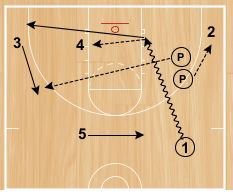
Cougar Shooting Drill

cougar-shooting-drill

In my opinion, the cones are not there to simulate defenders. They are there to show your players where to work on their dribble move. I believe that players need to develop skills before they can use them against a live defense.

#1 dribbles through the cones using various change of direction moves and attacks the basket.
After taking a shot, the player widens out to the corner and cuts hard off the cone simulating a cut off of a screen.
Coach passes the player the ball for a shot.

Utilize various moves on the first and second legs of the drill: Power finish, Shot-fake finish, Floaters, Runners, Reverse lay-up, Jump shot, Pull-up jump shot, Step-back move, Step-back counter move, Inside hand finish, Hips across lay-up, Spin move, Up and under move, Ginobili move, or any other move that you need to incorporate.

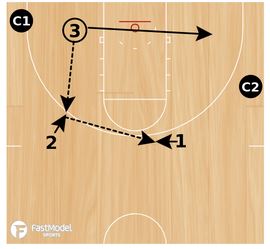
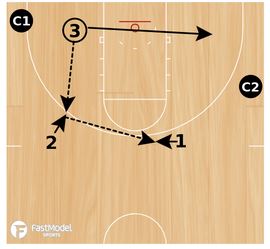
Plus 4, Minus 4 Shooting Drill

plus-4-minus-4-shooting

Jim Harrington, former Head Boys Basketball Coach, Elgin High School (IL):

Use the 7 spots on the floor that are shown in the diagram.

Player flips the ball out and get hind the ball (circle it)
You get +1 for a made field goal and -1 for a missed field goal
Play until you get +4 or -4 total.
Use or incorporate all moves (shot fakes, catch and shoot, cross/onside step, etc.)

3 on 2 to 2 on 1 Transition Breakdown Drill

By Brian Williams on February 15, 2016

Submitted  by Coach John Kimble
CoachJohnKimble.com

Retired high school and college coach

Follow him on Twitter @CoachJohnKimble

This post was originally written for Winning Hoops

INTRODUCTION

As in the majority of the drills, coaches should try to make the drills as “game-realistic,” as competitive, and as time-efficient as possible. Coaches should want to incorporate some offensive concepts and philosophies for one group of players to work on as another group within the drill works on developing specific defensive skills. This drill philosophy provides offensive as well as defensive teaching and practice during the same drill.

This drill can be a very effective breakdown drill for specific players to work on their particular transition responsibilities and assignments both defensively as well as offensively. This drill can be set up primarily for the two most important players in a team’s defensive transition—the two defenders that are to be first in getting back on defense. Every player should work on these two defensive positions because any player can end up in one of those particular positions. While not disregarding the other players in this drill, the two players that should be the first main focal points of the coaching staff’s attention are the initial two offensive players that will quickly become the two defenders that are in transition offense to defense. They are players X1 and X2 in the following diagrams.

The next focus is on the three offensive transition players that initially started on the defensive end. They are players O1, O2 and O3. During the next phase of the drill, the defensive focus is changed to the lone defender that goes back to the defensive end. This could be either O1, O2 or O3. During the same phase of the drill, the offensive focus is centered on X1 and X2 as they come down the floor in a 2-man offensive fastbreak.

If an offensive team shoots, misses, and surrenders a defensive rebound; there are two assigned positions for the first two defenders who are to get back on defense to protect their basket. If the offensive team loses possession of the ball via a turnover, there are no definite defensive transition assignments–it is simply imperative that the offensive team’s basket is immediately protected, regardless of who gets back first. That is the main reason that all players should be placed in these two positions with this drill.

THE INITIAL “3-ON-2” PORTION OF THE DRILL

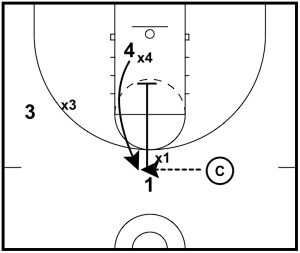
Diagram 1
Diagram 1

The drill can be set up with two defensive players (X1 and X2) starting the drill by literally being seated near the offense’s sideline hash-mark, and three offensive players (O1, O2, and O3) in lines that start on the offense’s baseline. The ball is advanced via dribbling and/or passing with the three offensive players staying in their three wide lanes as quickly as possible to attack their basket. The two defenders must quickly scramble to their feet and then sprint back to defend their basket. (See Diagram 1)

Diagrams created with FastDraw

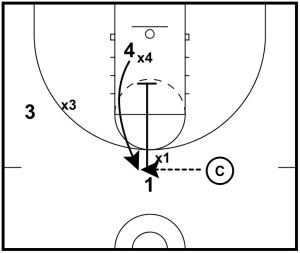
Diagram 2
Diagram 2

A more game-realistic method of starting the drill is to have the three offensive players (X3, X4, and X5) start in a “3 on 3” defensive alignment against three other players (O1, O2, and O3), with the potential two transition defenders (X1 and X2) making one or two passes before one of the other offensive players attempts to shoot and (intentionally) miss. The original three defenders (soon to become offensive players–O1, O2, and O3) work on boxing out, securing the rebound, and running  a three-man fastbreak in the three lanes. The two original offensive players out in the front of the offense (X1 and X2) sprint back as quickly as possible, communicating loudly on whom is to become “Ball-Man” and whom is going to become “Basket-Man.” The dummy offensive players (X3, X4, & X5) step off the court and get ready to step into the roles that O1, O2, and O3 currently are playing. (See Diagram 2)

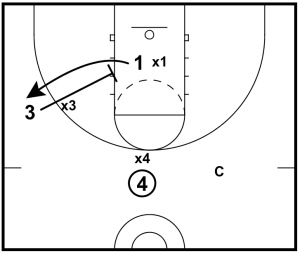
Diagram 3
Diagram 3

The first defender that gets back (X1 or X2; X1 in Diagram 2) settles in near the dotted circle in the middle of the lane and yells “Basket!” The second defender (X2 in the same diagram) that hustles back settles in the lane and cautiously approaches the dribbler as far out as the top of the key, by yelling “Ball !” The “Ball-Man” (X2) stops the dribble penetration of the dribbler, while the “Basket-Man” (X1) protects both low-post “blocks” and takes both the first and second perimeter passes made to either wing and then back to the center of the court. Therefore, when the offensive team passes the ball to either wing, the “Basket-Man” (X1) rotates out to defend the ball, while the original “Ball-Man” (X2) drops quickly down the lane to protect the basket. (See Diagram 3)

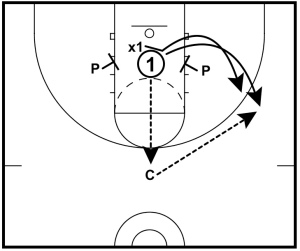
Diagram 4
Diagram 4

If the ball is passed from the wing back to the point, the original “Basket-Man”—X1 (who has defended the “Wing-Pass” — the first pass) would then defend the “Reversal Pass” also. This allows the original “Ball-Man”—X2, who has dropped down to protect the basket, to remain low to continue protecting both “blocks” and the basket. (See Diagram 4)   To explain the rotation and the coverage in a simple manner, coaches should use the phrase, “The first ‘Ball-Man’ must stop the ball and the first ‘Basket-Man’ has the first two perimeter passes!”

Major Points of Emphasis for the Defense

Diagram 5
Diagram 5

If the ball is centered up and then passed again from the top of the key to the wing on either side, the current “Basket-Man” (X2) would again come out to take the next two perimeter passes, with the current “Ball-Man” (X1) again dropping quickly to protect the basket. (See Diagram 5) The major points of emphasis for the two defensive players (X1 and X2 in Diagrams 2 thru 5) are:

  • Make sure that there is absolutely no question or doubt whom has taken the “Ball-Man” responsibilities and that the other defender has taken the “Basket-Man” assignment. (Diagram 2)
  • “Ball Defenders” (X2) must prevent dribble penetrations and drives to the basket and encourage the offense to pass the ball as often as possible–the more passes the opponents make, the more chance of a turnover and the more time the defense has bought to allow other defensive teammates to get back to help defend the basket. (Diagram 3)
  • After the “Ball-Man” (X2 in Diagram 3) has stopped dribble penetration and influenced a pass to either wing, he must quickly drop to the weakside block area, as if he were defending a backdoor cut. That is, he would turn his back on the ball and face the weakside block area where O3 would most likely cut, looking down his extended right arm for the ball.
  • The original “Basket-Man” (X1 in Diagram 3) should take the first and the second perimeter pass.
  • Both defenders should remember that once the ball is centered back up, the new “Basket-Man” (X2 in Diagram 4) again has the “next two perimeter passes.”

The phrase used in teaching this part of the defensive transition is “Solidly build the defense starting from the basket and then build it out to the dribbler.”

Major Points of Emphasis for the Offense

The major points of emphasis for the three offensive players (O1, O2 and O3 in Diagrams 2 thru 5) are:

  • The two wing players (O3 on the left and O2 on the right in Diagram 2 thru 5) should sprint out and get ahead of the ball, while constantly looking for the pass.
  • When the cutting wings hit the free throw line extended, each should plant off of their outside foot, and slash-cut directly to the basket.
  • The offensive team should try to keep the ball in the middle and get down the floor as quickly as possible, but under control.
  • The dribbler (O1) should not anticipate that the defense will stop the dribble penetration and if not stopped, they should then attack the basket until someone does stop them.
  • If and when the defense does stop the ball, that ball-handler should make a solid jump-stop and look to make a bounce-pass (below the outstretched arms of the defenders) to one of the cutting teammates.
  • All offensive players should avoid offensive fouls as a result of out-of-control dribbling.
  • If the ball is passed into a wing area to a player who is not driving (O2), that passer (O1) should then follow the pass a few steps to shorten the length of the potential return pass. (Diagram 4)
  • All offensive players should remember to “take what the defense will give you” and not force the action.

THE “2-ON-1” PORTION OF THE DRILL

Diagram 6
Diagram 6

When the three offensive players (O1, O2, & O3) lose possession of the ball because of a made shot, a missed shot, or a turnover; either the shooter or the player who committed the turnover must turn and sprint back to protect the far basket by himself. The original two defenders (X1 & X2) would then sprint back and run a two-man offensive fastbreak against the new lone defender. (In this case, the lone defender is O3).

The new lone defender works on his defensive techniques as a solo defender against the two offensive opponents trying to score an easy basket against his transition defense.

Major Points of Emphasis for the Defense

The major points of emphasis for the lone defensive player (O3 in both Diagrams 6 and 7) are listed below. The lone defender should:

    • Get back to protect his basket as quickly as possible.
    • Not worry or sulk about the missed shot or the turnover.
    • If possible, sprint into the lane and then turn around in the path of the dribbler with a wide and sideways stance, facing the receiver that is without the ball. In this manner, the defender has discouraged the dribbler from driving all the way to the basket. Being in this specific position-location, the defender has encouraged the dribbler into taking a jump shot or to pass the ball to the seemingly open teammate. Being in the sideways stance allows the defender to quickly rotate to the open man, when and if the pass is made. Coaches should use the phrase, “Physically you are here, but mentally you are there” to describe the “cat and mouse” game the lone defender must play with the two offensive opponents. (See Diagram 6)
    • Slash at the new driver (if the pass is made to the open player—X2) at an angle so that he would go behind the driver and go for the block with his belly facing toward the back of the driver and his right hand going for the ball. This body position will allow the defender to avoid the light contact and foul. Coaching staffs should not encourage cheap-shots or dirty play; but they should tell their defenders that if they are going to foul, to foul in a clean manner so that the offensive opponent cannot get the shot off. They could use the phrase, “No cheap shots, but no touch fouls!”
Diagram 7
Diagram 7
  • Look to draw an offensive foul before a shot is taken.   If the offensive charging foul is not called, a turnover might be caused or the worst case scenario might be that a blocking foul could be called. But that isn’t as bad as a two-shot shooting foul for the opponents
  • Coaches should constantly remind the lone defender that he is at a numerical disadvantage, and that he is trying to “just buy his teammates some time.” The more passes and dribbling he can influence, the more time it would give his teammates to arrive back to help him “defend the gold—the basket.” Encourage the defender to be aggressive, but NOT to go out and attack the dribbler. This saying can be used frequently, “Remember that you have something that the bad guys want–our basket. You have something to protect, so stay at home and protect it.”

Major Points of Emphasis for the Offense

The major points of emphasis for the two offensive players (X1 and X2 in Diagrams 6 and 7) are:

  • Both players should sprint quickly down the floor as quickly as possible, under control and looking for defenders as well as the basketball.
  • Both should stay widely apart to prevent the one defender from being able to guard both of them,
  • Offensive players should not make a decision too early on what they are going to do with the basketball-they should have an idea-but read the defense and take what the defense will give to them.
  • Offensive players should remember that “rebounders jump while passers stay on the ground”—offensive players should not leave the ground to pass and get lured into an offensive foul, especially when there is an offensive numerical advantage.
  • Offensive players should look to make bounce passes to teammates that are close to the basket, because those type of passes are more difficult for defenders to deflect or intercept.

After one shot or turnover, the “2-on-1” action is over. Then quickly begin to set up the next “3-on-2” scenario, and the drill continues without any interruptions. (See Diagram 7)

This drill works on specific techniques for the defensive transition as well as the offensive transition. Offensive fundamentals such as passing, catching, dribbling, running, shooting, and quickly getting back on defense are incorporated in this drill on a fast paced full-court scale. Defensive fundamentals such as stopping dribble penetration, guarding the ball, reacting to passes, defensive box-outs, defensive rebounding, and quick and immediate full court offensive transition. For both groups, there is a certain level of physical conditioning in running full court sprints.

SUMMARY

This drill is a unique way to break down techniques and concepts to both teach and review to all players concerning offensive and defensive basketball. Defensively, a coach must be able to teach and coach his players to prevent the opposing teams from getting any easy points. They must instill the philosophy “That if a team is going to score on us, they must have to work to earn those points!” Conversely, successful offensive teams are teams that know how and are able to score a few easy points in each and every game to counter the tough defenses that they will eventually face somewhere in their season.

The drill allows for players to be able to run and jump and cut loose with a lot of energy. It can be a helpful conditioning drill, but also a motivational and inspirational way to start off a practice with all of the movement and structured freedom that can be incorporated into the drill.

And as in all of the drills, it combines both offensive and defensive fundamentals and basics into the same fluid and time-efficient drill; making it an invaluable teaching and evaluating tool for coaches.

About the Author

Coach Kimble was the Head Basketball Coaching position at Deland-Weldon (IL) High School for five years (91-43) that included 2 Regional Championships, 2 Regional Runner-Ups and 1 Sectional Tournament Runner-up. He then moved to Dunlap (IL) High School (90-45) with 2 Regional Runners-up, 1 Regional, 1 Sectional and 1 Super-Sectional Championship and a final 2nd Place Finish in the Illinois Class A State Tournament. He was an Assistant Basketball Coach at Central Florida Community College in Ocala, FL for 1 year before becoming Offensive Coordinator and then Associate Head Coach for 3 additional years He then was the Head Basketball Coach at Crestview (FL) High School for 10 years, averaging over 16 wins per season.

He has had articles published in the following publications such as: The Basketball Bulletin of the National Association of Basketball Coaches, the Scholastic Coach and Athletic Journal, Winning Hoops, Basketball Sense, and American Basketball Quarterly. He has also written and has had five books published along with over 25 different DVDs by Coaches Choice and Fever River Sports Production.

See him on Twitter @CoachJohnKimble and his Web Page “www.CoachJohnKimble.com”

Drills from University of Tennessee

By Brian Williams on February 11, 2016

Clinic Notes from:

These are some of the notes presented by Dean Lockwood at a PGC/Glazier Basketball coaching.

He is currently the Associate Head Coach for the Michigan State women’s program.

Dean was an assistant in the Tennessee Women’s Program for 15 years.

He was also an assistant in their men’s program for 5 years.

In between those stints at Tennessee, he has been the men’s head coach at Saginaw Valley State, and Northwood University.

Persistence Drill

The objective of this drill is to develop a mindset of toughness.

Drill is executed with 3 teams of 5 or 3 teams of 4.

Shot clock is utilized; clock can be set at 1:00, :45 or :30. (The longer the shot clock, the tougher the drill is to complete.)

Drill begins with an offensive team attacking the defensive team in the half court. The shot clock starts. Offense can employ anything they want to get a shot. If defense gets a stop, the shot clock stops immediately. Offensive team goes out, and the team waiting (A’s) comes in on offense. If offense scores or gets fouled, shot clock resets and a new offensive team comes in while the defense stays on the floor.

The goal of the defense is to get stops & get the shot clock to expire. (Defense must get PERFECT defensive possessions. Shot clock stops once defense secures ball.)

The goal of the offense is to continue to score, get fouled or get offensive rebounds to keep the shot clock resetting & keep the defensive team on defense.

THERE IS A NEW OFFENSIVE TEAM ON EVERY CHANGE OF POSSESSION.

THE DEFENSE STAYS ON DEFENSE UNTIL THE SHOT CLOCK READS 0:00. THIS IS THE ONLY WAY THE DEFENSIVE TEAM CAN EARN THEIR WAY OUT OF THE DRILL.

If defense takes a charge, :05 can be deducted.

If a possession starts with under :10 on the shot clock, coach can designate to play the entire possession out or to play the shot clock.

You can also use the drill to practice short clock situations.

Numbers Rebounding Drill

numbers

Diagrams created with FastDraw

Coach starts with ball anywhere on court.

Xl, X2 and X3 are defenders; all 3 defenders start in paint.

Players 1—5 are offensive players, each assigned a specific number. Players 1—5 are positioned outside of arc but can change positons (But NOT their numbers’) and can also move.

Just prior to shooting ball, coach calls 3 offensive player numbers; coach then shoots and misses. The more realistic the coach can make the miss–a shot off the rim that simulates a miss in a game, the more effective the drill is.

The 3 players called by the coach immediately crash boards. Defenders must communicate, box out the 3 offensive rebounders, and secure rebound. They must recognize who the best offensive rebounder who is coming and get that player blocked out.

Once ball is shot by coach, it becomes live play until 3 defenders secure the rebound. The offense looks to score if they get the rebound.

Scoring system:

2 points for an offensive rebound, plus 2 or 3 points for a made shot off the offensive rebound.
The defense gets 1 point for each defensive rebound and a 1 point bonus for 3 defensive rebounds in a row.

You can also include allowing the defensive to take the ball in transition to the other end as a reward for rebounding

Chaos Rebounding Drill

chaos

Defensive team lines up across the floor at the level of the block.

Offensive team lines up across the FT line.

Coach blows whistle and the defensive team sprints to touch the baseline while the offensive team sprints to touch the hash mark lines extended. (See diagram)

Coach shoots ball & misses —— drill is live.

If offense gets rebound, they attack & try to score.

If defense gets rebound, they convert to other end.

(2 ways drill can be executed at this point:
5 on 0 conversion or 5 on 5 conversion)

Point system:
2 points for offensive rebound
1 point for defensive rebound
1 point for a score or a foul

Ben Jacobson Competitive Defensive Drills

By Brian Williams on February 10, 2016

These defensive drills and defensive philosophy with Ben Jacobson are from this week’s featured eBook bundle. The eBooks are Coach Scott Peterman’s Basketball HoopScoop Coaching Clinic Notes Series.

We have 62 Digital Coaching books between the HoopScoop and Coaching Toolbox playbooks that are available in bundles of 4 for $35. You can choose the Coaching eBooks that you are interested in at this link: 4 for $35 eBook sale.

Diagrams created with FastDraw

Northern Iowa Defensive Philosophy
1. Create an identity for you program- ¼ court defense
2. Charges and Loose balls- you must finish possessions–These are two things that your guys can rally around
3. Communication must be part of everything
4. 4 Key Areas of Defensive Play
a. Guard the basketball- with a certain level of pressure and limited rotation…build a wall
b. Don’t take yourself out of position to guard…shot fake…jab…closouts…jump the passing lane
c. Be part of our team defense- you are not guarding a guy
d. Finish every play- charges, loose balls, defensive rebounds…talk about every day in practice, you cannot give in at the end of defensive possession. You need consequences, competitive drills

Drill: One-On-One Live From the Wing

uni1

1. If you want to get better guarding the ball…you must play live one on one
2. Head up on the ball…square
3. You cannot get beat baseline…if he goes middle you must level the dribble off going toward the top of key
4. Ball pressure is scouting based…pressure to your ability…if you can dominate the ball, dominate the ball
5. When the ball is in the middle, you level off the dribble both directions
6. Trace the ball with one hand…as it moves your hand will change…start with a ball call
7. Hand the ball to the offense…end the possession
8. Offense has three dribbles
9. When the dribble is picked up…chest up with your knees bent…both feet on the floor…finish plays in this position…shooters are bothered more this way
10. When starting on the wing the ball must be leveled off above the elbow

Drill: Two on Two Angle of Approach-

uni2

1. When the ball is at the top…level it off above the elbow
2. On the wing…don’t get beat baseline
3. Use the elbow as the pack line
4. When off the ball you are in a closed stance…gives you a better opportunity for a short close out when the ball goes to your man
5. As your man moves down the floor you must stay up in the gap…if you get flat in the gap it kills this defense…even with your man…when the ball is dribbled right on top of you, you can never get to the corner
6. Angle of approach- get underneath opponent to approach head on when closing out to your man when he received the
ball…puts you in a position to cut off baseline
7. Take the same angle on the wing and at the top
8. Communicate in the drill…Talk to each other…Talk to each other by name
9. Close out…weight back, chop your steps, throw both hands high
10. Do not bounce when you guard the ball…you cant bounce
11. When you throw up both hands…take his vision away

Drill: Three on Three Angle of Approach
1. New position is the midline defender
2. Ball side foot must be on the mid line…much better position to be in to be part of team defense
3. Same emphasis on angle of approach and close outs

Drill: Paint Touch Drill
1. 3 on 3. offense is trying to touch the paint as many times as they can…or beat them baseline…coach counts
2. When you get loose ball recovery every sprints to help him up…rally around it
3. Make competitive…Defense has an up and back for each paint touch or baseline drive
4. Any time an offensive player is on the move and they leave their feet it has to be charge

Drill: Rotation (3 on 3)
1. Why do you work on rotation if it violates the rules? They are not supposed to get beat but they do
2. Teaches your players how to play…teaches them to play as a team…get stops as a team
3. When the ball goes baseline…mid line defender gets outside of lane line…top man covers down outside the land…butt to the baseline…below the offensive player
4. When the bal comes out…Cover down guys takes first pass…ball defender rotates with his momentum to the mid line
5. Get two good rotations…any more than that and you are just running around
6. Long close out sprint half way first

uni3

Drill: Four on Four Scramble

1. Promotes communication
2. Great Daily Drill
3. Offense starts with ball…when coach says go…they scramble to a defensive position…defense then becomes the offense…the new defense must cross the midline and sprint to defensive spots
4. Don’t run to a man…sprint to your position
5. As soon as the defense picks the ball up they are trying to drive and score
6. Get to ball…get is covered
7. Give the offense 18 seconds to score…that is good defensive possession
8. To give the defense more time…require offense to complete one pass (start with this, then go to the dribble)

These defensive drills and defensive philosophy with Ben Jacobsen are from this week’s featured eBook bundle. The eBooks are Coach Scott Peterman’s 2011 and 2012 Coaching Clinic Notes.

If you are interested in adding to your Coaching Toolbox take look at what I believe is our best offer.

CLICK HERE to select from a list of more than 70 eBooks.


Turning the Ship Around

By Brian Williams on February 9, 2016

Turning the Ship Around
Cory Dobbs, Ed.D.

A maxim of team building is that the biggest wins start small.  This too is true of the biggest losses.  Recently, I was called in by a successful coach to help him save his season from becoming a complete disaster.  At the time of the call the team was five and fifteen.  And four of the five wins came from beating perennial losers. Essentially this team won only one competitive match.

No matter how hard you try it takes the greater part of a season to pull together a group of young student-athletes. Cohesion is never a given.  Unfortunately for the distressed coach who called me for help, the pulling together had yet to take place.  Rather, bit-by-bit the players built relationships that pushed them apart, a gap emerged from player to player.  Conflict avoidance and superficial harmony were the unwritten rules of relationship building.  The result was a downward relational spiral in which morale deteriorated gradually at first, then a tsunami of ill-will permeated interpersonal interactions.

Finally, the team woke up and realized that there was no sense of unity or authentic camaraderie on the team, which translated into a team of selfish and uncommitted players.  Luckily for the coach, most of the players admitted fault (as did the coach) and willingly accepted working side-by-side with the coach to create an engaging and inspiring environment.

Over the years I’ve come face-to-face with the reality that something big always comes from something small.  Small causes are so often the start of something big—both on the positive and negative side of the ledger.  Yet too often we only attend to something after it has already become a hefty problem requiring a massive undertaking.

For the coach and the player to recover the season they realized change was necessary for survival.  The time had come for all team members, coaches included, to shed the illusion that they were building right relationships that would take them where they wanted to go.

COURSE CORRECTION

To inspire the team to quickly adopt changes—those the players proposed and others put forward by the coaching staff—they decided to look to Hollywood.  Yes, tinsel town!

Screen writers tell us that there is really only seven or so master plots from which all stories are developed.  These story structures are called archetypes.  An archetype offers the audience a relatable back-story with a familiar pattern that taps into the mental models of the viewer.  The classic archetypes include: rags to riches, overcoming adversity, the quest, comedy, tragedy, voyage and return, and rebirth.

The idea was for the team’s members to create a story that they wanted to “write.”  All participants agreed that to transform the team required a story that would fit the team today and acknowledge its current realities.  The goal was for the team to agree to adopt, enact, and live the story daily.  The team agreed to undertake the challenge of change by employing the archetype of Disastrous Voyage and Fortunate Return.  This was fitting because this archetype is about progression from naivete to wisdom, from disparity to triumph.  In typical Hollywood movies the protagonist stumbles across obstacles and challenges with the mistaken notion that they know where they are going.  In this real-life voyage the players sadly were heading in the wrong direction to creating a competitive team with a sense of well-being for its participants.

Beginning with the team’s current realities it seemed fitting to “title” the change story Turning the Ship Around.  The student-athletes discussed together their story with candor and enthusiasm—how they got to where they were and how they wanted to go about changing their course.  By agreeing to the archetype they went about living a shape-shifting story of resurgence and resurrection based on building durable and enduring relationships.

Fortunately, the path to turning the season (the ship if you will) around began with small victories.  Not victories on the playing field, rather small wins in building right relationships.  Day-by-day living the narrative of Turning the Ship Around the team did come to experience a successful change of course.  After one more loss the dedicated team lived to tell the tale of a seven-game win streak to finish out the season. By righting the course the team is now ready to set sail for an exceptional season next year.

“Tell me and I’ll forget. Show me and I may remember. Involve me and I will care.” -Your Student-Athlete The world of coaching is changing. In Coaching for Leadership you’ll discover the foundations for designing, building, and sustaining a leadership focused culture for building a high-performance team. To find out more about and order Sport Leadership Books authored by Dr. Dobbs including Coaching for Leadership, click this link: The Academy for Sport Leadership Books

About The Academy for Sport Leadership

The Academy for Sport Leadership is a leading educational leadership training firm that uses sound educational principles, research, and learning theories to create leadership resources.  The academy has developed a coherent leadership development framework and programs covering the cognitive, psycho-motor, emotional and social dimensions of learning, thus addressing the dimensions necessary for healthy development and growth of student-athletes.

The Academy for Sport Leadership’s underlying convictions are as follows: 1) the most important lessons of leadership are learned in real-life situations, 2) team leaders develop best through active practice, structured reflection, and feedback, 3) learning to lead is an on-going process in which guidance from a mentor coach helps facilitate learning and growth, and 4) leadership lessons learned in sport should transcend the game and assist student-athletes in developing the capacity to lead in today’s changing environment.

8 Minute Shooting Progression Drill

By Brian Williams on February 4, 2016

This drill is among the thousands of resources for both coaches and player available from basketballhq. They have several more videos as well as basketball coaching resource articles.

You can use this drill to get some ideas for a way to create a similar routine into your practices or improvement season workouts. I like the idea of a timed competition to keep players focused. You can substitute your own finishing moves such as jump hooks, floaters, up and under, or anything that your players use to score in the lane.

A good time for college players is 8 minutes, but for high school it could be 9 minutes. The best way for you to determine the time is by running the drill with your squad a few times–especially if you make adjustments to adapt the drill to different shots.

Layup drills are 10 makes, jump shots require 8 minutes from each spot.

The drill is from Coach Mike Roberts, University of North Carolina Greensboro Assistant Mens Coach

Please make sure your sound is on to see the video.

Click the play arrow so see the drill. The drill is a You Tube video, so you will need to be able to access You Tube to see the drill.

8 Minute Partner Progression Shooting Drill

  • « Go to Previous Page
  • Page 1
  • Interim pages omitted …
  • Page 49
  • Page 50
  • Page 51
  • Page 52
  • Page 53
  • Interim pages omitted …
  • Page 96
  • Go to Next Page »

Primary Sidebar

  • Twitter
  • Facebook
  • Linkedin
coachestoolbox
personaldevelopmenttoolbox
basketballplayerstoolbox
basketballtrainer
athleticperformancetoolbox
coachingbasketball

© Copyright 2026 Coaching Toolbox

Privacy Policy