• Skip to primary navigation
  • Skip to main content
  • Skip to primary sidebar

  • Basketball Plays
    • Ball Screen Sets
    • Horns Sets
    • Man to Man Post Up
    • Man to Man Isolations
    • Backdoor Plays
    • Man to Man 3 Point Shot Plays
    • 2-3 Zone Attack
    • Baseline Inbound Plays
    • Sideline Inbound Plays
    • Combination Defense Attack
  • Drills
    • Defensive Drills
    • Offensive Drills
    • Competitive Drills
    • Passing Drills
    • Rebounding Drills
    • Shooting and Scoring Drills
    • Toughness Drills
    • Transition & Conversion Drills
    • One on One Drills
  • Blueprint
  • Practice
  • Mental Toughness
  • Skill Development
  • Offense
  • Defense
  • Store

Basketball Drills

Turning the Ship Around

By Brian Williams on February 9, 2016

Turning the Ship Around
Cory Dobbs, Ed.D.

A maxim of team building is that the biggest wins start small.  This too is true of the biggest losses.  Recently, I was called in by a successful coach to help him save his season from becoming a complete disaster.  At the time of the call the team was five and fifteen.  And four of the five wins came from beating perennial losers. Essentially this team won only one competitive match.

No matter how hard you try it takes the greater part of a season to pull together a group of young student-athletes. Cohesion is never a given.  Unfortunately for the distressed coach who called me for help, the pulling together had yet to take place.  Rather, bit-by-bit the players built relationships that pushed them apart, a gap emerged from player to player.  Conflict avoidance and superficial harmony were the unwritten rules of relationship building.  The result was a downward relational spiral in which morale deteriorated gradually at first, then a tsunami of ill-will permeated interpersonal interactions.

Finally, the team woke up and realized that there was no sense of unity or authentic camaraderie on the team, which translated into a team of selfish and uncommitted players.  Luckily for the coach, most of the players admitted fault (as did the coach) and willingly accepted working side-by-side with the coach to create an engaging and inspiring environment.

Over the years I’ve come face-to-face with the reality that something big always comes from something small.  Small causes are so often the start of something big—both on the positive and negative side of the ledger.  Yet too often we only attend to something after it has already become a hefty problem requiring a massive undertaking.

For the coach and the player to recover the season they realized change was necessary for survival.  The time had come for all team members, coaches included, to shed the illusion that they were building right relationships that would take them where they wanted to go.

COURSE CORRECTION

To inspire the team to quickly adopt changes—those the players proposed and others put forward by the coaching staff—they decided to look to Hollywood.  Yes, tinsel town!

Screen writers tell us that there is really only seven or so master plots from which all stories are developed.  These story structures are called archetypes.  An archetype offers the audience a relatable back-story with a familiar pattern that taps into the mental models of the viewer.  The classic archetypes include: rags to riches, overcoming adversity, the quest, comedy, tragedy, voyage and return, and rebirth.

The idea was for the team’s members to create a story that they wanted to “write.”  All participants agreed that to transform the team required a story that would fit the team today and acknowledge its current realities.  The goal was for the team to agree to adopt, enact, and live the story daily.  The team agreed to undertake the challenge of change by employing the archetype of Disastrous Voyage and Fortunate Return.  This was fitting because this archetype is about progression from naivete to wisdom, from disparity to triumph.  In typical Hollywood movies the protagonist stumbles across obstacles and challenges with the mistaken notion that they know where they are going.  In this real-life voyage the players sadly were heading in the wrong direction to creating a competitive team with a sense of well-being for its participants.

Beginning with the team’s current realities it seemed fitting to “title” the change story Turning the Ship Around.  The student-athletes discussed together their story with candor and enthusiasm—how they got to where they were and how they wanted to go about changing their course.  By agreeing to the archetype they went about living a shape-shifting story of resurgence and resurrection based on building durable and enduring relationships.

Fortunately, the path to turning the season (the ship if you will) around began with small victories.  Not victories on the playing field, rather small wins in building right relationships.  Day-by-day living the narrative of Turning the Ship Around the team did come to experience a successful change of course.  After one more loss the dedicated team lived to tell the tale of a seven-game win streak to finish out the season. By righting the course the team is now ready to set sail for an exceptional season next year.

“Tell me and I’ll forget. Show me and I may remember. Involve me and I will care.” -Your Student-Athlete The world of coaching is changing. In Coaching for Leadership you’ll discover the foundations for designing, building, and sustaining a leadership focused culture for building a high-performance team. To find out more about and order Sport Leadership Books authored by Dr. Dobbs including Coaching for Leadership, click this link: The Academy for Sport Leadership Books

About The Academy for Sport Leadership

The Academy for Sport Leadership is a leading educational leadership training firm that uses sound educational principles, research, and learning theories to create leadership resources.  The academy has developed a coherent leadership development framework and programs covering the cognitive, psycho-motor, emotional and social dimensions of learning, thus addressing the dimensions necessary for healthy development and growth of student-athletes.

The Academy for Sport Leadership’s underlying convictions are as follows: 1) the most important lessons of leadership are learned in real-life situations, 2) team leaders develop best through active practice, structured reflection, and feedback, 3) learning to lead is an on-going process in which guidance from a mentor coach helps facilitate learning and growth, and 4) leadership lessons learned in sport should transcend the game and assist student-athletes in developing the capacity to lead in today’s changing environment.

8 Minute Shooting Progression Drill

By Brian Williams on February 4, 2016

This drill is among the thousands of resources for both coaches and player available from basketballhq. They have several more videos as well as basketball coaching resource articles.

You can use this drill to get some ideas for a way to create a similar routine into your practices or improvement season workouts. I like the idea of a timed competition to keep players focused. You can substitute your own finishing moves such as jump hooks, floaters, up and under, or anything that your players use to score in the lane.

A good time for college players is 8 minutes, but for high school it could be 9 minutes. The best way for you to determine the time is by running the drill with your squad a few times–especially if you make adjustments to adapt the drill to different shots.

Layup drills are 10 makes, jump shots require 8 minutes from each spot.

The drill is from Coach Mike Roberts, University of North Carolina Greensboro Assistant Mens Coach

Please make sure your sound is on to see the video.

Click the play arrow so see the drill. The drill is a You Tube video, so you will need to be able to access You Tube to see the drill.

8 Minute Partner Progression Shooting Drill

3 Line Closeout to Help Defensive Drill

By Brian Williams on January 31, 2016

This defensive dill was posted in the FastModel Sports Basketball Plays and Drills Library by Kyle Gilreath, Assistant Basketball Coach at Fort Myers (Florida) High School.

Kyle previously served for five seasons as an undergraduate manager and graduate assistant for Billy Donovan at Florida.

You can also find out more about FastModel Play Diagramming software by clicking this link: FastDraw

The drill works on players closing out to their help positions when the player they are guarding does not receive the basketball.

You can apply your defensive rules and make any adjustments to make the drill more like your games.

This is a good way to practice skills involved in defensive rotations so that your team has organized defensive rotations and not chaotic defensive scrambles.

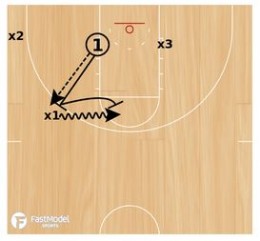
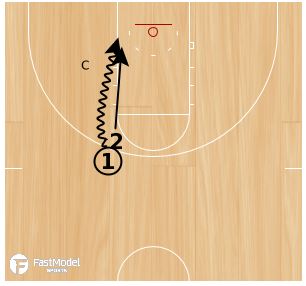
closeout1

Players start on whistle slapping the floor and footfire. On the pass they close out to where they should be in conjunction with their man and the ball.

The offense can pass the ball around but do not add dribbling yet.

x2 is guarding the coach who catches the basketball, so he closes out on the basketball.
x3 is guarding the coach at the top and closes out into the passing lane (or help gap depending on your defensive scheme)
x1 is guarding the player on the help side and closes out to the midline.

Make sure the defensive players rotate so they aren’t always closing out to the same player.

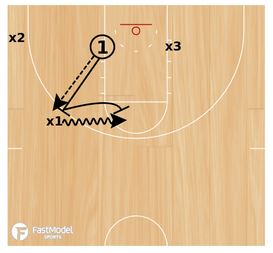
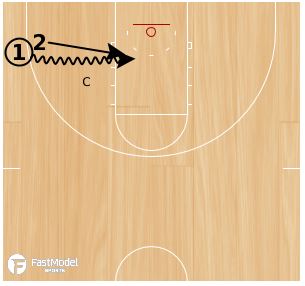
closeout2

The second diagram shows the rotations if ball is passed to top.

The defensive players are guarding the same players, so they have different responsibilities when the ball is passed up top. Again, rotate so that all players are guarding different positions and practicing closing out to all spots.


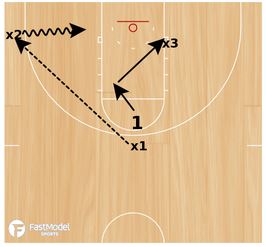
closeout3

The final diagram shows the rotations when ball is passed to left wing.


Consecutive Free Throws Drill

By Brian Williams on January 25, 2016

This video of a free throw shooting drill is with Delta State University Head Men’s Coach Jim Boone.

The drill is a You Tube video, so to be able to watch them, you will need to be able to access You Tube on the server that you are on.

Make sure your sound is on as you watch.

In my opinion, having your players shoot for streaks is a good way to put pressure on your free throw shooters in practice.

The shooter’s goal in the drill is to make 3 in a row. After they make 3 in a row, they report to the scorekeeper

The team goal is to make 100 sets of 3 in a row in 5 minutes. If you don’t like using a set amount of time, you can give them a specific number of times to attempt three in a row. That way you could allow them to use their normal free throw routine.

Coach Boone has won almost 500 games as a college coach. This drill is from his Coaches Clinic DVD which you can find out more about and see more samples from, at this link: Jim Boone Coaches Clinic

Click the play arrow to see the drills.

Off the Block Post Drill

By Brian Williams on January 19, 2016

These two drills, Off the Block Post Drill and Up and Under Post Drill are among the thousands of resources for both coaches and player available from basketballhq. They have several more videos as well as basketball coaching resource articles.

Please make sure your sound is on to see the video.

Click the play arrow so see the drill.

The drill is a You Tube video, so you will need to be able to access You Tube to see the drill.

Even if you don’t agree with the teaching points or philosophy in the drill, it is important to work with your post players on what you want them to do if they do catch the ball off the block.

The coach in both videos is Chris Capko.

At the time the videos were filmed, he was on the USC staff. He is currently an assistant at Florida International.

Off the Block Post Drill

Up and Under Post Drill

Skill Development Drills

By Brian Williams on January 13, 2016

These three skill development drills are from Coach Scott Peterman’s NBA Skill Development Playbook.

The first drill is for perimeter shooters. The other two drills are for inside players.

This week’s eBook bundle is Coach Peterman’s NBA Skill Development Playbook and Tim Springers’ NBA Scoring Drills Playbook. You can find out more about them at this link:

NBA Skill Development/Scoring eBook Bundle Feel free to email me or call/text (317) 721-1527 if you have any questions about the eBooks

Diagrams created with FastDraw


14 in 90

skills1

The shooter (2) starts in the corner.

The shooter must make two in a row to move to the next spot.

The shooter shoots from 7 spots going for 14 makes in 1:30 minutes.

You can use different spots other than the 7 in the diagram.

If you have 3 players, you can use 2 basketballs and have a rebounder and a passer.

If you have 2 players, you can use 1 basketball and have a rebounder for inside-out shots.

Blind Man Drill

skills2

The Post Player (5) stands under the front of the rim facing the basket. The coach (3/4 in black) is at the top of the key. (3/4 in white) is the rebounder.

The coach calls out the player’s name and the player turns and faces the coach. They turn opposite each time.

The coach passes the ball to the post player. The post player catches and finishes with a different hand each time.

He must immediately go up to finish with no gather/pivot.

You can also have a coach or manager give some resistance with an air dummy.

Step / Explode / Extension Drill

skills3

The post player (4) will start with the heels on the foul lane. The coach (1) will throw the ball over the basket to the other side. The post player will take a step and then explode up to get the ball.

The post player will not bring the ball below his chin. He can add a shot fake to the drill, but the drill must end with a power layup/dunk / reverse layup.

You can also have a coach or manager give some resistance with an air dummy.

This week’s eBook bundle is Coach Peterman’s NBA Skill Development Playbook and Tim Springers’ NBA Scoring Drills Playbook. You can find out more about them at this link:

NBA Skill Development/Scoring eBook Bundle Feel free to email me or call/text (317) 721-1527 if you have any questions about the eBooks

  • « Go to Previous Page
  • Page 1
  • Interim pages omitted …
  • Page 50
  • Page 51
  • Page 52
  • Page 53
  • Page 54
  • Interim pages omitted …
  • Page 96
  • Go to Next Page »

Primary Sidebar

  • Twitter
  • Facebook
  • Linkedin
coachestoolbox
personaldevelopmenttoolbox
basketballplayerstoolbox
basketballtrainer
athleticperformancetoolbox
coachingbasketball

© Copyright 2026 Coaching Toolbox

Privacy Policy