• Skip to primary navigation
  • Skip to main content
  • Skip to primary sidebar

  • Basketball Plays
    • Ball Screen Sets
    • Horns Sets
    • Man to Man Post Up
    • Man to Man Isolations
    • Backdoor Plays
    • Man to Man 3 Point Shot Plays
    • 2-3 Zone Attack
    • Baseline Inbound Plays
    • Sideline Inbound Plays
    • Combination Defense Attack
  • Drills
    • Defensive Drills
    • Offensive Drills
    • Competitive Drills
    • Passing Drills
    • Rebounding Drills
    • Shooting and Scoring Drills
    • Toughness Drills
    • Transition & Conversion Drills
    • One on One Drills
  • Blueprint
  • Practice
  • Mental Toughness
  • Skill Development
  • Offense
  • Defense
  • Store

Basketball Drills

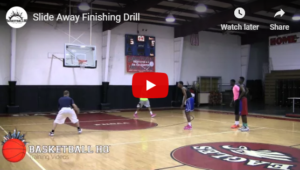
Shot Fake and Finish Rebounding Drill

By Brian Williams on March 31, 2016

This offensive rebounding drill is among the thousands of resources for both coaches and player available from basketballhq. They have several more videos as well as basketball coaching resource articles.

The drill is with Coach Ryan Panone

You might not want to do the drill exactly as it is laid out in the video, but the idea behind the posts I make is to get you thinking about creating drills that will allow for your players to make maximum improvement.

The key is to make it fit what your players need to be able to do within your system.

Please make sure your sound is on to see the video.

Click the play arrow to see the drill.

The drill is a YouTube video, so you will need to be able to access YouTube to see the drill.

Multiple Effort Skill Drill

You will want to come up with your own teaching points that fit your purpose, but the teaching points for the video are:

1) Changing the pace of the time after the shot fake to finish
2) Keep the ball up high after the shot fake
3) Finish with both left and right hands
4) Rebound the ball at its peak with arms extended
5) Finish through contact

Basketball Coaching Mistakes Part 3

By Brian Williams on March 24, 2016

This post is the third part of an article that Arkansas women’s coach working on to detail his move from assistant coach to head coach. The article is entitled “418 Mistakes Later” and he is still adding to it.

I know that he is much harder on himself than he should be, but the points he makes are lessons to consider for all coaches, not just head coaches.

Here are links to the first parts of the article:

Coaching Mistakes We All Make Part 1

Coaching Mistakes We All Make Part 2

I GOT OUT OF ALIGNMENT BETWEEN PROCESS AND RESULTS

When you get your opportunity to be a head coach after years of being an assistant coach, you have a mountain of ideas on who you think you want to be. You have been watching your mentors for years making mental notes of ways you want to be like them and ways that you don’t want to be like them. You have been attending clinics hearing speakers filing away bullet points of this you are going to do some day. You have observed, studied, researched, and compiled. You have most likely put together some form of portfolio for a hiring committee that details everything you have been thinking about. Probably took it to Kinko’s and had it bound even. It’s yours, but is it YOU?

I am not saying any of the above is a bad idea. But, I am saying, be careful of who you say YOU ARE, before you know who you are.

My biggest mistake in this area was talking about Process, process, process but in many causes becoming reactionary to Results. When that happens it alienates the people you are trying to lead.

You can’t preach process then turn around and speak about results. The very second you do this, the process loses its punch.

It’s okay to be results driven. It’s okay to be process driven. It’s not okay to teeter back and forth between the two.

If I had to do it all over again, I would have been a little more patient in announcing to the world who we were and what our identity was going to be. My mental image that had been conjured up over the years simply wasn’t doable in the timeframe that I had all worked out in my mind.

I didn’t understand how time consuming things can be. I didn’t understand how long it takes to assemble a staff. I didn’t understand budgetary issues. I didn’t understand many aspects of the position of being a Head Coach. As a result my alignment between process and results was often a blurred line. Creating confusion and uncertainty among the people I was trying to lead.

Don’t give you team three goals that they need to achieve to win a game, then lose your mind in the locker room afterward only to realize later that night they had met all three. Don’t set standards that are met yet don’t produce results. Don’t celebrate good results that were not reflective of the process. All these things are easy to do because of human nature. And are very easy to do as a young head coach.

Be patient in deciding who you are and who you want your program to be. But when you decide, stick to it and don’t get out of alignment with your team, your staff, your administration, and your loved ones.

I HAD NO IDEA HOW TO MANAGE A STAFF OR HOW TO “MANGAGE UP”

Going from “being on a staff” to “having a staff” overnight is one of the greatest challenges I faced. It’s also an area that now, almost two years in, I continue to struggle with. It’s hard. My situation was particularly challenging because five of my staff members were co-workers, equals, and colleagues the day before my hiring was announced.

One day you are 100% focused on doing everything in your power to make your boss look good, do their job better, do their job easier, and being ready to do whatever is asked. Your world is focused on doing What You Do. The next day, you ARE the boss and your actions and decisions effect the lives and lives of families for other people.

As an assistant my actions reflected only on me.

As an assistant my decisions only had repercussions on me.

As an assistant my accountability was to one person.

As a head coach your actions reflect on numerous people… the people who hired you, the people who work for you, they people who you lead.

As a head coach your decisions impacts a pyramid of people that cascades down and down and down.

As a head coach you are accountable to more than one person. You have many people ‘UP’ the ladder now that you are accountable to.

The learning curve for making this adjustment is expected. Most people will give you some free passes as you learn to navigate the waters for the first time. But it’s NOT LONG ENOUGH… trust me.

You can read all the leadership books you want to. You can seek advice from mentors. You can have a plan. All that helps for sure, but nothing can actually prepare you for the daily dealings that you have signed up for until you live them.

So, with that said, I say, read everything. Have a plan. Talk to your mentors… AND then expect to get it wrong some. Don’t expect it to work perfectly. Be adaptable earlier than I was. Don’t be rigid. It’s NOT a my way or highway situation. It can’t be. There is a great book called YOU CAN’T FIRE EVERYBODY that I wish I had read before I made the move.

You have to surround yourself with people that you trust and trust you. This way there is an understanding that you are both working through the process of figuring it out. While there will be mistakes made on both sides, you can survive it all and in time will begin to thrive. It will become very obvious who believes in and who is faking it. You will learn valuable lessons along the way that will shape your identity and the culture that surrounds your program.

You need to know what inspires each member of your staff. From your “chief of staff” to your volunteer, you must have full understanding what inspires them to be a coach and drives them to excel in a profession that we all know can grind you down. Just like your players, each of them will be unique. You can’t treat them all the same. For some it’s good old money… incentives. Others it’s future jobs and responsibilities. Others it’s the being a part of the here and now. Other’s will be inspired by the intrinsic rewards being a part of team provides. Some day I am going to write up a FIVE LANGUAGES OF COACHING in reference to the great book by Gary Chapman THE FIVE LANGUAGES OF LOVE (which is a must read for anyone in any kind of relationship.) Until then, just be aware that what inspires you, doesn’t inspire everyone.

Sure you can get a staff of people that are inspired by the same things you are, but that is dangerous. Then you have YES people who may not tell you when you are wrong and when you are making these 418 mistakes!!!

Managing UP is a term I picked up from some reading. It’s how you communicate with the people who hired you and the people who hired them!!!

These are the people who believed in you most. They wouldn’t have hired you if they didn’t. It’s imperative you keep them in the loop. It’s imperative you tell them things FIRST before they hear it from someone or somewhere else. People UP the ladder hate surprises. Don’t YOU hate surprises from your players? Well, you are one of their players!!

It’s okay to show them vulnerability. My direct supervisor told me from Day 1 it’s okay to be a little scared…. It’s a big deal to be a head coach and if it doesn’t cause you a little anxiety, then you aren’t really the person for the job and don’t have a full understanding of what is at stake!! That message drove me. And while I didn’t make many mistakes in this area, I put it on here so that you don’t either.

I fully believe that this is what allowed us to survive my 418 Mistakes and actually find a way to win 20 games, keep our players off the front page and on the sports page, and raise our team GPA to unprecedented success.

While this wraps up the 12 categories I mentioned in the beginning, it segues nicely into the fact that WE DID ACTUALLY DO SOME THINGS RIGHT!!!

That may become an off season project.

Until then, I hope this piece will help a variety of people. I hope it will help long time head coaches as well as young assistant coaches who may simply file this piece way for “their day”.

And yes, I do have a list of Mistakes I am making in year 2. For those of you scoring at home that lists stands at 57. Yes, I have made a few twice but only a few.

Some of the new ones of have been BIGGER while others are smaller.

Needless to say, making mistakes is part of the profession we are in. We are the ones who choose a profession where we invite people to (in fact beg them at times) to come into our workplace and watch us work. Can you imagine 250 or 2,500 or 25,000 coming into an insurance man’s office and watching him settle a claim. Or a surgeon preforming open heart procedure in front of that many people AND being broadcast on the Pac 12 Network!!!

We choose this profession. We have to accept the scrutiny that comes with it. In fact, you must embrace it!
You’re not going to be perfect. You can try to be, but you’re not going to be.

While you certainly don’t have to keep a running list of your mistakes, I do think every coach can benefit from recognizing their faults. Moving on from their failures and rebounding from them improved.

Multiple Effort Skill Drill

By Brian Williams on March 10, 2016

This drill is among the thousands of resources for both coaches and player available from basketballhq. They have several more videos as well as basketball coaching resource articles.

The drill is with Kevin Sutton, Assistant Mens Coach at Rhode Island. At the time the video was made, he was an assistant at Georgetown.

You might not want to do the drill exactly as it is laid out in the video, but the idea behind the posts I make is to get you thinking about creating a multiple effort drill that will benefit your players in the “Improvement Season” (April through September). For example, you could use pads on the layup to simulate finishing through contact or could specify a specific type of finishing move other than a straight layup.

The key is to make it fit what your players need to be able to do within your system.

Please make sure your sound is on to see the video.

Click the play arrow so see the drill.

The drill is a You Tube video, so you will need to be able to access You Tube to see the drill.

Multiple Effort Skill Drill

Post Player Skill Development Drills

By Brian Williams on March 3, 2016

Clinic Notes from:

These are some of the notes presented by Brian James at a PGC/Glazier Basketball coaching Clinic.

Brian is an assistant on the men’s staff at Northwestern.

Post Player Development Drills

Defensive Rebound and Clear vs. Double Team

Post player starts at the elbow
2 coaches/managers/players with Air dummies under basket
Coach throws ball off glass and post player rebounds as high as possible
Once he lands, players with dummies push him
Post takes one dribble and throws ball to wing (outlet)

Can add:
Player pivots for 5 seconds while being hit with pads before passing to outlet
Blockout, or Hit and Get (chuck your player, then go get the rebound)

Scoring vs. Resistance Band

Player with resistance band around waist, coach with resistance band around back
Another Coach with air dummy
Player must score 3 times against band and pads
Go twice on both sides of the floor

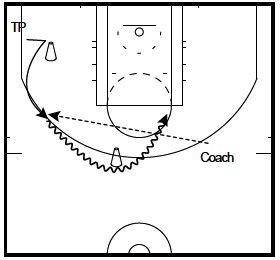
Diamond Speed Dribble into Score

diamond

Diagrams created with FastDraw

Cones 15 feet apart
Time this drill.
Start and finish behind baseline.
Score the layup before finishing across the baseline.
Each player goes twice one way and then twice, going the opposite direction around the cones.

Post Player Shooting/Scoring Drills

Philosopy
Work against air dummies and EAT Pads,
Work on post seal swim move
When posting, straddle the line above the block–that allows for baseline cut by passer.
Post players need 3 moves–a go to, a counter, and one other.
Work in pairs to push each other.
When a post player is guarded by a bigger player, he/she should turn and face the defender. Get to the middle of the lane and look to utilize a spin move.
Use power 2 foot layup with a defender, when there is no defense, score on a one foot layup

Shooting Drills they use with their bigs:
(They must make 5 for 7 on both sides of the floor for each drill before they move on to the next)
You will want to change the drills/spots to fit your needs, but have a standard that they must meet before moving onto the next drill or spot. Shoot 2 free throws after making 5 of 7 and before moving on to the next spot.

Work against air dummies or EAT pads.

1. Screen, Slip, Score.
2. Windshield Wiper Catch and shoot Mid Range Shots. Vary the spot on the floor, but the idea is like the elbow to elbow windshield wiper shooting drills (shoot from one elbow, move to the other elbow shoot, then back to the first elbow)
3. Transition Drag Screen and Pop or Roll Shooting Drill. They teach their post players to pop their feet when they land when setting a ball screen to avoid moving and illegal screens. That also cues the dribble to use the screen.

drag2

Note: Northwestern likes to set their drag screens like the 5 screen in the diagram, not the 4 screener. They feel it helps their guard with the basketball get downhill quicker.

4. 3 Post Moves for each player (go to, counter, third move). These moves are individualized to each player’s strengths.
5. Pop shooting vs. a downed ball screen

Here are some additional notes on improvement season skill development from Tom Richardson, Men’s Assistant at Vanderbilt from the Chicago PGC/Glazier Clinic.

1. Work on agility, balance, conditioning, quickness, speed, and skills.
2. You should work on skill development during the practice and games season, but in the improvement season (April-September) you should use drills that you don’t use in practice to avoid boredom.
3. Out of season workouts cannot be boring for the players! Keep them quick paced, high intensity, and high energy.
4. Conduct a shooting assessment as a “pre-test” at the beginning of the workouts, then measure periodically to determine improvement.

Basketball Defense Beilein Walled Layups Drill

By Brian Williams on February 29, 2016

These John Beilein defensive drills came from the FastModel Sports Basketball Plays and Drills Library.

You can also find out more about FastModel Play Diagramming software by clicking this link: FastDraw

The drills were contributed by Dennis Hopkins from the Basketball Coaches Association of Michigan Coaches Clinic.

Purpose of the drill is to work on keeping ball out of the lane without fouling and contesting layups without fouling.


Michigan Breakdown Defensive Drill

breakdown1

Guard starts with the ball in the lane and begins the drill by rolling the ball out to the perimeter wing.

1. Closeout properly with choppy steps and hands high. Mirror the ball.

2. The guard ties to drive to the middle. Defender walls the ball handler.


breakdown2

1. On the pass to the corner the defender quickly positions himself in help side defensive position.

2. On the drive by the corner, he must block out the weak side post.


Michigan Walled Layups

walled1

1. Coach is positioned in the help defense spot of the drive.

2. Offensive player puts the ball on the back of the defender.

3. When the ball is moved, the play goes live with the offense driving the pre-determined line.

4. The defense is trying to wall up the offense and contest the layup without fouling.

5. Run the drill to both sides of the floor.

walled2

Run the drill on the baseline as well and on both sides of the floor.


Basketball Drills: Defensive Cut Throat

By Brian Williams on February 29, 2016

This competitive defensive drill came from the FastModel Sports Basketball Plays and Drills Library.

You can also find out more about FastModel Play Diagramming software by clicking this link: FastDraw

This drill was contributed by Coach Greg White.

It is a way to play competitive cut throat so that to win, the team must get defensive stops and make defensive plays.

Defensive Cut Throat

In the diagram below, gray, red, and black are 3 separate teams of 4 players. Gray is starting on defense, red on offense, and black is waiting to go on as the new offense at the end of the possession.

Each team has it’s own score. In Defensive Cut Throat, teams waiting to come on are at half court.

When the offense makes a basket, they go on defense, the defense steps off and goes back up to half court line, new team comes on on offense.

Teams do not score points by making baskets. Points are only scored for defensive stops and plays. When the offense makes a basket, they earn the right to play defense. Being on defense is the only way to score points. (To reward toughness, you can give a team a point, if they score and are fouled “and-one”)

defensivecutthroat

The scoring for defensive cut throat is as follows. All points are rewarded only on defense.
(You can adjust the scoring to emphasize whatever you need to emphasize for your defense.)

1 point for defensive team for a stop.

3 points for taking a charge.

Bonus point for a defense completing 3 consecutive stops. (To reward them outlasting 2 other teams)

You can create your own rules as to why the defense loses the right to play defense such as:

1. Not talking
2. Not taking a charge
3. Giving up middle or baseline drives
4. Not blocking out
5. Sloppy closeout.

You can set the expectations at whatever level will allow your players to improve. The coach can control the pace of the drill by how quickly you put the ball back into play after a stop or a score.

  • « Go to Previous Page
  • Page 1
  • Interim pages omitted …
  • Page 48
  • Page 49
  • Page 50
  • Page 51
  • Page 52
  • Interim pages omitted …
  • Page 96
  • Go to Next Page »

Primary Sidebar

  • Twitter
  • Facebook
  • Linkedin
coachestoolbox
personaldevelopmenttoolbox
basketballplayerstoolbox
basketballtrainer
athleticperformancetoolbox
coachingbasketball

© Copyright 2026 Coaching Toolbox

Privacy Policy