• Skip to primary navigation
  • Skip to main content
  • Skip to primary sidebar

  • Basketball Plays
    • Ball Screen Sets
    • Horns Sets
    • Man to Man Post Up
    • Man to Man Isolations
    • Backdoor Plays
    • Man to Man 3 Point Shot Plays
    • 2-3 Zone Attack
    • Baseline Inbound Plays
    • Sideline Inbound Plays
    • Combination Defense Attack
  • Drills
    • Defensive Drills
    • Offensive Drills
    • Competitive Drills
    • Passing Drills
    • Rebounding Drills
    • Shooting and Scoring Drills
    • Toughness Drills
    • Transition & Conversion Drills
    • One on One Drills
  • Blueprint
  • Practice
  • Mental Toughness
  • Skill Development
  • Offense
  • Defense
  • Store

Basketball Drills

8-6-4 Conversion and Conditioning Drill

By Brian Williams on June 5, 2016

This drill was contributed by Aseem Rastogi to the FastModel Sports Basketball Plays and Drills Library.

Any drill that you see someone else do should always be tailored to your particular needs.

I think anytime you can structure your conditioning so that it is playing basketball, that is a good thing.

Here is an idea for a drill for you to think about and modify for your system, or to use a part of the drill to incorporate into your current drills.


8-6-4

8-6--4-1

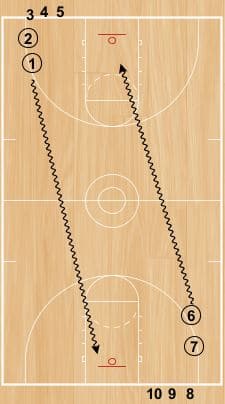
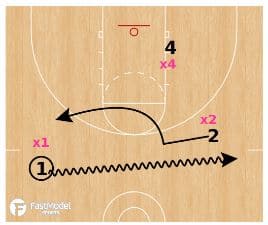
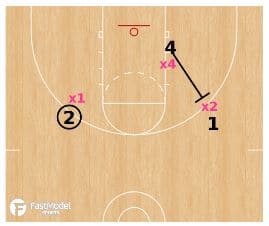
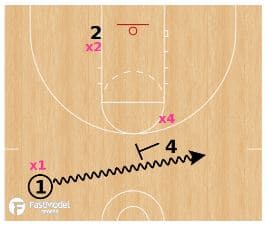
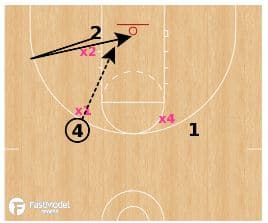
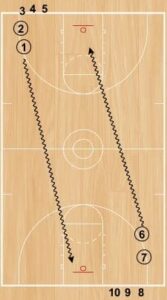
Initial Alignment – defensive team is on the baseline, offensive team is 4 out.

(You could have the offense pass and cut to get some movement)


8-6--4-2

Set clock for 8 seconds. Utilize shot clock here if you have one.

On the whistle, the defensive team must sprint to the opposite baseline, touch, and come back in transition defense.

After whistle, coach passes the ball to any offensive player. Up to the defense to locate the ball on the way back.

Note: Each team plays transition D differently – emphasize the points for your team.

The offensive team may attack as soon as they hear the buzzer.


8-6--4-3

If defensive team gets a stop, they go to 6 seconds for the next possession. If they get scored on, they stay at 8.

Defensive team has 6 seconds to touch opposite free throw line and come back in transition defense. Offensive team may attack at the buzzer.

Rotate in new offensive team each time to keep everyone involved.


8-6--4-4

If the defensive team gets a stop at 6 seconds, go to 4 seconds. If they don’t get a stop, they stay at 6.

Note: We have an accountability for staying at 8 for three possessions in a row – keeps the drill moving. Kids are sent with an assistant coach for a non-running accountability, such as pushups, planks, or wall sits. They will still finish the drill.

4 seconds – the defensive team runs to half court and back. Offensive team may attack at the buzzer.

8 Individual Shooting Drills

By Brian Williams on May 31, 2016

These shooting drills are from Dennis Hutter, Head Women’s Basketball Coach at North Dakota. His website, www.coachhutter.com . The website has more shooting, individual development workout, and leadership videos.

COMPETITIVE INDIVIDUAL DEVELOPMENT WORKOUT SHOOTING DRILLS

  1. Make 10 Shots Without Missing 2 in a Row

-Work at a pace that is “game like”

-Try to make 10 shots w/out missing 2 shots in a row

-If you miss 2 shots in a row, allow a “swish” on the next shot to continue the string.

-All shots are shot with the player spinning themselves a pass – Rhythm Shooting

-Can do this drill with stop and pop shots as well as jump shots


  1. Make 10 Shots in 1:15

-Player has 1:15 to make 10 total shots

-All shots are shot with player spinning themselves a pass – Rhythm Shooting

-Have to work at a pace that allows you a chance to make 10 shots

-Player gets their own rebound on all shots

-Great warm-up drill to “heat up” player before workout begins

[thrive_leads id=’26117′]

  1. “25” Point Shooting Drill

-Player alternates between shooting a “3” and shooting a stop and pop

-3’s are worth 3 points, and stop and pop shots are worth 2 points

-Player tries to get to 25 points in 2:00

-Player can’t catch ball in same spot twice in a row – use entire floor

-Use a rebounder with this drill

-Player alternates between right hand and left hand when attacking the rim


  1. 10 Spots in 2 Minutes

-Player has 2:00 minutes to complete this drill

-Player shoots from five spots:  corner, wing, top, wing and corner

-Player shoots from a spot until they make 2 in a row – start in corner

-After 2 makes in a row, player advances to next spot

-Spots 5 & 6 are in the same corner

-Use a rebounder for this drill, and an extra ball if there are long rebounds


  1. “21” Point Drill – Individual

-Player starts at half line

-Player shoots a lay up, a stop and pop and a “3” in that order

-Lay up is worth 1, stop and pop is worth 2, and 3’s are worth 3 points

-Player shoots shots in the order of lay up, stop and pop and 3 –continuous

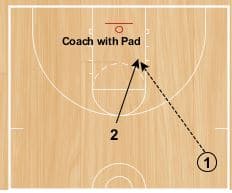
-Player sprints from half line and receives ball from coach at arc

-drives in and shoots a lay up – 1 point – then sprint to back to half line

-attacks rim and shoots a stop and pop – 2 points – then sprint to half line

-shoot “3” from top of the key

-Player continues shot order until they get to 21 points

-Great toughness/condition drill


  1. “30” Point Shooting Drill

-Player shoots shots from four spots: wing, pro spot, pro spot and wing

-Set up a chair or cone at each spot on floor, just outside of the three point line

-Player receives pass and attacks the chair or cone

-Player will shoot three shots from each spot

-Player shoots stop and pop “3”, then a right to left crossover move to a stop and

pop and then a left to right crossover move to a stop and pop shot

-Player shoots ball and then sprints back behind chair/cone to receive ball and

makes next move

-“3” worth 3 points, stop and pops worth 2 points

-7 points per spot for a total of 28 points – finish drill with 2 FT’s for a total of 30

-Try to achieve a goal of 23 points or higher


  1. “44” Point Shooting Drill

-This drill is done with a rebounder, and try to complete drill in 1:30

-Shots are shot in increment of 4

-Player receives ball at top of key and attacks basket for lay up – 2 with right

hand and 2 with left hand – alternate hands

-Player receives ball at top of key and attacks rim and shoots 4 stop and pop

shots – attack twice with right hand and twice with left hand.

Player then shoots 8 three point shots (wing, pro spot, wing pro spot) on the left

Side.  (Wing, pro spot, wing pro spot) on the right side.

-Finish drill with 4 free throws

-Lay ups and stop and pops all worth 2 points

-3’s all worth 3 points

-Free throws worth 1 point for a total of 44 points


  1. Free Throw Game

-Have to make 16 Free Throws in 6:00

-Free Throws are shot in 1 and 1 increments.

-Player makes both free throws they sprint to half line and back

-Player makes first FT and misses second they have one full court sprint

-Player misses front end of 1 and 1, they have a double sprint (down and back

twice)

-All sprints, player dribbles ball with weak hand

-Player continues drill until they either make 16 FT’s or use all 6:00

-Consequence is push ups

-16 – total makes x 2 = total number of push ups at the end


TEACHING CONCEPTS AND PHRASES WITH SHOOTING IDW’s


-Make your workouts like a game, so your games can be like your workouts

-The single best way to improve the team is to improve the individual player’s skills

-When you get better, the TEAM gets better

-Game shots, game spots, game speed with game conditions

-60% workouts – chart shots and have player make 60% of shots for entire workout

-Three Keys to Shooting

  1. Get the Ball Up
  2. Get the Ball Straight
  3. Hold a High One Second Follow Through

-Don’t miss two shots in a row – THE SAME WAY – Focus and Finish

-Always warm up with Shooting Progression and Stick the Stance Progression

-Consistent technique will bring about consistent results

-If you want to add competition to any drill or IDW, add time or score to the drill – gets the

player to workout at game speed.

-Be a “back half of the rim” shooter – don’t leave the shot short

-FIND A WAY TO WIN!!!!!!!!!!!!!!!!!! – Teach players to “find a way to win” at

Slide Away Basketball Finishing Drill

By Brian Williams on May 30, 2016

This driving and finishing drill is among the thousands of resources for both coaches and player available from basketballhq. They have several more videos as well as basketball coaching resource articles.

Make sure that your speakers are on to hear the narration and that you can access YouTube to see the videos.

BasketballHQ has just released their Basketball Coaches Training Group. In the group you will get access to different workout plans that are going to be for the team as a whole, by position, by the number of players and more. This is an all inclusive training group that is going to allow you to walk onto the court with a full workout plan in hand for your players through our easy to use Iphone and Android App. Every drill comes with a video breaking down the details of the drill, and all of the videos are instructed by a Pro or College coach and demonstrated by a high level player. click here for More Information on the Basketball Coaches Training Group.

I have posted a sample from the Coaches Training Group below the first video.

The Coach in the video is Brian Baudinet, formerly an assistant coach with the NBA D-League Tulsa 66ers. Since the video was made, Coach Baudinet has taken a position with the Duquense University Men’s Staff and the Tulsa 66ers are now known as the Oklahoma City Blue.

The purpose of this post is to get you to think about adapting it to your needs and not just running the drill as is. The teaching points might fit your philosophy and if they don’t, at least it might stimulate your thinking to more clearly define and communicate to your players what you do want.

I like the idea of giving consideration to where your players will be spaced and where the help is likely to come from as you work on your straight line driving and finishing at the basket. You can also put your players in different spots on the floor and how you would teach your drives and finishes.

You will also want to work on the various finishes that your players use and not just the finishes in the drill.

Click the play arrow to begin the videos.

Slide Away Finishing Drill

Here is a 2:00 minute sample of the type of content that is available in the BasketballHQ Coaches Training Group.

Multiple Action Skill Drills

By Brian Williams on May 18, 2016

Some drills from Scott Peterman’s Basketball HoopScoop NBA Skill Development Bundle.

I like the ideas of players having to make multiple cuts and use multiple skills in a drill just like they have to do during the course of one possession during a game.

Use the drills to stimulate your thinking and staff conversation to find ways to more closely simulate the cuts and skills that your players use within your system during a possession.

This week’s eBook bundle is the Coach Peterman’s NBA Skill Development Playbook and Tim Springers’ NBA Scoring Drills Playbook. You can find out more about them at this link:

NBA Skill Development/Scoring eBook Bundle

Feel free to email me or call/text 317-721-1527‬ if you have any questions about the Bundle.

Diagrams created with FastDraw

Steve Nash High Pick and Roll Bounce Out

nash

Nash takes a high pick and roll screen and attacks the elbow.

If the help is sitting in the paint he will bounce off the lane line into a jump shot.

Drill: Use the chair for a high pick and roll. Attack the elbow and bounce out for jump shot.

Make 20 from each side of the court.

Use different types of ball screens that you utilize in your offense.

When creating space on the second defender, you can also simulate an off balance closeout and drive to score with a floater or some type of finish at the basket.

Look for ways to create drills that work on not only beating their primary defender, but also having to work at beating a second helping defender.

Tony Parker Down Screen into Pick and Roll

parker

Come off a down screen in the corner.

As soon as he catches it off the screen (going full speed), he will dribble into a pick and roll.

Drill: Explode off the first cone (down screen) and catch the ball into a pick and roll (2nd cone) for jump shot
at the elbow.

Make 20 on each side.

You may not have this exact action in your offense, but think about incorporating cuts and movements your players make during the course of a possession into your shooting/scoring drills

This week’s eBook bundle is the Coach Peterman’s NBA Skill Development Playbook and Tim Springers’ NBA Scoring Drills Playbook. You can find out more about them at this link:

NBA Skill Development/Scoring eBook Bundle

If you are interested in adding to your Coaching Toolbox take look at what I believe is our best offer.

CLICK HERE to select from a list of more than 70 eBooks.


Duck and “W” Basketball Shooting Drills

By Brian Williams on May 16, 2016

I received these shooting drills from Dennis Hutter, Head Women’s Basketball Coach at Mayville State University. His website, www.coachhutter.com . The website has more shooting, individual development workout, and leadership videos.

“Duck” Shooting Drill

Coach Hutter’s comments on the drill:

We picked this drill up from the coaches at the University of Oregon Women’s Basketball Program. This is a great shooting and competition drill for your players.

The shooter will shoot for 5:00 straight from seven different spots. Corner, Wing, Pro Spot, Top of Key, Opposite Pro Spot, Opposite Wing, Opposite Corner. Shooter starts in the corner. The goal is for the shooter to make two shots in a row, once they make two shots in a row, they advance to the next spot.

They keep working around the arc, advancing every time they make two three’s in a row. Spots “7” & “8” are both located in opposite corner and spots “14” & “15” are back at starting corner spot, and spots “21” & “22” are back in opposite corner and so on. Your score is the spot you finish up on when the 5:00 is up.

26-30 – Excellent Shooter
21-25 – Above Average Shooter
16-20 – Average Shooter

“W” Shooting Drill

Because we are a transition team, we like to use drills that involve a lot of sprinting and shooting off of the sprint, like we would in transition. With “W” shooting, we use the same seven spots as we use in “Duck Shooting” (Corner, Wing, Pro Spot, Top of Key, Opposite Pro Spot, Opposite Wing, Opposite Corner). The shooter will start in the corner. Shooter will shoot and then run and touch the half line and then advance to the next spot. Shooter will shoot a total of seven shots. Goal is for shooter to make five or more shots in 40 seconds or less.

10 in 75 Drill

Shooting Technique Thoughts & Ideas from Coach Hutter

-Quality of the jump shot comes from the feet:
-Quality = how open you are, low quality = high contested shot attempt
-“Shot first” mentality on all catches – Be an offensive threat with the ball
-Great balance on all catches, before the shot
-Balance starts with a great base of support with the feet and low center of gravity
-2 biggest keys in shooting for us is: “Get the ball up” & “Get the ball straight”
-Analyze your misses – don’t miss two shots in a row – THE SAME WAY
-NSM = Next Shot Mentality
-4 Points in the shooting technique need to start and finish in a straight line
-Shooting foot
-Shooting knee
-Elbow
-Hand/Follow Thru

-Proper consistent technique will bring about consistent results
-We want consistent shooters and that starts with having consistent technique
-Proper shooting technique starts with the feet and builds up from there
-NO FEET = NO SHOT
-You are the most open you will be when you first catch the ball
-so get ALL of your work done before you receive the ball
-Catch and shoot the ball in rhythm
-Shooting is a rhythm skill – like swinging a baseball bat – no hitches, no pauses – JUST FLUID
-Shooting the ball is one upward FLUID motion – Rhythm
-Hold a high one second follow thru on every shot
-We want quiet/quick feet on all catches – Stay light on your feet
-Make your workouts like games, so your games can be like your workouts – DEVELOP GOOD HABITS
-Every pass should hit the shooter in the hands and lead to a rhythm jump shot for us

Shooting Workout Thoughts & Ideas from Coach Hutter

-Never miss two shots in a row the same way
-Clean makes to end a drill
-makes the shooter concentrate more when they are most fatigued to complete the drill
-Use drills that involve making 2 and 3 in row – makes shooters have to focus on consistent technique
-Chart shots in individual workouts – allows players to see improvement
-also creates motivation to improve when they see improvement
-also creates competitiveness within players to achieve higher score than previous workout
-Chart shots as a team during practice and team shooting workouts – makes players focus on team more
-every shot from every player within every drill COUNTS towards team’s success
-Make shooting drills competitive during practice – Have team compete against the game as one team
-add time and score to drills to have team compete against the game
-will also make you a better passing team
-Have individual shot charts for players during practice and games, instead of team shot charts
-Categorize your shots so you can see who and how your players are getting shots

1. Lay Up
2. Post Shot/Block
3. Post Shot w/ Dribble
4. Lane Shot
5. Lane shot Off Dribble
6. Mid-Range Shot
7. Mid-Range Shot Off Dribble
8. “3”

-Inside/Out “3” is the best “3 to shoot in rhythm
-Shooter is already squared up and facing the rim – shooter does not have to fight w/ their feet
We want players to shoot 60% or better from behind the arc in drills that involve no defense

C2E Crossover Spin-Handle Permutations

By Brian Williams on May 8, 2016

This ball handling drill was contributed by Rick Allison, Owner/Founder/Lead Trainer of LoneStar Basketball Academy to the FastModel Sports Basketball Plays and Drills Library.

You can also find out more about FastModel Play Diagramming software by clicking this link: FastDraw

This is a training progression for one or more players to improve their ball handling transitions from one or more crossovers into a spin crossover.

It begins with a simple front cross into spin crossover and progresses to more challenging combinations and permutations as the player develops more confidence and dexterity.

Alternating dominant and non-dominant hands are incorporated to facilitate movement across the court.

There are links to You Tube videos of the drill at the bottom of the post.

shakedown1

[note: Description is per this illustration..could have players turned around or starting on other sideline. Key aspect of progression is to have pound dribble on side toward direction of travel (illustrated by red dashed line).]

– Each player is on the left sideline, has a ball in their left hand, is in a double-wide stance, and is facing the midcourt line (left shoulder pointing in direction of the opposite sideline)

– movement starts with a left hand pound dribble, into a front crossover to the right hand, and then a spin crossover by pulling the ball and reverse pivoting 180 degrees on the left foot into a right hand pound dribble on the right side

– the player is now facing the baseline with the ball in the right hand on the right side and has progessed one body width toward the opposite sideline

– the pound dribble after the spin crossover actually begins the reverse action for the next front crossover and spin (i.e., right hand pound dribble into a right to left hand front crossover and left hand reverse pivot spin off the right foot)

– by alternating the right hand and left hand spin move in this manner the player progresses to the opposite sideline (see video clip for movement progression)

– this progression provides numerous right and left hand repetitions to allow incremental refinement, and facilitates improvements in the hand placement for the transition into the spin move (a particularly

difficult maneuver for many players)

– emphasis should be on proper weight shifting and balance, wide lateral displacement, low crossover and hand positioning, and increasing quickness

shakedown2

Return trip (change front crossover to through-the-legs crossover before spin):

[note: Description is per this illustration..could have players turned around or starting on other sideline. Key aspect of progression is to have pound dribble on side toward direction of travel (illustrated by red dashed line).]

– On return trip, each player is now on the right sideline, has a ball in their right hand, is in a double-wide stance, and is again facing the midcourt line (right shoulder pointing in direction of the starting sideline)

– movement starts with a right hand pound dribble, into a through-the-legs crossover to the left hand, and then a spin crossover by pulling the ball and reverse pivoting 180 degrees on the right foot into a left hand pound dribble on the left side

– the player is now facing the baseline with the ball in the left hand on the left side and has progessed one body width toward the starting sideline

– the pound dribble after the spin crossover again begins the reverse action for the next through-the-legs crossover and spin (i.e., left hand pound dribble into a left to right hand through-the-legs crossover and right hand reverse pivot spin off the left foot)

– by alternating the right hand and left hand spin move in this manner the player progresses to the opposite sideline (see video clip for movement progression)

– emphasis should again be on proper weight shifting and balance, wide lateral displacement, low crossover and hand positioning, and increasing quickness

shakedown3

Repeat Outbound (change through-the-legs crossover to behind back crossover):

[note: Description is per this illustration..could have players turned around or starting on other sideline. Key aspect of progression is to have pound dribble on side toward direction of travel (illustrated by red dashed line).]

– Each player is again on the left sideline, has a ball in their left hand, is in a double-wide stance, and is facing the midcourt line (left shoulder pointing in direction of the opposite sideline)

– movement now starts with a left hand pound dribble, into a behind-the-back crossover to the right hand, and then a spin crossover by pulling the ball and reverse pivoting 180 degrees on the left foot into a right hand pound dribble on the right side

– the player is now facing the baseline with the ball in the right hand on the right side and has progessed one body width toward the opposite sideline

– the pound dribble after the spin crossover begins the reverse action for the next behind-the-back crossover and spin (i.e., right hand pound dribble into a right to left hand behind-the-back crossover and left hand reverse pivot spin off the right foot)

– by alternating the right hand and left hand spin move in this manner the player progresses to the opposite sideline (see video clip for movement progression)

– the behind-the-back crossover to spin crossover handle is a tough manuever that many players struggle with..dropping the hips and keeping hands low can help improve the ball-hand transfer

– emphasis should again be on proper weight shifting and balance, wide lateral displacement, low crossover and hand positioning, and increasing quickness

shakedown4

Repeat return trip (mix it up now by sequencing to a different crossover before each spin):

– sequence would be as follows: pound/front cross/spin.. pound/through-the-legs/spin.. pound/behind-the-back/spin.. [repeat]

– emphasis should again be on proper weight shifting and balance, wide lateral displacement, low crossover and hand positioning, and increasing quickness.

shakedown5

Advanced permutations:

1) Inside-out series: add inside-out move before pre-spin crossovers. For example:

– trip 1 (pound/inside-out/front cross/spin)

– trip 2 (pound/inside-out/thru-the-legs/spin)

– trip 3 (pound/inside-out/behind-the-back/spin)

– trip 4 (mix it up)

2) triple permutation series:

– trip 1 (pound/front cross/front cross/front cross/spin)

– trip 2 (pound/front/thru-the-legs/front/spin)

– trip 3 (pound/front/thru/behind-the-back/spin)

– trip 4 (pound/thru/behind/front/spin)

– trip 5 (pound/thru/behind/behind/spin)

– trip 6 (pound/behind/behind/behind/spin)

etc., etc., etc.

  • « Go to Previous Page
  • Page 1
  • Interim pages omitted …
  • Page 46
  • Page 47
  • Page 48
  • Page 49
  • Page 50
  • Interim pages omitted …
  • Page 96
  • Go to Next Page »

Primary Sidebar

  • Twitter
  • Facebook
  • Linkedin
coachestoolbox
personaldevelopmenttoolbox
basketballplayerstoolbox
basketballtrainer
athleticperformancetoolbox
coachingbasketball

© Copyright 2026 Coaching Toolbox

Privacy Policy