• Skip to primary navigation
  • Skip to main content
  • Skip to primary sidebar

  • Basketball Plays
    • Ball Screen Sets
    • Horns Sets
    • Man to Man Post Up
    • Man to Man Isolations
    • Backdoor Plays
    • Man to Man 3 Point Shot Plays
    • 2-3 Zone Attack
    • Baseline Inbound Plays
    • Sideline Inbound Plays
    • Combination Defense Attack
  • Drills
    • Defensive Drills
    • Offensive Drills
    • Competitive Drills
    • Passing Drills
    • Rebounding Drills
    • Shooting and Scoring Drills
    • Toughness Drills
    • Transition & Conversion Drills
    • One on One Drills
  • Blueprint
  • Practice
  • Mental Toughness
  • Skill Development
  • Offense
  • Defense
  • Store

Practice

Improving Execution in Basketball Practice

By Brian Williams on November 10, 2016

One of the many challenges we face as basketball coaches is to create an environment and develop systems in practice that lead to constant improvement in both team execution and individual development.  I have always subscribed to Chuck Knox’s philosophy that “Practice without improvement is meaningless.”

One way to emphasize specific points of execution is to make special rules in practice.  Each year, revisit your special rules and make adjustments and adaptations that fit your current team.  The rules should force players to develop the habits that you want in your drills and scrimmages that will carry over to the game.

The idea is to put the players’ focus on the execution (the process) and not on the results or outcome of the play.

You can also use them to create more competition between your first and second teams.  With their implementation, the second team gains the opportunity to score more points and possibly win the scrimmage on the scoreboard, which forces the starters to compete.  This serves to make your practice much more competitive which is crucial to the improvement of your team.

Your players must understand the purpose of the rules.  It must make sense how your rules will develop practice habits that will carry over to games.  Players don’t have to agree with everything, but if they understand the reasons by the practice rules, there is a much higher likelihood that your system will produce the intended improvement.

The rules should be simple to implement and easy to track.  They should not interfere with the flow of the scrimmage if they are confusing and take time to think through and score.

Run the clock and the scoreboard like a game when you scrimmage in practice.  Make every special rules violation either result in a turnover, adding points to the score of the other team, or both.  It is too difficult for the individual who is keeping score to take points away from a team.  If you just yell, “Two points for the red team because the white team did not chin the defensive rebound,” the players know why the points were lost and the scoreboard operator can just add them to the score of the second team.  The point differential is the same regardless of whether you add to the second team’s score or subtract from the first team, so it makes sense to make it easier on your scorekeeper.

If you have enough managers or assistant coaches, keep a possession chart and record what violation resulted in the points so that you can analyze what rules you are violating the most frequently and then work to improve those areas.  If you don’t have access to a scoreboard, you can still designate a coach or manager to keep a possession chart on a clipboard and call out the score.

Here are some suggestions for special practice rules.  The key is to keep them pertinent to how your team plays and to make practice scrimmages competitive.

In my opinion, it would be too big of a distraction to use all of them at once.  Too many extra rules disrupts the flow of the scrimmage when you award points.  Pick no more than 3 at most each day that fit the way you play.  It could be a different group of rules the next day.

Here are some ideas for special practice rules, but the most effective special rules will be the ones that you create that encourage your players to play the way you want and need them to play.

  • 2 points to second unit for a shot that isn’t contested by the first team, regardless of whether it goes in or not.  You can still award the points if the shot goes in, putting even more emphasis on the need to challenge every shooter.
  • Regular rotation players cannot dribble to encourage players who don’t have the ball to screnn and cut to get open.
  • Any foul by first team is automatic 2 points for second team to emphasize the need to stay out of foul trouble and to keep your opponent off the free throw line and out of the bonus.
  • Every turnover by 1st team is 2 points for the 2nd team
  • Anyone on the first team not chinning a rebound is a turnover—loss of possession and the two points that are the result of every turnover.
  • If a player takes what you define as a bad shot, award two points to the defense.
  • 2 points to the offense for every player not sprinting back when converting to defense.
  • 2 points for the defense for an offensive player dribbling without a purpose

The most meaningful special rules for you will be the ones you create to fit your systems and areas of emphasis.

The purpose of the rules—to make practices competitive–must be understood by all of your players.  Most second units can’t match the first team in size, skill, and experience the way that the other schools you play will.  It keeps them from getting away with mistakes that will cost them on game night and allows your reserves some hope of winning your practice scrimmages.

This is one of the ideas in our 130 Great Ideas Practice e-book.

You can download the first chapter for free at the link below:

Click here for  information on the complete basketball practice e-book
“130 Great Ideas to Get a Lot More Accomplished in Practice”
5 Ways Players Can Lead Themselves in Practice

By Brian Williams on September 17, 2016

This post was written for PGC Basketball by Graham Maxwell, Assistant Men’s Coach at Emmanuel College.

I hope you can find a few items to share with your players in one way or another.

This blog post is specifically for those athletes who want to be the best they can be as players and leaders. If you want to be an effective leader it is crucial to first lead yourself.

Learning the following five habits to lead yourself in practice will not only earn the trust of your teammates and coaches but it also will give you confidence in yourself.

WORK ON YOUR GAME OUTSIDE OF PRACTICE

I know this says specifically for practice but I couldn’t let this one slide. If you want to be your best in practice you have to work outside of practice. The best shooters and ball handlers are not made because of the shots or dribbles they take in practice. They are the best at what they do because of the work they put in when nobody is watching. You will never be a great basketball player if you only work on your game during practice. It is also true that if you want to be the best leader possible you have to work on being leader outside the practice facility. You don’t earn the trust of teammates by just showing up and having good practices. You have to put in the work outside of the gym.

Great players are the best at what they do because of the work they put in when nobody is watching.

CHANGE YOUR VIEW TOWARDS PRACTICE

I have been around players long enough to know that the majority of their thoughts surrounding practice is negative. I was once a player too. I know practice at times was not the most fun thing to attend. If you want to lead yourself in practice, you have to change your initial thoughts about it. Instead of saying, “ I have to go to practice” start saying “I get to go to practice.” It takes you from a place of negativity and complacency to a place of appreciation and opportunity. So I challenge you to start viewing practices as privileges and opportunities.

Read More: 4 Ways to Have the Most Fun Playing Basketball

HAVE 1 MAIN OBJECTIVE FOR EACH PRACTICE

Every single day, you should know what you want to get better at during practice. If you are unsure on what your focus should be, ask your coach. Ask them how you can improve as a player, leader, or teammate. Your coach determines your playing time so what he or she values is a good indicator of what you need to work on.

For example, let’s say I have had difficulties turning the ball over in our games. More specifically, my passes keep being deflected or stolen. My next practice(s) will be focused on completing passes. In every drill and every scrimmage, I am going to be the best passer on the team. No turnovers. Nothing high or low. Only goldilocks passes. If I really want to challenge myself, I will tell a teammate my practice goal so they can hold me accountable.

Every single day you should know what you want to get better at during practice

CLICK TO TWEET

After practice, I made sure to have a thoughtful evaluation of my goal. If I tried to focus on 20 things to improve, during practice, then by the end I would have gotten better at none of them. Focus on one aspect of your game and grow that during your practice time.

IS THE PRACTICE BETTER WITH YOU THERE?

Be honest with yourself and ask “is practice better because I am here?” If practice is not better because you are there figure out why and fix it.  Are your teammates better because you are there? If not, fix it. Do not be disengaged with what is going on around you. Great leaders do not have the luxury of minding their own business.

Take it a step further and ask yourself, “is this drill better because I am in it?” Great leaders and great players are constantly aware of their surroundings. Be aware of what is happening in practice good or bad. Special leaders and special players hold themselves accountable for their environment. If practice could be better or they are not enhancing their environment they do not fade into the background and blame the coach or a teammate, they accept the challenge and fix it.>

Great leaders do not have the luxury of minding their own business

CLICK TO TWEET

VISUALIZATION AND IMAGINATION

A great way to lead yourself in practice is to have a game-like mentality. If you go through the motions in practice, there is a good chance you will not be as sharp for the games. If you throw lazy passes in practice or you have a nonchalant approach why do you expect a different result in the games?

If you throw lazy passes in practice, why do you expect a different result in the games?

CLICK TO TWEET

Always imagine anything you do you are playing against the toughest opponents you will face all season. When you are on the sidelines, waiting to jump into the drill, visualize yourself making the right reads on defense or making the right decision on offense.

When those plays happen in a game you want your mind to think it is second nature. So use your imagination to practice the plays you will make in a game and visualize your success. Remember, “In times of most extreme pressure you revert back to your most deeply held habits”. You want your habits to be thought of and visualized so much that a game is actually easier than practice. Put pressure on your self in practice so the pressure of a game won’t throw you off. The best way to practice championship like pressure is to visualize it.

Read More: How to Play in a National Championship

I hope you can take these five keys and put them into practice as soon as you can. Not only will these habits benefit you now as players they will also spill over into your every day life. The more belief you have in yourself the more everyone else will believe in you as well. To be a leader of others you must first lead yourself. Don’t let practice be an excuse for you not lead yourself.

To learn more about PGC Basketball, including additional training tips and videos, you can visit their YouTube Channel

Tennessee Competitive Practices

By Brian Williams on August 11, 2016

These are some of the notes presented by Dean Lockwood. Dean is currently the Associate Head Women’s Coach at Michigan State. He was an assistant in the Tennessee Women’s Program for 15 years. He was also an assistant in their men’s program for 5 years. In between those stints at Tennessee, he has been the men’s head coach at Saginaw Valley State, and Northwood University.

It takes more time and thought to plan practice to make it as competitive as possible.

Players must be held accountable for competing, but it is the coaching staff’s responsibility to set the tone.
The UT staff will not accept a player not competing–it is one of their non-negotiables
What do your players say are the most important things in your program? At Tennessee one of those things is competing.
Competition is valued highly at UT because we all compete in life almost every day.
Competitors are harder and harder to find and to create.

Establish competition in practice early and be consistent.
Tennessee starts competitive drills and games the first day of practice
Emphasize supporting the players through the competition
Be precise and demanding about how you want your players to compete–specific time and score
Your entire staff must know what you are looking for

Competitive drills help to keep players from hiding in practice
Have something on the line a lot
Competitions keep the coaches from always being the “Bad Guy”
Don’t stop a competitive drill to correct a mistake.
Don’t stop the masses for the one–you can get that on player with a coach for your teaching

Competitive drills promote “readiness.” There is a difference between readiness and preparation
Always recognize selfless acts made for the benefit of the team–example a screen that leads to a shot. Show
appreciation and respect for outstanding efforts. Include those types of plays in your film breakdowns.

Utilize peer pressure within your team
Have no more than 2 areas of emphasis for a drill. Everyone runs on unmet goals of emphasis. It is a team thing.
No missed lines on sprints.
Place a time on all running
Put pressure on seniors and veterans when their team loses in scrimmage or drills
If the first team is beating the second team in a scrimmage, switch scores and force the first unit to play from behind.

Put your best player with the 2nd team. Helps your first team practice playing without him or her, makes the scrimmage more competitive, and raises the level of play for your second unit.
Every competitive game is charted and winners get marks on a scoreboard in the locker room.

Some ideas for competitive drills.

Warm Up Drills: set a standard of execution. For example, if you run 5 star passing or a similar drill, set a specific number of passes that must be thrown and caught correctly and with no fumbles. If there is an error, start over. In layup drills, each player must make 2 from each side so that there are no misses–12 player team must make 48 consecutive layups or start over. You can come up with similar standards for your drills.

50 Pass Drill: Drill is to work on passing, catching, spacing, cutting. Defense can do anything regarding denying, switching, trapping. Players cannot make consecutive passes back and forth to each other except for a give and go. The offense is not allowed to dribble. No shots are taken except layups. The offense scores 1 point for each completed pass and 10 points for a made layup. With a turnover or the rebound of a missed layup attempt, the teams change who is on offense and who is on defense. The first team to 50 wins.

Spurs Drill: Starts 5 on 5 Half Court. If the offense scores, they keep the ball in the half court and play against the same defense. If the defense makes a stop, play it out in transition to the basket on the other end of the court. If that teams scores in transition, they get the ball in halfcourt and if they score, they keep and stay in half court. Play to a specific score that you establish.

Attack Cut Throat: Play Cut Throat, but the team coming on to offense sprints to half court. Tennessee plays it this way to promote an attacking offensive mentality and to prevent a back it out and set it up mentality.

Start at 2 Drill:
To work on valuing each possession. It is a short, but intense game. Half court offense. The score starts at 2. Each basket or foul is a plus one for the offense. The defense gets a minus one for a stop. If the score of the drill gets to 4, the offense wins. If the score gets to 0, the defense wins. There is a consequence for the losing team such as running.

PGC/Glazier Basketball Clinics is a preferred partner of The Coaching Toolbox

Coaching Basketball: Practice What Wins

By Brian Williams on July 26, 2016

These are some of the notes presented by Tyler Coston at this past spring’s PGC/Glazier Basketball coaching Clinic in Chicago.

Practice What Wins

There is no excuse not to examine every aspect of your practice and why you do what you do.

Transition and change is the thing that happens most in games.  Not just transition from offense to defense and defense to offense, but from ball side to helpside, during an offensive possession, a player is a cutter, a screener, a rebounder.  Basketball is a game where the players current responsibilitites are changing.

Most games are won in transition.

That is why Tyler believes in ending everything in practice with a transition

Pick 3 things that you want your team to be great at to develop a clear and narrow focus.

For Tyler’s teams his three things are toughness, shot selection, and hard to score on

The three things are not the same for every team.  Each team’s system of play is unique. Pat Riley did closeouts every practice.  The Seattle Storm does not help or rotate on defense, they stunt.

Technique on closeouts–lean in the direction of the drive you want to take away, hands up and form a diamond with index fingers and thumbs.  Take away 2 of 3 things (drive left, drive right, shot) and battle to take away the 3rd.  He works on angles of closeouts and technique at least 2 or 3 minutes each practice.

The three games within the game, offense, defense, rebounding

He believes that everyone has the same chance for every rebound

One season, he had a team that needed to become a better rebounding team.

He instituted a rule in every practice and every skills training session.  If the ball hit the ground on a missed shot, they ran.  Someone had to rebound it before it hit the ground.

He did a survey and found that 72% of the rebounds in his team’s games were 2nd touch rebounds.  He used that to instill not giving up on the rebounds.  Even if the percentage isn’t that high in your team’s games, why wouldn’t you use that to motivate players to be tenacious rebounders?

Tyler assigns rebounding roles to his players:
Chaser–They don’t block out, they just go after the ball.  These are players who are guarding the players on the other team who get back to defend transition when the shot is taken and don’t look to offensive rebound
Eraser–They block out, but hold their blockout and don’t pursue the basketball
Spacer–They use the chuck and go (get the ball) rebounding technique

They wedge under the basket rather than blocking out right at the basket

It is not only what you do in practice, but more importantly, how you do it.

Their motto is that they are going to do everything with more energy and higher standards

Coaches must constantly be asking themselves, what can I do to create a competitive advantage for my team?

Here is an example from Carlton University in Canada

They play “Lock Left” defense

They force the opponent to enter the ball to the left on every possession

The player guarding the dribbler forces the ball to be dribbled to the left side

They guard in an open pack line stance to force left dribbles

All defenders to the right of the ball deny one pass away so that they don’t allow the ball to be revesred.

They full front on ball side post ups

That idea might not work for your team, here are some ideas that you might use to find your way to give your team a competitive advantage:

What do most of the teams in your league do?  Can you do the opposite of that?

Can you do intentional cross matching with who your players guard to give you a window of oppourtunity for an advantage in transition as your opponent scramble to find their matchup?

Can you find ways to win the foul game?  Stan Van Gundy practices getting fouled on drives, ball screens, rebounding, and by taking charges.

Can you double team bad post players and create turnovers?

Basketball is often beautiful chaos, good looking layups nver won a game, practice layups the way your players will shoot them in games.

Most of the game is played in chaos, so find ways to practice that so your players are ready

Most players make between 20 and 30 “mistakes” per game including turnovers, missed shots, errors in judgement, etc… (Maybe you can come up with a description other than mistake)  Elite athletes take 7 to 10 seconds to return to their concentration and flow after each mistake.  Your athletes probably take longer.  If you can get them to recover much quicker than your opponents recover from theirs, that gives you a competitive advantage.

Using the Activity Triangle for Planning Practices

By Brian Williams on March 13, 2016

This post was written by John Carrier and originally posted on his Coaching Basketball Blog

I hope that you might be able to use these thoughts to put together a similar system to get the most out of your spring improvement season individual skill workouts.

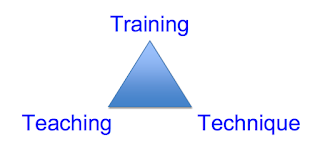
The diagram below is one I use on a daily basis when structuring practice.

It’s a great way to ensure the activities you are doing in practice meet the current needs of your team.

I’m not sure where I got it from, but I am confident I stole it from somewhere. Apologies to the person who didn’t get credit.

The triangle is used in two ways. First, I use it to analyze WHY I am doing a various practice activity.

I try to be very systematic about planning practice and using the right tool to teach a given aspect of the game.

To me, ANY team activity outside of warm ups fall into one of three categories:

  1. Teaching
    • When you are showing the players how to do something, you are in the teaching phase of practice.
    • This is usually categorized by instruction, demonstration, and players doing the action at a speed of 75% or less.
    • I know it’s time to move past the teaching stage when players can verbalize or explain the action you are teaching and can also show you how to do it correctly.

  2. Technique
    • Technique accounts for most traditional “drills”. Anything where players are performing a given aspect of the game and really focusing on technique.
    • This category is identified by it’s focus on performing a single action repeatedly between 75% and full speed. It’s also identified by it’s lack of game like environment and randomness.
    • I know it’s time to move past technique when players can correctly perform the action in a drill setting, at game speed, over and over again (85%-100% correct).
  3. Training
    • Training is any full (5 on 5) or small sided game in practice with rule modifications used to focus the game on the skill you are using. Also can be any small sided or full sided games in general that allows players to APPLY the skill in a realistic game setting.
    • This is the type of activity to use when players can perform a skill in drills, but seem to “forget” or not be able to perform it in a live game.
    • This is where you get the carry over from practice to games. 

The key here is to look at everything you do in practice and understand why you are doing it. If your players can’t tell you how to do something, then you need to teach (or re-teach) it. If they can correctly explain the skill, and preform it at game speed in a drill, then they need to spend time in training activities. At the same time you can’t jump into training activities before players can perform the movement correctly. It’s a important balance to strike in your practices, and is important to understand where your players are in regards to the skills you are trying to teach them. As a rule of thumb if they don’t know – I teach. If they know, but can’t do it – we drill technique. If they can do it correctly in a drill but not a game – we train.

I will use defensive slides as an example. At the beginning of the year I spend 5-8 minutes TEACHING the footwork. I demonstrate it (or have a player demonstrate it), then have everyone do it in slow motion. We might break into partners and do it in slow motion until everyone has a feel for it. I’ll even ask a few players how to perform the movement to see if they at least KNOW what they should be doing. After that we go through some traditional drills – mass stance, 1 on 1 dummy cut offs, etc. Once we see players doing it technically correct, we move into training. In training we play variations of 1 on 1 and 2 on 2 that force them to defend the ball constantly. As they play, I watch their form. If they start to develop poor technique, we move back to technique. We alternate between technique and training as needed, with the occasional “reteach” thrown in when warranted.

The other way I use the triangle is as visualization tool for how we utilize our practice time. When looking at various skills or tactics, I like to think about where the red dot would fall on the triangle from day to day, week to week, or even practice to practice. It’s a great way to monitor amount of time we are spending in a given area, and analyze if it’s meeting the needs of our players. Very early in the year the dot would be more toward the bottom middle of the triangle because we would be spending a lot of time teaching and drilling technique. By the end of the year we should be spending most of our time in training because we’ve learned the skill and gotten the technique down – hopefully.
Hopefully this is useful for you when it comes to practice planning. I’ve found it very beneficial and think it applies directly to making me a more efficient coach.

Games Based Approach to Coaching Basketball

By Brian Williams on February 8, 2016

This post was written by John Carrier and originally posted on his Coaching Basketball Blog

Whether you agree or disagree, I hope there are a few ideas that you can apply to your practices.

I Drilled It, What Happened? 
Like most coaches, including myself, I am sure you’ve had the following scenario happen to you. Your team needs to work on some aspect of the game. You spend a good chunk of time in practice drilling that aspect. Your players look great in the drill. Then comes the game, and the wheels come completely off the wagon. It’s like they never practiced the aspect of the game you devoted so much time to. You can’t believe it and are left wondering “What happened?!”.

Well, what happened was that your players spent a lot of time that practice mastering a drill and not really learning how to execute the skill you wanted them to. It happened to me more times that I care to admit, but recently I’ve found the solution – using a games based approach to teaching basketball.

For the last number of years I’ve been using the idea of teaching games. For a while now I’ve been reading Brian McCormick’s work and loved it. I started to incorporate a lot more games into my practices with good results.  Last season though, I took it to the next level. I was lucky enough to spend last season working with Art Errickson. Coach Errickson pushed me to use a more games based approach and it has really changed how I teach the game. Teaching the game using games may be the single most important thing I’ve learned in my career in terms of the actually on court coaching.

Why Drills Alone Don’t Work
Drills alone don’t work because they lack specificity. They are not specific to the real game that is being played. Players learn a skill or action out of the context of the game. What they are really learning is the pattern of the drill and not the skill within a game. So what happens is when a real game occurs players are not used to doing that skill within the specific context of the game – thus not performing the skill correctly, or many times forgetting to do the skill at all. Players who are trained using drills are not learning when and how to use the skill, which is as important as the movement. The end result is that you don’t get the transfer that you desire.

Drills are also block practice, and not random. Block practice is doing the same movement, the same way, in the same environment. You are memorizing a drill pattern, not a game skill. Random practice is practicing a skill in an ever changing environment so the player needs to adjust how they perform the skill. Anyone can do something in isolation, but those skills learned in isolation quickly disappear when you add defenders, other teammates, etc. It’s important that your practices consist of activities that are both specific to the game and random in how the skill is practiced.

If you are going to have successful carry over from practice to games, how you practice needs to change. You need to start “Training Ugly” which is my new favorite term from Trevor Ragan. You need to train your pl ayers on the skills you want within the context of an actual game. It’s about creating came like environments and using the game to teach the game. That’s where the games based approach comes in.

What is a Games Based Approach?
A games based approach is using different games to teach players the skills/aspects of the game you want. The games should always be random, and specific when possible. There should also be a competitive component where the team or player is playing against themselves (personal records), time, score, or other teams. The key is to modify the number of players, advantages, rules, surface, etc to create an environment that stresses the habits you want taught within the game setting. Below I’m going to give some examples of how you can modify games – and you can use multiple modifications within the same game:

Number of Players
Play 1 on 1, 2 on 2, 3 on 3, and 4 on 4 are great ways to teach skills.  They are better than 5 on 5 because you get more reps and touches than a traditional five on five game. Some skills such as ball handling are best done in small (1 on 1 and 2 on 2) numbers to maximize reps. Passing can be done in any number 2 or above, and I think team related drills are best done 3 on 3 or 4 on 4.

You can also play Cutthroat where you have 3-4 teams of 2, 3, or 4 playing. Two teams play one possession. At end whoever lost the possession is out and a new team comes on. You can play until one of the teams achieves a mile stone of your choosing.

Size of the Court
Everyone plays half court, which is a good way to do it, but have you ever played 2/3 court where they can only work half court and from a step off the opposite block to the ball side sideline? That makes players LEARN how to be creative in space. Have players play 1 on 1 from the free throw line where they can’t go outside the lane lines – then you will see players learn how to straight line drive well. Why were NYC guards so good back in the day? Because they played primarily on narrow street courts and had to really get good at navigating tight spaces, you can create that same environment with your games.

Rules
You can have all kinds of rules. The rules should shape the game to teach the habits that you want. And as in any game, there are penalties for breaking the rules, usually turnovers or loss of turn on defense. Below is a great list to start with that you can add or subtract from games of 1 on 1 to 5 on 5.

  • Dribble Rules
    • No dribble
    • Only “attacking the basket” dribbles (my favorite)
    • Limit number of dribbles – don’t like this as much
  • Movement Rules
    • Being in the right spots on defense
    • Being in the right spots on offense
    • Moving on offense – pass and watch
    • Screening a DEFENDER
    • Cutting hard
  • Ball Clock
    • This is one Coach Errickson put me onto and I love it.
    • Player has X amount of seconds to make a decision with the ball or it’s a TO.
      • I like 2 seconds but might want more to start and with younger ages.
    • Player has X amount of seconds with the ball or it’s a TO.
  • Dribble Hand Rules
    • Doing dribble tag or rodeo? Have them use their weak hand only.
  • Time Rules
    • Play with a shot clock
    • Play with a ball clock – mentioned above
  • Foul Rules
    • What do you call a foul?
      • Want offense to be tough, don’t call anything.
      • Want defense to stop fouling, call everything!
  • Really any other rules you want to make up as you go.

Advantage/Disadvantage
I like using disadvantages more than advantages. You can do several different things to create disadvantages that help players learn a skill or concept. You can take away the dribble. You can add extra players on offense or defense. You can officiate differently to create situations you want. And so on.

Some Sample Games
Below are some sample games I use and have used in the past.

Teaching Ball Handling and 1 on 1 Skills

  • Dribble Tag
    • I know it sounds juvenile but it’s fun, competitive, and it’s random practice. Kids have to apply the skill in a random setting that’s always changing.
  • Rodeo
    • Groups of 3. One player has the ball and 2 other players chase them and try to force a turnover or the dribbler to pick the ball up. You can play in the half our quarter court.
    • You can play for X number of seconds each player (and track if they turn it over or not +1 for not and play to 2-3 points). Or you can just have them play whoever gets it goes and try to keep it the longest.

One of the best ways to work on ball handling and 1 on 1 skills is to play 1 on 1. In all these 1 on 1 games I would play to 3 scores and have something for the losers (2 pushups, clap for the winners, don’t care really).

  • Post 1 on 1
    • Play 1 on 1 from the post. Have another player feed and work on post feeds too.
    • Work on the 1 on 1 post play live – move and a counter move.
  • Iowa 1 on 1
    • Groups of 2-5. Offense starts on the FT line. Defender starts under the rim with the ball. Defense throws to the offense and sprints to close out. As he closes out, reads the closeout and attacks. The lane lines are out of bounds which teaches straight line drives. They can shoot it or drive depending on the defense.
    • Teach players to drive in a straight line, attack with shoulder to hip, and read the defender’s close out. Teach players to use different ways to finish around the rim.
  • St. Joe’s 1 on 1
    • Groups of 2-5. Offense starts on the baseline in a line about 2 steps off the lane line toward the side line. The defense starts on the baseline about 2-3 steps farther toward the sideline from the offensive group. Each line has a chair across from it at half court. On coaches or defender’s “Go” call, the offense dribbles as fast as they can out to the chair, dribbles around it (outside to inside) and attacks the basket as quickly as possible. As that is happening the defender is racing around his chair (outside to inside). They play 1 on 1 form there.
    • Work on attacking the rim and making dribble moves (cross over) based on the position of the defense. If the defender is straight up, attack hard if cut off change hands and attack again. If the defender is shading you ball side, attack and change. If the defender is shading you not ball side blow by or fake crossover and blow by. Work on finishing off of two different ways at the rim. You can add double moves as well.
  • Attack 1 on 1
    • Defender starts under the basket. Offense starts at half court. On defense’s go, offense takes off dribbling at the rim as hard as they can. Defense sprints out and guards them. Offense reads the defense and attacks.
    • Work on attacking the rim and making dribble moves (cross over) based on the position of the defense. If the defender is straight up, attack hard if cut off change hands and attack again. If the defender is shading you ball side, attack and change. If the defender is shading you not ball side blow by or fake crossover and blow by. Work on scoring off of 2 at the rim. You can add double moves as well.
  • Johnson 1 on 1
    • Got this when we were preparing a few years ago to play our section opponent St. Paul Johnsonm who is very good defensively and amazing on the ball.
    • Start with an offensive player with the ball at half court. One defender starts on him. The other defender starts under the basket. Offense must rip and attack the first defender (who can push and hack him). Once he reaches the top of the key extended the first defender must leave him and the second one runs out, the dribbler then attacks the second one to score.
    • Work on handling the pressure and physical play, attacking defense, protecting the ball, scoring at the rim.
  • Catch and Go 1 on 1
    • Passer starts at the top of the key. Offense and defense start in the corner. Offense cuts up and defense follows. Passer hits the cutting offense. On/before the catch the offense reads the defender (who is tight on him) and attacks. If the defender is trailing the offense just turns and goes. If the defender is ahead of him (getting into denial) the offense rips and goes the opposite way.
    • Work on peaking to read defender, attacking off the catch, finishing at the rim.
  • 1 on 1 From Different Spots
    • Play 1 on 1 from corner, elbow, short corner, top of key, wing, etc.

Teaching Passing

Passing may be the most over drilled skill in basketball. How many times will players be throwing a pass to a stationary target, without a defender on them or their receiver? Never. So why spend time on it!?

  • 10 Pass Drill
    • Can be played 2 on 2, 3 on 3, or 4 on 4
    • Players get 1/2 or 1/4 court to work with. Offense can move anywhere they want.
    • No scores, offense must make 10 passes in a row without a turnover. If they do they win, if they don’t the defense wins. Switch off ever time.
    • Work on how to get open, moving without the ball, leading cutters, cutting through passes, back cutting denial, cutting hard.
    • Screening is optional, can have a 5 second count or not, if it gets too easy add defenders or raise the number of passes.
  • 2 on 2, 3 on 3, 4 on 4, or Cutthroat No Dribble
    • Play to 3-4 scores without the dribble.
    • Teach players to be creative in how they get open and get their teammates open.
    • Work on how to get open, moving without the ball, leading cutters, cutting through passes, back cutting denial, cutting hard.
    • Can play full and half court.
  • Ping Pong
    • Play 3 on 3 on 3 or 4 on 4 on 4 full court. One team starts on offense and the other on defense. The third team is waiting on the opposite end. If the offense scores they take it out and go to the other end with the original defense pressing them to HC. If they defense gets the stop they take it the other way with the original offense pressing to HC.

Defense

I love teaching defense using games. There really is no better way to get transfer from practices to games.
  • Defensive Cutthroat
    • This is the best THING I’ve seen to teach defense. 
    • You have three to four teams. Two are playing and one is sitting at half court waiting to come in. Play normal basketball, offense looking to score. If the offense scores or the defense makes an “out”, the defense sprints off right away, the new team comes in on offense, and the old offense is now on defense. If the defense gets the stop, the offense sprints out, defense stays, and the new team comes in on offense.
    • You score 1 point for every stop and play to 2-3 stops.
    • You can do it 3,4, or 5 on a team, but 3 or 4 is my favorite.
    • You can add “outs” that are as good as a score. The “outs” should help create habits you want your players to do. I would also start with one out and then slowly add as the year goes on until they are having to play perfect defense.
    • Possible Outs
      • No ball pressure, note closing out, not moving on air time, incorrect position, offensive rebound, allowing a straight line drive, allowing a post entry, allowing a paint touch of any kind, etc.
  • 1 Down Transition Defensive Cutthroat
    • You can play cutthroat with the traditional drill where the offense starts on the baseline, defense starts on the free throw line extended facing the offense. Coach throws the ball to an offensive player, and everyone transitions to the other end. Whoever is across from the ball has to touch the baseline before transitioning down.
  • Cutthroat from Different Looks
    • BLOB, SLOB, sets,
    • Have both teams in the lane. Throw the ball up at the rim, whoever rebounds is on offense and transition to the opposite end.
    • Play vs. different offensive actions.
      • All ball screens, all screen aways, etc
      • Works on specific actions you want.
  • Run a Drill into 3 on 3 to 5 on 5
    • For example, take shell drill. Players shell for 3 reversals, on the third reversal it’s live. Each stop is 1 point, play to 2-3 stops.
    • We run a drill called DeLaSalle Help the Helper. There is an open coach on the wing, player at the top of the key, a backside wing, and a backside block. Coach passes to the top of the key reverses to the opposite wing, and back to the coach. Once the coach has it he drives. The post player comes out to help and the backside wing helps the helper. In our version, we run the drill and the coach passes out into 3 on 3 live. If the defense doesn’t help and help the helper correctly the drill is blown dead and the D is out.
  • Disadvantage Games
    • Bring in extra offense, call more fouls on defense, etc.
  • If you don’t have enough for cutthroat play 3 on 3 or 4 on 4 the same ways outlined above.

Motion Offense, R and R, Attack and React, Dribble Drive, or General Offensive Concepts

  • Offensive Cutthroat (3-5 per team)
    • Play offensive cutthroat in all the ways described for the defense. But now the other team is waiting on the baseline to come in and everyone comes in on defense.
    • Outs
      • Standing, passing and standing, banana cuts, not screening someone, dribbles that are not north/south, ball clock, taking bad shots (you define bad), passing up on good shots, whatever you want the team to do or not do.
      • Can play no dribble
  • ______ to Score
    • Play cutthroat or 2 on 2, 3 on 3, 4 on 4 or 5 on 5.
    • Offense has to score on a specific thing
      • Paint touch, cut, off a screening action, etc.
      • Forces your offense to hunt for specific actions you want to work on.
  • Ping Pong
    • Great way to work on press breaking and transition offense.
  • Disadvantage Games
    • Bring in more defense than offense.
Obviously there are hundreds more games I could list. There are tons of varieties of 2 on 2 more, 1 on 1, etc, but for the sake of time I am going to stop here. You get the idea. And I honestly believe it’s best if you make up your own games as you need them.Block and Games Cycle
Now going to a games based approach doesn’t mean you have to abandon all the drills. It just means cut way down on the drills and spend most of the time playing games. It also means that the drills you do should be dictated by what you see in the games and in free play (scrimmages and games).So for example, you played last night and you weren’t very good on being in the correct defensive position. You may combined block teaching (drills) and games in a way such as below.

  1. Present the goal – show players a quick clip or 2 of them not being in the right position. If you don’t have film quickly explain that we were not in great position at the last game. 2-3 minutes tops. 
  2. Block Practice – have them shell drill and practice moving to the ball and being in position. 10-15 reps, 5 minutes tops. 
  3. Teaching Games – Have them play cutthroat where the “out” is them being out of position. Then have them play transition cutthroat. 10-20 minutes. 
  4. Free Play – Have them play one or two 2 minute 5 on 5 games. As they play, watch and see if what you worked on is better, if not, repeat.

You wouldn’t do this for every aspect, but if you felt like there was something you really needed to drill, then do a quick block and get back to the games.


Some Games Based Coaching Tips

  1. Let go and don’t be afraid to “Coach Ugly”. Practices are going to be ugly and look out of control, but those are the best learning environments. We all learn better by DOING.
  2. Play short, fast games. If playing by time play 2-3 minutes tops. If playing by score play to 2-3 scores tops. Short games increase urgency and effot.
  3. Be creative – create games that fit what you NEED.
  4. Coach in bullet points not paragraphs – invent little sayings and reminders for each concept you teach. For example, when teaching close outs I like “sprint, drop, chop, high hands” if they don’t do that I’m talking that at them as they play.
  5. Coach in the moment – use each game to teach the game.
  6. You can’t judge carry over until you actually PLAY IN GAMES, so keep that in mind.

Conclusion
Kids sign up for basketball to have fun and play basketball, not run drills. That might be the best reason to use a games based approach to basketball. Your practices will be instantly more fun and engaging. The players will also work hard because of the environment you create. The hardest part for you as the coach is going to be giving up control and letting guys just learn from playing. It’s not going to be pretty, but boy it is effective. It’s the most fun I’ve had coaching and I believe it will greatly help you.

  • « Go to Previous Page
  • Page 1
  • Page 2
  • Page 3
  • Go to Next Page »

Primary Sidebar

  • Twitter
  • Facebook
  • Linkedin
coachestoolbox
personaldevelopmenttoolbox
basketballplayerstoolbox
basketballtrainer
athleticperformancetoolbox
coachingbasketball

© Copyright 2026 Coaching Toolbox

Privacy Policy