• Skip to primary navigation
  • Skip to main content
  • Skip to primary sidebar

  • Basketball Plays
    • Ball Screen Sets
    • Horns Sets
    • Man to Man Post Up
    • Man to Man Isolations
    • Backdoor Plays
    • Man to Man 3 Point Shot Plays
    • 2-3 Zone Attack
    • Baseline Inbound Plays
    • Sideline Inbound Plays
    • Combination Defense Attack
  • Drills
    • Defensive Drills
    • Offensive Drills
    • Competitive Drills
    • Passing Drills
    • Rebounding Drills
    • Shooting and Scoring Drills
    • Toughness Drills
    • Transition & Conversion Drills
    • One on One Drills
  • Blueprint
  • Practice
  • Mental Toughness
  • Skill Development
  • Offense
  • Defense
  • Store

Practice

Keeping Practices Meaningful

By Brian Williams on February 1, 2016

I have always felt that it is also important to add as much variety as possible to help players stay focused.  Additionally, I feel that our players have the responsibility to push themselves to get the most out of practice, but as coaches, it is our number one job to make sure that we are creating practices that are as engaging as we can make them for our players.

Even if you already do the things listed in this post, I hope you take some time to think about how you can make those segments even better in contributing to the improvement of your players as individuals and to your team as a whole.

This post contains practice ideas from Texas A&M Women’s Assistant Bob Starkey. His Hoop Thoughts Blog should be on your regular reading..

The following is a great passage from the book “Toughness” written by Jay Bilas which speaks to the mindset of a player in regard to practice.

How many players start practice with the intention or goal of simply “getting through” practice? Instead of “getting through” a workout, players need to “get from” a workout-to get the most from it, and the most from themselves. No player ever got better by just getting through something. True toughness is competing through the end of a practice or workout after having prepared yourself mentally to compete. That is a key mind-set of the toughest players.

A key question for us as coaches is how can we help our players with this process? There are several things that have served me well and here are a few.

INDIVIDUAL PRACTICE GOALS
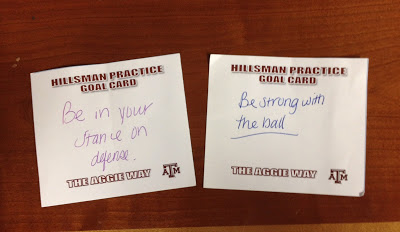
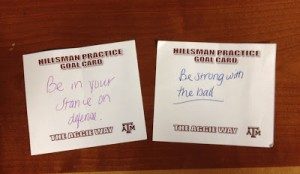
photoSomething I started last here with our freshman post player Khaalia Hillsman was to have an individual practice goal.  I created some cards for her and placed them in her locker.  Each day she has to pick something that she wants to give extra concentrated effort on.  I let her pick it…she writes it down…she gives it to me when she first comes to practice.  I then make sure I am watching her to see how she is doing.  I compliment her when she is successful and remind her when she falls short about her goal.  After practice, I give her a grade on her goal and from time to time support that grade with video.

PRE-PRACTICE

This is a short period at the beginning to do position work.  It’s also quality time between a coach a small, select group of players.  I was even more impressed to find out that it was done on a daily basis each practice of the season — all the way to the completion of the year. As a coach, you can set the tone in terms of what needs to be accomplished as a player and a team for this particular day.

Simply stated, it is a period of time before practice where you work on parts of the game that can sometimes be overlooked once the season begins and you are preparing for an opponent.  The majority of the time we break our team up into post and perimeter players and work on specific areas in relation to their positions.  I’ve been on staffs that have broke the group up into 3’s when space permitted.  At times, we will have half perimeter and post on each end when we want to work on areas that incorporate them both.

While we want focus and concentration in these areas, often it is a time where the coach might do a little more talking to explain and correct.  We can continue to work on fundamentals such as ball handling, passing, screening, dribbling and defense.  We can also work on a phase of the game that maybe we feel the need to improve upon from the previous game.  Possibly we did not do a good job of feeding the post so we can break it down in our pre-practice portion.  It could also be that we can focus on something of importance for an upcoming game.  If we are playing a team that drives the ball baseline from the wing well, we can look at are positioning and talk about and work on that fundamental.

Almost always there will be a drill or two that will relate to our Emphasis of the Day.  If our emphasis of the day is screening, as shown in the practice plan below, then we will have a few screening drills in our pre-practice session.  In the practice plan below you see “1/0 DS w/2nd Cut” — which is a 1 vs. 0 Down Screen situation.

I also like the opportunity to communicate with the players during this period.  We will spend a little more time explaining while also allowing the players to ask questions they may have.

While staff size can be a factor, I would have a Pre-Practice period even if I was the only coach.  Monday I would have the perimeter players come in early with Tuesday being for the post players, etc.

The length of time varies…generally pre-practice last between 15-30 minutes.  When we get into the meat of the season, especially in February, we will cut back on practice time but still have a pre-practice period.  Again, it makes sure that we never veer to far away from fundamentals and teaching.

EMPHASIS OF THE DAY

We believe this is a great way of focusing a team’s attention for a practice.  Picking a phase of basketball or an intangible and making that a special focus for that day.  We will have specific drills to highlight it as the “Emphasis of the Day.” It’s a simple way to make sure that your team improves in one area each day. That sounds simple, but think about it. If you could do something that would ensure that your team improves in one phase of the game each day, wouldn’t you jump at the chance?

Well, we’ve had that type of success with this concept and here is how it works.

First, you must pick what you want to emphasize each day in practice. We have a couple of schools of thought in this regard. The first is obvious—pick something that you struggled with the day before. Maybe on Monday your team didn’t do a good job of blocking out. So on Tuesday you make blocking out your emphasis of the day.

The second way of choosing an emphasis is to look at your upcoming opponent. Maybe the next team on your schedule does a nice job of running with the basketball. Your next practice might have transition defense as your emphasis of the day.

Choosing the emphasis of the day is just the beginning…now it’s time to start emphasizing! This comes from several different means and they all need to be a part of the process for it to be successful.

First, when the players come to practice, they will find a sheet of paper with the emphasis of the day in their locker. On the way out of the locker room they will see that same sheet of paper on the bulletin board. When they walk on to the practice floor, they will see it taped up at each basket and at the water cooler. There will be no doubt in their mind that the coaches are going to work diligently that day to improve that area.

We start each session with a “Pre-Practice.” In this segment, the team is broken down into smaller numbers for some individual attention and part-method teaching. Some of these drills will be devised to work on the days emphasis.

Following Pre-Practice, we will start regular practice by huddling up, at which time I will mention the emphasis of the day and why it is important. We will generally start practice with a drill that is specific to the emphasis of the day. Throughout practice, the coaching staff will constantly mention the emphasis in all drill work. The majority of the time, the emphasis will be related to a basketball fundamental: Blockout, Low Post Feeds, Shot Fake, Contest the Shot, etc. On occasion, it will be a mental emphasis: Concentration, Communicate, Listen, Intensity, etc.

We have also on occasion tied our video into the emphasis of the day. Before going to the floor for Pre-Practice, we might watch some video clips of what our emphasis of the day will be.

PRACTICE STATS

If its going to be important, find a way to measure it.  We keep practice stats everyday.  We might keep a special stat on a specific day to compliment a particular emphasis — and we share it with our players…often in the middle of practice to let them know how they are doing.  Here is an older post about the topic of Practice Stats.

Click here for information on the basketball practice e-book “130 Great Ideas to Get a Lot More Accomplished in Practice”

Using NCAA’s Greatest Games to Practice Situations

By Brian Williams on December 6, 2015

This idea for using some of the NCAA tournament’s greatest games came from John Carrier’s Basketball Coaching Blog. If this way of practicing special situations doesn’t fit your needs, I think it is worthwhile to come up with your own end of game situations and practice them a couple of times each week.

Written by John Carrier.

This was a topic I THOUGHT I blogged about before, but when I looked back I hadn’t. So here it is.

As coaches we want our players to understand late game situations. It’s a must in good coaching. But how do we do it? There are a lot of ways, but one way I like is having a “Greatest NCAA Tournament Games Day” to teach late game situations, and basketball history.

This is a really simple concept. On a bunch of notecards, write down situations from great NCAA games or great NCAA comebacks. One team picks a card (they are the team that is behind). They play out the last 30s-3 min of the game. The length of time depends on the game that you are playing out. The players go on the floor and play the game as the two teams. After they play it out, you show them the video clip (if available), or tell them really happened. Below is an example of one we’ve used.

UNC vs. Georgetown 1982

Gerogetown Up 62-61
Georgetown playing a packed in 1-3-1
35 seconds left.

Have the players play the game out. Then after they are done, show them what really happened. Then use it to address some specific late game situations.

Opponent is playing zone – what shots and how to attack it to get a shot.
How to handle the other team scoring to go ahead late.
How to handle us scoring a basket to go up late.

Last year when I did this it was the BEST thing we did all year. The players loved it and BEGGED to do it again. It was well worth the half of practice we invested. This year I might do one every day over a few weeks, to keep the excitement. Either way I hope you can use it to add value and excitement to your practices.

Xavier 4 Minute War

By Brian Williams on December 6, 2015

This post is from an old Xavier Basketball Coaching Newsletter when Chris Mack was at Xavier. You can see their archives and subscribe at this link.

Even though high school teams don’t have media timeouts, you can still incorporate the idea of four minute segments in games and in practices. I think scrimmaging in four minute segments helps players stay focused and it also gives you more changes to practice your end of quarter or end of half situations several times in a practice.

At Xavier, we want our players to play with great passion. We are constantly looking for ways to motivate our players to commit to our system and reach their maximum potential. One way in which we have challenged them is with the concept of the 4-minute war.

We want our players to play with energy and intensity for the entire game. We motivate our players to put forth maximum effort for a focused period of time. With the 4-minute war, we divide the game into ten four-minute segments. After each segment, there is a media timeout (approximately every four minutes) in which the team has an opportunity to rest for a minute and refocus on the next segment.

Each segment is a “mini-game” within the game, and it is referred to as a “war” to characterize the type of effort that is required to excel at the highest level. Our goal is to win each 4-minute war. We chart the results on the bench, and we communicate them with our team at every timeout. The 4-minute wars allow us to provide some measurable feedback about our execution and effort over each segment of the game.

Throughout the course of the season, we can evaluate the tendencies of which segments our team plays well and which segments we have lapses.

We use the 4-minute war concept as a way to focus our team on playing the “Xavier Way.” We want to improve the execution of our system in every game. We want our players to play with the mentality that every possession counts, and that every possession needs to be played with a high level of intensity. Furthermore, we want to play our way regardless of the score at any particular time in a game.

If we are winning by several points, we do not want to let down and allow our opponent back into the game. We want to dominate by continuing to develop proper habits. If we are struggling in a game, our disposition is not to change what we do. Rather, we believe in trusting the system, and our challenge is to get our players to play harder with what we do. By breaking the game into 4-minute wars, we focus on the process of playing
our system throughout the entire game.

There are a number of ways that we incorporate the 4-minute war concept into our practices. First, scrimmage segments are played as 4-minute wars. We want our players to compete every second at a high intensity, and we want them to be conditioned in a way where they play in game-like conditions (i.e., play for four minutes, rest for a minute, and play again). These scrimmage segments also enable us to cover a variety of situations in our practices. A second practice idea is that we play “One Possession Games” in practice. We will have a jump ball to begin the game, and the first team to score wins (losers run). The purpose of this drill is to emphasize the importance of each possession and the value of the ball. We might spread a few of these games in throughout a given practice.

Coaching Basketball: Helping Players to Value Practice

By Brian Williams on October 14, 2015

This post contains quotes from two Texas A&M Women’s Assistant Bob Starkey on practice. His Hoop Thoughts Blog should be on your regular for basketball coaches.

Some maxims to use throughout the coming season to help players see the value in well planned and purposefully
conducted basketball practices. I have also added a few of my favorites at the end of the post.

I hope you find some useful ideas to inspire your players and coaching staff to make the most of your practice time.

from Coach Bob Starkey

Because it’s that time of the year, here are some great quotes on the value of practice:

“An ounce of practice is worth more than tons of preaching.” -Mahatma Gandhi

“When you are not practicing, remember, someone somewhere is practicing, and when you meet him he will win” – Ed Macauley

“It’s not necessarily the amount of time you spend at practice that counts: it’s what you put into the practice.” -Eric Lindros

“Practice is the best of all instructors.” -Publilius Syrus

“We learn by practice. Whether it means to learn to dance by practicing dancing or to learn to live by practicing living, the principles are the same.” -Martha Graham

“Winning means you’re willing to go longer, work harder, and give more than anyone else.”-Vince Lombardi

“Don’t practice until you get it right. Practice until you can’t get it wrong.” -Unknown

“Take chances, make mistakes. That’s how you grow. Pain nourishes your courage. You have to fail in order to practice being brave.” -Mary Tyler Moore

“We have all the light we need, we just need to put it in practice.” -Albert Pike

“I play to win, whether during practice or a real game. And I will not let anything get in the way of me and my competitive enthusiasm to win.” -Michael Jordan

“Don’t only practice your art, but force your way into its secrets; art deserves that, for it and knowledge can raise man to the Divine.” -Beethoven

“I’ve always considered myself to be just average talent and what I have is a ridiculous insane obsessiveness for practice and preparation.” -Will Smith

“My father taught me that the only way you can make good at anything is to practice, and then practice some more.” -Pete Rose

“Practice is everything. This is often misquoted as practice makes perfect.” -Periander

“Everything is practice.” -Pele

“I’m a strong believer that you practice like you play, little things make big things happen.” -Tony Dorsett

“Knowledge is of no value unless you put it into practice.” -Anton Chekhov

“I am playing the violin, that’s all I know, nothing else, no education, no nothing. You just practice every day.” -Itzhak Perlman

“Before we can talk about a championship, we have to practice like a championship team.” -Mike Singletary

“Practice puts brains in your muscles.” -Sam Snead

And a few of my favorites…

EVERY TIME WE TAKE THE FLOOR, WE PRACTICE AND PLAY WITH THE TECHNIQUE, INTENSITY, TOUGHNESS, AND TOGETHERNESS OF A STATE (OR NATIONAL) CHAMPION.

“The quality of practice greatly influences the outcome of games, and of great significance is that practice is something that your team can control.”

“I just love the game of basketball so much. The game! I don’t need the 18,000 people screaming and all the peripheral things. To me, the most enjoyable part is the practice and preparation.” Bob Knight

“Practice without improvement is meaningless.” Chuck Knox
[adinserter name=”Block 3″]
“In practice, don’t just run basketball drills, teach the players how to play basketball.” Don Meyer

“Practice does not make the athlete. It is the quality and intensity of practice that makes the athlete, not just repeated practicing.” Ray Meyer

“To give yourself the best possible chance of playing to your potential, you must prepare for every eventuality. That means practice.” Unknown

“Habits are cobwebs at first; cables at last.”

“In theory there is no difference between theory and practice. In practice there is.” Yogi Berra

Daily improvement is directly proportional to your attention to detail in practice.

No coach ever won a game by what s/he knows; it’s what their players can execute.

The greatest mistake is to continue practicing a mistake.

“That which we persist in doing becomes easier for us to do; not that the nature of the thing itself has changed but our ability to do it has increased.” Ralph Waldo Emerson

You are making progress if each mistake is a new one.

“I will get ready and then perhaps my chance will come.” Abraham Lincoln

The only thing that really counts is “are we getting better each day?”

“Good players can take coaching. Great players can take coaching and learn.” John Wooden

Before you can be great, first you must be good. Before you can be good, you must be bad. Before you can be bad, first you must try.

If there is no struggle, there is no progress.

When you see a successful individual, a champion, you can be very sure that you are looking at an individual who pays great attention to the perfection of minor details.

Click here for information on the basketball practice e-book “130 Great Ideas to Get a Lot More Accomplished in Practice”

“The Talent Code” is another outstanding resource on improving through practice. You can click the cover of the book to read a portion of the contents.

Coaching Basketball: Improving Your Pre-Season

By Brian Williams on September 23, 2015

These ideas for improving your pre-season came from Alan Stein.

In Episode #179 of the Hardwood Hustle Basketball Podcast, Alan Stein (Stronger Team) and Adam Bradley (Lead ‘Em Up) get you ready for the upcoming season with the 8 things you need to do to get your team ready!

Editor’s note from Brian: I realize that in the pandemic world we are living in, some of these ideas might not be executable, but I hope there are one or two things that you can get some ideas from.

8 Things You Need To Do This Pre-Season

1. Establish your culture

Alan: Part of establishing culture is to effectively communicate your rules, your policies, your standards and your expectations to the entire team. That stuff needs to be crystal clear.

Adam: If it is not communicated in advance, it looks like you are making it up on the fly.

Alan: It should be a healthy reminder for the players coming back in to your program and it should basically set the tone for any body that’s new in to your program. But clearly communicating these things is the most important part.

Alan: At the college and NBA level, your culture is everything. Culture is a culmination of all these different things that we talk about.

2. Communicate roles

Alan: Now you need to clearly communicate with each individual player, and at the high school level with the player’s parents, primarily about their role. What you foresee that player’s role being this upcoming season and if they want to expand their role, what types of things they should do in the pre-season to earn that expansion.

Alan: At DeMatha we want to treat our players like young men so the meeting is actually with the player but he invites the parents and wants the parents there merely to be a fly on the wall. Although the conversation is directly with the kid, he doesn’t want anything lost in translation and when you’re communicating with teenagers this can happen very easily. So he wants the parents there to hear everything first hand and certainly if the parents have questions or concerns they’re allowed to voice those in that meetings, but he wants to make sure he looks that player in the eye and says, “Here’s exactly what I think of your game, here’s exactly what I expect of you and if you’d like any discussion about it now would be a great time to have it.”

Alan: There are certain things that are best to talk to the entire team as a group, obviously basketball is a team sport, but there also are certain things that it’s most important to discuss individually. Now what I will say is, once he’s come to you and you guys have basically agreed on expectations and role, now your role will be shared with the rest of the team, but he doesn’t share that until he knows you and I are on the same page. It’s important for everyone on the team to know what your role is and it’s important for you to know what each other’s teammates role is so that we’re all on the same page moving forward.

3. Assess and/or recover from the summer

Alan: Because the landscape of youth and high school basketball has now become a year-round sport, most players have had a very busy spring and summer playing usually AAU basketball or going to summer camps or what have you, maybe even working with a trainer, you need to assess and/or recover from the summer. We’re talking physical, we’re talking mental, we’re talking potential nagging injuries, anything that needs to be addressed, now is the time to do it.

Alan: We have to gauge their level of mental and physical fatigue when they show up around Labor Day. We have to see, “Where are they right now?”

Alan: Instead of taking the old coaching ideology of taking a round peg and forcing it into a square hole, I can’t make too many decisions as DeMatha’s performance coach until I see what hand I’ve been dealt.

4. Discuss Goals

Alan: Whether or not you do this as a team at first or you do it individually, but you start to manage taking a step further than the expectations as far as roles are concerned, what’s our identity as a team, who are we going to be as a unit and what is it we are collectively trying to accomplish? What are some of the goals that we want to put in place?

Alan: This is when we want to start coming up with the list of standards, these process goals are going to help us be successful.

Alan: If we’re going to say that we’re going to be a running team, than we may say our goal is to score 20 points every quarter. We want to score 80 points a game in high school basketball.

5. Implement a consistent pre-season schedule

Alan: This isn’t about what you can or can’t do, its about being consistent and maximizing what you’re allowed to
do.

Alan: We have five things at DeMatha that we want to pay attention to. First is performance, which is what I do, strength and conditioning. Second is skill work, which our coaching staff is allowed to do with our players. Third is organized pickup, so the guys are actually playing and learning how to play and starting to build that unity. Next is what you’re an expert in, which is actual leadership and character development. Then lastly is mental training, is teaching our guys what it truly means to be mentally tough, which as we’ve said before is their ability to play
present.

Alan: My sincere condolences to some of the coaches out there who cannot address these because of the rules, but just do the best you can with where you are.

6. Staff Development

Alan: You always need to have some sort of staff development, or like a retreat. Something where you’re going to unify the staff. This is away from the players.

Alan: You should enjoy the company of the people you’re going to spend the most time with over the winter. It needs to be more than just talking about X’s and O’s, it should be a bonding experience with your fellow coaches. You’re all just getting on the same page and the same wave-length because you know it’s going to be a long
season.

7. Build chemistry and unity

Alan: I love what we do at DeMatha because Coach Jones finds fun ways to work in some stuff that our group can do. We have sometimes decided to cancel a pre-season workout and we take the whole team to the movies if there’s an appropriate movie to watch. Sometimes we’ll just play whiffle ball for an afternoon instead of doing any strength and conditioning. We’ve taken the bowling before. We’re not doing this every time, because we’re not trying to win a bowling championship and we’re not movie critics, we’re doing this because every once in awhile we feel that our players have earned the right to do something fun and special and we want to get them away from basketball every now and then so they can solidify their friendships and build their team unity and chemistry.

Adam: I’m always intrigued by this idea of taking the team bowling, of going out to eat and stuff like that. I think that’s a very positive thing to do, don’t get me wrong, but I think it needs to be taken to the next level and I think even beyond that coaches need to be intentional to make sure that it’s accomplishing what they want it to accomplish.

8. Allow adequate rest and recovery and make things fun

Alan: I can stress enough at the high school level how important it is to have fun in everything you do.

Alan: I’ve said on several previous episodes, every single year I’ve been in this, going in to my 13th year now, I’ve done less and less from a volume standpoint to get a better result because the rest and recovery becomes so important. It’s not so much how much you do, it’s how well you do it that’s important.

Coaching Basketball Bob Hurley Uptempo Practice

By Brian Williams on January 16, 2015

A few takeaways from some of Bob Hurley’s thoughts on practices. You might already do a lot of these things, and some you won’t agree with, but it is always good to see what the great ones do.

Shared by Victor Sfera as a part of Coach Scott Peterman’s bundle of Greatest Basketball Coaching Notes Collection
.
These competitive basketball drills from Coach Bruce Weber come from Coach Scott Peterman of the Men’s Basketball Hoopscoop Coaching site.

Bob Hurley Uptempo Practice

I. Practice Essentials

‐Put it Down on Paper
o Can’t wing practices, plan in advance!
o Hurley keeps practices for several years to compare current quality of practice
o Stick to what you write down!

‐Alternate Hard and Easy
o Hard parts of practice shouldn’t last more than 5 minutes
o Alternate hard and easy parts of practice

‐Practice the Way You Play
o St. Anthony’s practice mostly in the fullcourt since they are an up and down team

‐2/3 time on individual skills, 1/3 team
o Work on individual skills to improve the overall team

‐Practice to Improve Team 1st
o Treat every game the same (Kids notice when something is different)
o Focus on your opponent 2nd

‐Breakdown Work Daily
o Have 1 coach with big men, 1 with guards

‐Shoot 20 minutes Daily
o Everything else you practice is worthless if you can’t take advantage of scoring opportunities

‐Shorten Practices as Season Goes On But Keep Intensity Up!

‐Special Situation Practices Regularly

o Hurley has 1 special situation practice per 2 weeks (1 1/2 hours goes over 20 different
situations)

‐Shorten Practices Pre and Post Game
o Before: focus on things you want done in the game but leave time for legs to recover for game
o After: If team has bad game, don’t take it out on your team (they didn’t intentionally lose.) Teach instead

‐Start and End Each Day with Meeting
o Starts positive
o Ends positive (reminders for what’s coming up and tomorrow’s focus)

II. Daily Practice Tips

1. Players are responsible for the mood and correcting mistakes
a. Leaders on team need to be held accountable for getting it going
b. Coaches just make a suitable situation for learning
2. Team Meeting at Beginning and End of Practice
3. Early Drills
a. Players call out names of teammates and names of drills
4. Head Coach uses each player’s name within first 15 minutes
5. Earn Maroon Shirt
a. No such thing as a game player (come to practice and work)
b. Designate 5 players who have maroon shirts at beginning of season (starters)
c. Each day the 2nd unit (Gold Unit) fight to earn the maroon shirts and the starters fight to keep them
d. 5 players who finish a practice with maroon shirt will start the next day’s practice with them on; if next day is a game those 5 will start
6. Change Practice Partners Regularly
a. New faces help push players instead of settle
7. Keep stats on drills
a. Have something to shoot for
8. Listen to Practice
a. You can find out a lot about your team by closing your eyes for a few seconds in practice
9. Use a variety of drills
a. Identify where you got them from
b. Makes players feel like they have the edge
10. All Conditioning with the ball
a. Don’t run just to run unless punishment
11. Utilize assistants and gym space
12. End Practice on Positive Note
a. Reward practice players for effort

III. Warm‐up Drills

• 3 Man Weave (5 passes, 4 passes, 3 passes)‐ Up and Back x2
• 3 players pass back and forth (there) Breakout 1 pass for layup; opp. Wing covers backboard
• Chase the Point Guard
o PG has 4 dribbles to take length of the court
o 2 players on defense chase the point guard once the first dribble hits the floor
o When defense comes back for 2 on 1: Inbounder baseball passes to wing
• Chase the Point Guard‐ Drill B
o PG has a teammate; pass back and forth
o 3 defenders chasing
o Coming back: 3 on 2‐ outlet pass

III. Shooting

• 4 ball shooting
o Baby hook
o Smart shot
o Curl @ Elbow rip back to middle
o3 point shot; big men shot fake jumper

• Follow the leader (Partner shooting)
o Group of 2; possibly 3‐‐‐1 ball Lead shooter, follower
o Whatever the lead shooter does, the follower(s) does

IV. Rebounding & Finishing Drills

• Superman drill
o Throw ball on opp. Side of the glass and go get it, landing outside the paint
• Tip Drill
o Throw off glass and tip it in (finish everything)
• Throw off glass, rip to chin, and score
• Rip, fake, and power up
• Rip, fake, and reverse layup

V. Ballhandling

• Quick change partner drill
o Start with right hand facing partner
o When arms length away from partner, switch hands
o Works on being quick in small spaces
o If you don’t call out which hand you are using, a collision is likely
Crossover
Through the legs
Behind the back
Spin

VI. Combination Drills

• Foundation for passing
o Restrictions:
Offense can’t dribble
6 passes=1 point
Post pass=1 point; Must put priority on feeding the post
Basket=2 points
12 passes=2 points
Defense scores on a stop
15 point games
o Start out by having 2 down screens and then flowing into a motion‐type offense
• Foundation for defense
o Promotes communication, positioning, and rotation
o Starts out like a shell but with 5 vs 5
o On “switch” defense goes to offense
However, no one can guard the same person
• Most important to guard immediately: Person with ball
• 2nd most important: 1 pass away
• Least important: Weakside wing
This is where communication comes into factor
“we don’t talk, we have no chance.”
o On “double” we double team the ball
Help defense needs to take away the next 2 passes
One protector of rim
Giving the offense a cross‐court pass (gives defense time to regroup)
o On “change ends” offense goes to the other side of the floor and is now on defense; while the other team is in their offensive transition downcourt

These competitive basketball drills from Coach Bruce Weber come from Coach Scott Peterman of the Men’s Basketball Hoopscoop Coaching site.

If you are interested in adding to your Coaching Toolbox take look at what I believe is our best offer.

CLICK HERE to select from a list of more than 70 eBooks.


  • « Go to Previous Page
  • Page 1
  • Page 2
  • Page 3

Primary Sidebar

  • Twitter
  • Facebook
  • Linkedin
coachestoolbox
personaldevelopmenttoolbox
basketballplayerstoolbox
basketballtrainer
athleticperformancetoolbox
coachingbasketball

© Copyright 2026 Coaching Toolbox

Privacy Policy