• Skip to primary navigation
  • Skip to main content
  • Skip to primary sidebar

  • Basketball Plays
    • Ball Screen Sets
    • Horns Sets
    • Man to Man Post Up
    • Man to Man Isolations
    • Backdoor Plays
    • Man to Man 3 Point Shot Plays
    • 2-3 Zone Attack
    • Baseline Inbound Plays
    • Sideline Inbound Plays
    • Combination Defense Attack
  • Drills
    • Defensive Drills
    • Offensive Drills
    • Competitive Drills
    • Passing Drills
    • Rebounding Drills
    • Shooting and Scoring Drills
    • Toughness Drills
    • Transition & Conversion Drills
    • One on One Drills
  • Blueprint
  • Practice
  • Mental Toughness
  • Skill Development
  • Offense
  • Defense
  • Store

Filing Cabinet

We Over Me

By Brian Williams on December 6, 2013

By Alan Stein of Pure Sweat Basketball.

Two Great Exercises that every coach should do with his or her team…

A basketball coach’s most difficult job is getting 15 individuals to fully acknowledge and embrace this fundamental concept:

We > Me

This is not an easy task.

Human beings are inherently selfish. We are programmed at a very early age to always look out for #1.

Trust me, I have 3 children under the age of 4 years old, and their entire existence is consumed by the concept of ‘me.’

This is cute with toddlers, but not with basketball players.

Why?

Basketball is a team game, not an individual sport.

In order for a team to be as successful as it is capable of, each individual must sacrifice their own ‘wants’ for the betterment of the group.

It’s not about what you want; it’s about what the team needs. Powerful distinction.

Coach Jones recently conducted the following exercise with our varsity team at DeMatha:

In a private team meeting, he asked each of our 16 players to write on an index card the number of minutes they truly believed they deserved to play in each game this season. He then collected the cards and tallied the numbers up.

Like most high schools, we play a 32-minute game (4, 8-minute quarters) and are only allowed 5 players on the court at any given time. Therefore…

32 minutes X 5 players = 160 total game minutes

However, when Coach Jones tallied up the total number of minutes our players truly believed they deserved to play… it came to 276 total minutes.

I wasn’t a statistics major, but even I can spot a colossal discrepancy.

So what does this mean?

It means most of the players on our team will not play as much as they would like.

He then replicated the exact same exercise with shots instead of minutes.

Last year our team averaged taking 52 shots per game.

When he polled our 16 players about how many shots they truly felt they earned the right to take each game… guess what the total was?

109 shots!

Déjà vu.

This simple exercise was a major eye opener. It gave our coaching staff tremendous insight into just how important it is going to be for us to create a ‘We > Me’ culture.

In fact, this concept will define our season.

If we can successfully get all 16 of players to buy in to the fact that it is not about their minutes or the shots they take… we have a chance to be really, really good this year. We have championship caliber talent. But do we have championship caliber unselfishness? Only time will tell.

A vast majority of the time, if a player does not buy into this concept… they start worrying about ‘me’… and feel like they should be playing more…

This mindset is a cancer to your team is absolutely, positively unacceptable.

It is understandable to want more playing time.

It is understandable to want to take more shots.

Just because something is understandable doesn’t mean it is acceptable.

Just because you want it doesn’t mean it’s what’s best for the team.

It takes a very special player to admit…

It’s not about me; it’s about us.

I challenge you to be special.

Alan Stein
Pure Sweat Basketball
http://www.About.me/AlanStein
Basketball Coaching Team Leaders

By Brian Williams on November 22, 2013

Some good thoughts to share with your team’s leaders or with the entire team.

These two handouts were taken from Ryan Renquist’s “The Notebook of Champions” Building Success One Victory at a Time (Sixth Edition)

What is a Leader?

A LEADER, LEADS BY EXAMPLE: A leader must be a positive role model at all times. Every word spoken has to be a positive word. Every act he does must be a positive act. A leader can never be negative. He must be a shining example of what it takes to be great.

A LEADER BRINGS OUT THE BEST IN OTHERS: A leader must be the type of person that others want to be like. He has to inspire his teammates to be their very best.

A LEADER IS AN EXTENSION OF THE COACH: Most players are well behaved when the coach is around. However, when the coach is not around, negative things can occur. Any type of negative talk, about the team or another player, is detrimental to the team. A leader does not try to cut corners in any way. He knows what the team and school rules are and does not break them himself, or allow others to break them.

A LEADER IS A HARD WORKER: A leader must enjoy serving others. He must want to do the things that are necessary for a team to have success. A leader is always trying to think of ways he can help improve the team.

A LEADER PUTS THE TEAM FIRST: It is easy to come up with excuses why we can’t get a task done. I hear those excuses all the time. If you want to do something, you can almost always do it. If you don’t want to do something, you can almost always find an excuse so that you don’t have to do it. I want people who I can count on to be there. I want people who are committed to basketball all year – not just during the season.

A LEADER TRULY WANTS TO BE A SERVANT: You can’t fake it, you either want to be a positive servant to your team, or you don’t. The leaders of this team do not have to be the best players. In fact, I think it is neat when someone who isn’t a great player steps up and takes on a leadership role. Your job as a member of this team is to find some way to make a positive contribution to the team. For some that contribution may be providing leadership.

Leading by Helping Others:

If you think it ever was about you as a leader, you are wrong. Leadership is about others. Great leaders love and care about others more than themselves.

Here are four tips to help you love and care about those you lead. However, let me preface these tips by saying that the most important thing you need to do is not fake caring. Either you really love those you lead or you don’t. If don’t feel it, don’t fake it. Faking it will erode your trust as a leader very quickly. People know when leaders are genuine and when they are not.

1. Serve. There is a positive correlation between serving others and love. The more you serve others, the more you will care for and love them. The more you care and love, the greater desire you will have to serve. It can be as easy as sending a heartfelt card during a tender time in an employee’s life, or doing something nice for their family. There are many opportunities to serve those we lead, we just need to be aware and look for them.

2. Be empathetic. See those you lead as people with needs just like you. I was talking to a colleague of mine the other day who has an employee with a very sick father who lives clear across the country. She can’t afford an airline ticket to see him. This kind and generous leader is going to buy her a ticket so she can see her father, and he is doing it anonymously. He has truly seen those he leads as people just like him that he can reach out and serve.

3. See the positive. Everybody has good in them. The more you think and speak positively of others the more you will care. If you are always seeing the negative; it is difficult to care because those feelings are in direct conflict with caring. Some of you might be saying, “well, that is fine and dandy, but there is negative, and I have to address that too.” And I agree. But look for the positive first and then address the negative because you love that person, not because you are upset or angry.

4. Express it. Now, you don’t need to say “I love you.” That could be construed as something different than what you are trying convey. But telling those you lead that you really do care about them; that you appreciate them, and feeling it as you say it, will increase your love for them. There is a real connection that occurs when you express how you feel genuinely to others.

Basketball Coaching Team Perception Test

By Brian Williams on November 19, 2013

This post was written by Steve Smiley, Associate Head Coach at the University of Northern Coloradao. He has posted several really good articles for basketball coaches on his blog. Here is the link:

http://coachsmiley.blogspot.com

One idea as you begin your season is to do a quick “Team Perception Test.” The basic idea is to pick out anywhere from 5-15 categories (every player ranks every person in all categories, so be careful on doing too many categories, or it will take you several hrs to grade & evaluate the info). We tried one of these tests four years ago using 10 categories, and we revisited the Test this year, dropping down to the following seven categories:

  1. Who is our Toughest Player?
  2. Who is our Hardest Worker (including weight room, practice, etc)?
  3. Who is our most Vocal Leader?
  4. Which player do you want taking the last shot (our most Clutch Shooter)?
  5. Who is our Best Defender?
  6. Which player do you want taking the Free Throws at the end of the game?
  7. Who controls the locker room when the coaches aren’t there?

***Obviously, you could create a multitude of different questions that fit your team and what you’re really trying to learn from the exercise.

After creating your questions, make a grid on a spreadsheet like Excel for each question, and the entire roster named for each question, as follows:

Who is our best defender?

Name Rank
Taylor Millay
Iakeem Alston
Jeff Amazan
Tate Hilgenkamp
Fred Dure
Kaileb Rodriguez
Kyi Thomas
Josh Adeyeye
Rudolphe Joly
Abednego Lufile
Xavier Webb
Ravonn Posey
Preston Wells
Jamir Andrews

The players rank every player in every category that you choose, with 1 being the best, and in our case, 14 being the worst. After the players are done, they turn them into the coaches and we compile all of the data for each question, and we also create an overall average for each player, averaging the results of the 7 questions into one final average.

**As a side note, post players usually get drilled on these assessments, in terms of last shot, FT, etc, so take that into account when you look at the results.

After doing this in two different years (spaced out four years apart), I’ve been very pleased and surprised by the results of the exercise. As coaches, we think we know certain characteristics about our team. To get the player view, however, can either reinforce our thoughts, or if the results don’t match our perception of a category, can help us to rethink where our team is at.

I believe that the ultimate key to the exercise is to tell the players that you won’t share the results to the team, so they can be brutally honest. In my opinion, you need to be careful in using the results for the negatives, i.e. “your team views as the softest guy that we have”, etc. I do use it at times to pull a guy aside when he doesn’t take an open shot, for example, to tell him, “your team views you as one of our top 3 guys to take a shot, so be aggressive and if they’re not falling, stay confident. Your team believes in you.” I think the exercise can have a tremendous effect for the positives.

Depending upon the size of your team, it can take a significant amount of time to compile the results, but if it gives you a window into what your players are thinking, and how they view their teammates, it’s a no-brainer to try with your team.

Basketball Coaching Championship Standards

By Brian Williams on November 13, 2013

By Alan Stein, (re-posted with permission)

Coach K doesn’t really believe in rules and he isn’t much for setting goals.

Huh? What?

Coach K believes in standards.

Powerful distinction.

Rules confine people and put them in a box. Goals are often out of our direct control.

Standards are an effective way to hold people accountable to the process necessary to achieve success.

I received a very thoughtful (and completely unsolicited) email from Matt Schweinberg, an assistant coach at Normal Community High School in Normal, IL. Matt shared his NCHS basketball program’s Iron Standards.

The four areas that NCHS focuses on are humility, listening, serving and working. These four key areas help foster leadership on the team.

BE HUMBLE

• Realize you still have a lot to learn.
• Recognize you can learn from anyone.
• Be part of something bigger than yourself.
• Team goals should be placed ahead of personal goals.
• Show empathy towards others.
• Put others’ needs ahead of your own.

Everyone leaves a legacy; what will your legacy be?

LISTEN

• Listen to what others expect.
• Listen to what others need.
• Listen to the correct people.
• Listen to develop trust with others.
• Be quick to listen and slow to speak.
• What you say should have value & purpose.

Are you listening to what others have to teach you?

SERVE OTHERS

• Make the right decisions for the right reasons.
• Contribute positively anyway you can.
• Make those around you better.
• Take initiative – look for what needs to be done & do it.
• Build up others.
• Help others to reach their goals.

Are others better off because you are here?

WORK HARD

• Work hard to determine level of success.
• Work hard academically.
• Work hard athletically.
• Work hard at your relationships.
• Work hard when no one is looking.
• Recognize the greatest out work everyone.

Do others respect the work you do on & off the court?

What standards do you have in your program?

Alan Stein
Hardwood Hustle Blog
http://www.About.me/AlanStein

Basketball Coaching Championship Killers

By Brian Williams on October 31, 2013

Originally posted by Alan Stein on his Hardwood Hustle Blog (re-posted with permission)

11 Championship Killers

by Alan Stein

The wait is over! Basketball season is officially here. The NBA season kicks off tonight, college programs started practice earlier this month and most high schools will hold try-outs in November.

Man, this is my favorite time of year!

When the season first starts, every team is in the championship hunt. Every team sets their eyes on the final prize – winning a championship and being crowned #1

Legendary Hall of Fame football coach Bill Parcells once said, ‘In order to win, you have to figure out what makes you lose.’

That is a powerful concept.

So before you can win a championship, you need to figure out what will prevent that from happening.

Here are 11 Championship Killers:

  1. Entitlement: Players don’t feel they need to earn a championship. They think it will happen automatically based on tradition or last year’s success.
  2. Arrogance: Similar to entitlement, players don’t think losing is even possible. They lack respect for their opponent and for the game itself.
  3. Selfishness: Players think ‘me’ and not ‘we.’ They are more concerned with individual stats than with winning.
  4. Complacency: Players think ‘good enough’ is good enough. It isn’t.
  5. Lack of Confidence: Too much confidence (see #2) is a major problem. But so is a lack of confidence. You have to believe you can win it all.
  6. Lack of Effort: This one better be obvious.
  7. Lack of Trust: Players need to trust coaches. Coaches need to trust players. Lack of trust on either side will create dysfunction and dissention and cause the entire ball of yarn to unwind.
  8. Lack of Conditioning: It is a long season. If players run out of gas mid-way through, they can’t finish the race!
  9. Lack of Commitment: Winning a championship requires commitment on and off the court. Staying up late on your computer the night before a game or getting in academic trouble shows a severe lack of commitment.
  10. Lack of Leadership: Coaches can’t be the only leaders on the team. Period.
  11. Lack of Role Acceptance: Basketball is a team game. Every player on the team, from the leading scorer to the last player on the bench, has a specific role. To win a championship, every player on the team must know, accept and take pride in their role.

Keep Pushing

It is human nature to seek comfort. It’s in our DNA. We are programmed at birth to do everything we can to avoid discomfort… and to live in the ‘warm and fuzzy.’

But that is the exact opposite of what is required to make progress as a basketball player.

To maximize your potential for success on the court, you not only have to tolerate discomfort…

You have to pursue it.

You have to embrace it.

You have to crave it.

You have to fight against human nature and learn how to be comfortable being uncomfortable.

Intentionally leaving your comfort zone (mentally and physically) is how you make progress.

If you only do what you are currently capable of doing, you will never get better. You have to push beyond your own boundaries.

When you are doing lunges and your legs are on fire… keep pushing.

If you only do what you are currently capable of doing, you will never get better. You have to push beyond your own boundaries.

When you are doing lunges and your legs are on fire… keep pushing.

When you are running through shooting drills and you get winded… keep pushing.

When you have 10 minutes left in your workout and you are absolutely exhausted… keep pushing.

It will pay off, I promise you.

The best players on the planet, the LeBron’s – the KD’s – the CP3’s – all have an extremely high tolerance for discomfort. When most players quit; they are just getting started!

They fight against human nature every workout, every practice and every game.

Do you?

Alan has teamed up with Better Basketball to create a workout program for coaches called CoachFIT. Here is a link to an overview of the program:
http://betterbasketballtribe.com/coachfit/

CoachFIT is our way of helping coaches stay fit during the long, stressful season. Each workout…

  • Can be done in 15 minutes
  • Can be followed in real time on any smartphone, tablet or laptop
  • Can be done right on the court before/after practice
  • Can be done with minimal equipment
  • Can be done with the entire staff

Alan Stein
Hardwood Hustle Blog
http://www.About.me/AlanStein

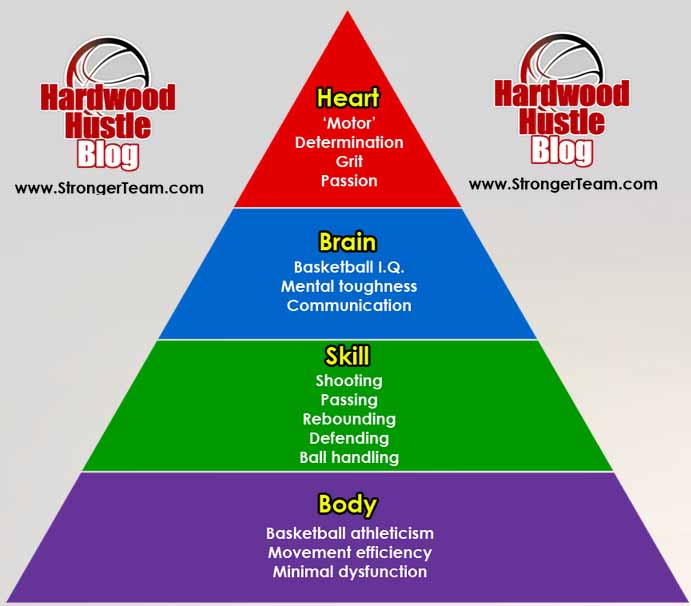
Basketball Coaching Complete Player Pyramid

By Brian Williams on October 23, 2013

Originally posted by Alan Stein of Pure Sweat Basketball

Something to share with your players. and to think about as you plan your season.

I have also included some links to other articles that Alan has written at the end of this post

It doesn’t matter how athletic a player is, if they aren’t skilled, they won’t be very good.

It doesn’t matter how athletic or skilled a player is, if they have a low I.Q., they won’t be very good.

It doesn’t matter how athletic, skilled or smart a player is, if they have no heart, they won’t be very good.

The only way you can build this pyramid successfully, and so it will last, is brick by brick.

Every rep of every set of every workout is another ‘brick.’

How many bricks will you add today?

Get better. FASTER.

Alan Stein
Hardwood Hustle Blog
http://www.About.me/AlanStein

  • « Go to Previous Page
  • Page 1
  • Interim pages omitted …
  • Page 9
  • Page 10
  • Page 11
  • Page 12
  • Page 13
  • Interim pages omitted …
  • Page 25
  • Go to Next Page »

Primary Sidebar

  • Twitter
  • Facebook
  • Linkedin
coachestoolbox
personaldevelopmenttoolbox
basketballplayerstoolbox
basketballtrainer
athleticperformancetoolbox
coachingbasketball

© Copyright 2026 Coaching Toolbox

Privacy Policy