• Skip to primary navigation
  • Skip to main content
  • Skip to primary sidebar

  • Basketball Plays
    • Ball Screen Sets
    • Horns Sets
    • Man to Man Post Up
    • Man to Man Isolations
    • Backdoor Plays
    • Man to Man 3 Point Shot Plays
    • 2-3 Zone Attack
    • Baseline Inbound Plays
    • Sideline Inbound Plays
    • Combination Defense Attack
  • Drills
    • Defensive Drills
    • Offensive Drills
    • Competitive Drills
    • Passing Drills
    • Rebounding Drills
    • Shooting and Scoring Drills
    • Toughness Drills
    • Transition & Conversion Drills
    • One on One Drills
  • Blueprint
  • Practice
  • Mental Toughness
  • Skill Development
  • Offense
  • Defense
  • Store

Filing Cabinet

Coaching Basketball Eliminate Losing

By Brian Williams on August 14, 2013

This article was written by Arkansas women’s head coach Mike Neighbors

Eliminate Losing

Good coaches that I have observed over the years have always done this with their teams. The GREAT coaches that I have observed over the years do this in their practices on a daily basis in all things that they do. So, as I was preparing for my first 5 practices as a college head coach.

I made sure that in every single drill and skill I put on the preparation plan reflective that thinking. If we can eliminate beating ourselves first, then the outcome of our games is completely in our control.

POOR PREPARATION: I have never seen a team who had a poor week (or day) of preparation win a big contest. Whether it is a poor scouting report, a shoot around that lacks focus, a pre-game warm-up full of distractions, a star player showing up late for bus, not sleeping the night before, eating an uncharacteristic pregame meal that upsets a stomach, etc.

POOR SHOT SELECTION: All teams will have nights when the ball won’t go in the hole. Not much you can do to control that. But you can control the quality of the shots your team gets. If you allow players/teams to take poor shots in preparation, they will do the same in games. WE GET WHAT WE TOLERATE. You have to be very clear with your team what YOU consider a good shot. Make sure your players/team understand it clearly, then defend that in every skill/drill that you do.

FOULING: This could be fouling too much. It can be too many fouls on an individual player, especially an impact player. It can be fouling at inopportune times. Either way, it can get you beat. You must “officiate” your skills/drills and scrimmages as your games would be called. We have goals to never put a team in the bonus in a first half. We have goals of only doing it in second half of games that we are trailing in. If we can keep teams from the FT line, we won’t beat ourselves.

UNCHARACTERISTIC TURNOVERS: You are going to turn the ball over. Some games more than others depending on the number of possessions you/your opponent pace the game. When your teams/players make turnovers they normally don’t or shouldn’t then you put yourself in a position to lose. In preparations we have a ball rack that has 8 basketballs on it. When we turn the ball over in one of the above situations, we remove a ball from the rack. This is a visual to our players what we consider UNCHARACTERISTIC. When the rack is empty, we stop our drill and “remind” the team (running, stairs, pushups, situps, etc), fill the rack back up and start again.

If we can eliminate losing before we deal with our opponents play, then you can coach. The next time you feel like saying after a game that “we beat ourselves” take inventory on why you feel that way. Then go about eliminating those issues in your practices. Sometimes you are just going to lose. It happens to every coach and every team. But, try to eliminate beating yourself.
Mental Toughness Plan of Action

By Brian Williams on August 13, 2013

These thoughts on clutch performance are from Spencer Wood Icebox Sports Performance Resources.

Click the link below to see his website. There are some articles on mental training and other resources as well. Icebox Athlete

Developing a Mental Skills & Toughness Training Plan of Action

By Spencer Wood

Ask any athlete, coach or sports fan ‘of all the athletic attributes, which is the most important?’ Even the most casual athlete, coach or sports fan will provide an answer that in some way relates to the mental toughness, potential and power locked away in our mind. Yet, for so many coaches and athletes, unlocking the incredible athletic potential and power held in our minds is sometimes as much a mystery as it is a source of constant heartache and frustration. Many teams and individual athletes know what it feels like to bring their ‘A’ game against one program one day, and then almost unexplainably, they bring their ‘C’ or ‘D’ game against the very next program. Even worse, for those athletes who have experienced a major performance or skills slump in a big game or even over the course of a season – the frustration can feel like a slow death. Unfortunately, far too many coaches and athletes know this feeling all too well. For the progressive coach the response to these challenges is more than just extra running or longer practices.

While extra running, longer drills and additional conditioning can build certain aspects of mental toughness, and under a select few conditions may be suitable response for a lack of effort, games are not always won or lost because of a lack of effort. Games are often won or lost due to a lack of execution vs. lack of effort. The smart response then is to develop a mental skills and toughness training program that pinpoints the particular components of mental toughness that resulted in a lack of execution FOR EACH ATHLETE. Better still, coaches who proactively put such a plan in place before the start of the season will experience greater consistency and a significant competitive edge.

So how does a coach and team begin to implement a mental skills and toughness training program for clutch performance? It has been said that “sometimes things do not go according to plan because a plan did not exist in the first place.” For mental skills this plan begins with an honest assessment of each athlete’s mental skills and toughness strengths and weaknesses. But what kind of mental skills and toughness traits should you assess? While a seemingly endless stream of words and phrases can be used to broadly describe mental skills and athletic toughness traits, a useful summary traces each of these traits to one of more of the 4 C’s of Peak Performance – Composure, Concentration, Confidence and Commitment.

The 4 C’s of Peak Performance

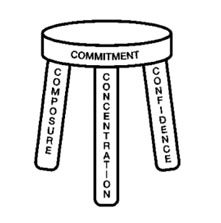
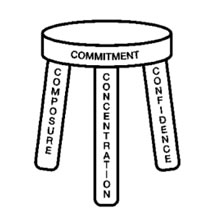
Together, these “4 C’s of Peak Performance,” Composure, Concentration, Confidence, and Commitment – work like a model of a 3 leg stool. The first 3 C’s of Peak Performance – Composure, Concentration, and Confidence are like the legs of the stool. Lose one or more legs and the integrity and balance of the stool is compromised. Translation – our performance suffers. And the 4th C of Peak Performance – Commitment – is the seat or platform of the stool that takes our weight and sustains us. No commitment or motivation, no stool. Each of these 4 C’s of Peak Performance profoundly affects the others. Developing tremendous composure allows us to better perform our concentration skills. A composed athlete who is able to effectively concentrate whenever necessary, will be a confident and highly effective athlete. And finally, a fully committed athlete will have harnessed the necessary drive and motivation to passionately pursue their mental and physical potential – committing to the necessary physical and mental training, maximizing their composure, concentration and confidence, and striving for Peak Performance. The “4 C’s Stool” diagram illustrates this Peak Performance Model.

4 C’s of Peak Performance

Mental Toughness for Basketball

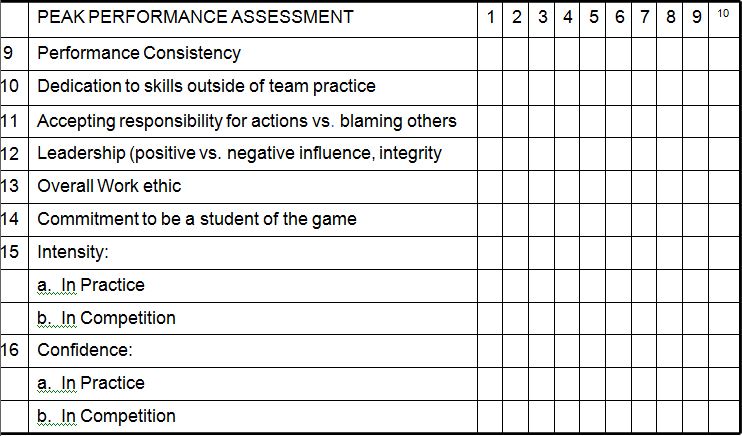
The Peak Performance Assessment examines current levels of practice and competitive composure, concentration, confidence and commitment, in addition to a number of other factors that can profoundly affect each of the 4 C’s of Peak Performance. These questions are scored on a scale from 1-10. A score of 1 = a “strongly disagree/very low” score. A score of 9 = a “strongly agree/very high” score. A score of 10 is a very rare “near perfect” score and should only be used sparingly. Encourage each of your players to complete the Peak Performance Assessment with complete honesty. Great athletes are great because they work on their strengths AND their weaknesses.Only complete honesty will allow your players to objectively identify these strengths and weaknesses before they are able to effectively improve these skills. The coach should also complete an assessment on each player, and should be compared with the player’s self-assessment in a one-on-one meeting with each player.

Any question with a score below a 7 should send up a ‘red flag’ and you should strongly consider working on this weakness with the athlete in question and turning the weakness into a future goal for improvement.

Developing a mental skills and toughness training plan for your team will certainly involve a time commitment. But this critical skill set will add a new, challenging and fun component to your practice schedule. In addition, the more you continue to train your team’s competitive mental muscle and refine your player’s mental training skills, the closer you will come to your team’s real potential. The pay-off in consistent peak performance, individual player improvement and your overall win column can be significant.

Mental Toughness for Basketball

Mental Toughness for Basketball

130 Great Ideas to Make Your
Basketball Team More Mentally Tough”
basketball practice

Click here for 12 ideas from the e-book

“This is great information that will help any coach to make their team more mentally tough and focused. I found sections 6 and 7 to be helpful to me as well as to our team. “

Brandon Sorrell
Assistant Girls Basketball Coach
Lawrence North (Indianapolis) High School

Basketball Coaching Basketball Workouts

By Brian Williams on August 2, 2013

By Alan Stein, Pure Sweat Basketball (re-posted with permission)

5 P.I.E.C.Es to a Killer Workout

I realize the landscape of youth and high school basketball has changed drastically over the past 20 years and that players don’t really have a true ‘off-season’ anymore. While my prescriptions for each have been severely modified over the last decade, I still choose to divide the calendar year into 3 phases based on the typical high school season in the United States:

  1. Off-season: April to August
  2. Pre-season: September and October
  3. In-season: November to March

In order to maximize workouts during any of these seasons, players need these 5 P.I.E.C.E.’s:

  1. Purposeful – The workout must address the movement patterns and specific skills that are actually used when playing. Dribbling 3 basketballs with your eyes closed and standing on one leg is great for YouTube views and is very difficult to do… but it serves absolutely no purpose.
  2. Intense – The workout must be done with game-like intensity. You must intentionally leave your comfort zone (physically and/or mentally). Casually shooting with no defender for a couple of hours each day will do very little to improve your in-game shooting.
  3. Effective – The workout must produce tangible results. It must be progressive and cause an improvement in the desired effect (if you do a vertical jump program all summer but don’t jump any higher when school starts… the program was obviously not effective). Sweating does not mean a workout was effective. Sweating is not an objective; it is a physiological by-product. Slapping on a weighted vest and dribbling a bowling ball up a hill for 2 hours is exhausting… and will certainly make you sweat… but it will do nothing to make you a better basketball player.
  4. Challenging – The workout must push you beyond your current limits. It must be difficult. It must force you to make mistakes. If you do a 30-minute ball-handling workout and never lose the ball… you didn’t get any better. All you did was something you were currently capable of doing. If you can currently make X number of elbow jump shots in 60 seconds; then you need to challenge yourself to make 1 or 2 more.
  5. Efficient – The workout must eliminate time fillers. More is not better when it comes to working out. Better is better. You are much better off doing a 45-minute workout that is purposeful, intense, effective and challenging… than going through the motions for 3 hours. Get in, put in quality work, and get out!

I encourage you to make sure you use these 5 P.I.E.C.E.’s in the final month of your off-season program to truly improve performance before school starts.

These 5 P.I.E.C.E.’s make up the backbone of what we teach at the D1 Experience Basketball Camp. NBA skills instructor Drew Hanlen and I show players of all ages and levels exactly what it takes to play college basketball.

The foundation of our philosophy is to show players how to work hard, teach players how to work smart, and inspire players to work consistently once camp is over. Players learn the level of effort required to play college basketball as well as how to work out with the 5 P.I.E.C.E.’s so they can get there.

Alan Stein
Hardwood Hustle Blog
http://www.About.me/AlanStein

Mental Toughness and Clutch Performance

By Brian Williams on August 1, 2013

These thoughts on clutch performance are from Spencer Wood Icebox Sports Performance Resources.

You can visit his site to learn more from him: Icebox Athlete

According to a study based on professional athletes in the NBA, NFL, and NHL, the following eight traits were found to constitute the ultimate athlete:

  1. Ability to work hard and sustain intensity.
  2. Competitiveness.
  3. Athletic ability.
  4. Sacrifice for the team.
  5. Coping with criticism, failure, and success.
  6. Clutch performance, poise, and focus.
  7. Ability to execute game strategy.Passion
  8. for the sport and commitment to excellence.

Five of the above traits are mainly mental attributes.

There isn’t a coach in America who would say that mental skills and toughness isn’t critical to clutch performance. But how many coaches devote fifty percent of their time developing mental skills?

Misconception that metal skill and toughness only need to be worked on if there’s something wrong.

We must give our athletes an actual skill set to work on. A crisp definition of what is expected.

Mental Toughness = The Four C’s:

  1. Composure.
  2. Concentration.
  3. Confidence.
  4. Commitment.

What happens to the brain under stress?

Perceived threat leads to a fight or flight reaction.

  1. It’s important for our athletes to realize that this process is common.
  2. Not too many athletes are going to acknowledge they’re nervous.
  3. Take time to talk with your athletes about what happens to your mind and body in clutch situations.

Four things occur in clutch situations:

  1. Heart rate changes.
  2. Breathing pattern changes.
  3. Digestive system breaks down – blood from digestive system is rerouted to the prime movers of the body in preparation for fight or flight.
  4. Muscular tension – effects fine motor skills (e.g. shooting).

How does this effect performance?

  1. 8% differential between practice free-throw percentage and game free-throw percentage in NCAA.
  2. 13.6% difference in free-throw percentage between regular season and playoff NBA games.

Fight or flight is not all bad.

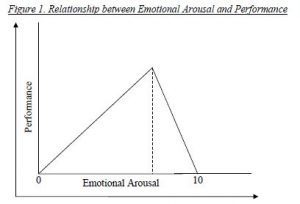
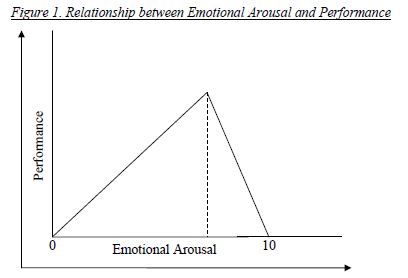
  1. There is a direct relationship between emotional arousal and performance.

Emotion Arousal (EA):

  1. Coming out of the locker room before a game, or coming out of a key timeout in a clutch situation, an athlete’s emotional arousal level increases.
  2. As emotional arousal increases, performance potential increases. However at a certain level, emotional arousal reaches a level where performance potential is maxed (as identified by the dotted line in figure 1).
  3. Once this level of optimum emotional arousal is passed, performance potential tanks.

basketball practice

  1. Different players may perform best at different levels of emotional arousal.
  2. Some young coaches pride themselves on their ability to jack up their team without knowing that two of their studs may play better at a level two or three of emotional arousal.
  3. Ray Allen for example seems to perform best at a very low emotional arousal level. You could have a player with an emotional arousal level of three who looks like they don’t even care.
  4. There is nothing on Earth that you should let take you out of your optimal arousal zone.

Determining a player’s optimal EA level:

  1. It is critical to ask the athlete what EA level they think they perform best at.
  2. Ask your athletes to think back to the three or four best games of their career, and there will be some continuity to the level of arousal they were at during those performances.
  3. Also challenge your players in practice. Manipulate their arousal levels and see at what level they perform the best.
  4. Don’t confuse arousal level and intensity. Intensity must always remain high for optimal performance.

Maintaining optimal emotional arousal

  1. There is a big difference between finding a players emotional arousal level and maintaining that level.
  2. Once an athlete has identified their level, teammates and coaches can help the player reach that level before a game
  3. It is up to the athlete to not let anything take them out of their optimal emotional arousal zone.

Mistake Management:

  1. You can tell a lot about a players emotional arousal level by how they react to mistakes.
  2. Train your athletes on how to react to mistakes.
  3. Great athletes aren’t great because they are perfect. They are great because they have the perfect reaction to their mistakes.
  4. Screaming after a miss is the ego saying I usually make that. However it reveals a level of frustration to our opponents.
  5. The external reaction of screaming is nothing compared to what is going on under the surface.

Take out the trash:

  1. With every single mistake made on the court, take out the trash.
  2. Remove the mistake from the mind of the athlete.
  3. There has to be a cognitive process to remove the mistake from the mind. Otherwise it remains with players, erodes confidence and kills clutch consistency.

Two step process:

  1. Take out the trash (erase the mistake from the mind like burning a photograph).
  2. Visualize the correct image.

When you see an image in your mind, whether it is real or imagined, you have a greater chance of reciprocating that image.
Three rules for using imagery before a game to improve a young person’s skill level:

  1. A goal has to be set.
  2. Visualize from an inside out view.
  3. Activate all five senses in the visualization (smell the popcorn vendors, hear the sound of sneakers squeaking on the floor, see the colors of the jerseys).

There is a huge difference between an outside-in view and inside-out view

  1. Outside-in view is like visualizing the action as if you were watching from the stands.
  2. Inside-out view is as if you are the one performing in the competition.

Self Vocalization:

  1. Positive self speak.
  2. We need to put the right words and images together.
  3. There are words that we can use that will help us perform at our best.

If we took a mediocre NCAA basketball player, and one of the greatest players in NCAA history and a mediocre player, and compared their self speak, would there be much of a difference? Yes the difference would be immediately apparent.

The inner voice of the mediocre athlete is like this:

  1. “Oh no this is a big one,” “don’t screw up now,” “don’t you choke,” and “I can’t miss this one, my contract is on the line here.”

The elite athlete’s self speak is like:

  1. “Oh yeah, I’m at my best when it counts the most,” “I’m one of the best players in the league,” and “I am so consistent in the clutch.”

If you could take down everything Michael Jordan said to himself during a game it would be owe inspiring.

There is a process to marry the right words and the right images to enhance clutch performance.

1. Set the goals.
2. Keep the statement positive and realistic:

    1. “I never miss in the clutch” – negative and unrealistic.
    2. “I always make free-throws in the clutch” – positive but unrealistic.
    3. “I am so consistent in the clutch” – positive and realistic.

Law of Dominant Thought:

  1. Mind doesn’t always distinguish between do and don’t do.
  2. Important to keep this in mind when we’re coming up with these key sentences for our internal script.
  3. “I never a miss a free-throw in the clutch” vs. “I always make my clutch free-throws. The first is negative, the second is positive.
  4. It may seem complicated to come up with the right words and the right sentences, but once an athlete devises a script, and practices it, it will be with him forever.

Channel Selection for Focus:

  1. There are seven different things that we can focus on.
  2. The first five are our senses (hearing, vision, touch, taste, smell).
  3. The 6th channel is our imagination – our ability to see images from the past and the future.
  4. The 7th channel is our inner voice.
  5. You can only effectively focus on one channel at one point in time.
  6. Our mind oscillates between these channels.
  7. If we just focus on one channel that sense is heightened.
  8. Most sports success is played in the visual channel.
  9. 90% of success played in the visual channel.

With a mediocre player, focus switches between channels more often in clutch situations than an elite level performer.

In timeouts get the players to switch to their audio channel.

Is it alright during a timeout to say: “If we make the free-throw we’re in this, if we miss the free-throw we’re in that?”

  1. Absolutely, you have to scenario plan, players need to have instruction. However understand the difference between giving these instructions during the timeout, and a player focusing on the worse case scenario while attempting clutch free-throws.

Have you ever seen a player use negativity to fuel a better performance?

  1. Negative motivation can have just as much positive effect on performance on gross motor skill output as positive motion.
  2. However for fine motor skill coordination there is a huge disparity between positive motivation and negative motivation.
  1. Choking has nothing to do with the outcome.
  2. If you lose one or more of the 4 C’s of performance you have choked.
  3. It’s not possible to determine if someone has choked without knowing what went on in their mind. It could be a physical breakdown.

Clutch attitude – Fear of failure / choking vs. focus on important cues:

  1. Focusing on outcome brings you that much closer to losing,
  2. Focusing on the variables responsible for success (The 4 C’s) will bring you that much closer to winning.
  3. Define what choking is and what it is not with your athletes.
  4. Focus should be on the present and not the future (ramifications of winning / losing).
  5. Build a team culture of “STEPPING UP.”

Educating your athlete on what choking is puts them in a different mindset when it comes to taking that final shot.

The question now is not whether I’m the G.O.A.T. or not if I miss this, the whole focus is on maintaining the 4 C’s which will in turn increase the probability of success.

130 Great Ideas to Make Your
Basketball Team More Mentally Tough”
basketball practice

Click here for 12 ideas from the e-book

“This is great information that will help any coach to make their team more mentally tough and focused. I found sections 6 and 7 to be helpful to me as well as to our team. “

Brandon Sorrell
Assistant Girls Basketball Coach
Lawrence North (Indianapolis) High School

Basketball Coaching Building a Bench

By Brian Williams on July 30, 2013

This article was written by Brian Anglim. Brian has coached basketball at both the high school and college levels. He has some really good articles on his blog and I encourage you to take a look at it.

Coach Anglim has a newsletter that he does not publicize much because it is not on a regular schedule. But, if you are interested in subscribing to it, email me and I will forward your request to him.

Basketball Coaching–Building a Bench

by Coach Brian Anglim

A key factor in the Miami Heat victory over the Indiana Pacers was the weakness of the Pacer’s bench.   Although a bench is generally a product of talent, there are a number of things we can do as coaches that can help develop our team’s depth. I am a big fan of Coach Vogel of Indiana (he got more out of Lance Stephenson that I ever thought possible) but his ability to develop his bench seems to be a chink in his armor. Here are some ideas on how to improve the effectiveness of your bench.

Skill development

Player development is a key emphasis to any basketball program and its influence is even greater in developing depth.  We all work on shooting, passing, and a variety of skills in our practices but to maximize your player development I would encourage coaches to look into more individualized skill work.

For example, your starters played a tough game on the road the night before, have them come to practice 20 minutes late so that you can use this time with your bench players. Another idea I have stolen from NBA coaches, they will take their bench/developmental players and spend 20 minutes prior to game warm ups to do basic skill development workouts.  These players can get in lots of form shots, finishing work, and simple ball handling drills prior to the game with limited space. In an 18 game season that is 6 extra hours of practice time, that can make a real difference to an engaged athlete.

Skill development sessions should be very individualized.  I like working with groups of 1 to 3 athletes per rim. I think for at least 10 minutes per day a player should be getting individual attention from the head coach or one of the assistant coaches. This personal interaction on a daily basis is how we build great players and become positively involved in their lives.

You need to sell players on that investing in themselves can lead to an expanded role within the team and push the team toward on-the-court success. It is this culture that you create.

Strength and Conditioning

A big philosophical change in the last couple of years for me has been my belief in a structured strength and conditioning program. Many coaches see athletic ability at a fixed level that can only improves with age.  Athletic ability can not only be improved, but with a well defined strength and condition program can lead to dramatic changes.

Good coaches take an active interest in performance enhancement in their off-season program but great coaches think of it in a year round manner.  As with skill development, I look to individualize these strength and conditioning program by the needs  and demands put on the player.  For a player who is playing major minutes, it is important that we save their legs and we are looking to maintain their strength levels. A bench player however does not have nearly the same game day demands and we can be aggressive in this program.

If we have a freshman who can only clean 45 pounds, if I were to maintain his strength level within the season what would that really get me? Don’t waste the season to maintain subpar strength/power levels.  We can be aggressive in our approach with that younger player.  Some coaches don’t believe in lifting on game days, but we see it all the time in the NBA and it is appropriate for players that only limited amount of minutes.

In fact it is not uncommon for players playing under a certain number of minutes for a game going through a post game conditioning session.

Selling a program like this might be difficult, but it falls within my philosophy continual growth as individuals and as a team.

Develop Roles for Bench Players

All players have strengths and weaknesses. Create roles for your less talented players that they can excel. This gives them confidence that they can contribute and building that confidence means everything.

We still need to be aware of that player’s weaknesses as well. We need to coach the heck of these players to ensure that they make good decisions with their playing time (ie shot selection and decision making) and focus our skill development sessions to remedy the holes in their game.   We can also make tactical changes within our offenses and defenses to protect them, for example having a player who is a non-shooter always curl cut a down screen.

Use the appropriate offensive and defensive systems for your team

To me this is an extreme option but something I want to mention.  Be aware of the talent, athletic ability, and experience of the players on your floor when you decide what offenses and defenses you might play. If you care constantly changing from zone to man to full court pressure, these changes can be difficult on the fly for a younger player. You might have to play a more passive defense for your less athletic players or you might be able to go the other direction when you have a bench that are more athletes than basketball players.

You can also put your bench players in a “hidden delay game” to minimize their possessions while they are on the floor. For example, you could put them into a zone on defense and have them play motion offense but not allow a shot other than a layup until there have been 10 passes. This lengthens both the offensive and defensive possessions while your other players get a break. I also love the idea of teaching the flex as a secondary offense, it kills clock and often leads to free throws with its inside oriented design.

One final point to leave you with, you need to have confidence in those players and give them a chance to make mistakes and learn from them.  Be sure to give them at least a little bit of time every game and let them know that with continued improvement there role might expand. If you want to build a great bench then you need to believe it first.

As I mentioned in the most recent newsletter, I have been sending out coaching notes and handouts on a weekly basis, if you are interested in being notiefied when i send these out please follow me on twitter @CoachAnglim or on Facebook.

Basketball Coaching Keys to Increased Winning

By Brian Williams on July 26, 2013

This article was written by Coach Randy Brown. He is a former D1 Assistant Coach at Iowas State and Arizona. His 18 years in college basketball highlights a successful 23-year career. Mentored by Basketball Hall of Fame coach Lute Olson at Arizona.

He has passion for the game of basketball and works as a basketball consultant and mentor for coaches.

Randy’s coaching resume includes positions at Arizona, Iowa State, Marquette, Drake, and Miami of Ohio, 5 Conference Championships and 5 NCAA appearances. His efforts have helped develop 12 NBA players including Steve Kerr, Sean Elliott, and Jaamal Tinsley. To contact Randy, email him at [email protected]

6 Keys to Increased Winning

During my career, I have hosted several coaching clinics. Although most coaches want to learn about offenses and defensive systems, my clinic presentations deal with coaching philosophy and though proving topics. In this article I presents six important issues that dictate the level of success for all basketball coaches.

1. Your TOP 3

This is a philosophical exercise to help establish your TOP 3 values as a coach. This is the ANCHOR of your coaching success and consistency. These three items are the foundation of your program and are your non-negotiables. Everything your coaching represents comes directly from the emphasis you put on your TOP 3.

The TOP 3 is your road map as a coach and guarantees that your coaching will be focused daily on the items you feel leads most to winning.

2. A Plan for self-improvement – Addressing weaknesses and increasing knowledge of the game.

Many coaches attend one or more clinics during the year to increase their coaching knowledge and strategy.

Self improvement as a coach does not come from clinics but rather from focused work and research on your weaknesses and new learning. It comes from being open to the advice, feedback and critique of others. Elements of this include; coaching round tables, research on areas of weakness and working with a mentor.

3. Finding and working with a Mentor.

Having a coaching mentor will help improve your coaching more than anything else you can do. A mentor can help you look at yourself in an entirely different way and help you identify areas to focus on to improve. Mentors are not a threat to your coaching but an ally that is available to you at any time.

Working with a coach mentor can help expedite your improvement due to learning about the mistakes and victories your mentor has previously experienced.

4. Organize your System.

Organization of materials, notes, video tapes, statistics and X & O’s are a move toward to efficiency. Your coaching notes, coaching tools, practice plans are useless unless they can be accessed through organization. The more you simplify and organize they more valuable your system of coaching will become.

5. Vision Exam – How players and assistant coaches see you and the game

A great coaching attribute is looking at the game as your players and assistant coaches do. Tunnel vision is a common downfall of many coaches. Not until you begin to see how your limited vision of the game can hurt your coaching, will you see that you can change. Concepts include “what it takes to get in the game

6. Tools and resources for enhanced coaching

Taking advantage of technology can not only make coaching easier but more effective. Practice planning, drills, video editing and program planning can all be simplified with available coaching tools and resources. Feature includes: Yearly practice and drill collection and yearly notebook.

  • « Go to Previous Page
  • Page 1
  • Interim pages omitted …
  • Page 11
  • Page 12
  • Page 13
  • Page 14
  • Page 15
  • Interim pages omitted …
  • Page 25
  • Go to Next Page »

Primary Sidebar

  • Twitter
  • Facebook
  • Linkedin
coachestoolbox
personaldevelopmenttoolbox
basketballplayerstoolbox
basketballtrainer
athleticperformancetoolbox
coachingbasketball

© Copyright 2026 Coaching Toolbox

Privacy Policy