• Skip to primary navigation
  • Skip to main content
  • Skip to primary sidebar

  • Basketball Plays
    • Ball Screen Sets
    • Horns Sets
    • Man to Man Post Up
    • Man to Man Isolations
    • Backdoor Plays
    • Man to Man 3 Point Shot Plays
    • 2-3 Zone Attack
    • Baseline Inbound Plays
    • Sideline Inbound Plays
    • Combination Defense Attack
  • Drills
    • Defensive Drills
    • Offensive Drills
    • Competitive Drills
    • Passing Drills
    • Rebounding Drills
    • Shooting and Scoring Drills
    • Toughness Drills
    • Transition & Conversion Drills
    • One on One Drills
  • Blueprint
  • Practice
  • Mental Toughness
  • Skill Development
  • Offense
  • Defense
  • Store

Program Blueprint

Bob Hurley: The St. Anthony Way

By Brian Williams on February 2, 2017

These notes from the 2013 TPG Master in Coaching Clinic were posted by Zak Boisvert on his basketball Coaching Website: Pick and Pop

Bob Hurley

St. Anthony HS (Jersey City, NJ)
“Over 40 years of sustained success—the St. Anthony way”

-St. Anthony players receive a contract on the first day of school. They must bring it home to sign.
• Lists 20 expectations of them
• Covers everything they to do to be a successful student-athlete
• Parents must sign as well

-St. Anthony curfew extends to social media (no Twitter/Instagram/Snapchat posts past a certain time).

-This is a scary time because our gyms are filled with a generation of kids who don’t like to work on their games.

-Hard to keep this up, but tries to schedule practices with the court open an hour in advance. Appoints a coach to be there an hour early working with any kid that shows up on offensive skill work.

-What you’re responsible for at St. Anthony (as a player) every single day:
1. Be enthusiastic
2. Correct mistakes

-The purpose of practice:
1. To get better
2. To prepare for the next opponent

-Everything in practice is game-speed and everything is competitive.

-Our day-before practice is the same speed, it’s just not as long.

-If I don’t like a kid’s effort, I give him a warning. If I see it again I point to the door.

-The things you struggle with will show their face against the best teams on your schedule.

-We constantly remind our players about the things we feel they need to work on.

-St. Anthony starts practice with 7 players in maroon every day. If you end the day in maroon, you start the next practice in maroon.

-Hurley’s view: St. Anthony plays every game to build for the post-season.

-During St. Anthony’s 83-game winning streak, Hurley didn’t talk about winning a single time. The focus every day was on getting better.

-Use your assistants—the power of delegation.

-Save your best stuff for Post-season.

-Simple objectives
• Play hard
• Play smart (“or we try to”)
• Be unselfish
• Don’t give opposing team points
• Be in good shape

-Hurley’s teams play straight man-to-man defense for the first ten games of the year.
He wants to establish the way they play without the help of gimmicks.

-After the first 10 games, Hurley will use zone press off free throws (make or miss).

-St. Anthony will zone the opponent’s first 2 BLOBs of the game and then play man-to-man.

-After game 10, Hurley will look to mix in his Box-and-1, Triangle-and-2, different zones as he sees fit.

-First three steps of conversion: make up for a lack of speed by transitioning quickly mentally.

-What “being really solid” means to Hurley:
1. Sprint back every possession
2. Block out on every shot
3. Organized press O

-St. Anthony WIN stat: a culmination of deflections, charges, defensive rebounds, shot contests, loose balls, block-outs, throw aheads (and more).

• Game leader is excused from all conditioning during practice(s) until the next game

-Passing is the most important skill in the St. Anthony program.

-Attack the x5 for 32 (or 40) minutes. Put him in a ball screen the first play of the game.

-As a coach, Hurley puts the onus on himself to find 10 points per game on special situations.
• Hurley tells his team this
• Team has do their part as well, but knowing the playbook inside-out, paying attention to details, having great huddles, and executing every part of their duty on a given play.

-Tries to shoot the last shot of all four quarters (important though to shoot with enough time on the clock to get an offensive rebound).

-After the season, Hurley lets the year breathe for one week before scheduling meetings with every player in the program (and his entire staff) to discuss what theplayers can do to improve.

-It sounds bad, but it’s probably in the kid’s best interest to be the 1st or 2nd option on his AAU team. He needs opportunities to develop—those opportunities may not come during the high school season where the success of the program is paramount.

-Your JV team should mirror your varsity. As the varsity head, you need to pay close attention to your freshmen and JV teams.

-Hurley loves Rex Ryan’s “Play Like a Jet.” Develop an identity for your program and a way your players should play/act and hold them accountable to your vision.  Editor’s Note from Brian.  I do realize that Rex Ryan is no longer coaching any team.   The purpose of this site is not to judge coaches or to criticize that saying Rex Ryan and Jets is outdated.  The purpose of the site is to provide as many good ideas as I can for coaches to pick and choose from.  I think the idea of “Play like a (fill in your school’s mascot)” or something similar, is worth considering for adoption for your program.

-Hurley knows how frustrating it can be to work with the big kid whose skill level is woefully far behind the rest of his teammates. He urged coaches to stay positive with that kid and keep working with him.
• “Treat that kid great until he loves the game. As soon as he does: treat him like everyone else.”
10 Areas for Player Self Evaluation

By Brian Williams on January 22, 2017

—Excerpted from the book, “Running the Show” by Dick DeVenzio

Posted with permission from PGCBasketball

You can read ways 1-10 at this link: Part 1: 10 Areas for Honest Self Evaluation

Stemming from the need for a standard of personal excellence, I offer a citizenship test or “State of the Person” report card. In brief, here are twenty-one categories or subjects in which I think each person should strive to get an A. In my opinion, all A’s in these would qualify a person to think of himself as approaching excellence as a person in the same way Michael Jordan approached excellence as a basketball player.

How do you measure up?

11. SERIOUSNESS

Are you serious about the things you do and aware of the impact you can have on others and on your own future?

pat summitt copy

12. COMMUNICATION

  • Do you understand that reading, writing, speaking, and listening skills are valued throughout the world?
  • How is your eye contact, hand shaking, sentence structure, empathy, expression?
  • Are you taking full advantage of the remarkable powers of sincere, effective communication?

13. PHYSICAL FITNESS

  • Are you giving your body the opportunity to enhance your life via energy level, appearance, strength, sport?
  • Do you maintain a regular regimen of fitness?

14. MODERATION

  • Are you intelligent, in control, and aware of the consequences of your actions?
  • Do you moderate your own urges as well as your own judgment of others’ actions?
Are you intelligent, in control, and aware of the consequences of your actions?

Click To Tweet

2017 PGC SUMMER BASKETBALL CAMPS

We provide intense, no-nonsense basketball training for dedicated players and coaches. Each camp and clinic is designed to teach players of all positions to play smart basketball, to be coaches on the court, and to be leaders in practices, games, and everyday life.SCHEDULE AVAILABLE JAN. 13TH

15. GENEROSITY

  • Do you find ways to give away a lot of the things you have so that others can enjoy them?
  • Do you need a lot of material  things to be happy, or are you more interested in getting material things for others?

16. THINKING AND REASONING

  • How well do you deal with problems, evaluate opinions, and form your own ideas?
  • What religions have you studied?
  • What foreign or unusual ideas and philosophies have you weighed?
  • Could you help opponents to find some areas of common ground and help solve their problems?

17. BROADMINDEDNESS

  • How do you respond to other cultures and religions, unusual ideas, unexpected comments, and different tastes in fashion?
  • Do you do anything to try to expand your tolerance and objectivity?

18. DESIRE TO MEET CHALLENGES

What energy and effort do you bring to subjects you don’t like in school, activities that are new to you, problems that are difficult to solve, and conflicts in your home or among friends?

19. TOUGHNESS

  • How good are you at overcoming fatigue in school, during homework, and in sports?
  • How good are you at taking criticism?
  • How quick are you to complain or blame?
  • How good are you at taking full responsibility for the circumstances that confront you?
  • Do you control circumstances or do you let them control you?

20. OUTREACH

  • How often and how well do you reach out to include and invite others to show off their talents, express their feelings, and share your friends and interests?

It would be difficult to be too good at this.

BONUS: SELF-PRIDE

  • What would you want the world to see if 60 Minutes broadcasted a documentary report on you?
  • Would you be a terrific role model to the rest of the world if they suddenly got an inside, detailed look at the way you live your life?
  • Would you be proud of what the world would see?

Is it hard to do all these things? You betcha. It’s hard to bring the ball down the court against Gary Payton, contain Allen Iverson and slam dunk on Shaq too. But that’s what Michael Jordan and excellence are all about in basketball. Should excellence as a person be any easier?

To learn more about PGC Basketball, including additional training tips and videos, you can visit their YouTube Channel

Characteristics of a Coach of Excellence

By Brian Williams on December 6, 2016

These characteristics of coaches of excellence were posted on Bob Starkey’s Basketball Coaching Blog, hoopthoughts.blogspot.com.

Coach Starkey is an assistant coach in the LSU women’s program.

Editors’ note from Brian: Even though these concepts came from a very successful NFL executive, most of the thoughts can be applied to any level of coaching for any sport. Also, the article is written with male references, but in my opinion, my of the lessons can be applied to man and women, boys and girls.

Bill Polian is one of NFL’s best General Managers.  He has a proven formula of success and that has transcended from one organization to the next.  Hired as the Buffalo Bills GM following a 2-14 season, he soon had the franchise going to three straight Super Bowls.  From there he became the GM of the Carolina Panthers where he had the team in the NFC Championship Game in only their second year of existence.  From there he took over the Colts organization and one of his first moves was to draft Peyton Manning who would ultimately guide the team to a Super Bowl Championship.

Each spring I’m honored to be a part of Felicia Hall Allen’s A Step Up Assistant Coaching Symposium,”which is a unique format to help assistant coaches become better at their craft.  Obviously, one of the topics each year is moving  into the head coaching position.  Felicia brings in a wide variety of people to help paint the picture they need to move up.  One of the obvious speaker choices new head coaches that have just made the jump.  But she also brings in Athletic Directors, Search Firms and Head Hunters to give us a unique look at what the people doing the hiring are looking for.

I think sometimes as coaches we tend to lean on other coaches maybe too much for information instead of stepping outside our comfort zone and meeting with the true “decision makers.”  Have you met with your Athletic Director and discussed what he/she looks for in a candidate?  Do you have the courage to ask that AD what your deficiencies are and what you should look for?

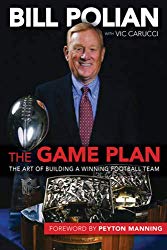
Polion has an outstanding book that I’ve read a couple of times titled “The Game Plan: The Art of Building a Winning Football Team.”  For those interested in becoming a head coach, Chapter 2: Deciding on the Decision Maker is worth the price of the book alone as Polion gives great insight to what he is looking for.  Below, is a brief look in to what he views important.

  1. Organization. That ranges from how he organizes his playbook to his practice plans, from year-round staff assignments to his off-season program.  Each of those areas and many more must be laid out in writing and explained completely, step by step, especially with a candidate who has never been a head coach before.

Today, every coaching candidate shows up for an interview with a “book” detailing all aspects of his program.  But the book is only as good as the person reading it.

  1. Leadership. Does he have the philosophical approach, verbal skills, physical presence, stability, and courage to lead and motivate the coaching staff, the players, and the support staff?
  1. Communication. Does he have good verbal skills?  Does he listen?  Does he respond to questions in a thoughtful way, or does he just tell people what to do?  Is he open to suggestions? Can he interact with ownership, management, and other departments on their terms?

Can he sell his program to all of the team’s stakeholders?  Does he care and communicate that care to others or are they just numbers to him?

Can he teach or is he a lecturer?  A teacher gets everyone involved.  He is able to illustrate his lessons with real-life examples and sometimes funny parables.  He gets his students invested and involved in what he’s teaching.  A lecturer just stands at the podium and spits out notes.

  1. Emotional Stability.  Can he function well under pressure from players, staff, ownership, fans and the press?  Does he remain cool on the sidelines?  Does he remain composed, organized, and does he take the lead at halftime?  Doe he use genuine anger as a motivational tool or does he come apart when he’s frustrated?

Is he coherent in his remarks to the players, staff, ownership, and the press after a loss?  Does a loss stay with him too long?  Can he keep everyone in the program, including the general manager focused by his own leadership when the “roof is falling down?”

  1. Vision.  This is the most important quality of them all.  Does he have a clear picture of how he wants his team to look and play?  Can he articulate it verbally and in writing?

Can he make long-term decisions in order to implement his vision when pressure is great for him to make a short-term, quick-fix decision?  Has he organized the program in such a way as to implement his long-term plan?

  1. Strategy.  Is he mentally prepared to make decisions on the sideline or does he react?  Does he have direct responsibility for key strategic decisions?  I other words, is he the guy making them or is he going to lean on somebody else?  He’s got to be the one to decide whether to go for it on fourth-and-goal.  He’s got to be the guy to decide whether he’s going to kick a field goal or go for a touchdown.

As Marv Levy always used to say, “If we’re penalized for having 12 men on the field, that’s my responsibility.

  1. Flexibility.  Can he adjust to changing trends and rules, personnel, opponent schemes, personality or culture of players?  And then I ask two rhetorical questions.  First, can he change the nuts and bolts of his program to adjust to circumstances without changing his approach to the fundamentals?

Secondly, can he be flexible and take advantage of circumstances or does he buy someone else’s program, lock, stock and barrel?  I other words, does he say, “Oh, gee, Pittsburgh won using a 3-4; let’s switch to a 3-4?”

  1. Ability to judge talent. He’s got to be able to see potential rather than just saying, “This is college player A and this is college player B.”  He’s got to be able to see what the potential of college player A is versus college player B.
  1. Public relations. Essentially, it boils down to, can he handle himself well in this media maelstrom that he’s forced to endure these days?

If interested in finding out more about the book, you can click the image of the cover below to the left.

  1. Player respect. Does his knowledge, leadership, teaching ability, approach to squad morale and discipline, and his personal habits and dignity earn player respect? Do they look up to him?

Is his approach to discipline fair?  Do his personal bearing, conduct, and dignity — which encompasses work ethic, temperament, personal habits, etc. — generate respect from the players?  Not liking, but respect.

  1. Character.  It boils down to one thing: do you want this man as a standard-bearer for your franchise.

Bill Walsh on Teaching and Player Development

By Brian Williams on September 13, 2016

These notes on Bill Walsh’s Philosophy are from Bob Starkey’s Basketball Coaching Blog, hoopthoughts.blogspot.com.

Coach Starkey said, The following comes from one of the absolute best coaching books I’ve every read, Finding the Winning Edge by Bill Walsh. I agree that it is one of the best coaching books I have read as well.


Drive the players to concentrate. Be assertive in your insistence that they focus on the task at hand.

Individualize your teaching approach to fit certain individuals, when necessary. Give extra time to those players who need it.

Be as precise as possible when teaching. Always use the system’s terminology as a common language.

Be patient, but demanding. Require your players to adhere to proper techniques at all times.

Teach the skills progressively. Adhere to a systematic methodology of teaching that allows the players to improve and enhances their level of confidence in your competence and professionalism.

Keep your finger on the pulse of the situation. Be alert to the intensity level of the players. Be sensitive to signs of those factors which can affect the learning curve. Never overlook the fundamental reality of the teaching axiom, “quality repetitions are the mother of all learning.”

Keep the meetings quality, not quantity, oriented. Use a variety of learning tools to enhance the learning environment and to help stimulate the players’ level of concentration and focus.

Demonstrate the highest level of knowledge about the subject matter being taught.

Teach the players in a professional manner. Unless you’re trying to elicit a specific emotional response from your players, refrain from screaming and demonstrative behavior. Keep in mind that such behavior seldom, if ever, enhances the learning curve particularly if the subject matter involves technical information.

Evaluate the players’ performance on a daily basis to ensure that they are progressively mastering the techniques required to perform the tasks they are assigned in an effective and efficient manner.

Rapidity is the essence of war; take advantage of the enemy’s unreadiness, make your way by unexpected routes, and attach unguarded spots.

Another teaching technique that has proven to be very effective is to have players emulate the techniques and actions of other athletes. For example, if players watch videos showing Jerry Rice run a particular pattern in a certain way, you (as the head coach) can single out and stress particular coaching points, by using Rice as the case in point.

All factors considered, players tend to respond more favorably to an actual visual representation of a particular teaching point than to tan abstract illustration of that point drawn up on a chalkboard or written up in a playbook. This learning technique is typically referred to as “modeling.”

“Win the war, then win the fight.”

And, a few more notes from Bill Walsh on Decision Making

A big part of coaching is the ability to make decisions.  When you think about it, coaches have numerous decisions that they must make on a daily basis.  All are relevant to our programs though certainly some are more important than others.  Here is a great list of thoughts in regard to decision making from Bill Walsh from his book “Finding The Winning Edge.”

-One of the main attributes a leader must have is the ability to discriminate from what is often contradictory information. In this matter, it takes a thorough understanding of the situation and of the sources of information to act effectively.

-Decision making involves more risk and responsibility than any other managerial activity. The work of problem analysis and evaluation can be delegated to others in the organization, but the responsibility for decision making is ultimately assigned to one individual. Choosing among various alternatives often demands courage and moral judgment, as well as intelligence.

-Effective decision making is vital to the growth of any organization.

-Toward that end, there is a series of questions that you should address when making a decision, including:

  • What difference does it make what course of action you decide to adopt?
  • Do you have sufficient information to fully analyze the issue/matter under consideration?
  • If you are lacking essential information, do you know how to get it?
  • How critical to implementing your decision is its acceptance by those who will be affected by it?
  • To what degree does the commitment of others to your decision depend on their active participation in the decision-making process?
  • Is everyone affected by your decision in general agreement with its basic objectives?
  • To what degree will those who will be affected by your decision disagree over possible alternative solutions?
  • Do the individuals involved in your decision have the capability to implement the decision as planned?

– An educated guess is just as accurate and far faster than compiled errors. – George Patton

You can click the link below to find out more about the book:

Bill Walsh: Finding the Winning Edge

I Just Don’t Read

By Brian Williams on September 4, 2016

This article was written and contributed by Scott Rosberg

Today’s post comes from a comment I have heard various coaches make through the years – “I just don’t read.” As an English teacher for 18 years, reading was obviously a very big part of my job, and it was a huge part of what I was trying to get my students to do. As teachers, we expect our students to read the various assignments that we give them. No matter the subject, reading is extremely important to the success of our students.

Reading is also extremely important to my success as a teacher. Of course, I need to know what I am teaching, but I also should know a variety of material that would support or be in the realm of what I am teaching, too. It also helps to have a general knowledge of various elements in the world. Obviously, the more I know, the better prepared I can be. Reading is one of the best ways for me to prepare to be my best.

This same concept is important in athletics, as well, especially when it comes to coaches. There are a variety of ways for coaches to improve themselves. Live coaching clinics & workshops, DVD’s, online video clinics, meetings with mentor coaches, online magazines, blogs, podcasts, YouTube videos, downloadable PDF’s, newsletters, print magazines, books, eBooks, and booklets are all ways to learn more about one’s sport, coaching & athletics in general, or any other self-improvement topic that could help one become a better coach. Looking at that list, there is a wide variety of media that a coach can turn to learn more about his/her craft.

Each of those methods of learning has value, merit, and worth. I always suggest to coaches that they open themselves up to as many methods as possible to improve at their craft. Reading is one of those methods, and I would argue that it is quite possibly the most important of those methods because there are more chances to read than any other medium out there.

However, when talking with coaches about various written materials that I think they should read, I sometimes hear from them, “You know, I just don’t read all that much.” While I don’t say it, some of my first thoughts are usually, “Seriously?! Why not? Do you want to be the best you can be? What if your players said to you, ‘I just don’t ________.’ about something that you tell them they need to do to help be the best they can be?”

I realize that coaches come in all varieties, and some just aren’t as into developing themselves as much as others. Some are just helping out a team in a rec league to offer the head coach a little help, so they are not necessarily focused on getting too much information on coaching. However, I would submit that these people are prime candidates to learn a bit more on the topic of coaching and coaching their sport, so they can maximize their chances for helping the kids have a great experience.

Other coaches fall into the realm of “long-time veteran” coach. They sometimes feel they have all the knowledge they need, so there is no need for them to read more on coaching or on their sport. Well, I fall into that category of “long-time veteran” coach, and I have always read as much as I could on coaching and on my sports. There is always more to learn, and it is also enjoyable reading about something for which I have a passion.

In between the novice and the long-time veteran are the majority of coaches – coaches who have been coaching for a few years, but who still have a lot to learn. These are the coaches that are the most disappointing when I hear any of them say they “just don’t read,” as their reason for not reading certain books that could help them become better coaches. They have the most to gain and to give, so increasing their knowledge is critical to their success and their ability to help their players and teams develop.

Now, it could be that they just don’t read anything, not just coaching materials. Some people have struggled to read their whole lives or they just were never into reading, and so they just didn’t do it much. For some people, reading may be difficult, so they choose not to do it. Or they may feel they are too busy to read. However, for anyone who struggles with these situations, there are other ways to “read” materials to help them.

Audiobooks are a great way to “read” a book. You get the same information, you often get it in the writer’s voice, and you can do it while doing something else, so you don’t have to set aside extra time for it. Podcasts are another great medium to get a lot of information to help you improve. While podcasts are not exactly like audiobooks, many podcasts are basically blog posts or some other form of the written word conveyed through audio. But even for those that aren’t, there is often a lot of great information for listeners to consume that will help them improve in whatever they desire. I have been listening to podcasts for two years, and many have really helped me in my coaching and other areas of my life.

Webinars and online courses are also great formats to learn a lot of information packed into a fairly short amount of time. So are online videos. While there is not much in the way of reading in the video format, you can get a lot of information, and you can see it put into action. Video is a great way for coaches who don’t read much to still pick up a lot of great information.

No matter what method you use to “read,” make sure you do so. While I prefer actually reading a book, booklet, article, post (like this one!), etc. over most other formats, any method of consuming helpful information will give you new ideas and strategies to help you improve your coaching. Please don’t use the excuse that “I just don’t read” to limit yourself from becoming a better coach. Find some way that works for you, carve out the time necessary to do it, and then get ready for new levels of growth and development.

Then again, if you have read this far in this article, you are probably already doing those things. I guess it’s time for me to do a podcast and a video of this post for all those people that “just don’t read”!

I would love to hear your thoughts on these ideas in the Comments section below or on the Coach with Character Facebook page. My next post will focus on some different books, blogs, podcasts, etc. for you to consider “reading” this summer.

About the Author of this Article

Scott Rosberg has been a coach (basketball, soccer, & football) at the high school level for 30 years, an English teacher for 18 years, and an athletic director for 12 years. He has published seven booklets on coaching and youth/school athletics, two books of inspirational messages and quotes for graduates, and a newsletter for athletic directors and coaches. He also speaks to schools, teams, and businesses on a variety of team-building, leadership, and coaching topics. Scott has a blog and a variety of other materials about coaching and athletic topics on his website – www.coachwithcharacter.com. He can be reached by email at [email protected].

Scott is also a member of the Proactive Coaching speaking team. Proactive Coaching is dedicated to helping organizations create character and education-based team cultures, while providing a blueprint for team leadership. They help develop confident, tough-minded, fearless competitors and train coaches and leaders for excellence and significance. Proactive Coaching can be found on the web at www.proactivecoaching.info. Also, you can join the 200,000+ people who have “Liked” Proactive Coaching’s Facebook page at www.facebook.com/proactivecoach. Scott can also be reached through Proactive Coaching at [email protected]

The Seven Essential Roles of a Basketball Coach

By Brian Williams on August 23, 2016

Just as you have segments of the game that you must cover in practice such as offense, defense, shooting, special situations, conditioning, etc… there are also seven segments that you need to perform to effectively lead and develop your basketball team.

  1. Philosophy and Leadership—Define and instill your program’s ideals.
  2. Organization and Management—maximizing the resources at your disposal.
  3. Individual Participant Development–Develop your players’ skills and attitudes within your system.
  4. Team Development– Develop, implement, and teach systems for team play that fit your players’ abilities and strengths.
  5. Role Definition–Assign roles that best fit each players within the system, work to keep them in those roles, and redefine roles as players change or the needs of the team change.
  6. Coaching Staff Development—Intentional professional development for the entire coaching staff.
  7. Service, Promotion, and Public Relations. Promoting the basketball program as a whole and the players individually.

#1: Philosophy and Leadership Define and Instill Your Program’s Ideals

My first priority is to make sure that I have (in writing) a clear direction and philosophy on which to build every aspect of our program around. You also need to update that document annually to make sure that it keeps up with your current thinking and beliefs about your job.  A huge part of your job as the coach is to develop it, present it, and embody it so that our assistant coaches, players, and managers not only “buy in,” but that they believe in it, support it, and feel that it is essential to our success.

Player development (Area #3 in my seven areas of focus) has the biggest impact on winning and losing.  Having your philosophy entrenched as #1 provides direction for your player development efforts within the scope of your overall system.

If a coach doesn’t have a clearly defined and written vision, it is impossible to achieve the consistency, unity, and intangibles a program needs to succeed from year to year as players and assistant coaches change.

#2 Organization and Management Maximizing the Resources at Your Disposal

For a business, this are would fall under “Operations.”  It is not the most enjoyable part of coaching, but it has to be handled well.

Even if your athletic administrator does the purchasing, facility maintenance, and scheduling for your program, you still need to stay on top of each of those areas and offer input.  Taking care of organizational items is not the most exciting part of coaching, however it is definitely important. It is a responsibility that is better handled proactively rather than re-actively.  Often the best way to deal with administrative items is to delegate them to a trusted staff member.

Have a long term plan for funding and purchasing big ticket items such as a shooting gun, or similar items.  Those projects require more planning and possibly even fundraising, so it is important to keep those items on your to do list and in front of the administration. The only way to do that is to give it some thought and review on a continual basis. Even smaller “extra” items such as practice gear, shooting shirts, shoes, travel bags, team meals may require fundraising, donations, or budgeting.

Keep a file of the officials who work your games both at home and on the road. That way you can make recommendations to your Athletic Administrator as far as who to hire at home. You will also be prepared when it comes time to turn in evaluations to your state association.

The more efficiently you can handle these types of items that need to be done, the less they become urgent “in your face” tasks when you are more focused on coaching basketball.

#3: Individual Participant Development of your players’ skills and attitudes within your system

In most games, the team with the best players usually wins. Granted, there is a certain amount of talent and attitude that is natural.  Our most important job in terms of winning games is to develop our players’ on-court abilities and skills so that we can put the team on the floor that has the best players.  In addition to developing basketball skills you can work to improve their athleticism, and to develop their mental toughness to handle the competition and pressures of a basketball season.   You must implement a year round program to develop your players’ skills place both during the season and out of your games season.

We have a plan to develop mental toughness in our players that includes defining what it is and what it is not, not allowing anyone in the program to use or accept excuses, not accepting moping, pouting,  or poor body language, and rehearsing in practice any and all pressure situations we might encounter in a game. That is not to say that we can simulate the pressure of a game in practice, but I feel that if we have rehearsed it in practice, it gives the player confidence that they have a plan of attack for the games.

#4 Develop, implement, and teach systems for team play that fit your players’ abilities and strengths.

Your system of play must take into account not only what each player does well, but also your depth, what it will take to win in your conference, against your schedule, and in season ending tournament play.
This is something that our staff works on throughout the year, but once we have selected the team, it is time to tweak and implement our system of play around the abilities of our players. It is an ongoing process throughout the regular season. We do not make wholesale adjustments, but will add in wrinkles, or subtract things that aren’t working as well as we thought they would when we included them as a part of our scheme.

This is a philosophical decision that you must make as a coach, but my philosophy is that we are going to utilize systems of play and structure our areas that we emphasize in practice, that give us the best chance to advance in our season-ending state tournament. As an example, if we know we’re going to have to beat a team that runs flex in our first round of the state tournament, then without telling our players what we were doing, we will practice defending the flex all season long. If our pack defense gives us the best chance of winning in the sectional, that is what we play during the season and work at daily. We do not play other styles of defense during the regular season even if they might be effective against one or two regular-season foes.

I refer to this role as team development because not only does it involve our offensive and defensive systems, but it includes team building and team chemistry as well. You’re not going to be able to reach your potential as a team unless there is a cohesion and camaraderie among the players. As coaches we can influence that togetherness of our team by the attitudes that we exhibit and instill in our players, the team building activities that we do, and the emphasis that we put on it.

#5: Assign roles that best fit each players within the system, work to keep them in those roles, and redefine roles as players change or the needs of the team change.

Deciding how each player, each assistant coach, and each manager is going to help the team and then working with that team member to coach them and make them better in that role is a crucial part of your job.  Providing those roles in writing in players and coaches notebooks is a very clear way of giving the direction they need to get started. But, just as important as having a plan to get started is your ability to have a plan to evaluate how each person is performing his or her role, how to keep them within their role and what to do if they grow out of that role.

#6: Intentional professional development for the entire coaching staff.

With all of the daily responsibilities that a coaching staff has during the regular season, it is very tough to spend any time on staff development.  Just like you ask your players to work on their game during the improvement season, the coaching staff also needs to sharpen their skills. There are five areas for each coach to work on and that coaches should have an individual development plan, just like players have an individual workout plan. The five areas to develop are:

  1. Technical Knowledge of the game of Basketball.
  2. Ability to teach the game of Basketball.
  3. Ability to bond a team.
  4. Ability to develop players’ individual skills.
  5. Leadership Skills

Create a coordinated development plan as a staff, so that you have different coaches working in different areas and can share their information so that everyone benefits from each other’s work.

Area of Focus #7: Promoting the basketball program as a whole and the players individually.

We don’t do complicated things, but strive to build relationships between our players and our community. The main thing is that you are working to create interest in and present your program in the best possible light.

We have a simple web site promoting our program that we email a link to for potential college recruiters as well as media members.  We write a basic pre-season media guide to hand out at games.  We run a summer youth camp and involve our players as instructors.  Each summer we hold a one day father/son one day clinic on the Saturday before Father’s Day.  We have an autograph night during the season where our players stay in the gym to sign autographs for anyone who is interested. We schedule all of these a year in advance so that we have the facilities and administrative blessings that we need.

We keep a resume for each player of his best games and honors such as player of the game, etc… to use to nominate them for post season honors and scholarships as well as to provide to potential college recruiters.

The key to the success in these seven areas, and ultimately your basketball team and program is your ability to visualize what you want in each of the seven key result areas, write long range, yearly, monthly, and daily goals and tasks, and then implement them through the work of everyone in your program.

  • « Go to Previous Page
  • Page 1
  • Interim pages omitted …
  • Page 3
  • Page 4
  • Page 5
  • Page 6
  • Page 7
  • Interim pages omitted …
  • Page 15
  • Go to Next Page »

Primary Sidebar

  • Twitter
  • Facebook
  • Linkedin
coachestoolbox
personaldevelopmenttoolbox
basketballplayerstoolbox
basketballtrainer
athleticperformancetoolbox
coachingbasketball

© Copyright 2026 Coaching Toolbox

Privacy Policy