
• Skip to primary navigation
  • Skip to main content
  • Skip to primary sidebar

  • Basketball Plays
    • Ball Screen Sets
    • Horns Sets
    • Man to Man Post Up
    • Man to Man Isolations
    • Backdoor Plays
    • Man to Man 3 Point Shot Plays
    • 2-3 Zone Attack
    • Baseline Inbound Plays
    • Sideline Inbound Plays
    • Combination Defense Attack
  • Drills
    • Defensive Drills
    • Offensive Drills
    • Competitive Drills
    • Passing Drills
    • Rebounding Drills
    • Shooting and Scoring Drills
    • Toughness Drills
    • Transition & Conversion Drills
    • One on One Drills
  • Blueprint
  • Practice
  • Mental Toughness
  • Skill Development
  • Offense
  • Defense
  • Store

Program Blueprint

5 Team Themes to Help Develop Your Culture

By Brian Williams on May 26, 2016

This article was written and contributed by Scott Rosberg

For quite a few years now, I have established and taught team themes with my teams. Whether it be our team’s core covenants, John Wooden’s “Pyramid of Success,” or just random life lessons that I believe are important to discuss with our kids, we have had some kind of focus each week throughout the season. This week I am going to talk about five of the themes I have used, and next week I will pick five more to discuss. All ten of these themes make up ten sections of my gift book for graduating seniors called Inspiration for the Graduate. The book covers each theme in more detail, and there are many more quotes to support the themes.

Work Ethic

No matter where you go or what you do in life, you must have a strong work ethic. Whether you are continuing your education, you are going into the military, or you are joining the work force, the ability to work hard is going to be crucial to your success. Athletes are expected to give their best effort every day to help their team have its best chance at success.

Most often when we think of work ethic, we think of some physical labor. But along with the physical part of having a strong work ethic comes focus, initiative, and attention to detail. When you develop strong work habits, you can accomplish so much more in life, both individually and as a team.

The harder you work, the harder it is to surrender.”  Vince Lombardi – Professional Football Coach

Discipline

Discipline is having a focused attention and effort.  It is doing what needs to be done, doing it the proper way to accomplish the task at hand, and doing it that way every time one is working to accomplish that task.  Sometimes, though, there is no task – there is just living your life. When speaking of discipline in this situation, one has to have the discipline to live one’s life as she should in order to be all that she can be.

Discipline is a choice. One who has discipline has chosen to do all that is necessary to succeed, whatever that entails. The disciplined worker shows up at the job site on time, knows what needs to be done and does it without being told or reminded, and sees the job through until its completion.  Discipline carries people and it carries teams to heights unattainable without it.

 “Discipline helps you finish a job, and finishing is what separates excellent work from average work. Discipline yourself, so no one else has to.” Pat Summitt – Women’s College Basketball Coach

Poise

Most of us think of poise as controlling one’s emotions while maintaining a calm demeanor and a self-assured dignity.  The person with poise can maintain a sense of composure when things are not going well or not going as planned.

While this ability is extremely helpful for individuals to be able to achieve their goals, it is crucial for success in any team or group setting. When teammates see others reacting to stressful situations with poise, it gives the rest of the team the confidence it needs to deal with the situation.  Conversely, when teammates see one another displaying anger, temper, or frustration, it ratchets up everyone’s anxiety. Be a person who shows poise in the midst of chaos.  Be the face your team needs to see.

“Losing your head in a crisis is a good way to become the crisis.” C.J. Redwine – Author

Enthusiasm

Enthusiasm is a critical component of anyone involved in any worthwhile endeavor, and it is critical to success for someone to possess enthusiasm for whatever they are involved in.  From school to sports to work, those with enthusiasm bring more to the experience, both for themselves and for others. Enthusiasm is catching.  When people on a team or in any group see and hear others displaying enthusiasm, it spreads to all involved.

When people choose to be enthusiastic, they up their own output, and they help spread excitement to others in the organization.  Put your heart and soul into all you do and let it show to the world around you.  You, and the people who you touch in your life, will be glad you did.

“The successful man has enthusiasm. Good work is never done in cold blood; heat is needed to forge anything. Every great achievement is the story of a flaming heart.” Harry Truman – President of the United States

Confidence

Confidence comes from a few different sources. It takes preparation and success to have confidence become a part of one’s character. The truly confident person is prepared. He realizes that any future success is only going to occur by preparing properly for the chance to create the outcome he seeks. He realizes that, while hope and prayer have their merits, the only sure-fire way to create the best chance at success is to prepare for it. The truly confident person carries himself with a quiet, peaceful inner confidence that says, “I have prepared well for this, so I know that I can perform well.”

The other quality that breeds confidence is success.  Those who have experienced success before generally feel confident that they can achieve it again. Interestingly, these people’s confidence may carry over into other areas of their lives where they have not had success before, but because they understand the importance of preparation for success in one realm, they can see its value in all of the realms of their lives.  But again, it all comes back to preparation.  The prepared person is a confident person.

“Confidence comes from being prepared.” John Wooden – College Basketball Coach

This is just a small sampling of the kinds of themes you can use with your teams and just a glimpse of some of the ideas you can talk about with your teams when discussing these themes. The next post will cover another five themes that you may want to consider discussing with your teams.

Each of these themes is discussed in my gift book for graduates, Inspiration for the Graduate. There are also many more quotes in support of each of the ten team themes covered in the book. Also, the first page is set up for you to write your own personal message to the graduate. The cost of the book is $7.95 plus shipping, or you can get a 10-Pack Bundle for just $70.00 plus shipping. To order Inspiration for the Graduate or to download a free PDF of the Introduction and First Chapter of the book, just click here.

About the Author of this Article

Scott Rosberg has been a coach (basketball, soccer, & football) at the high school level for 30 years, an English teacher for 18 years, and an athletic director for 12 years. He has published seven booklets on coaching and youth/school athletics, two books of inspirational messages and quotes for graduates, and a newsletter for athletic directors and coaches. He also speaks to schools, teams, and businesses on a variety of team-building, leadership, and coaching topics. Scott has a blog and a variety of other materials about coaching and athletic topics on his website – www.coachwithcharacter.com. He can be reached by email at [email protected].

Scott is also a member of the Proactive Coaching speaking team. Proactive Coaching is dedicated to helping organizations create character and education-based team cultures, while providing a blueprint for team leadership. They help develop confident, tough-minded, fearless competitors and train coaches and leaders for excellence and significance. Proactive Coaching can be found on the web at www.proactivecoaching.info. Also, you can join the 200,000+ people who have “Liked” Proactive Coaching’s Facebook page at www.facebook.com/proactivecoach. Scott can also be reached through Proactive Coaching at [email protected]
Do You Recognize Two Signs of Emotional Intelligence?

By Brian Williams on May 12, 2016

by Stephanie Zonars, Life Beyond Sport.

A dear friend lost her husband to a sudden heart attack recently. Only in his 50’s, he was a great man and they had a beautiful marriage. Her loss is truly heartbreaking.

It’s a deeply painful time, but she will make it through this.

Certainly because of her faith. But also because of two signs of emotional intelligence (EI) that I’ve seen her exhibit.

Part of EI is the ability to recognize, understand and manage our own emotions. Experts say that high EI is a better indicator of our success in life than high IQ.

My friend is displaying high emotional intelligence at one of the most difficult times of her life.

It’s remarkable.

And it challenges me, because I have a lot of room to grow in these areas.

EI is crucial to your ability to lead well, so I wanted to share these observations:

EI skill #1: awareness of her emotions.

Granted, this is an extreme situation and her emotions are raw and intense. It’s hard to miss them.

Even so, in this first week without her beloved she can articulate the moments of the day that are hardest. She is aware of her capacity and when she needs people or time alone.

She has a keen sense of what is going on inside her and her emotional triggers.

This kind of awareness is the first step in developing emotional intelligence, and a huge hurdle for many.

Why is this important?

Because most of us have ways of responding to life that we’d like to change, but we can’t change the behavior without identifying the emotion that causes it.

One of my clients, for example, was an assistant coach with a difficult co-worker.

Every time he knocked on her office door, negative emotions welled up inside her. And they resulted in behaviors like a frustrated tone and the inability to make eye contact.

She tried to change her behavior, but it never lasted long. The route to real change was through identifying the emotions and addressing her triggers.

A feeling wheel can be super helpful here. It gives you language for emotions when you can’t find the right words. Here’s how it works.

Maybe you feel scared. That’s helpful, but using the wheel you can drill down to a more specific adjective. Do you feel anxious? Insecure? Helpless? Rejected? Confused?

And if you choose anxious, is that the right word or is overwhelmed a more accurate description?

This may appear elementary, but it’s important to pinpoint the emotion. How can you manage what you can’t identify?

One friend even kept a feeling wheel on her refrigerator to teach her children how to identify their feelings. The earlier we learn this life skill, the better.

The second sign of my friend’s emotional intelligence is equally, if not more, important.

EI skill #2: asking for help.

Not only did she notice that mornings are tough, but she calls a friend to talk or pray with her. She invites others into her grief and pain and receives support and love.

This is part of managing emotions effectively. And it’s a choice. Believe me, she doesn’t feel like reaching out.

And even in much less painful situations, neither do I. Perhaps you can relate.

One friend who just lost her first head coaching job would say that if she could try again she’d ask for help sooner.

Asking for help shows humility—that you know you can’t do it all.

What you think makes you look weak or stupid, simply makes you look human. It endears you to your staff and co-workers. People love following and working with humble leaders.

Asking for help promotes teamwork—giving others an opportunity to offer their gift to the team.

During my time on the Penn State’s women’s basketball staff, I liked being asked to help my co-workers or boss. I felt needed and valued, like my role and work mattered.

Asking for help is not a sign of weakness but of strength. It’s not an imposition, but a gift. [Tweet That!]

“Accepting help is a gift to the helper.”

—Robyn Benincasa, World Champion Adventure Racer

Regardless of the challenges you face this week, these two life skills—awareness of your emotions and asking for help—are imperative to your success as a leader.

Which one needs more of your attention this week? What action will you take to get better?

Do You Recognize 2 Signs of Emotional Intelligence? appeared first on Life Beyond Sport.

What Coach Don Meyer Taught Me

By Brian Williams on May 12, 2016

by Stephanie Zonars, LifeBeyondSport

Stephanie started a petition to encourage the NCAA to keep the Division I, II and III women’s games in the same city. Here is the link if you are interested: Petition

Coach Don Meyer’s presence made you want to sit up a little straighter.

As a counselor at his Lipscomb basketball camp (the largest basketball camps in the nation at that time), I remember one day in particular.

We had just eaten lunch in the cafeteria and he took a few moments to address the whole camp.

With his own unique style of interspersing nuggets of wisdom between recording reminders to himself on his handheld dictaphone, he told us something I have never forgotten.

None of us are too good to pick up trash.

Might seem an odd lesson to teach at a basketball camp, but it’s completely indicative of what Coach Meyer was all about: developing servant leaders.

And to this day, when I see a piece of trash I hear him reminding me to pick it up.

Coach Meyer won 923 games and 1 NAIA National Championship. But he coached a lot of champions.

The following is an excerpt from my new book, Wisdom for the BusyCoach—Volume Two:

You don’t have to win a championship to be a champion. —Don Meyer [Tweet That!]

Most BusyCoaches define a champion as the individual or team that comes in first place. Yet only a few teams finish the season with a win. In fact, many compete for years and never win a championship.

The dictionary defines a champion as a fighter or warrior. Champions keep fighting no matter what the scoreboard says. Champions battle through all the uncontrollables of competition (and life) by focusing on what they can control. Champions fight for a higher value or purpose. Champions never, ever give up.

All competitors strive for championships, and many become discouraged when they don’t achieve that goal.

Remember, hoisting a championship trophy isn’t the only way to become a champion.

But as for you, be strong and courageous, for your work will be rewarded. —2 Chronicles 15:7

Click Here for more information about Wisdom for the BusyCoach—Volume Two

What Coach Don Meyer Taught Me appeared first on Life Beyond Sport.

About Stephanie Zonars

Stephanie Zonars helps coaches build and maintain winning team cultures through her business, Life Beyond Sport. Teams at Penn State, Notre Dame, West Point and over 60 other schools have built stronger trust, communication and teamwork through her workshops. Stephanie spent three years on staff with the Penn State women’s basketball team, assisting the team to back-to-back Big Ten Championships. She’s also the author of three books. For more tips on leadership and team culture, visit LifeBeyondSport

The Lynchpin to Team Cohesion

By Brian Williams on May 12, 2016

by Stephanie Zonars, LifeBeyondSport

Stephanie started a petition to encourage the NCAA to keep the Division I, II and III women’s games in the same city. Here is the link if you are interested: Petition

The Lynchpin to Team Cohesion

Player leadership is crucial to creating a winning team culture.  You long to have a few players on the team with the courage to step up and lead on the court or field and in the locker room.

But there’s another role that is equally important to team cohesion and creating a solid team culture.

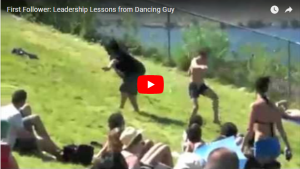
In the video below, Derek Sivers calls this person the “first follower.” Check out the fascinating video about how to start a movement in under 3 minutes, then look over the key points and finally, see how this relates to you and your team.

As outlined in the video:

The leader—

  • has the guts to stand alone and look ridiculous
  • nurtures first follower as an equal
  • makes it about them, not him/herself
  • makes it easy to follow

The first follower—

  • has a crucial role
  • shows everyone else how to follow
  • is embraced by the leader as an equal
  • calls others to join
  • has the courage to be the first one to follow and to stand out
  • typically is under appreciated
  • transforms the lone nut into a leader

The reason so many of you tell me that you don’t have leaders on your team is that most young people don’t have the courage to “stand alone and look ridiculous.” Players may say they want to be leaders, but finding ones who will actually hold teammates accountable and defend the culture seems daunting.

BUT, it may be easier if they had the certainty of a first follower. If they knew that a teammate would follow well and show the rest of the team how, it may be easier to muster up the courage to step up and lead.

One of the things I loved about our team handbook at Penn State was the page about how to be a good follower.

We talk so much about leadership, but sometimes fail to mention the importance of learning how to follow. [Tweet That!]

Just as your team leader(s) serve as a liaison between you and the team, the first follower serves as the connector—the lynchpin—between the team leader(s) and the rest of your players. When the leader(s) embrace the first follower as an equal and make it about the team, they become easy to follow.

You probably have identified players that you are helping to develop leadership skills.

Who are you looking to to fulfill the first follower role? Identify that player, make sure she knows the crucial nature of the role, then help her to embrace and fulfill it with excellence.

The Lynchpin to Team Cohesion appeared first on Life Beyond Sport.

About Stephanie Zonars

Stephanie Zonars helps coaches build and maintain winning team cultures through her business, Life Beyond Sport. Teams at Penn State, Notre Dame, West Point and over 60 other schools have built stronger trust, communication and teamwork through her workshops. Stephanie spent three years on staff with the Penn State women’s basketball team, assisting the team to back-to-back Big Ten Championships. She’s also the author of three books. For more tips on leadership and team culture, visit LifeBeyondSport

Growing as a Basketball Coach

By Brian Williams on May 9, 2016

This post was written by John Carrier and originally posted on his Coaching Basketball Blog

Notes from Minnesota State High School League’s “Why We Play” conference at Bethel University.

“Why We Play”  is a program that promotes positive coaching and teaching character through athletics. The structure was two whole group sessions with a main speaker, two breakout sessions, and everyone back together for one final session. Below are some of the best ideas that I pulled out from each presentation.

Rod Olson
Coach Olson is currently working with the Pittsburgh Pirates developing their coaches. He also works with the Navy Seals and has authored two books on coaching. Coach Olson gave two talks. One was the opening talk on “7 Marks of a Mature Coach” and then gave a talk on what he’d learned during his time with the Navy Seals. Some of the finer points of his talk are below. I am going to buy both of Coach Olson’s books and would recommend looking at his material – it’s really good!

Kids now grow up in a different “SCENE”

  • Speed: Slow is bad to kids
  • Convenient: Hard is bad to kids
  • Entertained: Boring is bad to kids
  • Nurturing: Risk is bad to kids
  • Entitlement: Work is bad
  • So the question for coaches is, based on this “SCENE” how are we going to deal with our kids and teach them that slow, hard work, that is boring and risky is actually a GOOD THING?

Quantico Test

  • Give your players a mental and physical test that takes some critical thinking. This will tell you everything you need to know about the make up of your team. The task should include everyone on the team as one group.
  • The SEALs give their trainees a length of rope and tell them they must use to get everyone over the wall.
  • Give them 10 minutes to plan and 5 minutes to execute.
  • As they try to complete the task just WATCH who is doing what.
  • Who’s leading and taking initiative?
  • Who says something isn’t working?
  • Who follows.
  • Who doesn’t care. This might be the biggest one. If you’ve got these guys they will hurt your team.

Why Game

    • This is an exercise to help you get a much deeper understanding of your players motivation.
    • The gist of the exercise is to ask them why they play basketball, and then follow that up with 3 more “why” questions about their answer.

For Example:
Q: Why do you play basketball? A: Because it’s fun.
Q: Why is it fun? A: Because I’m with my friends.
Q: Why do your friends make it fun? Because they make me feel good.
Q: Why do they make you feel good? Because they pump me up when I do things correctly.

  • As you can see from the example, you get to the real root of why players are playing. Understanding why they play is essential to motivating your athletes.
  • Coach Olson shared a story about a football player they had. Dad played in the NFL, brother was a D1 player. The player started out well but they were motivating him by telling him this was going to lead to college, pros, etc and it didn’t work. They then found out that he loved basketball and he played football because of his friends. So they started to motivate him using his friends and peer relationships – which worked a lot better.

Mike Rowe
My first breakout session was with Coach Rowe. Coach Rowe is the head football coach at ROCORI High School in Cold Spring, MN. Coach Rowe’s breakout talk was on how their program develops the whole person. Some of my favorite parts of his talk are below.

Monday Meetings

  • Take 30 min out of practice each Monday for character development.
  • Intro the theme for the week.
  • Give a short presentation on the topic.
  • Breakout session in family groups. 8 groups for the program. Group has freshmen through seniors – stay with group all 4 years.
  • Each group has an activity around the theme of the week.
  • Reference the theme during the week.

Team Building Competitions

  • They have different competitions and you get points for each competition.
  • They do the team building competitions in their family groups.

Ryan Bartlett
Coach Bartlett is the head football coach at White Bear Lake. He spoke on Building Men for Others in White Bear Lake Football. He uses a lot of the ideas from the book Inside Out Coaching by Joe Ehrmann. Below are some of the things he does in his program to teach character to the players he leads.

    • Have a Word of the Week
    • Assistants pick the word (to be involved).
    • The word has to do with some facet of character development.
    • The coach introduces the word and talks about what the word means to the team. They then relate the word to real life – especially with a story or example.
    • The players select a teacher from the school that embodies the word of the week.
    • That teacher comes to the game, is on the field for the coin toss, and addresses the team in pre game.
    • Reading Program. Has the football players volunteer to read with elementary kids.
    • In order to get the “bear paw” decal on their helmet, players must do community service. The amount is based on their grade. It must be completed before they get the decal.

Seniors – 12 hours
Juniors – 10 hours
Sophomores – 8 hours
Freshmen – 0 hours – they are new to the program and might not know.

Tom Cody and Jody Redman
Mr. Cody and Ms. Redman did a great presentation from “Top 20 Training”. They covered a number of “mentality” issues that are helpful for both players and coaches. The best thing I got was their idea of people having “frames”.

Each person looks at the world through a different “picture frame” that influences how they see the world. The frame has see which influences feel which influences do which influences get which influences see. So what we see effects our feelings, our feelings effect what we do, what we do dictates what what get. The results (get) effect our feelings on a topic. The most important thing we can do if something isn’t going well is change the “see” part.
Easiest to change – how we see things. Gives the best, and longest lasting results. “If you can’t get out of it, get into it” So ask yourself how you can change your player’s “see” on something they are struggling with. Also ask yourself: how can YOU change your “see” on team/program issues that are driving you nuts?

Brad Stevens Off-Season Commitment

By Brian Williams on May 2, 2016

This post is a few years old, but has some good points to stimulate your thinking for what you can do to be most productive in your work to improve your program this summer.

More takeaways from my latest reading on Texas A & M women’s assistant Bob Starkey’s HoopThoughts. If it is not on your regular reading list, I recommend to add it. There are great articles on all aspects of coaching basketball.  I am not suggesting that coaches at all levels have the time and resources for such large improvement projects, but I think we can all come up with some projects that will help our teams improve.

“I’m a big believer that championships are won in the off-season, as must would agree.  But many think this is only conducive to players.  In fact, what coaches do in the off-season is often more important in the improvement or decline of their program.” Bob Starkey

Notes on Brad Stevens:

Brad Stevens summer laid the groundwork for the Celtics’ 15-win improvement and playoff appearance this season (204-15). It was a thorough plan rooted in research.

“I just kind of think of things I’d like to know, and I embark on a project,” Stevens said. “Sometimes they end up being worthless, and sometimes they help you. But it’s important to analyze, work, and scrutinize. Be critical of yourself, and start there.”

When looking back at 2013-14, Stevens knew the Celtics had faltered late in close games. In the final five minutes of contests in which the score differential was 5 points or less, the Celtics had a net rating — offensive rating subtracted by defensive rating — of -25.4, 29th in the league. Furthermore, in those situations they were averaging 16.1 turnovers per 100 possessions, the 28th-worst mark in the NBA.

The Celtics had not executed down the stretch and Stevens wanted to know why. So he began analyzing every possession in the last five minutes of every Celtics game that year.

There are generally about 200 total possessions in an NBA game, and the rate typically increases in the last five minutes because of fouls, so Stevens probably analyzed well over 1,500 plays.

“I broke down every possession in the smallest of details,” he said. “It was the most arduous — well, maybe not arduous, because it’s not real work compared to what some people do for a living — but it was the most boring yet helpful thing I probably did last year. It helped me figure out a lot.

“When you’re not in the season, you detach emotionally and you can see what guys are and aren’t doing, what guys struggle with, what you could have done to help them be successful and how you can be better moving forward.”

At the start of this past season, Stevens presented his findings to his players. His message was simple: You’re closer than you might think.

“He put it to us in a way that gave us confidence, that if we do these few plays a little bit better, it could result in making the playoffs,” guard Evan Turner said. “It gave us an idea of how slim the difference is between having a successful season and not, and we realized they were fixable mistakes.”

This season, the Celtics improved their net rating in late-game clutch situations from -25.4 to -7.5, and they lowered their turnover ratio from 16.1 to 12.6.

Stevens’s offseason focus was not solely on his players. He also identified about 35 stars from around the league whose games he admired. Then he assigned groups of them to his staff — also taking five for himself — and asked his assistants to dig in.

“We studied them inside and out,” Stevens said. “What made them great? What were their flaws?”

Assistant Micah Shrewsberry was tasked with analyzing guards Damian Lillard, Kyle Lowry, Tony Parker, and Ty Lawson. He said the project helped identify traits that they could pass on, and it also gave the Celtics a head start on individual scouting heading into the regular season.

The notes were taken from an article that was written by Adam Himmelsbach for the Boston Globe and you can read it at this link.


PLAYERS & COACHES: ENJOY & EMBRACE THE GRIND

Bob Starkey

Too many of us, young coaches included, want to be the overnight success story.  Players want to excel without executing…play without preparing…position without persevering…acquire without acting…take a test without the test of time…control without concentration.

Coach Dale Brown called it “the instant gratification syndrome” — some refer it to a “microwave society.”

I have been blessed beyond belief to work with some of the games greats — players and coaches that achieved the maximum benefits of a dedicated lifetime.  In studying these people I have found one thing in common.

It’s not that they worked hard — though they did.  It’s not that they overcame adversity — though they did.  It’s not that they did the little things necessary — though they did.  It’s not that they did the things they didn’t enjoy — though they did.

It’s the attitude in which they did it all.

They truly great ones — on a daily basis — over the LONG HAUL — not only do all the above but they actually ENJOY and EMBRACE the GRIND.

They no doubt groan when they roll out of bed at 5 AM in the off-season, but when they get to the gym, the track or the weight room, the adrenaline kicks in because of the incredible desire they have to excel and the knowledge they have of what it will take to get there.

These thoughts came to me as I read “Sometimes You Win, Sometimes You Learn,”by John Maxwell in a plane jetting across the Southeast this weekend.  There was a poem in the book titled “Climb the Steep” by James Casey:

“For every hill I’ve had to climb
For every rock that bruised my feet
For all the blood and sweat and grime
For blinding storms and burning heat
My heart sings but a grateful song
These were the things that made me strong.”

 
If you coach, ENJOY and EMBRACE the GRIND.  Take the road less travelled. Push yourself beyond all limits.  Are you finding time to read — blogs, books, magazines?  Not enough time?  Kevin Eastman is an assistant in the NBA and he finds an hour each day simply to read — and GROW!  I can’t even begin to imagine his time constraints — which is why he reads at 5 AM each morning.

Are you watching video…not just on your team but other teams…do you have teaching DVDs to study and learn.  Are you attending clinics…working camps…do you have a circle of influence of coaches and people you respect that can take you to another level.

Continual learners…continual teachers!

I am not a smart guy by any stretch but I do work extremely hard.  I have for over 30 years and I’m scared to slow down.  I’m reminded of the Steve Nash quote: “If every basketball player worked as hard as I did, I’d be out of a job.”  I feel the same way as a coach.  If I stop working..It I stop studying the game…If I stop learning  —  then the smarter coaches will pass me up — gotta keep working.

I heard Kelvin Sampson at a clinic about a decade ago when he was still at Oklahoma and he said, “All coaches have great energy at practice for the first two weeks.  But then a lot of ’em lose it.  They get a little tired or a bored.  The best know how to sustain the energy.”

As a coach, we are more than two weeks in — are you still humming along?  Still bringing the juice as practice?

ENJOY and EMBRACE the GRIND!

  • « Go to Previous Page
  • Page 1
  • Interim pages omitted …
  • Page 5
  • Page 6
  • Page 7
  • Page 8
  • Page 9
  • Interim pages omitted …
  • Page 15
  • Go to Next Page »

Primary Sidebar

  • Twitter
  • Facebook
  • Linkedin
coachestoolbox
personaldevelopmenttoolbox
basketballplayerstoolbox
basketballtrainer
athleticperformancetoolbox
coachingbasketball

© Copyright 2026 Coaching Toolbox

Privacy Policy





