• Skip to primary navigation
  • Skip to main content
  • Skip to primary sidebar

  • Basketball Plays
    • Ball Screen Sets
    • Horns Sets
    • Man to Man Post Up
    • Man to Man Isolations
    • Backdoor Plays
    • Man to Man 3 Point Shot Plays
    • 2-3 Zone Attack
    • Baseline Inbound Plays
    • Sideline Inbound Plays
    • Combination Defense Attack
  • Drills
    • Defensive Drills
    • Offensive Drills
    • Competitive Drills
    • Passing Drills
    • Rebounding Drills
    • Shooting and Scoring Drills
    • Toughness Drills
    • Transition & Conversion Drills
    • One on One Drills
  • Blueprint
  • Practice
  • Mental Toughness
  • Skill Development
  • Offense
  • Defense
  • Store

Basketball Drills

Basketball Drills Washington Shooting 2

By Brian Williams on November 21, 2013

These three shooting drill came from Coach Mike Neighbors.

Even if you can’t use these drills now, I think it is nice to have a large file to provide some variety to keep things fresh as the season progresses, or for summer practices/workouts.

4 Quarter Shooting

Great conditioning/shooting drill to challenge every level of shooter on your roster.

It’s also a great drill that requires no rebounder or passer.

Scoring: shots inside the paint = 1 point
shots outside paint but inside arc= 2 points
shots outside the arc= 3 points

First Quarter: Shooter has 1 minute to score 20 points
(if shooter successfully does this she advances to 2nd quarter)

Second Quarter: Shooter has 2 minutes to score 40 points

Third Quarter: Shooter has 3 minutes to score 60 points

Fourth Quarter: Shooter has 4 minutes to score 80 points

You will see there is simply not enough time to make all 1 pointers to achieve the scores, so a player must understand time/score and play to their strengths.

Drill can be done with a rebounder/passer just adjust time or score accordingly.

Sweep Shooting

Shooter starts at spot 1. We will use cones, a basketball on the floor, or a chair to simulate a defender as available.

On the catch, the shooter sweeps the ball and goes one dribble left into a pull up 15 footer. Shooter returns to spot. Catch, sweep, attack right one dribble.

Shooter then moves to spot 2 and repeats pattern. All five spots are completed giving the shooter 10 attempts.

They get 1:00 rest. Repeat. We do 5 cycles to get to 50 attempts.

Your best mid range shooters should score in high 30s with an occasional 40 thrown in there.

This is a GAME SHOT/GAME SPOT/GAME SPEED drill.

2 Ball Shooting Drill

Two shooters, one ball. We set score at 20 or 30 or 50 or…

The shooters alternate shots getting their own rebounds and passing to
teammate.

We say that each catch must be beyond the arc. The shooter can shoot the 3, drive 1 dribble for 15-17 foot for 2 points, or drive to basket for a 1 point lay-up.

Winning team gets to stay together until someone knocks them off. If a team loses, they split up into new teams.

For a variaton you can add a third shooter and a second basketball.

You can play to different scores.

Or, you can play for a certain amount of time.

Basketball Drills Team Defense

By Brian Williams on November 20, 2013

These defensive drills are from a collection put together by Nate Hill, Assistant Boys Coach at Colonel Crawford High School in North Robinson Ohio. He has coached for 18 years from 7th grade through Varsity Head Coach.

He has also started a basketball coaching newsletter.

You can see his first edition as well as subscribe to the Newsletter at this link: Next Level 419 Coaching Newsletter

In case you have any questions or comments for Coach Hill, here is his email address: [email protected]it

I hope that these drills give you some ideas for adding variety and simulating game situations in the defensive segment of your practice. Or, they get you thinking about ways to adapt these ideas to your program.

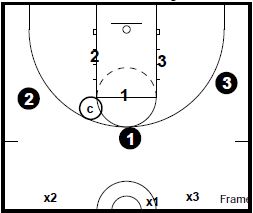
Shell Drill “Drive”

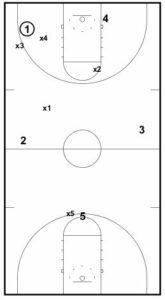
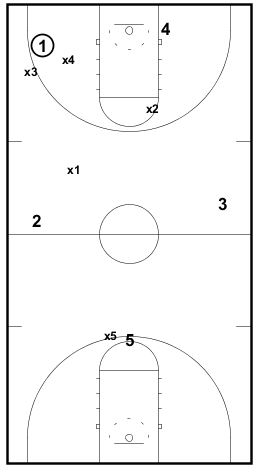
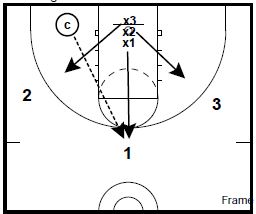
Call is used to make the offensive player drive and defense rotate. The defensive player must touch the sideline or volleyball line to give offense the advantage. Everyone must rotate and stop the ball.


“Drive” is yelled by coach, and 3’s defender must touch sideline. 3 drives and all rotate and help stop ball. Defense must talk. This can be called at any time


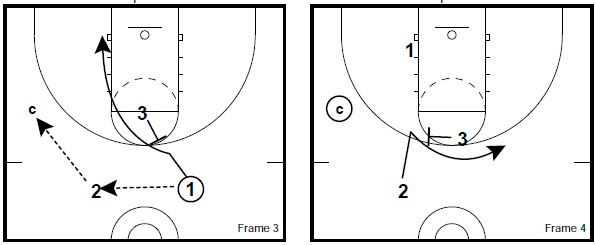
Stop Penetration Drill

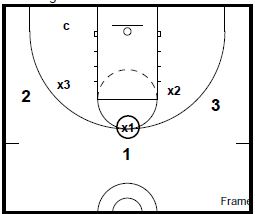
#1 – 1x starts behind 1. 4x or 5x must stop penetration. x2 or x3 must help the helper


#2: x2 starts behind 2 who drives. x4 must stop penetration. x5, x3, and x1 all must help the helper. Switch sides and alignments


Shell Drill “Trap”

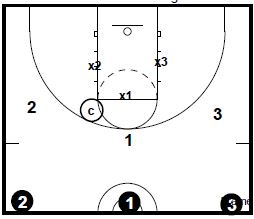
They use the “Trap” call in shell. defender whose man passes ball, goes and traps ball. Usually used in games when players cut weakside and isolate in corners


“Trap” is called. x3 and x4 go trap ball in corner. Players keep feet, trap with legs, and arms high. Other teammates look for tip,or deflection. Looking for weak pass with arms.


Basketball Drills 2 on 2 Full Court Convert

By Brian Williams on November 15, 2013

This drill was originally posted in the FastModel Sports Basketball Plays and Drills Library

The site has thousands of drills and plays that have been submitted by coaches from all levels and from all over the world.

You can also find out more about their Play Diagramming software by clicking this link: FastDraw

This drill was posted by Drew Hanlen of Pure Sweat Basketball.

Drew is an NBA Strategic Skills Coach & Consultant that has helped over 25 NBA and NBA pre-draft players.

Drew is the Head Skills Coach for Pure Sweat and has run his internationally renowned Elite Skills Clinics in over 30 states and 4 countries over the past four years.

Basketball Drills


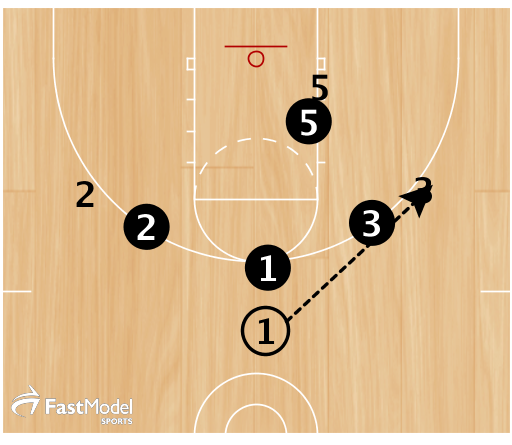
Live 2v2 in the half-court.

The Black Team starts by attacking the Red Team. Black Team vs Red Team.

Keep track of points scored for six minutes.

Loser has punishment for every point they lose by (sprints, defensive slides, closeouts, push ups, etc)


Basketball Drills


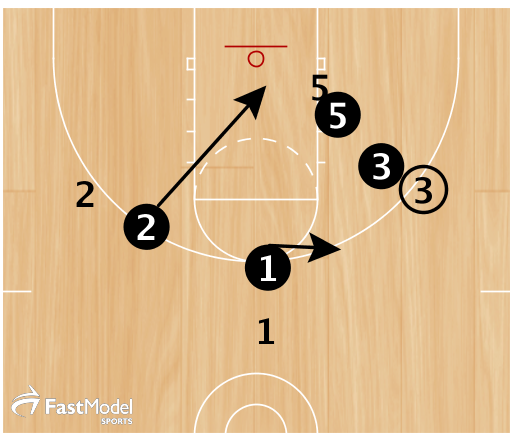
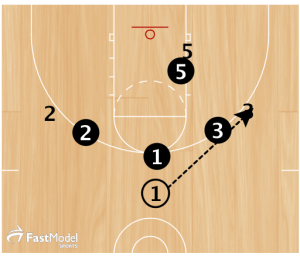
As soon as the Black Team scores or gets stopped, one member from the Red Team has to take the ball out of bounds and inbounds to the coach at the top of the key, while the Black Team players that just played offense have to sprint back on defense.

As soon as the coach at the top of the key receives the inbounds pass, he will pass to the coach on the other side of the ten second line.

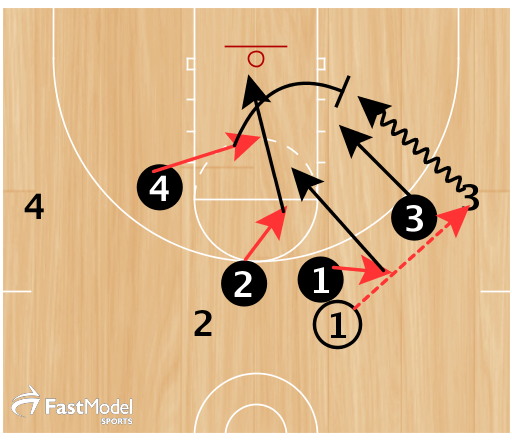
Once the second coach receives the ball, he will hit either of the new players from the Red Team (3 or 4) and it will be live 2v2 against the Black Team players that sprinted back on defense.


Basketball Drills


Drill now repeats heading in the opposite direction.

Rotation is Offense to Defense. Defense to Inbound Passer. Inbound Passer and other Teammate to back of your team lines.


Maximizing Basketball Scrimmages

By Brian Williams on November 7, 2013

These ideas on maximizing your scrimmage time came from the Xavier Basketball Newsletter

I have always wrestled with how much to let players play in practice and how much to stop and instruct. Obviously, they have to learn to play through mistakes in games, but, if we take the time to teach how to play, hopefully they won’t make as many mistakes.

It is a difficult balance to strike. These six ideas can help provide some structure to your five on five segments in practice so that your players will be used to game like transition and still allow your coaches the opportunity to teach.

There are 8 ideas altogether. Take the bits and pieces that you like and modify them to fit your needs.

Maximize the Scrimmage Situations

1) 4 Minute Games:
Playing 4 minute mini games allows for a number of aspects of the team to improve. For college programs, the mini games simulate the game time between media time-outs allowing players to maximize their effort between time-out rest time. Also, resetting the score after each session trains players to win the current 4 minute segment they are playing which helps in focusing them on each possession

2) Score…Stop…Score:
Calls for teams to execute scoring and defending for 3 consecutive possessions. Drill is blown dead as soon as a team doesn’t complete one of the 3 possessions effectively. We score the ability to have executed all 3 phases. We have found through our own research if a team can execute more than 5 of these per game they win. You consider having 5 or more 4-0 runs is like being up 20 points.

3) Stop…..Score…Stop:
Calls for teams to execute defending and scoring for 3 consecutive possessions. Drill is blown dead as soon as a team doesn’t complete one of the 3 possessions effectively. We score the team’s ability to have executed all 3 phases. Emphasis in the drill is turn your defense into points then create a second stop. Use this concept to start your games to set the tone of the game to be hard for your opponents to score on.

This drill is best introduced as a 3-on-3 situation. As the sequence of a STOP-SCORE-STOP is repeated and as the season progresses making it a 4-on-4 and ultimately a 5-on-5-on-5 situation will maximize the time and also create the most game like scenario possible.

With a large team you can have this going on both ends with winning teams advancing to play each other as needed. Divide into two 3-on-3 colored teams. Blue starts on offense. White on defense.

The main idea to communicate is that each possession either finishes in a STOP or a SCORE. It is each team’s goal to complete a 3 possession sequence of a STOP-SCORE-STOP. SCORE is anytime the offensive team scores a basket or draws a foul.

STOP is anytime the defensive team secures a defensive rebound, forces TO, or tie-ball. When a team comes up with a STOP they then must follow that with a SCORE to keep their sequence going. If that team completes the next possession with a defensive STOP they EARN a point.

We will either play this drill to a certain number of points or for a set amount of time.This is another drill that works both offense and defense simultaneously.

DEFENSE:

Teaches the importance of finishing possessions either with rebounds or steals or tying up loose balls. It teaches great communication. It teaches your players how quickly momentum can swing.

OFFENSE

Teaches the importance of shot selection, valuing the ball in risk/reward situations. As a Coach you must create the competitive spirit of this drill with your energy and ability to keep the drill flowing without long delays in the action.

4) Situational Scrimmaging:
Allows for teams to practice specific time and score situations. Increases players awareness and intelligence with game situations. See what players can handle different situations.

5) From a Free Throw:
Utilize your Free Throw situation to set up your full court defenses and press offenses. Players must come to the line and convert FT’s in order for team to be able to set up the full court defense or half court trap action. Offenses must respond in kind to the defensive pressure. Play 1 possession on a offensive score but allow the defense to convert their stop before blowing the drill dead. Converting to defense off a missed free throw is something that teams do not do well without practicing and most teams do not practice it enough.

6) BLOB and SLOB Sets:
Start your scrimmages with a BLOB or SLOB set. Having teams execute an inbounds set versus a live defense is great simulation to games. If they don’t have a shot off of the initial action, it is a good time to If the offense scores, blow it dead. If the defense gets a stop, allow them to convert to offense an have a chance to score before blowing it dead.

7) Play with Special Rules
Having too many special rules detracts from your scrimmage, but one or two special rule that fit what you are emphasizing will help players focus on those areas. For example, if you award a team an extra point for every pass caught in the paint or dribble penetration into the paint, you will see more of those. If you give the offense an extra point every time the defense does not challenge a shooter, you will get more contested shots. Select an area you want players to focus on and develop a scoring system that rewards your players when they execute it in a scrimmage.

8) Keep Statistics for Practice Scrimmages
This can also be a target that you are focusing on and doesn’t have to be the traditional field goal percentage, rebounds, assists, etc.. Have an assistant coach chart, and call out, missed block outs. Or do the same for the offensive end, when your players don’t go to their offensive rebounding spots–record it and call it out. The key is to select an area that your team needs to focus on to be their best.

Click here for information on the complete basketball practice e-book
“130 Great Ideas to Get a Lot More Accomplished in Practice”

Basketball Drills Washington Shooting

By Brian Williams on November 6, 2013

These three shooting drills came from Arkansas Women’s Coach Mike Neighbors when he was at the University of Washington.

If you would like to subscribe to his newsletter, email me and I will forward your interest on to Coach Mike Neighbors.

He is not publishing it at this time as he is making the transition between jobs, but will have it up and running again at some point.

I hope that these drills help you to provide some variety into the essential repetition that must take place to have a team that shoots well.

Diagrams created with FastDraw


Hubies

basketball-drills-hubies

This is a Game Shot/Game Spot drill… the best will go at Game Speed too

Put 3:00 on the clock.

Shooter is attempting 2 point shots at 15-17 feet. She stays at one spot until she makes 3 shots in a row… The string of 3 in a row=1 Hubie. She moves to another spot as quickly as possible and continues until time runs off the clock. Your best shooters should be able to complete between 10-15 Hubies.

When attempting 3 point shots, the shooter must only make 2 in a row to equal a HUBIE. Your best shooters should make between 28-25 HUBIES.

We always have a passer and a rebounder doing this drill so you may have to adjust your numbers accordingly. Keep the conditions the same when you are charting and comparing.

Big Shot

basketball-drills-big-shot

Shooter begins at Spot 1. Shooter remains at this spot until she misses two consecutive shots. After two consecutive misses you must move to
Spot 2. Again you make as many shots as possible without missing two in a row. Continue to Spots 3, 4, 5.


Each make is worth 1 to your score. BIG Shot is designed to be cumulative score of the total makes at all five spots.

You should attempt range appropriate shots. Shots do not have to be 3 point shots.

For a Division I Women’s team, these are recommended scores. You can set your scores at a level that are appropriate for your players.

Your best shooters should score above 500 on 2 point shots. Your best shooters should score above 200 on 3 point shots.

Star Shooting

basketball-drills-big-shot

Shooter begins in corner at spot 1. Make or miss sprint to spot 2, then to 3, then to 4, then to 5 attempting a shot at each.

The first trip is 5 shots.
The next trip is 2 cycles or 10 shots.
The next trip is 3 cycles or 15 shots.
The last trip is 4 cycles or 20 shots.
This gives us a total of 50 attempts.
Your best shooters should make 35-40 on 2 point shots.
Your best shooters should make 30-40 on 3 point shots.

Basketball Drills Archie Miller Finishing

By Brian Williams on November 5, 2013

This is a four and a half minute video of Dayton’s Archie Miller going through a drill to work on finishing in transition at the basket.

The video is a You Tube video.

Make sure your sound is on as you watch.

If you are interested in learning more about the entire DVD that this sample came, click this link. Anyone who purchases anything from the store receives one of my basketball coaching eBooks as a bonus. Just email me and let me know which one you would like to receive!

The video is 4 minutes and 45 seconds long

Make sure your sound is on.

If you are interested in learning more about the entire DVD that this sample came, click this link. Anyone who purchases anything from the store receives one of my basketball coaching eBooks as a bonus. Just email me and let me know which one you would like to receive!

  • « Go to Previous Page
  • Page 1
  • Interim pages omitted …
  • Page 80
  • Page 81
  • Page 82
  • Page 83
  • Page 84
  • Interim pages omitted …
  • Page 96
  • Go to Next Page »

Primary Sidebar

  • Twitter
  • Facebook
  • Linkedin
coachestoolbox
personaldevelopmenttoolbox
basketballplayerstoolbox
basketballtrainer
athleticperformancetoolbox
coachingbasketball

© Copyright 2026 Coaching Toolbox

Privacy Policy