• Skip to primary navigation
  • Skip to main content
  • Skip to primary sidebar

  • Basketball Plays
    • Ball Screen Sets
    • Horns Sets
    • Man to Man Post Up
    • Man to Man Isolations
    • Backdoor Plays
    • Man to Man 3 Point Shot Plays
    • 2-3 Zone Attack
    • Baseline Inbound Plays
    • Sideline Inbound Plays
    • Combination Defense Attack
  • Drills
    • Defensive Drills
    • Offensive Drills
    • Competitive Drills
    • Passing Drills
    • Rebounding Drills
    • Shooting and Scoring Drills
    • Toughness Drills
    • Transition & Conversion Drills
    • One on One Drills
  • Blueprint
  • Practice
  • Mental Toughness
  • Skill Development
  • Offense
  • Defense
  • Store

Basketball Drills

Coaching Basketball Trust Talent Time Part 2

By Brian Williams on August 22, 2014

Coach Mike Neighbors was a long-time and very productive D1 assistant coach after being a successful high school coach.

He has seen from many vantage points what it takes for an assistant to contribute to a program. Scroll below to read some of his thoughts:

This is the second part of the article. If you missed the first part, here is the Link: Trust, Talent, Time Part 1

TRUST, TALENT, TIME Part 2

Talent (Continued)

HAVE AN UNDERSTANDING OF EVERY ASPECT OF PROGRAM… while you want to be Head Coach of your main areas of responsibility it is also crucial to have a grasp of all aspects of the program. You don’t have to have the depth of knowledge in these areas, but is important to know they exist and are valuable to the head coach. This can be done without stepping on toes of those in charge of those areas. The best of best do this.

WANT IT RIGHT NO MATTER WHO HAS THE IDEA… Being an assistant coach is very competitive even within staffs at times. But the very best staffs embrace this idea. You can’t worry about who had the idea or who gets the credit. If you do worry about that, you will either drive yourself crazy on your current staff or burn yourself out of the game completely.

GROW THE GAME… the very best assistants find time to mentor younger, less experienced staff members. Although it is certainly not a must, the very best do. The most confident do. As with the above paragraph, some assistants are afraid to help others grow because they worry it will reflect poorly on them. That should never be the case for a good assistant. They should be confident enough to share their experiences. Has this back fired on people? Sure, but in the long run it is best to be out of those situations anyway.

Talent is ever changing and ongoing. Just like with our players, we want to constantly be striving to improve on our weak areas while continually growing stronger in areas we already excel. The very moment that a good assistant becomes content and feel like they’ll know it all; somewhere, someone else is surpassing their efforts.

Who could have predicted in 2000 that the ability to build a FACEBOOK or MYSPACE page would be a valuable asset? Who could have predicted that we could build Aps on our phone to help organize our daily routines?

Stay on the cutting edge of technology. Maintain contact with a core group of peers who you can readily share ideas and thoughts with. Read the latest books on leadership, management, and psychology. These are all ways to ensure you are not left behind or stuck with a dead idea.

TIME

Once a head coach believes they can TRUST you and you have proven to have the necessary TALENT to accomplish the duties assigned, they want to be sure you have the TIME do make it happen effectively. You have to present a clear picture to your head coach that you have your life balanced in all aspects so you can meet the time demands that are often placed upon an assistant coach. You can be a single person with a fish or a married person with six children and do this equally as well… and every situation in between those two extremes.

Each presents unique challenges, but the head coach must know you can manage the TIME aspect of this profession.
We have all seen unsupportive partners cost people jobs. We have seen single assistants with time consuming hobbies lose their jobs as a result. We have seen coaches young and old unable to find TIME to do the job.

There is no ideal profile. But one thing the best assistants have is TIME.

It just seems like they have more than the 24 hours everyone else does.

So, how do you go about proving you have created a lifestyle for yourself (and/or family) to your head coach?

WORK SMARTER… We are all afforded 24 hours in day, 168 hours a week, 8750 hours a year. It’s what we do in those hours that separate us. You must find ways to maximize the hours you have to perform your duties while still maintaining your life away from the team. Lean too far one way on your job suffers. Lean too far the other and you risk burnout or losing your life outside the game. The very, very best have this balance. It’s easy to spot the assistants who don’t have this. They are workaholics and when they are on the job they don’t even appear to be having fun!! As is true with all other areas of basketball, you must determine what works for you, have a plan of attack, and the discipline to execute it. Again, gather the best organizational ideas and make them your own.

GET THINGS DONE IN A TIMELY FASHION… when assigned a task, get it done. Don’t stress over perfection because it never will be perfect. Do it to the best of your ability and let your head coach know you are ready for the next task. This gives your head coach confidence that you can function independently and do not require constant follow up or monitoring. We have assigned tasks to people who ask so many questions and for so much input that in the end, we feel like we did the project and could have saved the time just doing it ourself. When your head coach sees that you can complete tasks in a timely manner they sense you have balance.

TAKE THINGS OFF THE DESK OF THE HEAD COACH… You can accomplish this a couple of ways. The best way is take them a completed task that wasn’t even assigned. For example, I am a nut for stats. I used to memorize the backs of baseball cards and have my uncles quiz me on batting averages and RBI’s. As a result, I am fascinated by stats and trends. A couple of years ago, I began tracking our line-up efficiencies… the points scored minus the points allowed for each line up we used in a game. Over the course of a single game it didn’t yield much usable information. But after five games and then ten games, I saw specific trends that helped us better manage our substitution patterns and in turn win extra games because we played our most efficient line-ups accordingly. The second way, is simply to ask your head coach if there is something on their desk or during their day that they simply hate to do. It might be paperwork or it might be their radio show. But by asking and showing desire to help, you might find yourself voting on the Top 25 or sitting in on a post game interview.

BE OVERPREPARED… Maintain a list of ideas beside your computer for when you head coach seeks input on any aspect of the program. Think ahead of the game and “outside the box”. Being over prepared will demonstrate that not only do you have time to complete your assigned duties but you also have time to perform more. If you consistently offer no new input, it appears that you are bogged down in the things you are assigned. This is not possible unless your main duties are covered but this is a sure way to show you are ready and capable of more. At the very least, it builds your head coach’s confidence that you are capable.

HAVE A “TO DON’T” LIST… must of us make a TO DO list to help organize our day. A good piece of advice I also implemented was a TO DON’T list. For example, it might say, DO NOT open my email until I have been at my desk and written three personal notes to recruits. DO NOT open Facebook until I have returned all the day’s emails. DO NOT return any phone calls an hour before practice. DO NOT leave for the day until I have communicated with three current players and checked on them for the day.

BE CONSISTENT… in other words, don’t be MOODY. Don’t be high as kite one day and down in the depths the next. Sure you are going to have good days and bad ones. But you can’t be a rollercoaster of emotion. This gives off the signal that you are not balanced. A consistent demeanor displays that you can handle the crisis mode days that often arise in this profession. It displays that no matter what happens, you have a response in mind and a plan to execute it.

GATHER INFORMATION… have a wealth of information readily available. Many times it won’t be used or asked for by your head coach. But having it in the times that they do makes a big impression. This is something that comes from observation. Have stats ready to back up a statement about offensive or defensive production. Have film clips ready to show if you want to implement a new inbounds series. Have access to more if more is needed. Don’t present an idea without evidence to support.

OVER PREPARE THE HEAD COACH… If they are going on a road trip, program the various directions into their GPS as well as hand them a file with printed off directions and confirmation codes. If they are married or have a partner, send a copy to them as well. They will appreciate this (might want to ask early on in your career as they might NOT want them to have it… haha) If they are off to do an interview on an opponent they have yet to watch film, hand them a very preliminary scouting report so they can speak intelligently about them. One of the best techniques I have used, is placing a card on the head coaches chair or computer after they leave for the day with something we have the following day. This is there in case they beat me into the office and start their day.

FIRST ONE IN OR LAST ONE TO LEAVE… I see too many inexperienced coaches worry about being the first one in AND the last one to leave. While I think that is certainly admirable, I don’t feel it reflects directly toward their ability to manage time. Sure it shows dedication, but I have learned the very best head coaches want assistants who work until they are done. Very rarely if ever do I now set a time on what time I am going in the office or what time I am planning on leaving on days without set meetings or events. I have for the last ten seasons followed this one however… If one day the head coach beats me to the office, I stay until they leave that afternoon. If I beat the head coach to the office that day, then I work until I am done and check in with them to see if there is anything else they need for me for the day.

ANSWER YOUR PHONE… or reply to a text/email. Technology allows us to stay linked more closely than ever. That can sometimes be a challenge. But never be that assistant who ignores a call or delays a return call to your head coach. I see it happen every single year on the road recruiting and I just shake my head. What kind of relationship do you have that you don’t take their calls??? Are there going to be times you wish you hadn’t, surely. But by answering it when it rings or replying quickly, again you are showing that you have enough balance in your life to effectively function away from your desk. This also builds TRUST that we spoke of initially.

CHECK IN WHEN YOU ARE AWAY… Take a vacation. Get away from the gym. Do something totally non job related. But before you leave, make sure your head coach knows where you are and when you will be returning. While you are gone, check in with them just to see what’s up. Upon return, hit the office and get back on task. Taking the time away will insure your head coach that you DO HAVE A LIFE. It will display to them that you can balance your life and are not nearing burn-out. This will reassure them that you are handling the responsibilities they have give you and may be ready for more.

Jacob Lew. Bruce Reed. Ronald Klain. David Addinton.

Any of those names ring a bell? Yeah, not to me either. Those are the last four White House Chiefs of Staff. They are the real live Leo McGarry’s. These are the people who are closer to the President than even the secret service. These are the people who are behind the scenes making sure the most powerful man on the face of the earth is on time, prepared, and looking Presidential.

If you are reading this piece there is a chance you have chosen to be an Assistant Coach. A profession that much like the White House Chief of Staff goes unnoticed unless you screw something up. It’s a career that is often under paid and over worked. It’s a career that has about the same life expectancy of an NFL running back. Yet you still choose it.

So to survive in it, you better be one of the best.

Hope this piece helps you in your efforts. Again, I don’t claim it should be the only resource you consult. Gather all the good ideas then make them into your own. Read a couple of new books. Google articles on the Internet. Speak to other assistant coaches. Observe good and bad. Take your own notes.

Then go to your local Best Buy or used DVD store and watch season 1 of the West Wing. If you can’t see yourself as a Leo McGarry or C.J. Crane or Josh Lyman or Donna Moss or Toby Ziegler, then you might want to rethink your career choice. If you can, then get to work being the best Assistant Coach you can be.

Basketball Drills 4 on 4 Conversion Drill

By Brian Williams on August 15, 2014

These 2 defensive drills come from Xavier.

You can see their archives at this link.

I hope you are able to modify one of these drills to help your team.

I like the idea of timing the players as they are converting to defense.

4 on 4 Defensive Conversion Drill

1. The drill begins with live four on four action taking place at a basket. On the shot by the offense or the command of “change” by a coach, a conversion takes place. If a shot is taken two forwards or bigs attack the offensive glass while the two guards get back on the shot. A coach is assigned the offensive rebounders and a second coach is assigned the two guards “getting back.”

2. On the conversion, all four defenders must cross the halfcourt line in 2.5 seconds or the drill stops and the four converting defenders will run. Editor’s note from Brian: IMO, this is the most significant takeaway from this post–giving your players a specific standard of what getting back quickly means to you as a coach.

As the drill continues the defense gets set and live four on four action takes place at the other end. Once again, on a shot by the offense or the command of “change” by a coach, a conversion takes place. There is no out of bounds. This action takes place for several minutes. The coaches are paying particular attention to offensive rebounding, getting the guards back on the shot and making sure all four defenders cross half court in 2.5 seconds or less.

3. To ensure more shot attempts the shot clock can be shortened for the offense promoting more rebounding opportunities and more conversions.

4 on 3 Offensive Movement Drill

1. The drill begins with a coach having the ball on the baseline under the basket. Three defensive players are facing the coach. There are four offensive players surrounding the three point line.

2. The coach passes the ball to one of the four offensive players. On the catch by an offensive player the offense can move anywhere in the halfcourt. Each offensive player is allowed two dribbles.

3. The three defenders closeout on each catch by the offense and begin to work together. One of the three defensive players must be guarding the basketball at all times. On a shot by the offense it is a four on three rebounding advantage. The defense must find a way to rebound the ball.

Wichita State Fatigue Shooting Drill

By Brian Williams on August 12, 2014

Today’s post contains two videos from Wichita State Head Basketball Coach Coach Gregg Marshall going through a series that they use to work on their wings players skills.

The video is about a minute long and shows a shooting drill that they use at the end of practice to develop the ability to shoot under fatigue.

You could use this as a team shooting drill in season, or tweak it when you are doing an individual workout with one or two players. Each player should shoot until he or she makes a shot at the spot while running to half court and back on a miss. They move on to the next spot when they make a shot from the current spot. Time them to ensure that they are running hard on their sprints.

They are You Tube videos, so you will need to have permission to view You Tube videos.

Make sure your sound is on as you watch. Click the play arrow to see the videos.

If you are interested in learning more about the entire DVD that this sample came from, click this link: Wichita State Skill Development Workout Guards. Anyone who purchases anything from the store receives one of my basketball coaching eBooks as a bonus. Just email me and let me know which one you would like to receive!

Basketball Drills Defensive Combination Screening

By Brian Williams on August 4, 2014

This drill is from Drew Hanlen of Pure Sweat Basketball. It requires players to defend a variety of screening actions in a short amount of time.

The drill is also posted in Fast Model Sports Basketball Drills and Plays Library.

Drew is an NBA Strategic Skills Coach & Consultant that has helped over 25 NBA and NBA pre-draft players. Drew is the Head Skills Coach for Pure Sweat Basketball. He has run his internationally renowned Elite Skills Clinics in over 30 states and 4 countries over the past four years.

You can also use this as a multiple purpose drill by having one coach working with the offensive players on setting and using screens.

If there are other screens, that you need to be able to defend from the teams that you play, you can always modify and adapt the drill to fit the needs of your team.

Here is how Drew runs the drill:

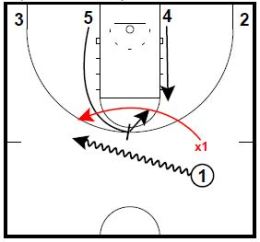
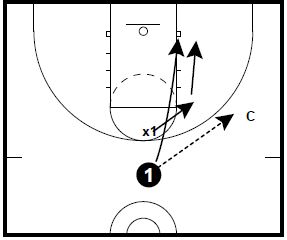
basketball-drills1

Ball handler (Player 1) will start with the ball at the top of the key and will be pressured by an on-ball defender (x1), while an offensive (Player 4) and defensive (x4) post player will start on the wing and an offensive (Player 2) and defensive (x2) guard will start on the strong-side block.

Offensive post player on the wing (Player 4) will set a pindown for the offensive guard (Player 2), who will use the pindown and pop to the wing and receive a pass from the ball handler (Player 1).

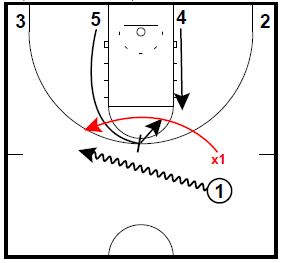
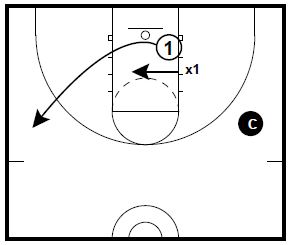
basketball-drills2

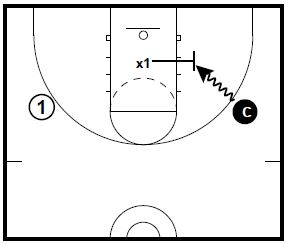
Offensive post player (Player 4) will then set a UCLA screen for the offensive player at the top of the key (Player 1).

Defender guarding the player using the UCLA screen (x1) will jump to the ball then get through the UCLA screen, while the screener’s defender (x4) will provide help if necessary.


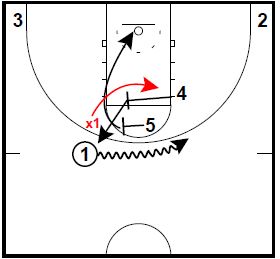
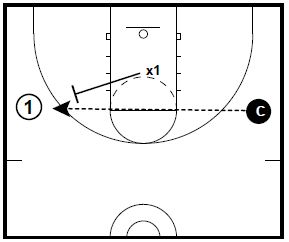
basketball-drills3

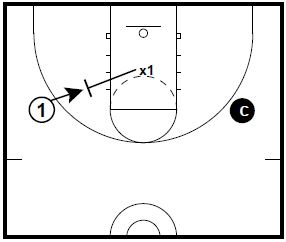
After setting the UCLA screen, the screener (Player 4) will pop to the three-point line and receive a pass from the ball handler (Player 2). Offensive player on the block (Player 1) will immediately set a back screen for the offensive player on the wing that just made the pass (Player 2).

Defender guarding the player using the UCLA screen (x2) will jump to the ball then get through the back screen, while the screener’s defender (x1) will provide help if necessary.

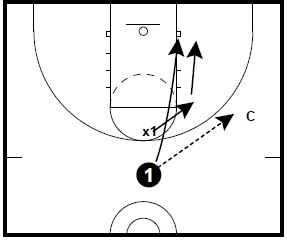
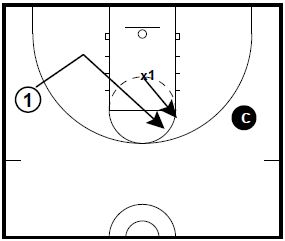
basketball-drills4

After setting the back screen, the screener (Player 1) will pop to the wing and receive a pass from the offensive post player (Player 4), who will then follow their pass and set an on-ball screen.

Drill becomes live 3v3. Defenders should guard the ball screen using their team’s defensive principles.


Basketball Drills: Xavier Defensive Drills

By Brian Williams on July 30, 2014

This post contains some of my takeaways from an old Xavier Basketball Coaching Newsletter

You can see their archives at this link.

The first 3 are defensive drills and the last one is a set of practice expectations. While not all will fit your coaching situation or personality, I hope you can find a few items that can be adapted for your team.

Competitive Shell Drill

1. The drill begins with three offensive players competing against three defensive players at the three quarter court level. The offensive team moves the ball over the half court line as the defense executes proper shell positioning. Once the ball is crossed over half court the offense runs the shell action of the day.

2. They compete until a shot is taken. If a basket is scored, the offense and defense switch roles. In order for the basket to count the offensive team that is now on defense, must get a stop to accompany their basket. A basket followed by a stop counts as one point. The drill is played until the first team scores three points – three baskets accompanied by three stops.

3. This same drill can also be executed four on four.

1 on 1 Bust-out Drill

1. This is a one on one fullcourt drill. The defensive player is positioned at the foul line three quarter court level, the offensive player is at the top of the key directly behind the defender. The action begins with a coach yelling “shot.”

2. On the “shot” the defensive player breaks to the outlet position and becomes the offensive player. The original offensive player attempts to deny the outlet and establishes three quarter court pressure on the catch.

3. They play one on one across half court. Once across half court the offensive player passes to a coach on the wing and inside cuts the defense. Assuming the offensive player did not receive the pass on the inside cut, he then cuts through the lane and out opposite.

4. The ball is now skipped to the offensive player by the coach. They play one on one live from the wing. On the conclusion of the one on one action, offense and defense switch roles and return back down the court.

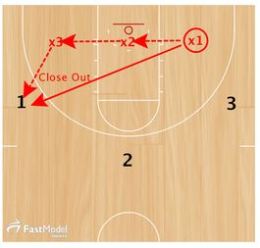
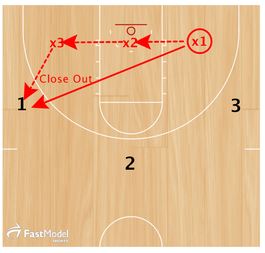
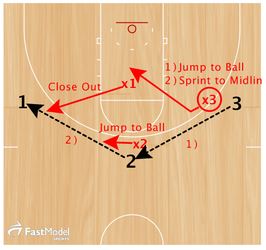
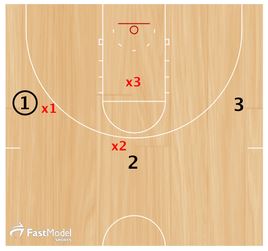
4 on 3 closeout Drill

1. The drill begins with four offensive players versus three defensive players. The offensive players cannot move without the ball. The drill is half court only.

2. The defense must get three consecutive stops to get out. Possession of the ball by the defense equals a stop. If the offense scores or is fouled before a “third consecutive stop” occurs, the consecutive stop count returns to zero.

3. The offense must shoot on three passes or less.

4. On every catch by an offensive player, one of the three defenders, the closest one, must actively closeout and defend the ball. A defender should not have to take two consecutive passes.

On Court Practice Rules

Below are the rules we shared with our team about our expectations of behavior in practice.

1. Always be on time. There is an 8 minute pre/post practice set up each day for your development. DTR means dressed, taped, ready for all practices including a morning on the court workout unless otherwise posted. Ankle braces and/or tape is mandatory unless a medical condition permits otherwise.

2. Being on time means being “ready to play” when the whistle blows to begin practice. Do not use our first drill to get ready because practice will always begin with a “bang”. We attack in everything that we do. This includes the start of each practice.

3. We will end each practice in a circle stretch.

4. When a coach talks, stop and listen. You can’t pay attention if you are moving. When a coach makes a teaching point to one player he is talking to all players. When on the sideline, watch a player at your corresponding position so that you won’t make the same mistake as him.

5. Don’t ever talk to another player while a coach is talking. We have no time to repeat what has already been said.

6. The pace of how we play has increased, so has the pace of how we practice. Going from one segment to the next has to happen quickly. Move from one thing to the next at a fast pace. Don’t walk anywhere.

7. No head bands or jewelry. Always have a 3rd color on – t-shirt.

8. Don’t shoot an extra shot or take an extra dribble after the whistle blows. No balls should be used while a player is out of practice unless given permission by a coach.

9. While standing on the X in practice, all players should be in front of me. We must see everyone’s eyes.

10. While shooting free-throws in practice, there is no talking.

11. Playing time is earned not given. We have a deep team and minutes in games will come from competing and performing on a daily basis. It is also important that you understand your role and our system. We need players that compliment each other and at the same time embrace what we do (The Xavier Way).

12. Coaches are not referees so play hard, compete and work to get better. Do not make a coach look bad because a “bad call” happened in a segment of practice.

13. Communication is an expectation in practice. We must communicate on a daily basis to be able to communicate under pressure in a game. In every segment of practice, communicate to your teammates. This is a point of emphasis in 06-07.

14. If moodiness is a part of who you are, get beyond it and understand that we depend on each other at all

Basketball Drills 20 Makes Jab Step Shooting

By Brian Williams on July 24, 2014

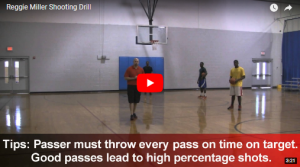
This basketball shooting drill is a high repetitions drill that teaches the player to be able to make shots under pressure, as well as when they are tired.

Since the drill is based on makes and not just a set time or number of shots, it forces the player to make shots to get out of the drill.

It is primarily a shooting drill, but the passer must focus on making quality on-time passes, and the rebounder must not allow any missed shot to hit the floor.

Both of these are key skills that will translate over to a live game.

The video is one of the 1,000’s of basketball training videos for all levels of coaches, players, and parents that is offered by BasketballHQ.

You can see more of this type of content at this link: Basketball HQ

20 Makes Jab Step Go Opposite Shooting Drill

The video is one of the 1,000’s of basketball training videos for all levels of coaches, players, and parents that are offered by BasketballHQ.

You can see more of this type of content at this link: Basketball HQ

  • « Go to Previous Page
  • Page 1
  • Interim pages omitted …
  • Page 68
  • Page 69
  • Page 70
  • Page 71
  • Page 72
  • Interim pages omitted …
  • Page 96
  • Go to Next Page »

Primary Sidebar

  • Twitter
  • Facebook
  • Linkedin
coachestoolbox
personaldevelopmenttoolbox
basketballplayerstoolbox
basketballtrainer
athleticperformancetoolbox
coachingbasketball

© Copyright 2026 Coaching Toolbox

Privacy Policy