• Skip to primary navigation
  • Skip to main content
  • Skip to primary sidebar

  • Basketball Plays
    • Ball Screen Sets
    • Horns Sets
    • Man to Man Post Up
    • Man to Man Isolations
    • Backdoor Plays
    • Man to Man 3 Point Shot Plays
    • 2-3 Zone Attack
    • Baseline Inbound Plays
    • Sideline Inbound Plays
    • Combination Defense Attack
  • Drills
    • Defensive Drills
    • Offensive Drills
    • Competitive Drills
    • Passing Drills
    • Rebounding Drills
    • Shooting and Scoring Drills
    • Toughness Drills
    • Transition & Conversion Drills
    • One on One Drills
  • Blueprint
  • Practice
  • Mental Toughness
  • Skill Development
  • Offense
  • Defense
  • Store

Blog

Basketball Thoughts from Joe Ciampi

By Brian Williams on January 20, 2012

This was posted on Texas A&M Women’s Assistant Coach Bob Starkey’s Blog:  HoopThoughts.  It is a great site for basketball coaches.  If you haven’t seen it, you should check it.

Coach Starkey is a former assistant at LSU and that is where this post originated.

One of the best Match-Up Zone coaches in the women’s game is former Auburn head coach Joe Ciampi.  Joe, a member the Women’s Basketball Hall of Fame still takes the time to teach and share his thoughts on match-up play and a lot more in terms of basketball.  Here are a few notes I took when Joe visited with our staff at LSU in 2005.  They excellent if you are looking to improve the way you play zone defense but they are equally important for you to read in your attack of zone defenses:

Four Key Words To Multiple Defensive System:

DELAY…the ball coming down the floor

DEFLECT…inside passes…all passes inside 3-point arc…fingertips on the ball.

DISRUPT…offensive flow thru traps…always trap out of a timeout.

DISGUISE…Auburn played 60% Match-Up 40% man during Ciampi’s career.
Offensive thoughts vs. Match-Up

Screen Outside (Elbow Screens)

Screen Inside (Post)

Few teams screen long enough or move often enough to have success against a true match-up.

Overall defensive philosophy: Have non-shooters shoot.

Ciampi defines offensive players as “shooters” or “drivers” (non-shooters)

Multiple defensive system will test opponent’s offensive IQ

Advantage to multiple defensive system is that offense has to constantly think about how they will score.

Good defense can make more adjustments than a good offense.

Thoughts on pressing: “The can pass around us or pass over us but we don’t want them to pass or dribble through us.”

Defenses either act or react…multiple defensive systems force offenses to react.

Awareness becomes better with strength, quickness and speed.

Can run system in segments…Ciampi likes to change before half or to start the second half.

Important to have defensive goals…players want to see numbers.

In everything you do in practice, have winners and losers….anything 2/2, 3/3, 4/4 have winners and losers…assign a coach to each team…ask winners why they won and losers why they lost…important they understand what went into the process.

Assign one coach to be a “praiser” at practice.

Ciampi believes that the coach controls practice and officials control games.

Ciampi believes that coaches spend too much time correcting poor performance and not praising good play.

Excellent 5/5 defensive possession doesn’t allow a pass inside the 3-point arc…give defensive team 3 points when that happens.

Consecutive turnovers by offense — stop practice and run…place a value on the possession.

Timeout: 1 offensive thought

1 defensive thought

Give most important thought last

Assistant coaches don’t work officials…I’ve gotten better but not where I should be!

Half-time stats of importance:
…..Opponent’s FG%
…..Rebounds

Find something to praise

Extending defense forces opponents to start offense with :20 or less on shot clock — this makes offense basically work to get a shot with only 3 or 4 passes.

Ciampi has :25 on shot clock when working offense in practice…more game like.

Captain’s role is to voice and protect the coach’s opinion.

Great statement: Leadership is more important in the 22 hours off the court than it is the 2 hours on the court!!!…reason Temeka was a great leader…(Coach Meyer: “Great leaders must be accessible”)

Important for head coach to have constant dialogue with team leaders.

Ciampi charts free throws by having player make 10 in a row to start and then chart the next 10…we need to do this in the fall with volunteer free throws….Ciampi also changes free throw pairs up each week…I think this is a great idea…we can do this easily by posting on the bulletin board who their FT and shooting partner is for that week…Ciampi likes to put good FT shooters with poor ones…veterans with rookies.

Two Main Concepts for Match-Up (in this order):
…..Where’s the ball
…..Where do I belong
…..(Can be said of our man-to-man defense as well!)

The Coaching Toolbox has hundreds of resources for coaching basketball including basketball practice, basketball plays, basketball drills, basketball quotes, basketball workouts, basketball poems, and more!

Coaching Basketball Post Game Evaluation

By Brian Williams on January 18, 2012

I have always felt that it is important to evaluate a basketball game with the players prior to moving on to the next game.  If we play poorly and I am upset, I try not to say too much after the game so that I can have a chance to watch the video and look at the stats in order to have items to improve upon.  I don’t want it to be a blame session or me venting frustrations.

Click here to see a sample pdf of the POSTGAME EVALUATION SHEET that I use.

If we win, we do a cheer, I deliver some sincere praise where it is deserved, and remind that as Dick Bennett said, if we are going to improve, “We cannot accept in victory what we would not accept in defeat,” in terms of our effort, our attitude, our unselfishness, and our execution.

I have included a link to the form that I have used to copy and hand to the players when we evaluate the game with them.

Each year is different in terms of our goals, but we are a packline defense program, and a program that emphasizes, playing your role (our best scorers will take most of the shots) shot selection, and not turning the basketball over.

I have examples of what I am talking about on the pdf with the download link below.

Or, you can view it here:

(If you can’t see the pdf in a frame, refresh the page.

Loader Loading...
EAD Logo Taking too long?

Reload Reload document
| Open Open in new tab

Download [142.99 KB]

For shot selection, I use the Don Meyer shot rating system.  We rate every shot taken in a game.  4 = power shot or layup  3 =wide open shot (not a shot from beyond the 3 point arc, but any wide open shot) 2 = a decent shot 1 =bad shot 0 = turnover (Take a 3 or a 4 or you’re off the floor)

We have cards on the players lockers and they receive stickers after the game for individual performances that benefit the team:

*1.5 Points Per Field Goal Attempt (need to get to the line to get this one)
* Take a Charge
* Big Plays–making the last shot of a quarter, a great individual defensive job, or any individual efforts
that turned the momentum or was a game changing play.  This is the coaching staff’s discretion.
* 8 Rebounds
* 5 Assists
* Conventional 3 Pt Play
* Put Back (offensive rebound and basket)

As I watch the video myself or with our staff, I make notes as to the clips that I want our players to see with times so that I can forward to the clips and they don’t have to watch the whole video.

We chart deflections, blockouts, and challenged shots.  In our packline defense, the key stat is opponent’s field goal percentage, so all of these are critical to keeping that percentage low.  Examples are on the pdf that has a link below.

We break our goals into quarters, so if our goal is to hold our opponent to 44 points, then we want 11 or less points EACH QUARTER.  The same for turnovers.  8 or less per game is our goal, so we want no more than 2 per quarter.  We do go over each turnover and what can be done in the future to correct it.  That is also on the link below.

Finally, with the team that is shown in this example, our Points Per Possession was highest if we had the ball for more than 30 seconds on a possession, so I timed each possession and looked at the Possession percentage for various lengths of time.   I do not do that with every team, but this one needed that to help them play their best.

On the sheet, I have used players numbers rather than names, but use names on what I give to the players.

Click here to see a sample pdf of the BASKETBALL POSTGAME EVALUATION SHEET that I use.

Thoughts on Shooting Instruction

By Brian Williams on January 17, 2012

Thoughts on Shooting Instruction

These ideas are from Coach Tom Traynor, longtime and highly successful Pennsylvania High School Coach .  Coach Traynor passed away in 2011.
I received these notes from Creighton Burns. 

Just to share a few ideas we us teaching shooting. We emphasize form at the beginning of each session and game speed the rest the way.

We have shooting sessions at every work-out and practice usually 15-20 minutes a day in drill. We begin with Free Throws for form shooting. Next we practice our shooting arm with the ball on the shooting hand directly in front and beside the rim. Then we work off the dribble.  Each practice we make 50 shots (as a team) behind the arc while running our drive and kick drills.


Points of emphasis in our shooting that are reviewed daily are:

1.  Get the shooting hand behind the ball – Rotate thumb around the ball to put 3 shooting fingers in the middle of the ball. – Turn hand and shoulder in.

2. Elbow under the ball facilitates forearm and hand to the hoop. Provides shooting power and control. When the elbow is low its kinetic energy brings the Humerus Bone into the release and the ball is pushed upward from the elbow rather than up and out by the forearm and hand. (45 degrees)

3. Accuracy at the middle of the hoop

4. Overcome distance with complete extension of joints. Elbow extension is most important. – Don’t be ½ inch short.

5. Forming up your jump shot

6. Power the ball with the toes, ankles, knees, shoulder (lifts the ball) hand and elbow. This is the shooting motion – Kinetic movement – extra energy because of the motion of the object. Slow or feather the finishing action of the forearm and hand to control the kinetic motion of the shot. Do not overpower your shot by flipping the ball into the follow through. Finish must be natural motion.

7. Develop forearm extension. Forearm controls distance. Setting the ball over the elbow means the force will be applied by the forearm –creates an outward movement.  The Humerus creates an upward movement.

8. Key Measurement Terms:

Control – Promotes precision

Consistency – measured by FG Percentage 

The Coaching Toolbox has hundreds of resources for coaching basketball including basketball practice, basketball plays, basketball drills, basketball quotes, basketball workouts, basketball poems, and more!

Underneath Out of Bounds Play

By Brian Williams on December 27, 2011

I received this underneath inbounds play from Brandon Rosenthal, assistant men’s basketball coach at St. Edward’s University.  

This would be a good one to save for the last couple of minutes of a game where you need a score.  

That way, your opponent would not have defended it earlier in the game.

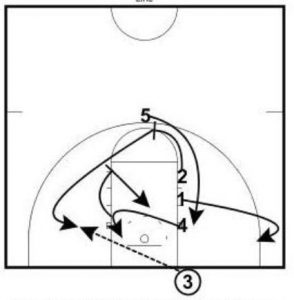
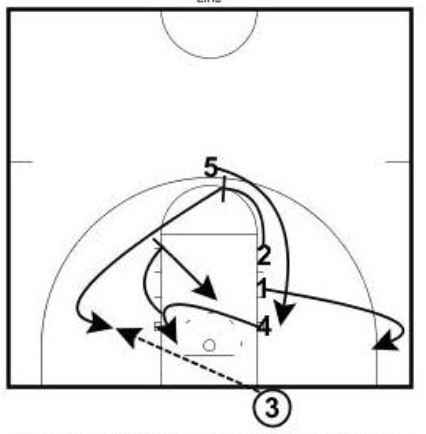
The name of the play is “Line.”

4 dives to opposite block

2 peels out and screens 5

4 screens 2, then dives to the rim

1 cuts outside the arc on ballside

2 cuts to short corner opposite ballside

A couple of thoughts of mine on inbounds plays.  Have the players begin their movements when the inbounder catches the bounce pass from the official.  I don’t like the idea of slapping the ball–it wastes a second on the five second count.

Even if you have a particular cut or a particular player that you are looking to hit, don’t turn down an available receiver who is open.  Throw the ball in to the first open player.

The Coaching Toolbox has hundreds of resources for coaching basketball including basketball practice, basketball plays, basketball drills, basketball quotes, basketball workouts, basketball poems, and more!

Basketball Practice Begins

By Brian Williams on November 10, 2011

This list was developed by Kevin Eastman and sent out by Steve Smiley.

You can also see another 5 minute video from Coach Eastman by clicking on this link: Keys to Quality Skill Development.

As practices at all levels begin in earnest in October and November, it’s always good to make sure that each group involved brings to each practice what’s most needed for each practice to be the best it can be.  Let’s take a look at some things that both coaches and players need to bring each day:

THE COACH

  • must bring great energy and enthusiasm (and not just the first week, but every day)
  • must bring the preparation needed to make sure that what he’s working on is what’s most needed for that day
  •  
     

  • must bring a keen eye to spot the mistakes that will keep the team from improving that day
  • must organize the practice so that he gets maximum work in the allotted time
  • must know his system so well that he actually has the answers before the players ask the questions

THE PLAYER

  • must bring great energy and enthusiasm
  • must walk onto the floor “clutter free” — all outside distractions must be cleared up or at least put to the side for that time period
  • must always seek to “get from” practice not just “get through” practice
  • must bring great focus, as the first month is always filled with teaching and learning
  • must have a “get in great shape” mindset for both physical conditioning as well as mental focus (being able to stay focused even through fatigue)

This is a short list of what all players and coaches must bring to make sure they’re holding up their end of the “practice bargain” and the “improvement bargain.”

One final thought — both groups must jump on every opportunity to help someone else get better, learn faster, go longer.  That’s a sign of a great team!

12 More Ideas to Improve Your Practices

Click here to read the first 12 Ideas from my basketball practice e-book
“130 Great Ideas to Get a Lot More Accomplished in Practice”

You can also see another 5 minute video from Coach Eastman by clicking on this link: Keys to Quality Skill Development.

Jay Bilas on Toughness in Basketball

By Brian Williams on October 26, 2011

This article is a few years old, but still has value for players at every level of basketball.

It was written by Jay Bilas – ESPN .com and posted on our blog with his permission.

I have heard the word “toughness” thrown around a lot lately. Reporters on television, radio and in print have opined about a team or player’s “toughness” or quoted a coach talking about his team having to be “tougher” to win.

Then, in almost coordinated fashion, I would watch games and see player upon player thumping his chest after a routine play, angrily taunting an opponent after a blocked shot, getting into a shouting match with an opposing player, or squaring up nose-to-nose as if a fight might ensue. I see players jawing at each other, trying to “intimidate” other players. What a waste of time. That is nothing more than fake toughness, and it has no real value.

I often wonder: Do people really understand what coaches and experienced players mean when they emphasize “toughness” in basketball? Or is it just some buzzword that is thrown around haphazardly without clear definition or understanding? I thought it was the latter, and I wrote a short blog item about it a couple of weeks ago.

If you are really interested in adding “Toughness” as a valued part of your program’s culture then we highly recommend you and your whole team reading the book “Toughness: Developing True Strength On and Off the Court” by Jay Bilas. 

The response I received was overwhelming. Dozens of college basketball coaches called to tell me that they had put the article up in the locker room, put it in each player’s locker, or had gone over it in detail with their teams.

Memphis coach John Calipari called to say that he had his players post the definition of toughness over their beds because he believed that true “toughness” was the one thing that his team needed to develop to reach its potential. I received messages from high school coaches who wanted to relay the definition of toughness to their players and wanted to talk about it further.

Well, I got the message that I should expound upon what I consider toughness to be. It  may not be what you think.

Toughness is something I had to learn the hard way, and something I had no real idea of until I played college basketball. When I played my first game in college, I thought that toughness was physical and based on how much punishment I could dish out and how much I could take. I thought I was tough.

I found out pretty quickly that I wasn’t, but I toughened up over time, and I got a pretty good understanding of toughness through playing in the ACC, for USA Basketball, in NBA training camps, and as a professional basketball player in Europe. I left my playing career a heck of a lot tougher than I started it, and my only regret is that I didn’t truly “get it” much earlier in my playing career.

When I faced a tough opponent, I wasn’t worried that I would get hit — I was concerned that I would get sealed on ball reversal by a tough post man, or that I would get boxed out on every play, or that my assignment would sprint the floor on every possession and get something easy on me. The toughest guys I had to guard were the ones who made it tough on me.

Toughness has nothing to do with size, physical strength or athleticism. Some players may be born tough, but I believe that toughness is a skill, and it is a skill that can be developed and improved. Michigan State coach Tom Izzo always says, “Players play, but tough players win.” He is right. Here are some of the ways true toughness is exhibited in basketball:

Set a good screen:  The toughest players to guard are the players who set good screens. When you set a good screen, you are improving the chances for a teammate to get open, and you are greatly improving your chances of getting open. A good screen can force the defense to make a mistake. A lazy or bad screen is a waste of everyone’s time and energy. To be a tough player, you need to be a “screener/scorer,” a player who screens hard and immediately looks for an opportunity on offense. On the 1984 U.S. Olympic Team, Bob Knight made Michael Jordan set a screen before he could get a shot. If it is good enough for Jordan, arguably the toughest player ever, it is good enough for you.

Set up your cut: The toughest players make hard cuts, and set up their cuts. Basketball is about deception. Take your defender one way, and then plant the foot opposite of the direction you want to go and cut hard. A hard cut may get you a basket, but it may also get a teammate a basket. If you do not make a hard cut, you will not get anyone open. Setting up your cut, making the proper read of the defense, and making a hard cut require alertness, good conditioning and good concentration. Stephen Curry is hardly a physical muscle-man, but he is a tough player because he is in constant motion, he changes speeds, he sets up his cuts, and he cuts hard. Curry is hard to guard, and he is a tough player.

Talk on defense: The toughest players talk on defense, and communicate with their teammates. It is almost impossible to talk on defense and not be in a stance, down and ready, with a vision of man and ball. If you talk, you let your teammates know you are there, and make them and yourself better defenders. It also lets your opponent know that you are fully engaged.

Jump to the ball: When on defense, the tough defenders move as the ball moves. The toughest players move on the flight of the ball, not when it gets to its destination. And the toughest players jump to the ball and take away the ball side of the cut. Tough players don’t let cutters cut across their face — they make the cutter change his path.

Don’t get screened: No coach can give a player the proper footwork to get through every screen. Tough players have a sense of urgency not to get screened and to get through screens so that the cutter cannot catch the ball where he wants to. A tough player makes the catch difficult.

Get your hands up: A pass discouraged is just as good as a pass denied. Tough players play with their hands up to take away vision, get deflections and to discourage a pass in order to allow a teammate to cover up. Cutters and post players will get open, if only for a count. If your hands are up, you can keep the passer from seeing a momentary opening.Play the ball, see your man: Most defenders see the ball and hug their man, because they are afraid to get beat. A tough defender plays the ball and sees his man. There is a difference.

Get on the floor: In my first road game as a freshman, there was a loose ball that I thought I could pick up and take the other way for an easy one. While I was bending over at the waist, one of my opponents dived on the floor and got possession of the ball. My coach was livid. We lost possession of the ball because I wasn’t tough enough to get on the floor for it. I tried like hell never to get out-toughed like that again.

The first player to get to the floor is usually the one to come up with any loose ball.Close out under control: It is too easy to fly at a shooter and think you are a tough defender. A tough defender closes out under control, takes away a straight line drive and takes away the shot. A tough player has a sense of urgency but has the discipline to do it the right way.

Post your man, not a spot: Most post players just blindly run to the low block and get into a shoving match for a spot on the floor. The toughest post players are posting their defensive man. A tough post player is always open, and working to get the ball to the proper angle to get a post feed. Tough post players seal on ball reversal and call for the ball, and they continue to post strong even if their teammates miss them.

Run the floor: Tough players sprint the floor, which drags the defense and opens up things for others. Tough players run hard and get “easy” baskets, even though there is nothing easy about them. Easy baskets are hard to get. Tough players don’t take tough shots — they work hard to make them easy.

Play so hard, your coach has to take you out: I was a really hard worker in high school and college. But I worked and trained exceptionally hard to make playing easier. I was wrong. I once read that Bob Knight had criticized a player of his by saying, “You just want to be comfortable out there!” Well, that was me, and when I read that, it clicked with me. I needed to work to increase my capacity for work, not to make it easier to play.

I needed to work in order to be more productive in my time on the floor. Tough players play so hard that their coaches have to take them out to get rest so they can put them back in. The toughest players don’t pace themselves.

Get to your teammate first: When your teammate lays his body on the line to dive on the floor or take a charge, the tough players get to him first to help him back up. If your teammate misses a free throw, tough players get to him right away. Tough players are also great teammates.

Take responsibility for your teammates: Tough players expect a lot from their teammates, but they also put them first. When the bus leaves at 9 a.m., tough players not only get themselves there, but they also make sure their teammates are up and get there, too. Tough players take responsibility for others in addition to themselves. They makesure their teammates eat first, and they give credit to their teammates before taking it themselves.

Take a charge: Tough players are in a stance, playing the ball, and alert in coming over from the weak side and taking a charge. Tough players understand the difference between being in the right spot and being in the right spot with the intention of stopping somebody. Some players will look puzzled and say, “But I was in the right spot.” Tough players know that they have to get to the right spot with the sense of urgency to stop someone.

The toughest players never shy away from taking a charge.Get in a stance: Tough players don’t play straight up and down and put themselves in the position of having to get ready to get ready. Tough players are down in a stance on both ends of the floor, with feet staggered and ready to move. Tough players are the aggressor, and the aggressor is in a stance.

Finish plays: Tough players don’t just get fouled, they get fouled and complete the play. They don’t give up on a play or assume that a teammate will do it. A tough player plays through to the end of the play and works to finish every play.

Work on your pass: A tough player doesn’t have his passes deflected. A tough player gets down, pivots, pass-fakes, and works to get the proper angle to pass away from the defense and deliver the ball.

Throw yourself into your team’s defense: A tough player fills his tank on the defensive end, not on offense. A tough player is not deterred by a missed shot. A tough player values his performance first by how well he defended.

Take and give criticism the right way: Tough players can take criticism without feeling the need to answer back or give excuses. They are open to getting better and expect to be challenged and hear tough things. You will never again in your life have the opportunity you have now at the college level: a coaching staff that is totally and completely dedicated to making you and your team better. Tough players listen and are not afraid to say what other teammates may not want to hear, but need to hear.

Show strength in your body language: Tough players project confidence and security with their body language. They do not hang their heads, do not react negatively to a mistake of a teammate, and do not whine and complain to officials. Tough players project strength, and do not cause their teammates to worry about them. Tough players do their jobs, and their body language communicates that to their teammates — and to their opponents.

Catch and face: Teams that press and trap are banking on the receiver’s falling apart and making a mistake. When pressed, tough players set up their cuts, cut hard to an open area and present themselves as a receiver to the passer. Tough players catch, face the defense,and make the right read and play, and they do it with poise. Tough players do not just catch and dribble; they catch and face.

Don’t get split: If you trap, a tough player gets shoulder-to-shoulder with his teammate and does not allow the handler to split the trap and gain an advantage on the back side of the trap.

Be alert: Tough players are not “cool.” Tough players are alert and active, and tough players communicate with teammates so that they are alert, too. Tough players echo commands until everyone is on the same page. They understand the best teams play five as one. Tough players are alert in transition and get back to protect the basket and the 3-point line. Tough players don’t just run back to find their man, they run back to stop the ball and protect the basket.

Concentrate, and encourage your teammates to concentrate: Concentration is a skill, and tough players work hard to concentrate on every play. Tough players go as hard as they can for as long as they can.

It’s not your shot; it’s our shot: Tough players don’t take bad shots, and they certainly don’t worry about getting “my” shots. Tough players work for good shots and understand that it is not “my” shot, it is “our” shot. Tough players celebrate when “we” score.

Box out and go to the glass every time: Tough players are disciplined enough to lay a body on someone. They make first contact and go after the ball. And tough players do it on every possession, not just when they feel like it. They understand defense is not complete until they secure the ball.

Take responsibility for your actions: Tough players make no excuses. They take responsibility for their actions. Take James Johnson for example. With 17 seconds to go in Wake’s game against Duke on Wednesday, Jon Scheyer missed a 3-pointer that bounced right to Johnson. But instead of aggressively pursuing the ball with a sense of urgency, Johnson stood there and waited for the ball to come to him. It never did.

Scheyer grabbed it, called a timeout and the Blue Devils hit a game-tying shot on a possession they never should’ve had. Going after the loose ball is toughness — and Johnson didn’t show it on that play. But what happened next? He re-focused, slipped a screen for the winning basket, and after the game — when he could’ve been basking only in the glow of victory — manned up to the mistake that could’ve cost his team the win.

“That was my responsibility — I should have had that,” Johnson said of the goof. No excuses. Shouldering the responsibility. That’s toughness.

Look your coaches and teammates in the eye: Tough players never drop their heads. They always look coaches and teammates in the eye, because if they are talking, it is important to them and to you.Move on to the next play: Tough players don’t waste time celebrating a good play or lamenting a bad one. They understand that basketball is too fast a game to waste time and opportunities with celebratory gestures or angry reactions. Tough players move on to the next play. They know that the most important play in any game is the next one.

Be hard to play against, and easy to play with: Tough players make their teammates’ jobs easier, and their opponents’ jobs tougher.

Make every game important: Tough players don’t categorize opponents and games. They know that if they are playing, it is important. Tough players understand that if they want to play in championship games, they must treat every game as a championship game.

Make getting better every day your goal: Tough players come to work every day to get better, and keep their horizons short. They meet victory and defeat the same way: They get up the next day and go to work to be better than they were the day before. Tough players hate losing but are not shaken or deterred by a loss. Tough players enjoy winning but are never satisfied. For tough players, a championship or a trophy is not a goal; it is a destination. The goal is to get better every day.

When I was playing, the players I respected most were not the best or most talented players. The players I respected most were the toughest players. I don’t remember anything about the players who talked a good game or blocked a shot and acted like a fool. I remember the players who were tough to play against.

Anybody can talk. Not anybody can be tough.

Mental Toughness for Basketball

Click this link to read a sample from the ebook 130 Great Ideas to Make Your Basketball Team More Mentally Tough:

https://www.coachingtoolbox.net/ebooks/mental-toughness/mental-toughness-ebook.html

  • « Go to Previous Page
  • Page 1
  • Interim pages omitted …
  • Page 3
  • Page 4
  • Page 5
  • Page 6
  • Page 7
  • Interim pages omitted …
  • Page 25
  • Go to Next Page »

Primary Sidebar

  • Twitter
  • Facebook
  • Linkedin
coachestoolbox
personaldevelopmenttoolbox
basketballplayerstoolbox
basketballtrainer
athleticperformancetoolbox
coachingbasketball

© Copyright 2026 Coaching Toolbox

Privacy Policy