• Skip to primary navigation
  • Skip to main content
  • Skip to primary sidebar

  • Basketball Plays
    • Ball Screen Sets
    • Horns Sets
    • Man to Man Post Up
    • Man to Man Isolations
    • Backdoor Plays
    • Man to Man 3 Point Shot Plays
    • 2-3 Zone Attack
    • Baseline Inbound Plays
    • Sideline Inbound Plays
    • Combination Defense Attack
  • Drills
    • Defensive Drills
    • Offensive Drills
    • Competitive Drills
    • Passing Drills
    • Rebounding Drills
    • Shooting and Scoring Drills
    • Toughness Drills
    • Transition & Conversion Drills
    • One on One Drills
  • Blueprint
  • Practice
  • Mental Toughness
  • Skill Development
  • Offense
  • Defense
  • Store

Blog

Competitive Basketball Practice

By Brian Williams on May 16, 2012

These concepts came from Coach Mike McNeil with the Comments by Alan Stein.

Some great stuff from Mike McNeil on ideas to make players more competitive in practice which translates into them going harder for longer period of times — really good stuff from Coach McNeill — thanks for sharing!

I (Alan Stein) have put my thoughts after each one in red italics.

Many years ago I had the opportunity to ask Gary Williams, the Head Coach at University of Maryland, what was the most important quality he looked for in the players he was recruiting. I was thinking he was going to say something like size, quickness, shooting ability, or understanding of game, but instead he looked at me like I must be from another planet, and said “they have to be a competitor”.  As a coach you want to believe that every contest you go into you know your players will give it everything they have to perform well.

The team may not shoot well, or they may turn the ball over but at least you know they will compete on every possession. While many people believe you cannot make non-competitors into competitors, I disagree to a certain point. I think if you use proven strategies in practice you can improve the competitive fire in all your athletes.  Are you going to make an infrequent competitor into a consistent, hard-nosed tough competitor? – I doubt it; but you can improve each of these athletes.

Just like any skill you work to improve you can help each athlete compete harder and more consistently by using some of the strategies described below. It is your responsibility as a coach to help your athletes become the best competitors they can become. Therefore you must create a practice environment where competition is expected and embraced.

A critical aspect of competing is being in the present – not thinking ahead and letting the past go. Coaches must teach, preach, and demand that players focus on the present responsibilities each player has so they will compete better. The following is a list of strategies that can be used to teach your team to play hard and to compete every possession.

1. The coach is the only one to call fouls. The coach can then set the standard of play. While it is important to teach players to play without fouling it is equally important to teach players to play through fouls, to play physically, and to play aggressively. It is also important players not concern themselves with the officials.

Alan’s comment:  We do this as well…when scrimmage against our male team; we will let them foul a little more than we allow our team…we want to be aggressive on defense without fouling.

2. There is no out of bounds! If the ball bounces out of the normal boundaries of the court the play is still alive. The players will then hustle after the loose ball to maintain possession. This will keep kids hustling after the ball. There are two arguments I have heard against this concept: 1) kids will get hurt –in 20+ years I have not seen it happen; 2) they will not be aware of where the out of bounds lines are –
again, I have not seen this be a factor.

Alan’s comment: We have several drills where we utilize this principle…we don’t do it all the time because we want them to know the floor as well.

3. Make every scrimmage or drill a competition; all competitions have either a score or a time standard.  Examples, you must make so many lay-ups in a 3 player weave in 2 minutes or first team to five baskets. The consequences for losing are severe if the losing team did not compete very hard – set of lines, suicide, 60 seconds. If the losing team did compete hard make it a less severe penalty or no penalty.

Alan’s comment: We are very big believers in this one — hold them accountable and have a penalty for the losing team. We do it in individual drills as well as team drills.

4. Play every drill, scrimmage, and breakdown until the defense gets the ball, i.e. if the offense scores and then recovers the ball from the basket they can score again. Our guideline for this is that we always want to convert as least one time (sometimes twice).

Alan’s comment: We might be working on our half-court offense but we are going to have one transition before resetting. The conversion game is very important to teach and it allows your team to play through all possessions.

5. Use overload situations, 3 vs 4, 4 vs 5, 5 vs 6. This places extra pressure on the out-manned team to concentrate and play harder to compensate for out-numbered situation and it also places pressure on the team with the numerical advantage because the expectation is to win. Give the team with the numerical advantage a slight score disadvantage to start each drill. We refer to these as “Disadvantage Drills.”

Alan’s comment: We may play 5/4 with the offense getting an extra player to overload the work on our defense. We might play 4/4 with no dribble to place our offense in a more difficult setting. There are a variety of ways to “stretch’ your team in competitive situations.

6. Use a rebounding bubble. Because no baskets are scored – score with stops, rating of shots and offensive rebounds. This will increase the hustle to secure the ball.

Alan’s comment: We use the rebounding bubble early in the season quite a bit. It is one of the most physically aggressive things we do. We tend to stay away from it during the season because of the possibility of injuries.

7. Give extra points for offensive rebounds. When you scrimmage or play any drill if a team gets an offensive rebound they get 2 extra points. Offensive rebounding is about desire and hard work – this should be rewarded!

We play “Motion Game” where we use points in a variety of ways. An offensive rebound is worth 1 point. A turnover is worth 2 points to the defense. In fact, you can utilize that drill in a variety of ways.  Maybe you want to work on your low post defense so you give the offensive a point for a low post feed.  A great imagination can make this type of scrimmage setting very effective.

8. Reward the team with extra points whenever there are hustle plays such as diving on the floor or drawing a charge.

The Coaching Toolbox has hundreds of resources for coaching basketball including basketball practice, basketball plays, basketball drills, basketball quotes, basketball workouts, basketball poems, and more!
Lawrence Frank Defensive Concepts

By Brian Williams on May 10, 2012

Lawrence Frank (former Coach Detroit Pistons and New Jersey Nets) – Defensive Concepts

I received these notes from Coach Steve Smiley.

“Your every day habits will determine your execution.”

To play on a good defensive team you must:
a. be a good individual defender.
b. be a good team defender.
c. be both a & b.
** If neither, you won’t play! **

Defensive non-negotiables:
1. Sprinting back on defense.
2. Protecting our paint.
3. Closing out hard and contesting the shot.
4. Playing aggressively without unnecessary fouls.
5. All five players blocking out and rebounding.
** No Layups
** No Freethrows
** No corner 3’s

If the ball gets into the paint, what are the consequences for the offense?
1. Charge
2. Steal
3. Deflection
4. Blocked shot
5. Hard “NBA” foul
** Never mention anything about scoring!

Transition Defense:
1 back = Dunk
2 back = Layup
3 back = Jumper
4 back = Got a chance
5 back = GAME ON!
– Win the first 3 steps!
– Stop the ball above the 3-point line
– Get the ball out of the middle 1/3
– Think “help”
– Open shots beat you in transition, but mismatches rarely will.

“Accept who they are. Your job is to make them better than they were.”

The Coaching Toolbox has hundreds of resources for coaching basketball including basketball practice, basketball plays, basketball drills, basketball quotes, basketball workouts, basketball poems, and more!
Jeremy Lin Scoring Workout

By Brian Williams on May 2, 2012

These drills came from Alan Stein’s Coaching Nuggets Collection.

They cover many areas of coaching basketball.

He even put my 37 ideas pdf in there!

These are 4 drills that Jeremy Lin uses as a part of his scoring workout.  

There are more drills from the workout available at the URL above.


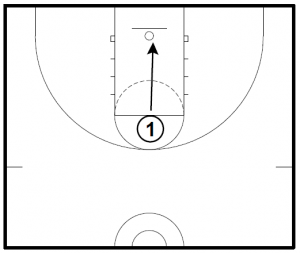
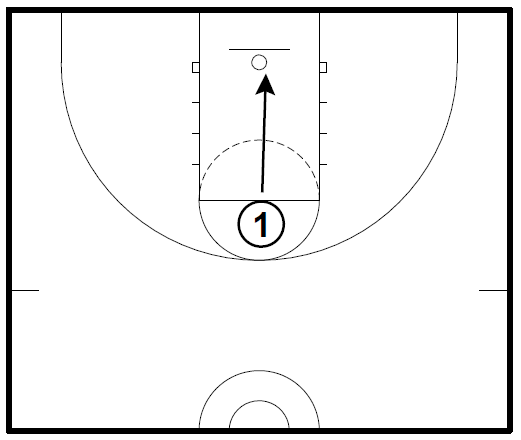
EXTENDED LAYUPS

Because he isn’t the most athletic player, Jeremy must do a good job of extending to the basket on all layups to separate from defenders.

Drill: Player takes large strides to jump and make extended layup on both sides of the rim. For next rep players self passes to FT line for catch, pivot and score.

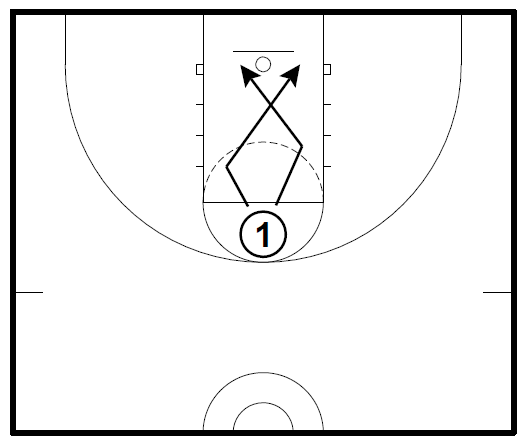
STEP THROUGH LAYUPS

Jeremy must also use the art of misdirection to score against larger help defenders.

Drill: Same concept as extended layups but make first step a misdirection jab step before extending into layup. Done on both sides of the rim.

 STOP AND GO ATTACKS

This is the move that Jeremy used on John Wall to get the dunk the other night. Defenders try hard to stop NY’s pick and roll. Jeremy reads this well and makes defenders pay by rejecting the screen and attacking.

Drill: Cone is screen (chair can be used too). Player sets up the screen and then makes movement towards it. Player quickly crosses back to other hand and attacks rim with layups already practiced or pull up jump shot.

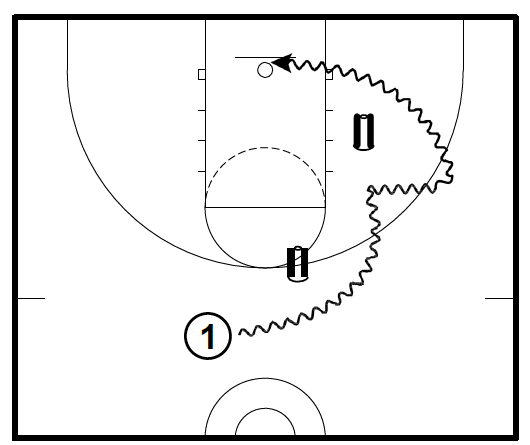
BOUNCE OUT TO RE-ATTACKS

Lin has great ball handling ability. He is able to keep a play alive when bouncing out from help defense to re-attack.

Drill: Come off pick and roll and attack second cone. Bounce out with dribble and re-attack either driving baseline or crossing over to the middle. Do drill to both sides of the court.

The Coaching Toolbox has hundreds of resources for coaching basketball including basketball practice, basketball plays, basketball drills, basketball quotes, basketball workouts, basketball poems, and more!
Extended Layups

Motivation for Basketball Players

By Brian Williams on April 30, 2012

This is a short video that is a good message for players to hear regarding basketball practice.

The thoughts apply to both in season practices and to out of season workouts.

I think that sometimes it is good for the players to hear another voice other than their coach’s.

Especially if that voice has credibility.

Even if you don’t want your players to watch the video, I hope it gives you some thoughts to add some variety to the messages you give your players regarding practice and skill development.

It is a YouTube video, which I know some of your school networks may block.

Click on the play arrow to see the video/strong>

The Coaching Toolbox has hundreds of resources for coaching basketball including basketball practice, basketball plays, basketball drills, basketball quotes, basketball workouts, basketball poems, and more!

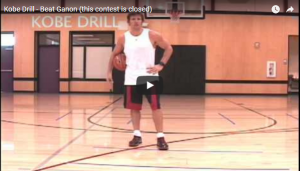
Ganon Baker’s Kobe Drill

By Brian Williams on April 23, 2012

I like to end our workouts with a toughness drill.

If the players have worked the way they should throughout the workout, they should be fatigued before starting this drill.

You can score it the best way that fits your players.

You can time them and require that they make each shot (no matter how many attempts are needed to make each one), prior to moving onto the next shot.

Or, you can time how long it takes them to shoot all 4 shots and add penalty seconds for the misses or subtract time for each make.

It is a good way to end a workout.

The contest is not open to beat Ganon, but you can certainly set up a contest to have your players compete against each other or themselves on the time that it takes them to make the 4 shots.

The video is a You Tube video and the sound is not the best, so you might have to adjust your volume setting to hear his instructions.

The Coaching Toolbox has hundreds of resources for coaching basketball including basketball practice, basketball plays, basketball drills, basketball quotes, basketball workouts, basketball poems, and more!
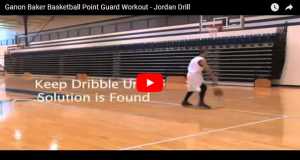
Point Guard Drill

By Brian Williams on April 6, 2012

The video below shows a drill to work with your point guards–or any player who drives to the basket on getting to the paint and then backing out if necessary.

The drill teaches to bounce off when there is no play to be made, then reattack–all the while the dribbler has his or her head up.

The video is 2 minutes in length.

It is a You Tube video, so make sure that you are able to access that site from the network you are on.


The Coaching Toolbox has hundreds of resources for coaching basketball including basketball practice, basketball plays, basketball drills, basketball quotes, basketball workouts, basketball poems, and more!
  • « Go to Previous Page
  • Page 1
  • Page 2
  • Page 3
  • Page 4
  • Page 5
  • Interim pages omitted …
  • Page 25
  • Go to Next Page »

Primary Sidebar

  • Twitter
  • Facebook
  • Linkedin
coachestoolbox
personaldevelopmenttoolbox
basketballplayerstoolbox
basketballtrainer
athleticperformancetoolbox
coachingbasketball

© Copyright 2026 Coaching Toolbox

Privacy Policy