• Skip to primary navigation
  • Skip to main content
  • Skip to primary sidebar

  • Basketball Plays
    • Ball Screen Sets
    • Horns Sets
    • Man to Man Post Up
    • Man to Man Isolations
    • Backdoor Plays
    • Man to Man 3 Point Shot Plays
    • 2-3 Zone Attack
    • Baseline Inbound Plays
    • Sideline Inbound Plays
    • Combination Defense Attack
  • Drills
    • Defensive Drills
    • Offensive Drills
    • Competitive Drills
    • Passing Drills
    • Rebounding Drills
    • Shooting and Scoring Drills
    • Toughness Drills
    • Transition & Conversion Drills
    • One on One Drills
  • Blueprint
  • Practice
  • Mental Toughness
  • Skill Development
  • Offense
  • Defense
  • Store

Blog

Core Values of a Championship Program

By Brian Williams on August 29, 2012

I received this from Steve Smiley.  The values are from The North Carolina women’s soccer program.  They have won 20 NCAA National Championships since 1982.  So, even though these are not from a basketball program, there is definitely something you can use to develop your basketball program’s culture.

The University of North Carolina Women’s Soccer Team’s Core Values 2012

People who make a living from studying what makes organizations excellent usually boil their consistent success down to the group living a powerful set of core values. So if you were to read “In Search of Excellence: Lessons from America’s Best Run Companies” (by Tom Peters et. Al) or “Built to Last: Successful Habits of Visionary Companies” (by Collins & Porras) or “Good to Great: Why Some Companies Make the Leap . . . and Others Don’t (Collins) or even “The Seven Habits of Highly Successful People (Covey) or “The 10 Natural Laws of Successful Time and Life Management” (Smith), and these might be the best of the books by the brightest minds, . . . what these people are trying to teach us is this: there are certain principles of behavior that produce extraordinary results.

Every year when I meet with the rising seniors each week in the spring our discussions center around our core values and what they can do to live them and how they can help drive everyone within the culture to live them as well. Human nature being what it is, some leaders embrace the personal and public challenge of our discussions and some don’t; just like some people within the culture live the core values and some just don’t have the strength.

What we are trying to do now is collect our core values under an umbrella of quotes that are meaningful to us (coaches and rising seniors). Obviously since I have been reflecting on this longer and with a better understanding of what kind of behavior will positively effect our culture (because I have seen quite a bit in coaching the past 36 years) much of what you are going to digest are ideas that have inspired me.

Still every rising senior has made contributions or is sold on these ideas because we ask them to review them in the spring. We need them to embrace and live what we have collected below because our culture and core values are only as strong as our leaders and what they endorse and drive as acceptable behavior.
So over the past 33 years, since our program began in 1979, what are the best elements of our tradition? What are our core values?

The Core Values

I. Let’s begin with this, we don’t whine. This tough individual can handle any situation and never complains about anything on or off the field. (“The true joy in life is to be a force of fortune instead of a feverish, selfish little clod of ailments and grievances complaining that the world will not devote itself to making you happy.” George Bernard Shaw).

TOUGH – from Nordic wheel cross signifying thunder, power, and energy


II. The truly extraordinary do something every day. This individual has remarkable self-discipline, does the summer workout sheets from beginning to end without omission or substitution, and every day has a plan to do something to get better. (“Roosevelt, more than any other man living within the range of notoriety showed the singular primitive quality that belongs to ultimate matter, the quality that medieval theology assigned to God: ‘he was pure act’.” Henry Adams Theodore Rex – Desmond Morris).

DISCIPLINED – from “careful” cycle on washing machine


III. And we want these four years of college to be rich, valuable and deep. This is that focused individual that is here for the “right reason” to get an education. She leads her life here with the proper balance and an orientation towards her intellectual growth, and against the highest public standards and most noble universal ideals, she makes good choices to best represent herself, her team, and her university. (“College is about books. And by the word books, the proposition means this: College is about the best available tools—books, computers, lab equipment—for broadening your mastery of one or more important subjects that will go on deepening your understanding of the world, yourself and the people around you.

This will almost certainly be the last time in your life when other people bear the expense of awarding you four years of financially unburdened time. If you use the years primarily for mastering the skills of social life—as though those skills shouldn’t already have been acquired by the end of middle school—or if you use these years for testing the degree to which your vulnerable brain and body can bear the strains of the alcoholism with which a number of students depart campus, or the sexual excess that can seem so rewarding (to name only two of the lurking maelstroms), then you may ultimately leave this vast table of nutriment as the one more prematurely burnt-out case.” Reynolds Price).

FOCUSED – from camera focus button

IV. We work hard. This individual embodies the “indefatigable human spirit” and never stops pushing herself. She is absolutely relentless in training and in the match. (“The difference between one person and another, between the weak and the powerful, the great and the insignificant, is energy – invisible determination . . . This quality will do anything that has to be done in the world, and no talents, no circumstances, no opportunities will make you a great person without it.” Thomas Buxton – Philanthropist).

RELENTLESS – from the symbol for Saturn: god of “relentless natural forces”


V. We don’t freak out over ridiculous issues or live in fragile states of emotional catharsis or create crises where none should exist. The best example is the even-keeled stoic that is forever unflappable and resilient. The worst example is the “over-bred dog,” that high maintenance, overly sensitive “flower” that becomes unstable or volatile over nothing significant. (“What an extraordinary place of liberties the West really is . . . exempt from many of the relentless physical and social obligations necessary for a traditional life for survival, they become spoiled and fragile like over bred dogs; neurotic and prone to a host of emotional crises elsewhere.” Jason Elliot An Unexpected Light: Travels in Afghanistan).

RESILIENT – nautical buoy symbol which rises and falls with the water,
always staying upright.

VI. We choose to be positive. Nothing can depress or upset this powerful and positive life force – no mood swings, not even negative circumstances can affect this “rock”. (“ . . . everything can be taken from a man but one thing: the last of the human freedoms – to choose one’s attitude in any given set of circumstances, to choose one’s own way. And there were always choices to make. Every day, every hour, offered the opportunity to make a decision, a decision which determined whether you would or would not submit to those powers which threatened to rob you of your very self, your inner freedom; which determined whether or not you would become the plaything of circumstance . . . in the final analysis it becomes clear that the sort of person (you are is) the result of an inner decision . . . therefore, any man can . . . decide . . . that (this) last inner freedom cannot be lost.” Viktor E. Frankl Man’s Search for Meaning).

POSITIVE


VII. We treat everyone with respect. This is that classy angel that goes out of her way to never separate herself from anyone or make anyone feel beneath her. “Class is the graceful way you treat someone even when they can do nothing for you.” Doug Smith, Mgr (’86))

CLASSY – British hobo symbol for “here live generous people”


VIII. We care about each other as teammates and as human beings. This is that non-judgmental, caring and inclusive friend that never says a negative thing about anyone and embraces everyone because of their humanity, with no elitist separation by academic class, social class, race, religious preference, or sexual orientation. (“No man is an island, entire of itself, every man is a piece of the continent, a part of the main . . . any man’s death diminishes me, because I am involved in mankind, and therefore never send to know for whom the bell tolls; it tolls for thee.” John Donne For Whom the Bell Tolls).

CARING


IX. When we don’t play as much as we would like we are noble and still support the team and its mission. This remarkably noble, self sacrificing, generous human being always places the team before herself. (“If there is a meaning in life at all, then there must be a meaning in suffering. Suffering is an ineradicable part of life, even as fate and death. Without suffering and death human life cannot be complete. The way in which a man accepts his fate and all the suffering it entails, the way in which he takes up his cross, gives him ample opportunity – even under the most difficult circumstances – to add a deeper meaning to his life. It may remain brave, dignified and unselfish. Or in the bitter fight for self-preservation he may forget his human dignity and become no more than an animal. Here lies the chance for a man either to make use of or to forgo the opportunities of attaining the moral values that a difficult situation may afford him. And this decides whether he is worthy of his sufferings or not.” Viktor E. Frankl Man’s Search for Meaning).

NOBLE – Hittite sign for king


X. We play for each other. This is the kind of player that works herself to death covering for all of her teammates in the toughest games. Her effort and care (her verbal encouragement) make her a pleasure to play with and her selflessness on and off the field helps everyone around her. (“People don’t care how much you know until they know how much you care.” Note given to me by Rakel Karvelsson (UNC ’98))

SELFLESS – from combination of ancient symbols for “not” and “relating to self”


XI. We are well led. This is the verbal leader on the field that is less concerned about her popularity and more concerned about holding everyone to their highest standards and driving her teammates to their potential. This galvanizing person competes all the time and demands that everyone else do as well! (“Not long ago, to ‘believe in yourself’ meant taking a principled, and often lonely, stand when it appeared difficult or dangerous to do so. Now it means accepting one’s own desires and inclinations, whatever they may be, and taking whatever steps that may be necessary to advance them.” William Damon Greater Expectations).

(“Not often in the story of mankind does a man arrive on earth who is both steel and velvet, who is as hard as rock and soft as drifting fog, who holds in his heart and mind the paradox of terrible storm and peace unspeakable and perfect.” Carl Sandburg about Abraham Lincoln)

GALVANIZING – international symbol for pushbutton or switch


XII. We want our lives (and not just in soccer) to be never ending ascensions but for that to happen properly our fundamental attitude about life and our appreciation for it is critical. This is that humble, gracious high-achiever that is grateful for everything that she has been given in life, and has a contagious generosity and optimism that lights up a room just by walking into it. (“Finally there is the question of whether we have a duty to feel grateful. Hundreds of generations who came before us lived dire, short lives, in deprivation or hunger, in ignorance or under oppression or during war, and did so partly motivated by the dream that someday there would be men and women who lived long lives in liberty with plenty to eat and without fear of an approaching storm.

Suffering through privation, those who came before us accumulated the knowledge that makes our lives favored; fought the battles that made our lives free; physically built much of what we rely on for our prosperity; and, most important, shaped the ideals of liberty. For all the myriad problems of modern society, we now live in the world our forebears would have wished for us—in many ways, a better place than they dared imagine. For us not to feel grateful is treacherous selfishness.

Failing to feel grateful to those who came before is such a corrosive notion, it must account at some level for part of our bad feelings about the present. The solution—a rebirth of thankfulness—is in our self-interest”. Gregg Easterbrook, The Progress Paradox.)

GRATEFUL – Gordian knot indicating person is “bound” by debt of thanks
Tubby Smith on Defense

By Brian Williams on August 1, 2012

These defensive principles are from Tubby Smith.  I received them in Creighton Burns’ Newsletter.  I have also posted some links at the bottom of this page to other articles on defense.

1. Wherever the ball is, be on the ball.

2. Contest every shot.

 3. Apply Constant Pressure.

 4. Quickly retreat to the ball line.

 5. Overplay/Deny penetrating passes.

 6. Allow non-penetration passes.

 7. Always see ball and man.

 8. Play up the court as close to the ball as possible.

 9. Attempt to intercept all lobs and bounce passes. Go for a steal with hand closest to the defender.

10. Say Ball and always pressure the ball. Pressuring the ball means to be one arms length away. Communicate with the correct terminology.

 11. Drives must always be stopped

 12. Defending the ball off a pass: when in the passing lane go for a steal with hand closest to the receiver—it leads to less grabbing. Passes away are defended  with one foot in the paint, sprint to the ball, sprint to the help. On pass from top—wing, get butt to baseline.

Other Posts on Defense:

Lawrence Frank Defensive Concepts–some defensive philosophy from Detroit Pistons Head Coach Lawrence Frank.

Brad Stevens Defensive Concepts–more defensive philosophy from Butler’s Brad Stevens

Defensive Conversion Concepts–some thoughts on forcing your opponent to play against your half court defense.

Larry Brown Defense–some drills and concepts from the new coach at Southern Methodist

The Coaching Toolbox has hundreds of resources for coaching basketball including basketball practice, basketball plays, basketball drills, basketball quotes, basketball workouts, basketball poems, and more!

Basketball Player’s Comfort Zone

By Brian Williams on July 11, 2012

This post is from Alan Stein.

One of the most significant ingredients to success is your ability to be comfortable being uncomfortable.

Your comfort zone is your enemy. It makes you soft. It leads to complacency.

You have to constantly and consistently step out of your comfort zone and challenge yourself. There is no reward for always playing it safe. The player who can push themselves further once the situation gets uncomfortable is the one who will win. That is what makes great players so lethal. They thrive in adversity.

In addition to helping players get stronger, quicker, and in great shape, it is my job to push players out of their comfort zone on a regular basis. It is my job to help them increase their tolerance for discomfort (mental and physical). I want them to train hard so the game becomes easy.

I tell my players of the time during our workouts, “Temporary discomfort leads to permanent improvement.”

I also tell them, “You can have the pain of discipline or the pain of regret… take your choice.”

Both of those quotes exemplify the same point – if you are willing to step out of your comfort zone now… you will reap the benefits ten times over in the future. But you have to have the courage to sacrifice your immediate personal contentment.

When you are lifting weights, do you stop as soon as there is a slight “burn”… or do you push through and do a few more reps?

When you are running sprints, do you stop as soon as you are a little “winded”… or do you suck it up and run a few more?

When you are working on your ball handling, do you spend extra time on your off hand even though you make more mistakes? Or do you just keep doing the drills you are already good at?

When you are getting up shots, are you a “casual shooter” or do you run through every rep at game speed? Do you come off of imaginary screens and make hard cuts… or do you simply do spot shooting?

The answers to these questions will determine how successful you will be next season.

Remember, you have to deserve success. And to do that you have to leave your comfort zone now.

Train hard. Train smart.

Alan Stein

The Coaching Toolbox has hundreds of resources for coaching basketball including basketball practice, basketball plays, basketball drills, basketball quotes, basketball workouts, basketball poems, and more!

The Science of Shooting a Basketball

By Brian Williams on May 22, 2012

I have always felt that the three most important aspects of the flight of a basketball during the shot are

1)      Getting the ball straight at the rim
2)      Arc of the Shot
3)      Shot Depth or Distance from front of the rim.

All of the fundamental teaching and practicing that we do as coaches regarding hand position and body alignment help our players shoot the ball straight.  I measure it visually by seeing where the ball lands on the rim, or by having players shoot the ball on the various lines in the gym and see if it lands straight on that line.  The great thing about shot line is everyone can see it.  The Player and Coach can see clearly if the shot misses to the left or right.

Like everyone else, we work on generating the force necessary to get the ball to the hoop –no offhand interference, bending knees, and flexing the wrist to generate the necessary force to get the ball to the basket consistently.

What I don’t feel that I have been as detailed about is the arc that our players shoot at.  Recently, I have found research data shows us that there are optimal angles.  My evaluations consisted of too flat or too high.  Everyone knows when the ball is shot too flat, it gives the ball less area within the basket to score and this hurts your shooting percentage.  However, most people don’t understand that an arc that is too high hurts your shooting percentage just as much as shooting too flat.   When a player shoots too high, they effectively lose control of the ball and begin missing short and long.    Also, when the ball is shot too high it comes into the rim at a greater velocity making the shot less soft and getting less friendly bounces.

I have learned that a very important piece of the puzzle to understand when trying to work with a player on arc is that they can’t see their own shot.   As pointed out above, when missing L or R the player can clearly see they are not shooting the ball straight.  However, when it comes to arc the player has no idea how high they shoot the ball.   Anyone that is watching the shot can see the arc very well, but the player shooting the ball cannot.   A player should never watch the ball and should be focused on the target, but even if they did they would just see the ball go up in a line and down in a line, having no idea how high it actually went.

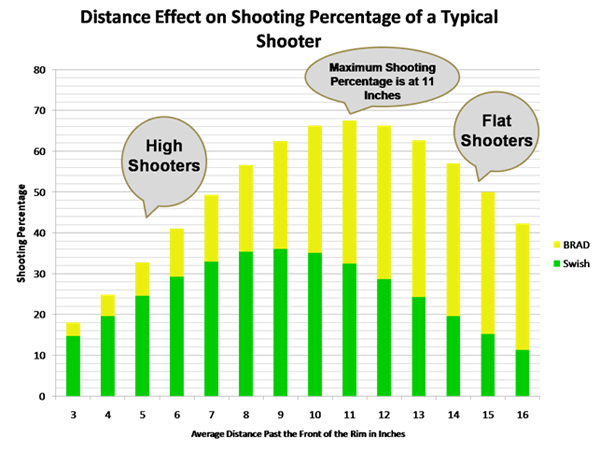
For over a decade, Noah Basketball has been conducting studies with the goal of finding the perfect angle and depth inside the rim for a shot to travel.  In addition to learning something about the perfect shooting arc, I also learned something about proper distance (shot depth) for the shot from their research.   That is that a perfect shot travels 11 inches beyond the front of the rim, which is 2 inches past the center.

                Facts regarding the arc of a shot

  • 45 degrees is the optimal arc.
  • 11 inches past the front of the rim is the perfect shot depth.
  • Every great shooter shoots the ball deep in the basket.
  • The best shooters don’t always swish the ball–they often hit the back of the rim.  Noah calls this a BRAD shot, which stands for Back Rim And Down.
  • The best shooters only vary only plus or minus two degrees on shot arc – Building the muscle memory to consistently repeat the shot is critical to great shooting.
  • High-arcing shooters generally are short when they miss while line-drive shooters skew toward being too long on their shots.

The Noah team developed a machine that enables a player to shoot the correct arc and shot depth.  It does this by providing immediate feedback.  When a player shoots the machine will immediately tell them the arc or distance of the last shot.  Since a player can’t see their own shot, this objective, immediate feedback leads to rapid learning.

Noah Basketball will do a FREE, no obligation shooting clinic in your gym, with your players.  During the clinic all players will have their shot evaluated by the Noah System and then a formal presentation will be given that explains the science of the basketball shot.  Click here for more details about the free clinic or call 1-888-TRY-NOAH. During the clinic, players will understand all the principles outlined above for the first time.  I have spoken to several coaches that have hosted one of the free clinics and they say it is well worth the time.

When a player shoots on a Noah, the Noah will announce the exact arc that the ball was shot with.   After a few repetitions, the player can begin to get a feel for what a 45 degree shot release feels like, and what the release feels like when the arc is too flat or too high.

In addition to hearing the arc, the arc and the depth of the shot are captured on a laptop computer so that the player and coach can review the data at the end of their workout.  And they now have a product that allows you to capture all this data on your iPad, iPhone, or Ipod Touch.

The information in this post was taken from the Noah Basketball Website www.noahbasketball.com

Here is a link to an article about the success that Dwyane Wade and the Miami Heat have had with Noah.

http://espn.go.com/blog/truehoop/miamiheat/post/_/id/12263/dwyane-wades-new-magic-number-45

For those of you that want to dig into a little more detail, below are some really interesting charts provided by Noah Basketball that explain some of the details I outlined above.   These charts are also a part of their clinic presentations.

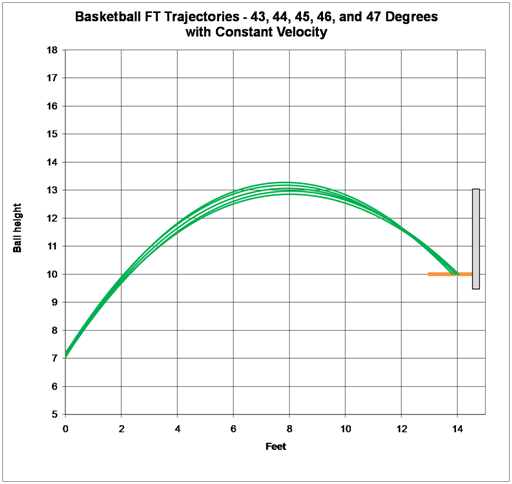
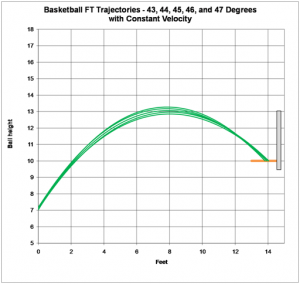
About the best a player can control the arc of the shot is plus or minus 2 degrees.  The chart below shows where the ball travels when a player shoots with the same power at 45 degrees, plus or minus 2 degrees.  There is a sweet spot at 45 degrees where a player can have a reasonable amount of variation in their shot, but the ball still go the same distance within the basket.   This is why all the great shooters shoot the ball at or very close to 45 degrees.

Coaching Basketball

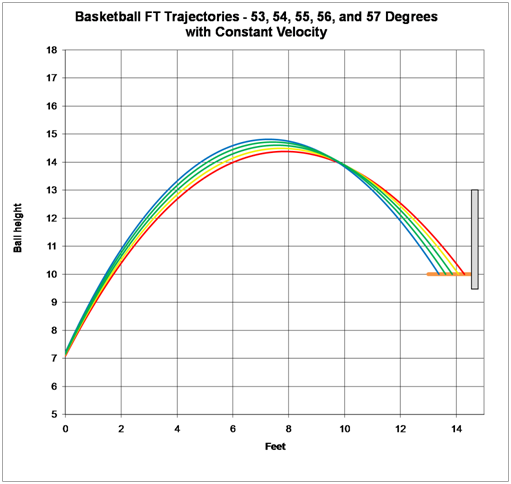
About the best a player can control the arc of the shot is plus or minus 2 degrees.  The chart below shows where the ball travels when a player shoots with the same power at 55 degrees, plus or minus 2 degrees.  If a 55 degree shooter misses slightly and shoots the next shot at 53 degrees with the same power, the ball goes 7 inches farther, making it miss long.  These high shooters will always “spray” the ball from the front of the rim to the back of the rim.  This is a problem that they will not overcome with more reps, better mechanics, etc., etc.    They are fighting the very laws of physics – a battle they will not win.

Coaching Basketball

All great shooters shoot the ball deep in the basket.  The chart below outlines the shooting percentage of a typical shooter based on their average shot depth in the basket.  As you can see, a shooter will make the most shots at 11 inches deep in the basket.   There are so many shooters that are losing 20 to 25 percentage points just because they aren’t shooting the ball deep enough in the basket.

Coaching Basketball

The Coaching Toolbox has hundreds of resources for coaching basketball including basketball practice, basketball plays, basketball drills, basketball quotes, basketball workouts, basketball poems, and more!

Basketball Plays: Spurs Set Play

By Brian Williams on May 21, 2012

From an Arizona Basketball Coaching Newsletter:

If you are interested in being added to his newsletter, let me know this information (which the Arizona staff requires):

1) Name

2) e-mail address

3) school/team

4) Coaching Position

The plays were contributed to their newsletter by Brandon Rosenthal.

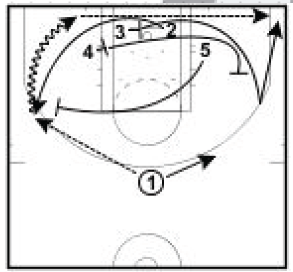
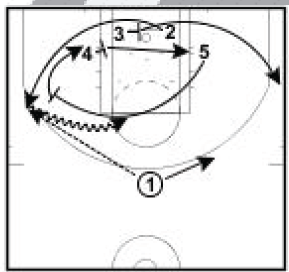
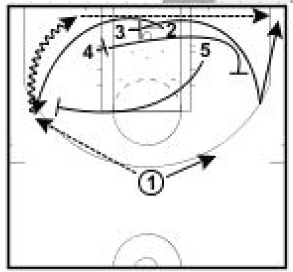
SAN ANTONIO STAGGER P&R (TWO OPTIONS)

Basketball Plays

(3) & (4) stagger screen for (2). (1) hits (2) and cuts away.

(3) cuts out to the wing and (4) searches the lane.  (5) sprints into side pick and roll.

Option 2 below is if (2) turns down the ball screen from (5), then (4) flair screens for (3).  (3) cuts to the corner for a 3 point shot.

Basketball Plays

Basketball Plays

#4 steps out and receives On the pass from #rim.

The Coaching Toolbox has hundreds of resources for coaching basketball including basketball practice, basketball plays, basketball drills, basketball quotes, basketball workouts, basketball poems, and more!

Point Guard Qualities

By Brian Williams on May 17, 2012

I received these notes from Weber State AssistantPhil Beckner.

Offensive Concepts/Point Guards

By: NBA Great Gordon Chiesa

Follow him on twitter: @gchiesaohmy

The NBA is a Point Guard driven league.

The hardest position in the NBA to learn and master is the “point guard position”.

About Point Guards…There are two kinds of Point Guards: 1) “New School,” aggressive, looking to score points early, by creating off the dribble; 2) “Old School”, trying to execute the offense first by getting other players shots early. As the shot clock is winding down, then being more aggressive.

The Point Guard position is about “winning intangibles.” The best ones make it special by their assists, leadership, clutch shooting, and defense!

About NBA Point Guards: You never want your point guard to be so “Shot Happy”, that he doesn’t or won’t get his teammates involved first in the flow of the “Team Offense”.

Good NBA Point Guards will always see the floor, control the tempo of the game, make timely jump shots, and uncanny lay-ups in the lane.

Good point guards should have an assist to turnover ratio of 3 to 1.

Good NBA point guards play the game “one pass ahead”. They feel/see the “play” before it happens.

Bright Point Guards learn to limit their own personal “emotional fogs” during games by playing forward, not backwards. Stay focused to lead!

Winning Point Guards respect the ball.  Their focus is to get as many offensive possessions possible by not committing “reckless turnovers”.

Smart point guards understand how/when to count internally, when the shot clock is winding down.  This “mental countdown” creates confidence.

Elite Point Guards master the intellectual, physical and verbal challenges of playing the position by consistently making “big plays”.

Winning, scoring point guards have that “instinctivemental balance” of understanding when to look to score, and when to get their teammates going.

Solid back-up point guards have an underrated impact towards winning by being ready to play due to injuries, foul trouble, and speed match-ups!

Electric Point Guards add value to their teams by scoring and creating in the open floor. They’re “tempo changers” of velocity and emotions.

The Coaching Toolbox has hundreds of resources for coaching basketball including basketball practice, basketball plays, basketball drills, basketball quotes, basketball workouts, basketball poems, and more!

  • « Go to Previous Page
  • Page 1
  • Page 2
  • Page 3
  • Page 4
  • Interim pages omitted …
  • Page 25
  • Go to Next Page »

Primary Sidebar

  • Twitter
  • Facebook
  • Linkedin
coachestoolbox
personaldevelopmenttoolbox
basketballplayerstoolbox
basketballtrainer
athleticperformancetoolbox
coachingbasketball

© Copyright 2026 Coaching Toolbox

Privacy Policy