• Skip to primary navigation
  • Skip to main content
  • Skip to primary sidebar

  • Basketball Plays
    • Ball Screen Sets
    • Horns Sets
    • Man to Man Post Up
    • Man to Man Isolations
    • Backdoor Plays
    • Man to Man 3 Point Shot Plays
    • 2-3 Zone Attack
    • Baseline Inbound Plays
    • Sideline Inbound Plays
    • Combination Defense Attack
  • Drills
    • Defensive Drills
    • Offensive Drills
    • Competitive Drills
    • Passing Drills
    • Rebounding Drills
    • Shooting and Scoring Drills
    • Toughness Drills
    • Transition & Conversion Drills
    • One on One Drills
  • Blueprint
  • Practice
  • Mental Toughness
  • Skill Development
  • Offense
  • Defense
  • Store

ICE to Switch Defensive Coverage

ICE to Switch Defensive Coverage

By Brian Williams on December 12, 2017

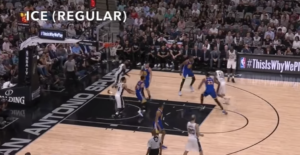
Army Assistant Men’s Basketball Coach Zak Boisvert has put together some short clips with some NBA techniques for defending pick and rolls using a technique known as ICE to Switch Defensive Coverage.

Coach Boisvert has posted several videos of some of the better schemes he has seen. His You Tube channel is: Zak Boisvert You Tube Channel

He also is also very active on Twitter: @ZakBoisvert

He has an outstanding resource site for coaches. You can access it here: PickandPop.net


The videos are YouTube videos, so please make sure that you are on a network that allows YouTube access. Some school networks may block YouTube access.

The videos are from 2018 and Golden State’s roster has changed. The idea of the post is to give you an idea for a defensive tactic that you might be able to use at some point. Or at least be aware that you might see it employed against you.

Click the play arrow to watch the videos.

Please make sure that your sound is on as Coach Boisvert has narration to go along with the video clips.
ICE to Switch Pick and Roll Coverage

Your Team’s Shot Selection

By Brian Williams on December 11, 2017

By Stephen Shea, Ph.D. (@SteveShea33) and published on his blog:  Basketball Analytics.  You can find out more about Dr. Shea and his work in the field of Basketball Analytics below the article.

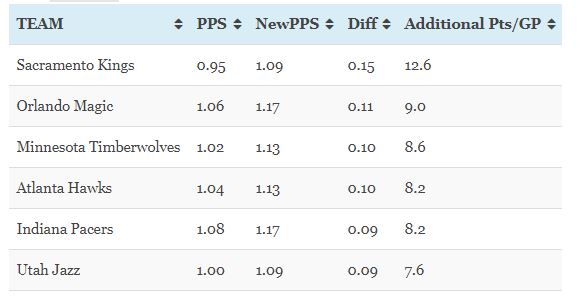
Editor’s Note from Brian The purpose of this post is to offer some ideas about applying these analytics to what you currently do and improve how you evaluate your offensive execution.  You probably won’t be able to apply all of this, but hopefully you can use parts of it to help your players understand and measure how you want your team to play on offense.  I have included screenshots of part of the tables as a way to add context to the points that Dr. Shea makes.

If you want to view the entire article including sortable data tables for all NBA teams, you can click here: What if Your Team had Houston’s Shot Selection I realize that the shorter distances for different 3 point shots does not apply to high school and college, but I also believe that there are specific spots on the arc that your players shoot better from, or at least favor as spots for 3 point attempts.

And, of course, we have to coach to our player’s strengths, but if we develop and play players whose strength is mid range, then we will be limited in the effectiveness of our offense, just as we would be limiting our offense if our primary ball handler could only dribble towards their strong hand.

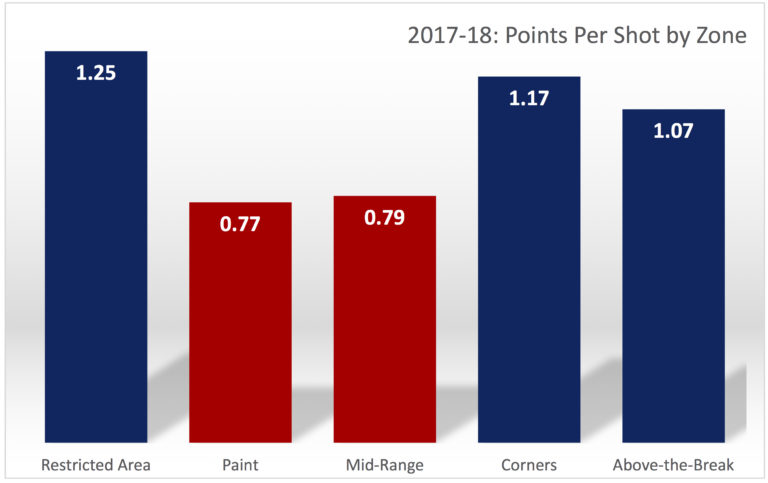
I also realize that free throw shooting is even more efficient than field goal shooting, and that you are going to get to the line more frequently by attacking the basket. That has to be factored in. Free throw scoring efficiency is tied to the ability of the free throw shooter. A 70% free throw shooter will score, on average, 1.40 points per 2 shot free throw possession, which is better tan any of these. To me, that still points out that paint shots outside the restricted area and mid range shots are the worst ways to attempt to score.

As always, my goal is to provide food for you and your staff to use to work to improve your program. I do believe that analytics have a place in the decision making processes for basketball coaches, but that it is not the only tool to use.

End of Editor’s Note

What if your team had Houston’s shot selection?
Stephen Shea, Ph.D.

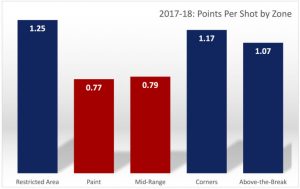
There are 5 major shooting zones on an NBA court: the restricted area (at the hoop), the paint (but not in the restricted area), mid-range, corners, and above the break. Among the zones, the paint and mid-range shots are, by far, the least efficient.

One team has leveraged this information to design a strategy that attempts to greatly reduce paint and mid-range shots. This season, just 7.6% of Houston’s field goal attempts have come from the paint and just 5.8% have come from mid-range. Both percentages are league lows.

Houston’s shot selection is far from the norm. While mid-range attempts are on the decline, many teams are still taking 20% or more of their shots from this inefficient region. What if they didn’t?

As a thought exercise, let’s suppose every team had Houston’s shot selection. We’ll keep each team’s field goal percentages from each zone the same. For example, Sacramento has shot 36.6% from mid-range this season and taken 28.1% of their shots from that region. We’ll assume Sacramento maintains their 36.6% but that they only take 7.6% of their FGA from mid-range (Houston’s percentage).

We’ll measure the team’s shooting efficiency by points per shot (PPS). The table below contains each team’s current PPS, their hypothetical PPS with Houston’s shot selection (labeled NewPPS), the difference between the hypothetical and actual PPS, and the additional points per game the team would score with Houston’s shot selection.

Shot selection can impact shooting efficiency, and so, it wouldn’t be fair to suggest that a team could radically alter their shot selection tomorrow and maintain their shooting efficiencies from each zone. Still, when we see that a team like Sacramento would produce 12.6 more points per game with their current field goal percentages and Houston’s shot selection, we have to ask, why aren’t they trying?

KP Shooting Drill

By Brian Williams on December 9, 2017

This drill is from Mike Neighbors, Arkansas Women’s Basketball Coaching Newsletter. It is back and I just sent him several email addresses for coaches who were interested in joining his list. If anyone else wants to be added, let me know and I will pass it on.

You might be able to incorporate this drill into your practices or possibly for your players who are looking to get in some extra shooting during winter break.

Here is what Coach Neighbors said about the drill:

This one will challenge the best of your best.

Put 1:00 on the clock.

One rebounder. One passer. Two Balls.

Round 1

Shooter must make one shot at each of the five spots. Time starts when ball is released on first shot and ends when ball clears net on final make. The time that remains on the clock, stays on the clock.

Round 2

Add 1:00 to the remaining time from Round 1.

Shooter must now make two shots in a row from each spot in the time on the clock.

Diagram created with FastDraw

This procedure continues as long as the shooter finishes with time remaining on the clock… add 1:00 per round and increase the number of makes in a row by one.

It’s imperative the shooter “build up time” each of the early rounds as the sheer number of shots increases in the later rounds.

If you find your team/players struggling to advance, you can change the drill to total number of makes rather than in-a-row.

We chart records on how many rounds and shots can be completed before time hits 0:00.

Keys to this drill:

1) Build time in early rounds
2) Avoid long slumps of makes
3) Get hot in one round when needed to survive

Brad Stevens End of Game Winner SLOB

By Brian Williams on December 7, 2017

This play to run at the end of the game down 3 was contributed by Doug Brotherton to the FastModel Sports Basketball Plays and Drills Library.

You can also find out more about FastModel Play Diagramming software by clicking this link: FastDraw

This is what Coach Brotherton said about the play:

This SLOB set was used by Princeton in the 2017 NCAA Tournament. Down by 3, with under 20 seconds left, this set resulted in a wide open three point shot. I have added an elevator screen to the end of this set, in the case that the first shooter does not have a shot.

I have also posted some video of the play that was edited by Gibson Pyper

Below the video is a second end of game sideline inbound play from Coach Stevens called “Brush Clear.”

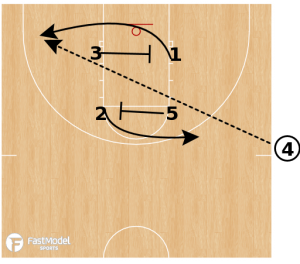
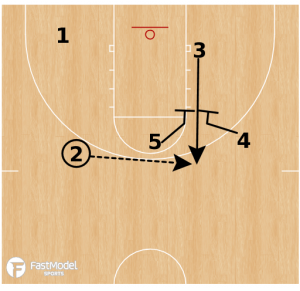
“Winner”


Box Formation

3 sets a back screen for 1

5 sets a cross screen for 2


On the catch, 5 re-screens for 2.

1 passes to 2 for the 3-point shot.


5 and 4 set an elevator screen for 3

3 cuts up the middle for a three point shot

This video is provided by Gibson Pyper, founder of Half Court Hoops

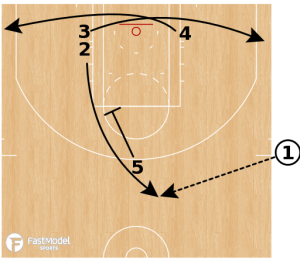
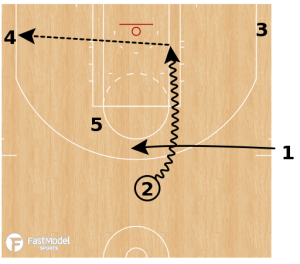
Brush Clear

 
Contributed by Matt Wheeler, Olympia High School, Orlando, Florida.

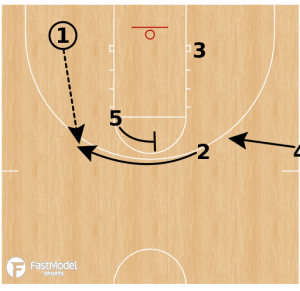
The Boston Celtics ran this play with the score tied and 36.3 seconds left in game 3 against the Cleveland Cavaliers. The Celtics wanted to get a quick score within 5 or 6 seconds so they would end up with the last possession of the game. As 2 gets the inbounds pass, 3 & 4 cut to the corners for spacing. 1 sets a brush screen for 2, allowing 2 to drive hard right looking for a layup or a kickout to a shooter.


5 sets a down screen for 2.

3 & 4 exchange and cut to opposite corners.

1 passes to 2.


1 sets a brush screen for 2.

2 drives right for a layup or a kick out to a shooter in the corner.


Diamond Overload 3-2 Zone Attack

By Brian Williams on December 5, 2017

This play to run against a 3-2 zone defense zone defense was contributed by Andreas Barthel to the FastModel Sports Basketball Plays and Drills Library.

Coach Barthel looks back on ten years of success on multiple levels. He has worked at the pro level in Germany and Austria. In addition, at the Bay Area varsity level.

His reputation is based on a strong analytical approach and profound analysis of all aspects of the game. A disciplined work ethic and goal driven attitude identifies him. He lives the way of a solution-oriented leadership style that instills a positive poise through the heart and mind.

During his career Barthel coached numerous professional players. Further he has worked with German and Austrian national team players, both youth and men. You can follow Coach Barthel on Twitter at @AndreasBarthel.

You can also find out more about FastModel Play Diagramming software by clicking this link: FastDraw

This is what Coach Barthel said about the play:

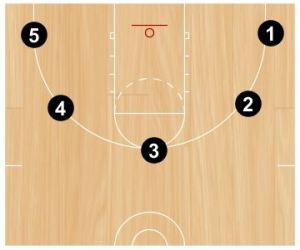
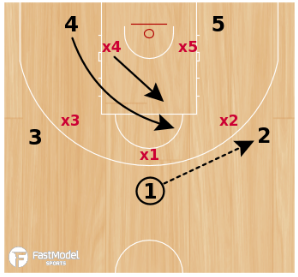
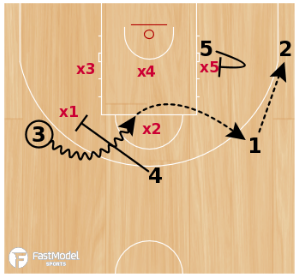
Very effective in attacking a 3-2 zone.

This play creates an open 3 point look in the corner and multiple options to score with.


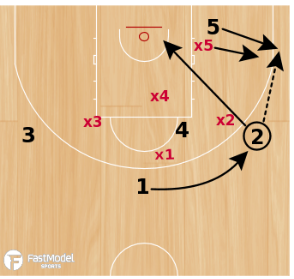
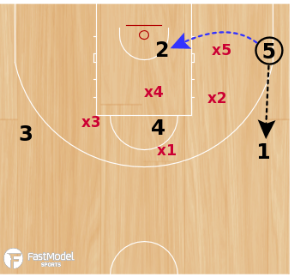
1 passes to 2

4 flashes to the ball side high post

This forces X4 to shift


5 pops out

2 passes to 5 and cuts to the basket

1 fills the ball side wing


IF X5 closes out on 5, then 2 will be open on the cut to the basket

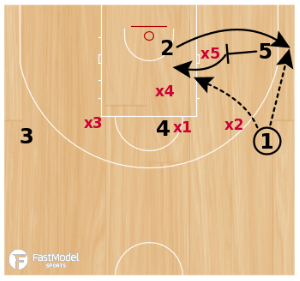
If not, 5 passes to 1


5 sets a screen on X5

2 cuts to the ball side corner

Either 2 will be open for a shot, or 5 after the screen and slip to the basket


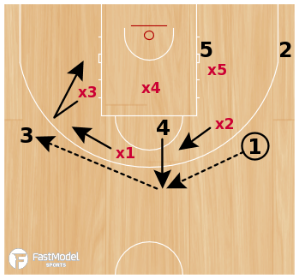
If 1 can’t pass the ball to either 5 or 2, then he passes the basketball to 4

4 passes the ball to 3

X3 is forced to step out and recover

X1 and X2 are forced to shift


4 screens on X1’s inside shoulder

3 attacks X2 with penetration and draws X2’s attention

3 passes to 1

5 sets a screen on X5

1 passes to 2 who still remains in the corner

The Process of Leadership

By Brian Williams on December 3, 2017

It’s All About Style
Mobilizing Purpose and Possibility with Transformative Leadership

Dr. Cory Dobbs.
Coaching Maxim:  Leadership demands we make decisions that define who we are and how we interact with others.

We often talk about a leader having a “style” of leadership, a distinctive way of thinking, feeling, and acting.  And it is true; coaches do have a style that shapes who they are and what they do.  The relationship between style and leadership is expressed as a systematic process in how a coach gets things done and inspires his or her players to be their very best.

Over the past decade I have watched many coaches in action and have detected a distinct difference between two dominant leadership styles.  There are many ways to describe the leadership habits of coaches, but it appears to me that as leaders most fall into one of two categories—drivers or builders.   Drivers tend to be what leadership experts refer to as transactional leaders while builders fall pretty naturally into the category of transformational leaders. Drivers and builders have two very different leadership mindsets and skill sets.

Drivers are generally after impressive achievements, especially the attainment of fame, status, popularity, or power.  Not that there is anything wrong with that, as Jerry Seinfeld would say.  Drivers view success to be mastery of the technical and tactical aspects of their sport. Builders commit to their calling and enjoy the human development side of coaching.  For them, significance is found in contributing to the lives of their players.  It’s not that they don’t want to win; it’s simply that winning includes building self-confident people who will succeed away from the playing field.

Coaching is a major factor in any team’s success.  Most players recognize this.  They’ve been coached since they were tots playing in youth leagues.  And for the most part they’ve believed in and trusted their coaches to teach them to play the game while instilling life skills and personal values.  However, many adults reveal years later that they learned little from coaches they encountered in their student-athletic experience.  Generally, the coaches that fail to have a long-term impact on student-athletes are transactional leaders.  Many former student-athletes view their experience as being a pawn in the game of student-athletics.
[thrive_leads id=’36827′]
Transformational leaders (builders) do more with and for their student-athletes than transactional leaders (drivers).  These leaders tend to empower student-athletes with challenge and persuasion and actively engage in supporting and mentoring the holistic development of their players.  Transformational leaders seek to inspire their followers to commit to a shared vision of how student-athletics can enhance their lives.  For the transformational leader the sport situation offers an opportunity for the participant to learn such life skills as perseverance, character development, relationship building, and goal attainment.

Transactional leaders, on the other hand, are those that prefer to set up simple interactional exchanges or agreements with their followers, often investing little in building relationships.  They manage players through the use of carrots and sticks—offering a reward (usually playing time) for a desired behavior.  These leaders are those that often use the maxim “the bench is my best teacher.”

This is a prime example of contingent reinforcement—you do “X” and I’ll give you “Y.”  A transformational leader, while certainly not shy to use the bench as a learning tool, would not view the bench as a teacher—that’s a role they cherish.  The transactional coach keeps his or her distance from the athlete, preferring to have a “distant” relationship.  Some coaches will fake the relational process, but the lack of authenticity is quickly recognized by the student-athlete.  The transformational coach is more likely to spend time building relationships with players and showing them he or she cares.  Their mindset is that people aren’t going to care about you and your concerns unless they know you care about theirs.

Transformational leaders don’t do this just to be nice, they understand it to be an effective and appropriate way to deal with young and developing student-athletes.  Building relations is not a road block to success as many coaches find that because they show they care about the person, they can ask for and demand more performance.  Think about it.  Are you more likely to extend yourself for someone you care about or someone you don’t like and care for?

Coaches do many things.  They inspire and motivate, they teach and instruct, and they set an example.  More than anything else, however, coaches help the student-athletes make sense of some of life’s most important lessons.

Over time many coaches move from a driver dominated way of coaching to that of a builder.  Take for example Westmont College men’s basketball coach John Moore.  “Coaching and teaching is more meaningful for me today than it was eight to ten years ago,” said Moore.  “It is more significant because of the kinds of things that are important in coaching.  Someone once said to me, ‘You don’t have a philosophy of coaching until you get to 15 years as a head coach.’ I discounted that originally, but there was a point for me, and it was in that 15-year range, that I realized that I had a philosophy of coaching – that makes it more meaningful for me and more meaningful for my players.”

Being a driver, a transactional leader, can be very effective in producing immediate results.  However, the constant pounding and intimidating of your student-athletes will reduce the motivation of most student-athletes.  Student-athletes prefer to be guided and seek motivation from the collaborative process of coaching.  Even the most self-motivated player will lose their drive if you don’t provide them with positive reinforcement and a sense of worth.

Transformational coaches appeal to players by working with the athletes to create a compelling and collective purpose; a purpose beyond individual ambition that enriches the possibilities of each team member.  By valuing both relationships and results, a builder’s influence leads to higher levels of trust, empowerment, and community.

For builders, the real definition of success is a life and work that brings personal fulfillment, lasting relationships, and makes a difference in the world in which they live.

Are You a Driver or a Builder?

Drivers  / Dominant Leadership Style: Transactional Builders / Dominant Leadership Style: Transformative
  • Put results first. Relationships are subordinate to results, a means to an end.
  • Put people first.  Relationships are priorities to producing results.
  • Make the decisions. Drivers like being decisive and in control.  Drivers set the agenda.
  • Stress team capabilities.  Builders want to build systems and talent.
  • Possess a controlling spirit.  They feel if they can control people, they’ll maintain absolute authority.
  • Get others involved.  Builders seek input from other coaches and value input from players.
  • Resort to more regulations.  Drivers use rules and regulations to enforce compliance.  Drivers want things done their way.
  • Let solutions emerge.  Builders don’t try to tackle every problem knowing that some problems solve themselves.
  • Crack the whip.  Drivers keep pressure on for accountability.  Come down hard when goals aren’t attained.
  • Take a long-term focus.  Builders assemble players, programs, and processes.
  • Take a short-term focus.  Drivers tend to focus on the day’s or week’s results.
  • Are mission driven. It’s the mission that sets the priorities.
  • Focus on “what” have you done for me lately? Enough said.
  • Are servant leaders. What’s my contribution?  Builders possess a mental model stimulated by a “What can I contribute to the lives of my players” approach to leading.
  • Get “in your face.”  Drivers thrive on confrontation.  “My way or the highway”.
  • Embrace empowerment. Builders work to prepare others for leadership roles.
  • Are more critical than positive.  Drivers find it difficult to accentuate the positive.
  • Support identity of team. No two teams will ever be the same.  Builders see value in the diversity of personalities.
  • Power trip.  Fear giving away power.  Empowering student-athletes to become team leaders is not a priority.
  • Vision is the main course, not an appetizer.  Builders weigh the costs of today’s decisions on  tomorrow.
  • Span of vision.  Concern is for results today regardless of costs tomorrow.

About the Author

Dr. Cory Dobbs is a national expert on sport leadership and team building and is the founder of The Academy for Sport Leadership.  A teacher, speaker, consultant, and writer, Dr. Dobbs has worked with professional, collegiate, and high school athletes and coaches teaching leadership as a part of the sports experience.  He facilitates workshops, seminars, and consults with a wide-range of professional organizations and teams.  Dr. Dobbs previously taught in the graduate colleges of business and education at Northern Arizona University, Sport Management and Leadership at Ohio University, and the Jerry Colangelo College of Sports Business at Grand Canyon University.

Dr. Dobbs recently joined Jamy Bechler on the “Success is a Choice” Podcast – hear his thoughts on team leadership and developing a leader in every locker here.

NEW RESOURCE

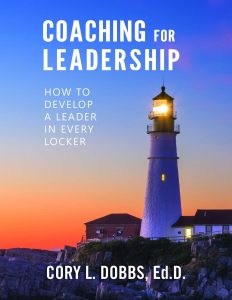
Coaching for Leadership: How to Develop a Leader in Every Locker. ($24.99)


The Academy for Sport Leadership

  • « Go to Previous Page
  • Page 1
  • Interim pages omitted …
  • Page 77
  • Page 78
  • Page 79
  • Page 80
  • Page 81
  • Interim pages omitted …
  • Page 288
  • Go to Next Page »

Primary Sidebar

  • Twitter
  • Facebook
  • Linkedin
coachestoolbox
personaldevelopmenttoolbox
basketballplayerstoolbox
basketballtrainer
athleticperformancetoolbox
coachingbasketball

© Copyright 2026 Coaching Toolbox

Privacy Policy