• Skip to primary navigation
  • Skip to main content
  • Skip to primary sidebar

  • Basketball Plays
    • Ball Screen Sets
    • Horns Sets
    • Man to Man Post Up
    • Man to Man Isolations
    • Backdoor Plays
    • Man to Man 3 Point Shot Plays
    • 2-3 Zone Attack
    • Baseline Inbound Plays
    • Sideline Inbound Plays
    • Combination Defense Attack
  • Drills
    • Defensive Drills
    • Offensive Drills
    • Competitive Drills
    • Passing Drills
    • Rebounding Drills
    • Shooting and Scoring Drills
    • Toughness Drills
    • Transition & Conversion Drills
    • One on One Drills
  • Blueprint
  • Practice
  • Mental Toughness
  • Skill Development
  • Offense
  • Defense
  • Store

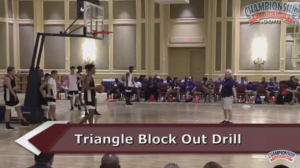
Bob Hurley’s Triangle Block Out Drill

Bob Hurley’s Triangle Block Out Drill

By Brian Williams on October 19, 2018

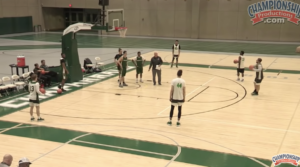
Today’s post is a defensive movement and rebounding drill with Hall of Fame and former St. Anthony Coach Bob Hurley.

The video of this rebounding drill is hosted on YouTube.

You will need to be on a network that allows you to access YouTube.

Click the play arrow to view the video.

There is narration with the video, so please make sure that your sound is on.

You can make adjustments to the drill to fit your needs, the types of actions that you defend, and your overall defense and defensive rebounding philosophies.

I like the concept that the rebounding drill involves the positioning and movement that is a part of the defensive system.

You can find out more about the Championship Productions video that this clip is from at this link:
Bob Hurley’s Drills for Defensive Mastery
Box and Break Drill

By Brian Williams on October 15, 2018

This drill was contributed to the FastModel Sports Basketball Plays and Drills Library by Randy Sherman of Radius Athletics.

You can also find out more about FastModel Play Diagramming software by clicking this link: FastDraw

“Box & Break” is a defensive rebounding drill at heart, but can also serves as a sudden change drill off turnovers and a conversion drill.

The drill can be regressed to 3v1 or 3v0 or loaded to 3v3 on the break.


Defense and Rebounding

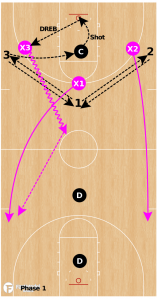
PHASE 1. 3v3 defensive shifting (three-player shell drill).

Offense move ball around forcing defense to execute defensive fundamentals.

If/when ball is passed to coach (shooter) the offense goes to the glass and defense boxes out.

Defense breaks full court (3v2) when they gain possession.

NOTE: Reset on all made shots.

Since this is primarily a box out drill, shooter can make a few shots to emphasize rebounding techniques when the offensive player goes to the glass.

Shooter can move around the court as well.

Break Off Turnovers (Sudden Change)

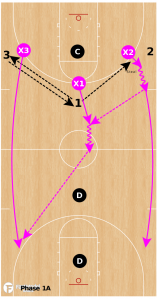
Phase 1A. If/when offense turns the ball over, the defense breaks full court.

On loose balls, the defensive player first cuts off their opponent then goes for the ball.

If/when the defense gains possession, they break 3v2 full court.

Play continues 3v2 until offense scores or defense gets possession.

Filling the Lanes and Attacking

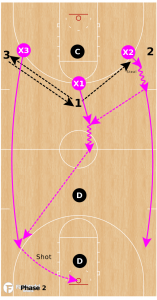
PHASE 2. Push!! PINK1 pushes the ball on a hard dribble looking to advance with the pass.

Wings get width and depth fast! Play continues 3v2 until the offense scores or the defense obtains ball possession.

REGRESSION: The break can be 3v1 or even 3v0 to just emphasize pushing off the rebound and turnover and finding width and depth and converting.

LOAD: The break can be 3v3

Repeats – Transition to Defense

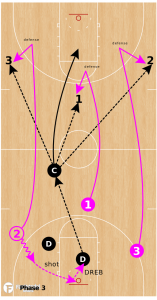
Phase 3. If/when the defense regains possession either after steal, DREB or FGM, they quickly make outlet to COACH who has moved into this side of play.

COACH then passes ahead to either 1, 2 or 3.

The three offensive players must sprint back and match up.

REPEATS. Offense again moves the ball side to side forcing the defense to shift.

If/when the defense deflects the pass and gains ball possession or rebounds a missed shot, they push the ball down 3v2 again.

CONDITIONER. Drill is repeated several times before the defensive players (PINK TEAM) steps off. Rotate offense to defense to out of the drill.

Bob Hurley’s “Duke” 5 Minute Shooting Drill

By Brian Williams on October 13, 2018

Today’s post is a shooting drill from former St. Anthony Coach Bob Hurley.

The video of this shooting drill is hosted on YouTube.

You will need to be on a network that allows you to access that site.

Click the play arrow to view the video.

There is narration with the video, so please make sure that your sound is on.

You can make adjustments to the drill to fit your needs.

For example, you can set a team standard, or a team record, that you are going for in 5 minutes.

You can change the time to 4 minutes and have two teams of 8 competing against each other (one team at each end) if you have 16 (or more) players in your practice.

I think it is good to have another competitive shooting drill to add to your drills list.

I also like that the players have to communicate before they get the basketball to shoot.

You can find out more about the Championship Productions video that this clip is from at this link:
Bob Hurley’s Drills for Offensive Mastery

Defensive Agility drills for the Pre-Season

By Brian Williams on October 7, 2018

By Jon Sanderson MS,CSCS,MSCC,USAW1,TPI,NASM-CES

Head Strength & Conditioning Coach-Michigan Basketball

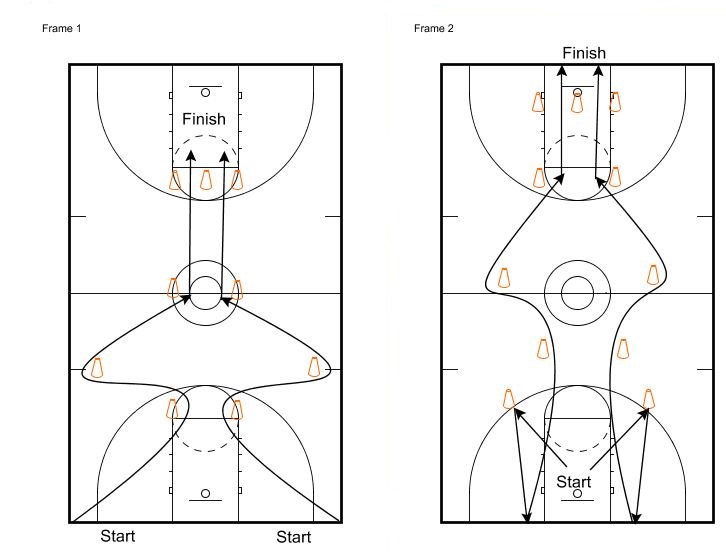
Below are 3 really effective agility drills that emphasize Defensive movements.

When doing these drills emphasize with your athletes to stay low in defensive stance and to explode from cone to cone.

I would recommend doing these drills prior to any traditional conditioning drills (i.e. lane drills, 17’s, conditioning ladders etc.)

Diagrams created with FastDraw


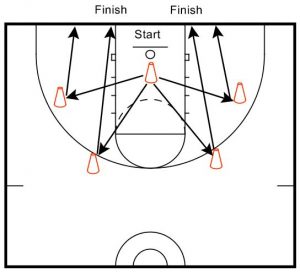
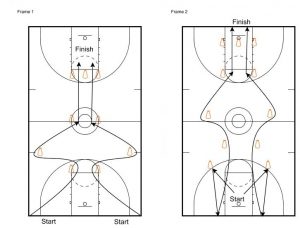
Defensive Close out Drill
– Start in the middle of the lane and closeout to cone #1 and slide to baseline.

Reset in the middle of the lane and proceed to Cones #2-4.


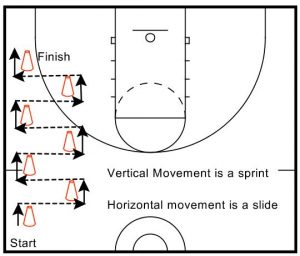
Cone Defensive Slides
– Start by sliding to the first cone, advance forward then slide to the next cone.

Repeat until the course is finished.


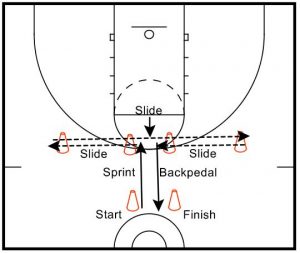
T-Drill w/ Defensive Slide– Start with a sprint to the middle cones, defensive slide to one of the outer cones, then slide to the opposite outer cone, and then back to the middle. 

Finish with a backpedal to the finish cone.


If interested in the Camp Sanderson S&C program powered by Blueprint Athletes App
Apple Phones   https://apple.co/2FYcJ00

Android Phones   https://play.google.com/store/apps/details?id=com.blueprintathletes.android

Jon Sanderson has been the head strength and conditioning coach for the University of Michigan men’s basketball team since 2009.

Regarded as one of the basketball strength and conditioning coaches in the business, Sanderson is the only strength and conditioning coach in NCAA history to participate in a Final Four as a player (Ohio State in 1999) and a coach (Michigan in 2013 & 2018).

Before joining the Michigan staff, Sanderson spent three years (2006-09) working at Clemson as the men’s and women’s basketball strength and conditioning coach, as well as the director of the Littlejohn Coliseum weight room. During Sanderson’s time at Clemson, the men’s basketball team won 20 or more games for three straight seasons — a first in program history. Also, during those three seasons, only North Carolina and Duke had more wins than Clemson in the ACC.

Prior to his time at Clemson, he served as the head strength and conditioning coach and sports nutrition coordinator for Olympic sports at Marshall University (2003-06). Before heading to Marshall, Sanderson was a strength and conditioning intern at North Carolina, working with the men’s basketball program (2002-03).

Throughout Sanderson’s career with the U-M basketball program, he has trained 11 student-athletes that have gone on to play professional basketball in the NBA, including MDarius Morris, Manny Harris, Tim Hardaway, Jr., Trey Burke, Nik Stauskas, Mitch McGary, Glenn Robinson III, Caris LeVert, D.J. Wilson, Derrick Walton, Jr. and Moritz Wagner.

Competitive Agility drills for the Pre-Season

By Brian Williams on October 6, 2018

By Jon Sanderson MS,CSCS,MSCC,USAW1,TPI,NASM-CES

Head Strength & Conditioning Coach

Michigan Basketball

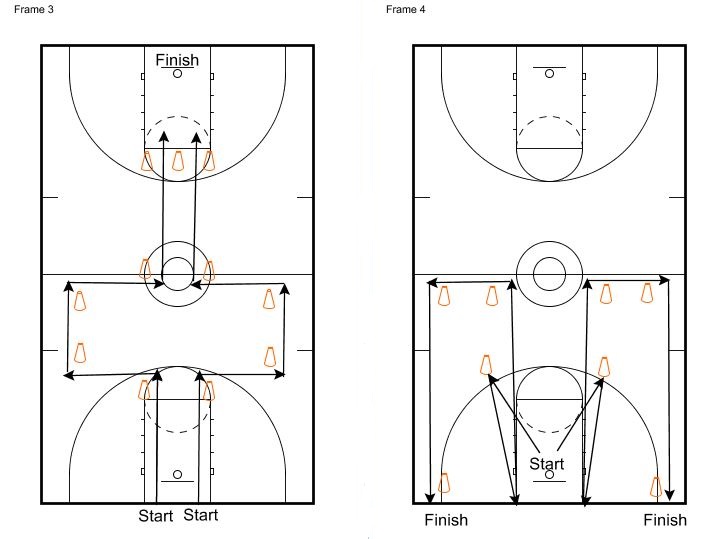
Below are 4 of my favorite agility drills that emphasize a competitive environment.

The first thing I do is pair up my athletes by size/speed.

For example, I want my point guards competing against each other or my bigs going against each other.

The paired athletes will line up opposite each other and essentially race each other to the finish line.

The race begins on the coaches command.  (Note that agility drill 2 and 4 begin with a close-out drill).

Diagrams created with FastDraw


If interested in the Camp Sanderson S&C program powered by Blueprint Athletes App
Apple Phones   https://apple.co/2FYcJ00

Android Phones   https://play.google.com/store/apps/details?id=com.blueprintathletes.android

Jon Sanderson has been the head strength and conditioning coach for the University of Michigan men’s basketball team since 2009.

Regarded as one of the basketball strength and conditioning coaches in the business, Sanderson is the only strength and conditioning coach in NCAA history to participate in a Final Four as a player (Ohio State in 1999) and a coach (Michigan in 2013 & 2018).

Before joining the Michigan staff, Sanderson spent three years (2006-09) working at Clemson as the men’s and women’s basketball strength and conditioning coach, as well as the director of the Littlejohn Coliseum weight room. During Sanderson’s time at Clemson, the men’s basketball team won 20 or more games for three straight seasons — a first in program history. Also, during those three seasons, only North Carolina and Duke had more wins than Clemson in the ACC.

Prior to his time at Clemson, he served as the head strength and conditioning coach and sports nutrition coordinator for Olympic sports at Marshall University (2003-06). Before heading to Marshall, Sanderson was a strength and conditioning intern at North Carolina, working with the men’s basketball program (2002-03).

Throughout Sanderson’s career with the U-M basketball program, he has trained 11 student-athletes that have gone on to play professional basketball in the NBA, including MDarius Morris, Manny Harris, Tim Hardaway, Jr., Trey Burke, Nik Stauskas, Mitch McGary, Glenn Robinson III, Caris LeVert, D.J. Wilson, Derrick Walton, Jr. and Moritz Wagner.

September 2018 Coaching Notes

By Brian Williams on October 3, 2018

University of Maine Men’s Assistant Coach Zak Boisvert has assembled some of his notes that he took in September.

He has an outstanding site with posts on various coaching topics at www.pickandpop.net

His You Tube channel has several videos with various types of man to man plays, zone sets, and inbounds plays.

You can subscribe to receive an update when he posts a new video Zak Boisvert You Tube Channel

You can follow him on Twitter at this link: @ZakBoisvert

-Leonard Fournette tweet: Someone took the same situation you complaining about & won with it.

-Inky Johnson tweet: If the reason is not big enough the excuse will be…. But at a certain point we have to become stronger than our strongest excuse.

-Change your best

-The voice of the off-ball defenders need to be the “eyes” of the on-ball defender

-Hardens: slow dribble + hard, fast dribble (David Thorpe)

–Luke Yaklich book recommendation: “Dream Teams: Working together without falling apart” by Shane Snow

-Chris Beard: “How have you helped a teammate today?”

-I want to do a better job this year impacting my players beyond the game of basketball. I need to
spend time consciously thinking about how I am doing this.

-What are we going to do today to accomplish what we want? – Ron Sanchez, Charlotte

-Porter Moser: if you capture the process that led you to success and set out to get better every day, you’ll have a huge competitive advantage.

Marcus Luttrell, Lone Survivor -It’s the focus on the little stuff that nobody else does, that separates champions from everyone else.

Jamion Christian: Each player makes 12,500 shots a month.

-Semi Ojeleye: I think the way we all get what we want is if we win.

-PGC on zone offense: Don’t trim the edges. Puncture the middle!

-How can we make our pregame warmups better?

Paul Weir, New Mexico: -Has a sign in his office over his recruiting board that reads “Coach THIS Team.” Don’t ever forget the team you have. Don’t get so caught up in those guys on your board, that you don’t fully invest in the guys that are already in your program. Through donations by fundraisers, he started a library in the players’ locker room. Built a book shelf and filled it with some of his favorite books.

Chris Beard Knight told him at the airport during his interview, “I’ve never been concerned with how hard someone works. That’s a given. I’m much more concerned with who can get what done.”

Tim Kight: -Elite culture are exclusive first, inclusive second. “If you meet our standard, you care about us, you
celebreate the people around you, and you do the work we need you to do in the group we are, you can be a part of us. But if you’re not willing to do that, you can’t be a part of us. Being you never supercedes who we’re going to be.

Dave Anderson-Changing a culture can create conflict. But temporary discomfort is better than temporary ease, if
it averts permanent failure.

Jon Gruden The real players want to be coached, they want structure, they want discipline, they don’t want it to be
easy.”

-If your teammates followed your example today instead of your advice, where would you be leading them?

-Ray Dalio: Principles are ways of dealing with situations. They are the evolving record of our understanding of what works well.

-Chuck Noll: “If you want to win, do the ordinary things better than anyone else does them day in and day out.”

John Wooden: “You either have a philosophy or you don’t. Players change … The philosophy doesn’t.”

In evaluating players, both during games and in film sessions, Brad Stevens is careful with language, according to coaches, players and team higher-ups. He focuses on actions: We didn’t get this rebound. You should have made this rotation earlier. The criticism is never about the player’s character. No one is labeled lazy or stupid or selfish. Stevens simply describes what did or did not happen, and what should happen next time.

Google Spent 2 Years Studying 180 Teams. The Most Successful Ones Shared These 5 Traits
-Google launched an initiative, Project Aristotle, to help the organization codify the secrets to team
effectiveness. Google wanted to know why some teams excelled while others fell behind.
– Before this study, like many other organizations, Google execs believed that building the best
teams meant compiling the best people
-5 characteristics of enhanced teams:
1. Dependability – Team members get things done on time and meet expectations.
2. Structure and Clarity – Clear goals + well-defined roles within the group.
3. Meaning – The work has personal significance to each member.
4. Impact – The group believes their work is purposeful and positively impacts the
greater good.
5. Psychological Safety – Everyone is safe to take risks, voice opinions and ask
judgement-free questions.

-What do you mean when you say you want high-culture guys, what do you really mean?

-My ego demands from myself the success of my team – Bill Rusell (my team’s success is a reflection of myself)

-“Wall” concept: Empty side ball screen…aggressive with the high guy on weakside…guy below is ready to stunt. We are forcing the ball-handler to pass. Can’t get rejected on initial pick & roll. Find tape of this!!

-Handedness of shooters – closeout to the hand of the shooter…right-handed shooter, I’m closing out my left hand. My foot angle doesn’t change, but I am sending him to his weak hand. I am playing him straight up.

-Frank Gore: I can help a locker room. I can help a team, just by the way I practice. I remember Tom Rathman said to me, “The only things you should worry about is your peers’ respect.”

-Steve Nash: There is no true development without competitiveness and resilience. Without those, it’s just window dressing.

-Steve Jobs: “It doesnt make sense to hire smart people and tell them what to do; we hire smart people to tell us what to do. Over the years we learned if we ask people to rely on logic & common sense instead of formal policies. Most of the time we would get better results and at a lower cost.”

Coach Moser’s leadership tips for Quinlan students
-Talk given to incoming Quinlan School of Business graduate students
1. Set the tone: Live the culture you want to create
2. Recruit and hire culture: Select coaches and players who already embraced the culture he
wanted
3. Empower your people: Because they feel empowered, they will work harder to make the
program better.
4. Be inspired by the past, and focused on the future
5. Be obsessed with getting better: The “Journey of Learning”
6. Leave entitlement at the door: Dabo quote, ““Let the light that shines in you be brighter than the
light that shines on you.”
7. Do it the right way

-Jon Gordon: “One person in pursuit of excellence raises the standard of everyone around them. And as they strive for greatness, they bring out the greatness in others. Be that one person today.”

-Albert Einstein (via Bob Walsh): 5 ascending levels of intelligence: Smart, Intelligent, Brilliant, Genius, Simple.

-“Silent defense is a soft defense.”

-“Being a good teammate is a skill.”

As a head coach, you have a significant role, but it’s the players’ game. The leadership in the locker room is everything.

  • « Go to Previous Page
  • Page 1
  • Interim pages omitted …
  • Page 58
  • Page 59
  • Page 60
  • Page 61
  • Page 62
  • Interim pages omitted …
  • Page 288
  • Go to Next Page »

Primary Sidebar

  • Twitter
  • Facebook
  • Linkedin
coachestoolbox
personaldevelopmenttoolbox
basketballplayerstoolbox
basketballtrainer
athleticperformancetoolbox
coachingbasketball

© Copyright 2026 Coaching Toolbox

Privacy Policy