• Skip to primary navigation
  • Skip to main content
  • Skip to primary sidebar

  • Basketball Plays
    • Ball Screen Sets
    • Horns Sets
    • Man to Man Post Up
    • Man to Man Isolations
    • Backdoor Plays
    • Man to Man 3 Point Shot Plays
    • 2-3 Zone Attack
    • Baseline Inbound Plays
    • Sideline Inbound Plays
    • Combination Defense Attack
  • Drills
    • Defensive Drills
    • Offensive Drills
    • Competitive Drills
    • Passing Drills
    • Rebounding Drills
    • Shooting and Scoring Drills
    • Toughness Drills
    • Transition & Conversion Drills
    • One on One Drills
  • Blueprint
  • Practice
  • Mental Toughness
  • Skill Development
  • Offense
  • Defense
  • Store

Basketball Drills 6 Shot Shooting

Basketball Drills 6 Shot Shooting

By Brian Williams on November 4, 2014

This drill is adapted from some competitive drills from the University of Kansas women’s team that were included in Mike Neighbors’ University of Arkansas women’s basketball coaching newsletter.

Let me know if you would like to be added to his newsletter.

Thought you might be able to use this drill to conclude your practices to do some conditioning with a basketball, work on scoring in transition, as well as force your players to shoot and compete when tired.

In the version from the newsletter, the passer at that top of the key is a coach and every player has a basketball.

I like the idea of having players work on making good passes to the shooter, so I have made some adjustments.

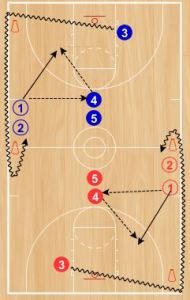
Split the squad into 2 teams–one at each end. In the diagram, red team and blue teams.
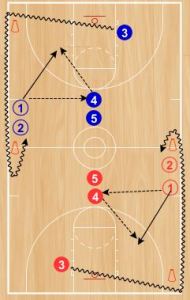
6shotshooting

Diagram created with FastDraw

Players 1 and 2 have basketballs, player 3 is the rebounder, and 4 and 5 are the passers.

Player 1 passes to player 4, cuts to the basket, receives a pass back and takes the shot. Player 3 rebounds. After shooting, 1 goes to the end of the passing line. 3 rebounds and dribbles around the cones back to the back of the shooting line. 4 (who passed to 1) becomes the rebounder.

The first end to make 20 shots wins that round. The winning team must “verify the win.” One player from the winning team has to go to the free throw line immediately and make one free throw. If the player misses the free throw, the win for that round does not count. Verifying the drill is something you can use in many of your drills to force players to shoot some free throws under pressure.

First end to win 3 rounds (and verify them) is the overall winner. Every player shoots the same type shot for each set of 20 makes. Make sure to only shoot shots in this drill that you would consider to be a good shot in transition. Here are some ideas for shots to use:

1) 1 foot layup
2) 2 feett power layup
3) Catch and shoot mid range shot
4) Rip through one dribble pull up
5) Change of direction cut into a jump shot
6) Catch and shoot 3 point shot
Basketball Drills 1 vs. 2 Dribbling

By Brian Williams on November 3, 2014

Brian Williams, The Coaching Toolbox.

I have always felt that one of the best ways to evaluate ball handling is by having our perimeter players dribble against two defenders in practice.

I also think that it is important that if you use the 1 vs. 2 drill in practice that you emphasize that it is an overload drill for practice only. Every other time you are double teamed while dribbling , you don’t dribble against it, you look for an open players to pass to.

I developed a scoring system to make the drill competitive and I based it on what I value as the outcome for the offensive player. You might not agree with the scoring system because you might have a different philosophy of what you want the dribbler to do.

Diagram created with FastDraw

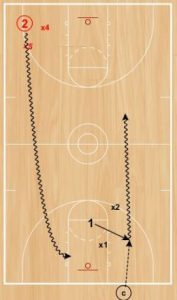
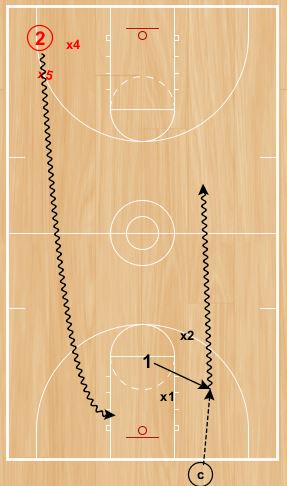
You can start the drill 2 different ways. If you want your players to work on getting open against a full court press and not catching the ball in a trap zone, you can begin the drill like the black players, offense 1 and X1 and X2.

The coach inbounds the basketball and the offensive player works to get open against X1.

If you want to put your player in a tough position and force them to get out of it, start them where the red players are O2 and X4 and X5.

Both groups from the diagram do not go at the same time, it is there to illustrate two ways to start the drill.

basketball-drills-1v2

Once the drill starts, the dribblers will go towards the opposite opposite basket from the end where they start, so it is a full court dribbling drill. If the defense steals the ball, they will attack the basket opposite from where the offense is looking to score.

Each possession lasts 20 seconds unless the ball handler loses the basketball.

You can allow the dribbler only half the floor or allow them to use the whole court. If you use the whole court, only have 1 group of 3 going at once. If you allow the to use only 1 side, you can have groups going both ways.

Here is what I think the best outcomes are for the dribbler: (5 being best outcome)

(5) Scores or is fouled shooting. For this drill, I don’t make a distinction between making a 2 point shot and making a 3 point shot, and we don’t shoot free throws. You can decide how to deal with non-shooting fouls. We handle them as no harm, no foul. I want the dribbler to be tough and not use contact as an excuse to lose the basketball.
(3) Retains dribble for the entire possession without losing the basketball and not picking it up.
(2) Picks up the dribble and can pivot without losing the ball. We don’t call 5 seconds since there are no other players to pass to. You could have a coach or another player be an outlet if you don’t like the idea of pivoting for more than 5 seconds.
(1) Commits a dead ball turnover (travel, offensive foul, 10 second violation, tied up by the defense, steps out of bounds, etc..) I would rather have a dead ball turnover than a live ball turnover because it allows us to set our defense.
(0) Misses a shot or commits a live ball turnover (loses dribble or is stripped while pivoting).

In order to motivate the defense to play hard, they can score if they make a steal. But it must be in transition. If they make a steal, they must go immediately and score in a 2 on 1 or 1 on 0. I don’t want them pulling it out. When we get a 2 on 1 in a game, I want to execution before more defenders retreat.

If the defense steals the ball and then scores or is fouled, both players get two points, even for a 3 point shot. I would rather they attack the basket on a 2 on 1 situation.

Again, these are the scoring rules that fit our system. Change your rules to fit your team.

Players compete in groups of 3 and rotate so that each player goes the same number of times on offense. Two or Three times is a good amount to have each one go. Once one possession is over, start on the opposite baseline and go full court the other way with a new dribbler.

I like to set the maximum length of a possession at 20 seconds, so we start the clock at 20 seconds when the player makes the first dribble.

Basketball Drills: Ball Screen Breakdowns

By Brian Williams on October 31, 2014

In keeping with a theme of providing drills for the start of practice, I am posting some ball screen breakdown drills that were sent to me by Nate Hill. He is the Assistant Boys Coach at Colonel Crawford High School in North Robinson, Ohio.

He provide a post where a few months ago where he outlined what he believes to be the strengths and weaknesses of five different methods of defending ball screens. Here is the link to that article on 5 options for defending pick and roll.

I think it is important for all coaches to put on paper what you believe the strength and weaknesses are for your specific team for various ways of defending ball screens and attacking those defensive strategies in your ball screen game.

That will help you to more clearly and effectively teach both the offensive and defensive ends of ball screens.

Ball Screen Breakdowns

Diagrams created with FastDraw

Start the drill with:

2 on 0 breakdown. Guards and bigs at separate baskets, working on the following ball screen reads: Hard Hedges,
soft hedges, jam and under, Switch, drops, refuse /ice, Blitz / double team.

Then move to:

2 on 2 Live: Coach chooses from under, hedge, switch, ice, drop, or trap. Offense must read the defense and make
the proper play. Offense goes for 2 minutes and switches spots on the court. Next defensive group comes in and
plays a different defense as instructed by the coach.

Here is a link to a post from a few weeks back for working on Attacking Hard Hedges

Defense Blitz

The defense gives up: pick and pops, slip pass, passes over top screen with bigger guards, slow rotations. Teams can make a pass out of the trap, and a quick extra pass to open players with good spacing.

Blitzing takes away: good shooters and drivers, forcing 1 to make solid pass, and 5 to make a shot / play. Forces players to make passes with weak hands

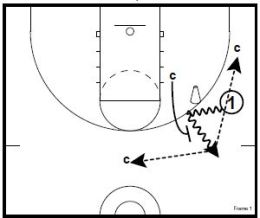
basketball-drills-ball-screen-breakdown1


Double team / Blitz = retreat dribble and pass: Coach/defender double teams the pick and roll. ball handler uses a retreat / pullback dribble and passes to coach. Coach can also incorporate slips.


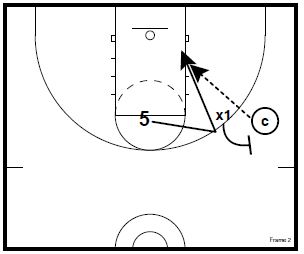
basketball-drills-ball-screen-breakdown2


Double team = SLIP: Defense traps the ball screen, big needs to dive automatically to the rim. Posts vary the finishes at the rim


Under

x1 goes UNDER screen.

The defense gives up: pull up jumpers, turning corner on drives

The defense takes away: screener rolling / slips. force ballhandler to shoot off dribble

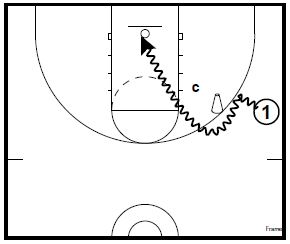
basketball-drills-ball-screen-breakdown3


Under Screen = race to rim, pull up, rescreen:
defender / coach goes under the screen. Ballhandler races defender to the rim, takes pull up jumper, and change directions for a rescreen. Vary your finishes, set up screen with jab or dribble move.


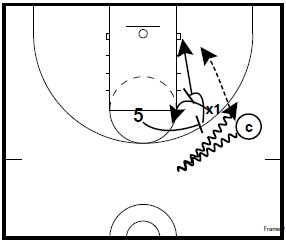
basketball-drills-ball-screen-breakdown4

Under Screen = RESCREEN: Defender goes under the screen, the big can RESCREEN and Roll

If you would like to see the remainder of the document and all 5 scenarios, Click Here for Ball Screen Breakdown 2.0


Basketball Plays BLOB vs 2-3 Zone

By Brian Williams on October 30, 2014

This post has two ideas for plays to run against 2-3 zones.

The first is a Baseline Out of Bounds play for a three point shot from Purdue.

The second is a quick hit to get the basketball inside from Kansas.

These plays are from Scott Peterman’s Zone Offense and Zone Defense notes collection.

I have several playbooks available in bundles of 4 for $35. You can make your selections here: eBook bundle pricing

Purdue BLOB

Diagrams created with FastDraw

basketball-plays-1


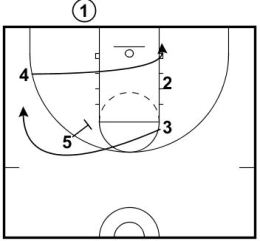
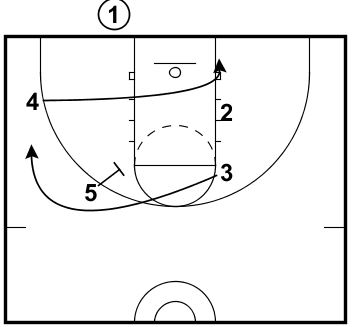
The action begins with 4 making a hard cut out of the corner to carve out space on the opposite block in front of the weak side defensive forward.

If he does a good job, it draws the middle defender towards him as well.
At the same time, 3 loops from the weak side elbow to the strong side wing with 5 screening in for him.

basketball-plays-2


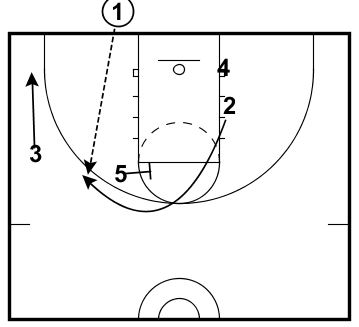
In diagram 2, you see 2 follow a similar path once 3 has cleared the wing area.

2 should be open on this as the ball side guard defender will have chased 3 and the opposite side guard is caught
on 5’s screen.

This is consistently an open three for the Purdue player in this position.

Kansas Zone Quick Hit

basketball-plays-3

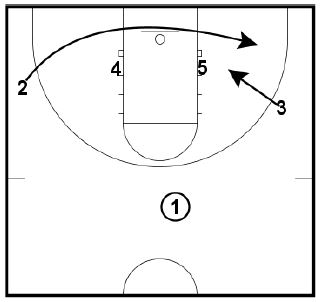
Starting in 1-2-2 set, the action is initiated by the 2 wings running into a cross.


2 goes first with the goal being the two wings crossing each other’s body on the right side of the lane.


basketball-plays-4

Rather than popping out to the wing, 3 steps to screen for 4.

4 gets another cross screen from 5 and cuts underneath the rim to a spot just below the block to catch a post entry pass from either 2 or 1.


Basketball Drills 2 Minute Weak Hand Combo

By Brian Williams on October 29, 2014

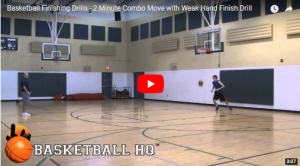
I like this move for working on weak hand finish drills. I also like keeping a score with the two minute time limit for the drill. The drill also forces players to finish when they are fatigued as they get close to the two minute time limit.

It does allow players to work on combo dribble moves, but if you feel it is taking the players too many dribbles to get to the basket, you can take the combo portion of the drill out, or have players start a step off the arc to make the combo move and minimize their dribbles.

Take the things you like and leave out anything that you don’t if you want to run a similar drill in your practices.

This video is among the basketball training videos for all levels of coaches, players, and parents that is offered by BasketballHQ. You can access their entire library with a pro membership. They offer a free 7 day trial for the the membership. If you are interested, you can see more at this link: Basketball HQ


Please make sure your sound is on to see the video. They are YouTube Videos

Click the play arrow so see the drill.

Basketball Drills 2 Minute Combo Move Weak Hand Finish

Establishing Player Roles and Soliciting “Buy in”

By Brian Williams on October 28, 2014

These articles were written and submitted by retired High School Basketball Coach Dave Millhollin.

Coach Millhollin is known throughout the Sacramento area for his Boys Varsity teams’ fundamental soundness, discipline, unselfishness, team defense and overachievement. Dave Coached for 27 seasons and compiled 391 wins. I have included more information about his coaching career at the end of the article.

If you would like to contact Coach Millhollin, email me and I will put you in touch with him.

Article #1 Loyalty and leadership

Two types of loyalty; (one genuine, one obligatory):

Freely given type (genuine loyalty):

This kind of loyalty is given to a caring authority by members of the group based on trust.  The authority figure expects results for the benefit of the institution as well as the group and all of its members. Group members are valued and recognized for exceptional performance. This creates an environment where group members want to produce expected results; they feel like they are working with their leaders.  A culture of shared accountability exists and leaders are respected.

Demanded type (obligatory loyalty):

This kind of loyalty is taken from members of the group by a demanding authority using intimidation and manipulation based on creating fear.  The authority figure expects results for institutional or selfish reasons.  The purpose of the group’s members is to serve the authority and the institution. Group members are taken for granted, they feel like they are working for their leaders and they are afraid of consequences for sub-standard performance. A culture of top down authority based accountability exists and leaders are often resented.

Which kind of loyalty do you want for your program?

What kind of leader and authority figure do you want to be?

Article #2 Establishing Players Roles and Soliciting “Buy-in”

First of all remember you as the head coach will decide what players make your team each year and what role each player will be assigned.

During the “off season” (spring through fall) when playing off season games is legal (make sure you are not breaking any rules) try to expose your players to as much philosophy and technique stuff as you can. Use this time to INDOCTRINATE your team. Let them know what your standards and expectations are and try to solicit as much “buy in” and acceptance as possible.

GET TO KNOW YOUR PLAYERS: Observe, scrutinize and evaluate each player during this time while trying to develop a rapport and healthy player/coach relationship with each of them at the same time.

Then, either during summer team camp or sometime in the fall or at the beginning of your season, go through the following process:

Your first priority is to identify the potential “cancers” on your team and the players you can’t trust. Any prospective players that are like this that you do not think will be able to change – should not make (or be near) your team.

Secondly identify your “leaders” and your “workers”.

You should select the team based on each player’s ability to trust and be trusted, real desire to win, willingness to work and take direction and UNSELFISHNESS.

Once you have your group identified (you do not have to have your final cuts made, but you should basically know who you want on your team) by now you should know what each player can do and what basic roles you think each player should have, but………Don’t hand out or discuss roles just yet.

At this point turn the attention of your players toward the things they (as a team) want to accomplish during the upcoming season and ask them to consider what reputation and identity they want to have.

With your guidance and manipulation, make, edit and finalize two lists with the group;

  1. A list of what the team wants to accomplish (goals) and be known for (reputation or identity)
  2. A list of what is going to be necessary to accomplish the goals and establish the stated reputation

Each player gets a final copy of both lists

The next step is to have each individual make a list of three things they are willing to individually sacrifice in order to help the team achieve its goals.

As the coach, you know what you need each player to do –individually— and you know what role you need each player to have in order for your team to be successful.

So it is after all this and in the context of the “team” that you get down to distributing individual player roles. Each player role is going to be predicated on affecting the goals of the team (winning).

Visit with each player individually, have them bring the goals and what’s necessary lists as well as their individual sacrifice list to the meeting (three lists).

Look over and discuss the individual sacrifice list with each player, then make the statement something like this: “In order for us to accomplish our goals this season; this is what we need you to do…….This is what we need your role to be…….   Take the time to thoroughly go over each player’s role with them, answer their questions, make any necessary adjustments and be very clear what the expectations are and how important it is for the team that their role is carried out to the best of their ability. After you are satisfied that the player understands and is committed to his/her role – ask for another list of three things that he/she is willing to commit to that will help their team achieve its goals. Let them know that each of their teammates will see and hold them accountable to their list.

This list gets printed up and distributed to each player. All players must understand and appreciate not only their own role, but the roles of each of their teammates as well. They can hold one another accountable.

You want to create an environment where it is not the comparison of roles that is important, but the execution of each role. Each player’s value should not be defined by the role they get but rather on how well they perform their roles. Everyone gives and receives credit and criticism as necessary and the goal is accomplishing the team goals (winning).

Individual accomplishment and recognition is accomplished in the context of unselfishly committing to the goals of the team. Each player aligns his personal goals to the goals of the team.

About the author of this article, Coach Dave Millhollin In fourteen years at Ponderosa High School, Coach Dave’s teams won 260 games (.665). From 2000 through 2009 Ponderosa won 207 games over a ten year stretch which included four SVC Conference Championships and two CIF Section final four appearances. Over his 27 year Boys Varsity Coaching career, Coach Dave posted 391 wins, produced 20 college basketball players and was named SVC Coach of the Year four times. At Ponderosa, Coach Dave’s teams were #1 in California in team defense five times and in 2008 Ponderosa was the top defensive team in the Nation among shot clock states. Over Coach Millhollin’s last five seasons (2005-6 through 2009-2010; 136 games) Ponderosa averaged a composite 50% total field goal percentage, 58% two point field goal percentage and 32% three point field goal percentage. Since retiring from High School coaching in 2010, Coach Dave has been actively involved in coaching Jr High level School and AAU teams as well as and running instructional basketball clinics from the primary grades through the College level.

  • « Go to Previous Page
  • Page 1
  • Interim pages omitted …
  • Page 173
  • Page 174
  • Page 175
  • Page 176
  • Page 177
  • Interim pages omitted …
  • Page 288
  • Go to Next Page »

Primary Sidebar

  • Twitter
  • Facebook
  • Linkedin
coachestoolbox
personaldevelopmenttoolbox
basketballplayerstoolbox
basketballtrainer
athleticperformancetoolbox
coachingbasketball

© Copyright 2026 Coaching Toolbox

Privacy Policy