• Skip to primary navigation
  • Skip to main content
  • Skip to primary sidebar

  • Basketball Plays
    • Ball Screen Sets
    • Horns Sets
    • Man to Man Post Up
    • Man to Man Isolations
    • Backdoor Plays
    • Man to Man 3 Point Shot Plays
    • 2-3 Zone Attack
    • Baseline Inbound Plays
    • Sideline Inbound Plays
    • Combination Defense Attack
  • Drills
    • Defensive Drills
    • Offensive Drills
    • Competitive Drills
    • Passing Drills
    • Rebounding Drills
    • Shooting and Scoring Drills
    • Toughness Drills
    • Transition & Conversion Drills
    • One on One Drills
  • Blueprint
  • Practice
  • Mental Toughness
  • Skill Development
  • Offense
  • Defense
  • Store

Basketball Drills Inferno Toughness

Basketball Drills Inferno Toughness

By Brian Williams on January 12, 2015

Diagrams created with FastDraw

Editor’s note from Brian: You might want to start out with one or two minutes rather than 4 minutes and have your players build up to 4 minutes. Especially for younger teams.

The drill was contributed by Coach Greg White. He had these comments about the drill:

One of my favorite drills is The Inferno. It immediately raises the intensity level or shows the lack of it.

What you’ll need: 3 Passers, 4 Offensive players, 4 Defensive players, 1 Basketball

Inferno Toughness Drill

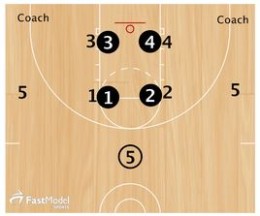
Players begin on the elbows and blocks. This drill is for 8 minutes. The team’s roles will switch at the 4 minute mark. There are no substitutions for the 8 involved. When the ball is at the top, the offense down screens. When the ball is on the wing, players screen across.

To keep the drill competitive, and it won’t take much, use one of the following scoring systems:

Each catch = 5 defensive pushups (5 keeps the speed going plus a good screening group will average 20 catches in 4 minutes)

Each catch = 1 pt for elbow catch, 2pts for catch on the block. Keep track and at the end of 8 minutes losing team has a reminder drill.

Each catch = live four on four. Offense gets whatever shot they score, Defense gets 2 for a stop, 3 for a charge, etc..

basketball-drills-inferno-toughness1

Offensive Players Start on on Elbows and Blocks.

This is an 8 minute drill: Switch Offense and Defense at 4 minute mark. No Substitutions!

OFFENSE RULES: MUST CATCH ON ELBOW OR BLOCK

DEFENSE: Don’t Let The Offense Catch on the Block or Elbow

You decide how to make it competitive. You can go live on the catch. Stop on the catch-keep score for catches or defense 5 pushups for every catch.
basketball-drills-inferno-toughness2

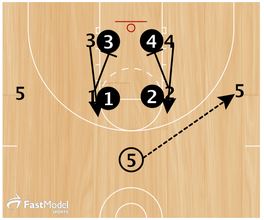
When the Ball is up top, Offensive Players down screen.

If passer can’t get a pass to either elbow, he passes the ball to the next passer to continue the drill.
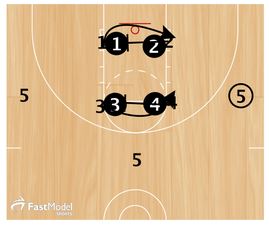


basketball-drills-inferno-toughness3


When the Ball is on the wing, players screen away from the ball
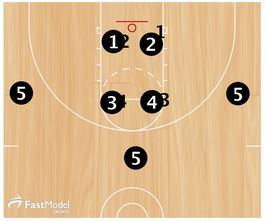


basketball-drills-inferno-toughness4

At the 4 minute mark, switch sides.

DO NOT SUB IN FOR THE 8 PLAYERS IN THE “INFERNO”


Coaching Basketball: Analytics That Improve Your Team

By Brian Williams on January 9, 2015

As coaches continually look for ways to improve their teams, I believe that analytics will be one of the next major trends that filters down from NBA and WNBA through college and eventually to high school.

To give you an idea of what is being measured, I have included some links to samples of an NBA teams stats pages at the end of this post. For shooting, they break down effective field goal percentage (link is to the previous post on effective field goal percentage) by catch and shoot, dribble pull-up shots, how many dribbles prior to the shot, how close the nearest defender was, and how far into the shot clock the shot was taken. The NBA pages also have examples of metrics of Dean Oliver’s four factors that correlate to winning.

Not all of those will have significance for you, but I have had experience with different players and teams where presenting statistical data about our performance has made a difference to our success. At different times and with different teams, I have measured factors such as how long we had the ball before shooting, a specific individual post player’s shooting percentage on the right block compared to the left block, a specific perimeter player’s shooting percentage for catch and shoot compared to one or two dribble pull ups made a difference in our performance and our number of victories.

The important data points vary with each new season and new player combinations, but determining what metrics make an impact each year is a part of the art of coaching.

Having been at a couple of small schools, I realize that you can’t measure everything but I truly feel that by investing the time to focus on a few key analytics and applying them not to both evaluate your players and team’s performance, and to determine and teach the most effective style of play. Mining Key analytics is a project that an assistant coach or a capable manager can have delegated to them.

“Touch Time”

Here is one stat that you might be able to use with your players as you practice or play summer league games to help convince them that the best teams pass and move the basketball and don’t hold it. Touch Time may not be the analytic that you are looking for, but I have always been a believer that “anything that is measured and watched improves” because you and the players will place more of an emphasis on it. Find something that you can improve in your program by measuring it.

Touch time is defined as the amount of time a player has the basketball prior to shooting. Stephen Shea (PHd Mathematics, Wesleyan University) wrote an article on his site regarding touch time and its correlation to effective field goal percentage. I have also included a link to that article below.

The findings were that, on average, NBA players who shoot in less than 2 seconds after getting the ball have an Effective Field Goal Percentage of .54. The Effective Field Goal Percentage of players who shot with a Touch Time of between 2 and 6 seconds dropped to .44. If the player had the ball for more than 6 seconds before shooting, the EFG% is slightly less than .44.

According to Shea, during the 2014-15 NBA regular season, the Atlanta Hawks had the highest percentage of shots taken with less than two seconds of touch time. Atlanta’s Head Coach, Mike Budenholzer, spent 18 years on the San Antonio Spurs staff, and know the type of ball movement that the Spurs play with.

Shea also points out that this data includes all clock situations and transition shots. I believe that it would be more helpful for high school and college coaches to know the numbers for half court offense, the breakdown for man to man defense and zone defense, and probably other scenarios that I am leaving out. I do definitely think it is something to think about for how your team players and team score most effectively. It is also worth considering having a manger use his or her phone as a timer and your game or practice video to collect some hard data.

I am not suggesting that you can use all of the ideas from the NBA you don’t have the time for that. I am also not suggesting that every statistic is relevant for every team . What I am suggesting is that it is at least worth taking some time to be aware of where basketball data is trending and will continue to trend over the next few years. I also believe that if you can find data and hard numbers for when your players are and are not effective, you can use it as one additional piece of evidence as you teach your players how you want them to play.

To see an entire article written by Stephen Shea regarding touch time, click here: Touch Time

For more ideas on how the NBA uses analtyics, here are some links as to what they track (Hope it gives you some thoughts on a stat or two that can help your team):

If you look at the links on the top navigation bar, you can find links to other data that they track.

Field Goal Percenetage on 1 Dribble. You can change the filter at the top of the page where it says “Dribble Range” to select different numbers of dribbles.

Field Goal Percentage Early in the Shot Clock (18-22 Seconds)

Field Goal Percentage with Touch Time 2-6 Seconds

Team Stats “Hustle Plays”

Again, if you are interested in seeing more, just check out the nav bars at the top of those pages. I know you can’t do even close to all of them, but you might find one idea that will help your players focus on being more effective at playing the way you need to play to win.

Basketball Drills Don Meyer Free Throw Games

By Brian Williams on January 8, 2015

These free throw games can give you some ways to practice shooting free throws that break up your routine and add a change of pace for summer practices and camps.

Make 25 without missing two in a Row

  • Cant miss 2 in a row
  • If you miss 2 in a row, you have to swish the next shot to stay in
  • Run if you fail

4 Up

  • Split into teams–teams take turns shooting free throws
  • Players get one free throw, then rotate shooters
  • 1 team has to get 4 shots ahead of the other team
  • Each player needs to mimic the shooting motion (even if you are not shooting)
  • Push ups for losers

Beat Steve Nash

  • Make a FT = +1 Miss a FT = Nash +3
  • 1st one to 10 wins

FT Point Game

  • Make 4 pts with 3 FT shots
  • 1 make = +1 point
  • 1 swish = +2 points
  • 1 miss = 0 points
  • Can split into groups of 1, 2 or 3

+2 -2 FT

  • Swish = +1 Miss = -1 Make with rim = 0
  • Goal is to get +2 before -2

16 FT in 6 Minutes (1-and-1 situation)

  • Miss 1st FT you run a killer (5 dribble max on the length of the court)
  • If you miss the back end of the one and one, you run up and back 2 times with the ball
  • If you make both FT’s, you have 1 sprint up and back with the ball
  • Note: you can also use NO rebounder
  • To win you must make 16 free throws in the 6 minute time frame

Team 1-and-1

  • 1 at each basket
  • Shoot the front end of a 1-and-1 FT —- set a team goal
  • If they don’t meet the goal – team runs

Buy the Bank

  • Teams of 3 – Alternate shots
  • 1 point for each make —- team accumulates points
  • Whoever misses accumulates those points

Cheer Free Throws

  • Take turns shooting Free Throws
  • If they miss, they run
  • Those not shooting clap and cheer for the person shooting
  • If someone is not cheering, team runs

Bubba FT

  • Bubba = 75 Team = 73
  • 3 people per team – all get 1 shot attempt —- 1 point per make

Scrimmage

  • When a player is taken out of the scrimmage
  • Has to make 6 FT’s in a row before he can come back in and play

Finish the Game FT Drill

  • Score is Home 44, Guest 43
  • All Players (starters and reserves) shoot a one and one.  Game is over after each player has shot.
  • Home Team scores a point on a make
  • Your Opponent gets 2 points for a miss
  • Players not shooting should line up on the lane lines while waiting to shoot or after shooting
  • You can change the starting score to challenge your team

These defense and rebounding basketball drills used by Bob Huggins and Larry Shyatt are from Coach Scott Peterman of the Men’s Basketball Hoopscoop Coaching site.

If you are interested in adding to your Coaching Toolbox take look at what I believe is our best offer.

CLICK HERE to select from a list of more than 70 eBooks.


Coaching Basketball Tight Curl Footwork

By Brian Williams on January 7, 2015

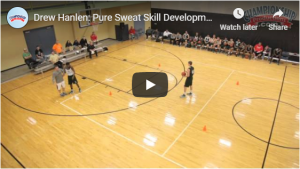
Today’s post is a two and a half minute video of Skill Development Coach Drew Hanlen teaching footwork coming off a tight curl pindown to create separation from the defender. You might agree with the technique, you might not, but I hope it provides you with some food for thought.

The video is a You Tube video so make sure that you are on a server that allows You Tube access.

If you are not, I have a link to be able to watch the video on the Championship Productions site.

Make sure your sound is on and click the play arrow to see the video of the drill below. They are slightly different versions, but it does give you a few things to think about.

If you cannot see the drill below in You Tube format, you can use the link below. It will take you to the Championship productions site, click the play arrow on the video icon.

Drew Hanlen: Pure Sweat Skill Development

There is nothing to purchase to see the drill, however if you are interested in purchasing this or any other Championship DVD, you can use this link:

Drew Hanlen: Pure Sweat Skill Development

The video is 2 minutes and 37 seconds long.

Coaching Basketball: Little Things Make a Big Difference

By Brian Williams on January 6, 2015

These 2 articles were written by Basketball Strength and Conditioning Coach Alan Stein.

I hope it is something that you can add to and share with your players.

Little Things Make a Big Difference

by Alan Stein

Championships aren’t always won with extraordinary players.

They are also won with ordinary players, doing the little things, extraordinarily well.

Who does all of the little things to make your team successful?

  • Who takes charges?
  • Who dives for loose balls?
  • Who hits crucial free throws?
  • Who talks on defense?
  • Who sets solid screens?
  • Who makes the extra pass?
  • Who boxes out every possession?
  • Who sprints the floor in both directions?
  • Who is never late?
  • Who does all of the above, every day, in practice?

Who stands up and claps when a teammate comes out of the game?

Who doesn’t care how many points they score or how many minutes they play?

Who only cares if the team wins and if they did everything in their power to contribute?

Every team needs players like this.

The more players you have, the better your success.

Because little things make a big difference.

And doing these things is a choice.

It doesn’t matter how old you are, how tall you are or high you can jump.

These things are all about effort and attitude.

Every single characteristic listed above is 100% within a player’s control.

Be THIS Player

by Alan Stein

A good friend of mine, Chris Lun (Head Basketball Coach at Whitman High School in Bethesda, MD), reminds his players every day to be the type of player that is…

Easy to play with and hard to play against

Despite its simplicity, that is a very powerful concept.

It is solid advice for players of every age and every level.

Make a conscious effort, in every practice and every game, to do all of the things that your teammates love and your opponents hate:

  • Box out on every shot
  • Close out with a high hand
  • Sprint the floor both ways
  • Make hard basket cuts
  • Crash the offensive glass
  • Bump all cutters
  • Set solid screens
  • Keep the ball out of the paint

If every player on your team makes a commitment to this concept, you will become the best team you are capable of.

Conversely, make sure everyone on your team avoids these Championship Killers:

Play hard. Play smart. Stick together.

Alan Stein
Pure Sweat Basketball

Click the following link to read a chapter from my eBook 130 Little Ideas That Make a Huge Difference in Your Program

Basketball Plays Husky Zone Set

By Brian Williams on January 5, 2015

This quick hitting set play to get the ball inside against a 2-3 zone defense is posted in the FastModel Sports Basketball Plays and Drills Library

The site has thousands of drills and plays that have been submitted by basketball coaches from around the world.

You can also find out more about FastModel Play Diagramming software by clicking this link: FastDraw

This post was made by Louisville men’s assistant video coordinator Michael Bowden.

I have also listed a couple of other ideas for quick hitters to run against a 2-3 zone at the bottom of the post.

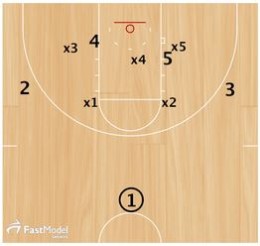
Here is the starting formation:


basketball-plays-husky-zone-set1


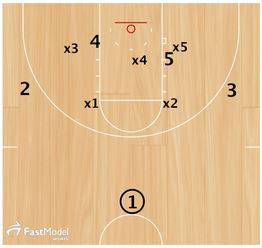
basketball-plays-husky-zone-set2

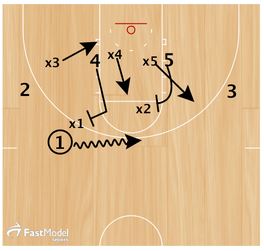
4 and 5 screen the top of the zone

These are the zone movements you are trying to force.

x1 is stuck in screen of 4

x2 is screened by 5

x4 steps up to help

x5 is ready to stunt/guard 3

basketball-plays-husky-zone-set3

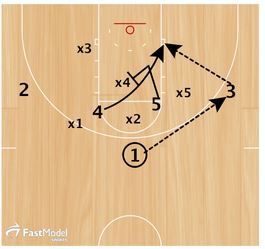
5 screens x4 and 4 flashes to the ball side block

You can space the rest of your players according to your feed and space rules.


Here is a quick hitter to use to get a corner three: Stack

This play results in a medium range shot for a post player: Overload

  • « Go to Previous Page
  • Page 1
  • Interim pages omitted …
  • Page 167
  • Page 168
  • Page 169
  • Page 170
  • Page 171
  • Interim pages omitted …
  • Page 288
  • Go to Next Page »

Primary Sidebar

  • Twitter
  • Facebook
  • Linkedin
coachestoolbox
personaldevelopmenttoolbox
basketballplayerstoolbox
basketballtrainer
athleticperformancetoolbox
coachingbasketball

© Copyright 2026 Coaching Toolbox

Privacy Policy