• Skip to primary navigation
  • Skip to main content
  • Skip to primary sidebar

  • Basketball Plays
    • Ball Screen Sets
    • Horns Sets
    • Man to Man Post Up
    • Man to Man Isolations
    • Backdoor Plays
    • Man to Man 3 Point Shot Plays
    • 2-3 Zone Attack
    • Baseline Inbound Plays
    • Sideline Inbound Plays
    • Combination Defense Attack
  • Drills
    • Defensive Drills
    • Offensive Drills
    • Competitive Drills
    • Passing Drills
    • Rebounding Drills
    • Shooting and Scoring Drills
    • Toughness Drills
    • Transition & Conversion Drills
    • One on One Drills
  • Blueprint
  • Practice
  • Mental Toughness
  • Skill Development
  • Offense
  • Defense
  • Store

Teaching Ball Screen Reads

Teaching Ball Screen Reads

By Brian Williams on March 11, 2015

Today’s post is an idea for a system that you can adapt to your practices to help your players develop decision making skills when coming off on ball screens.

These ideas were posted by Coach Greg White in the FastModel Sports Basketball Plays and Drills Library

The site has thousands of drills and plays that have been submitted by basketball coaches from around the world.

You can also find out more about FastModel Play Diagramming software by clicking this link: FastDraw

I am not suggesting that this is exactly how you will teach your decision making reads or tree, but I hope it gives you some food for thought to do some sustained thinking and develop your own that fits your offensive philosophy.

That will also help you to improve the drills that you are currently using to teach players to read the play in the manner that you want.

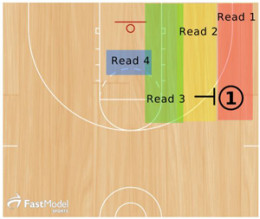
 Wing Ball Screen Reads
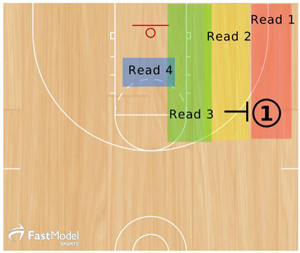
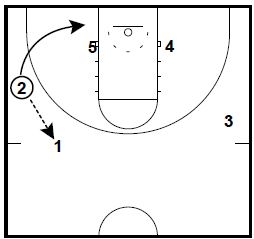
ballscreenreads1This is the tool we use when teaching guards how to use a ball screen on the wing. This chart, accompanied with breakdown drills creates a great understanding of the play.


Read 1

  1. Can I reject AND Get to the block?
  2. What am I hearing? (Trap, Switch, etc)

Read 2

  1. Where is the Screener’s defender?
  2. Can I split?
  3. Where are his hands (bounce pass or chest pass)
  4. Where is the help defender?

Read 3

  1. Is the Roll still there?
  2. Preparing for Elbow Jumper
  3. Looking at Opposite Post
  4. Find the Open Shooter. pass

Read 4

  1. Finish
  2. Pass to Corner 3

Slot Ball Screen Reads
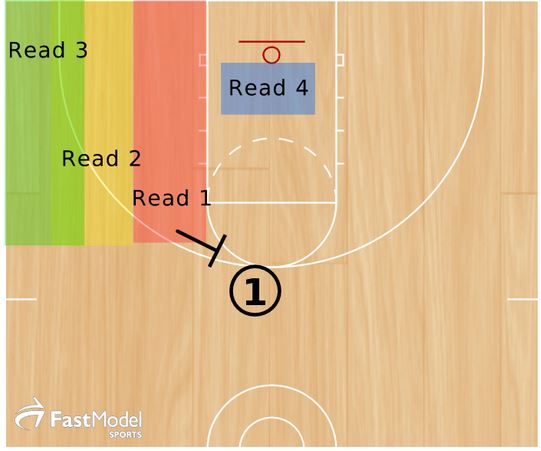
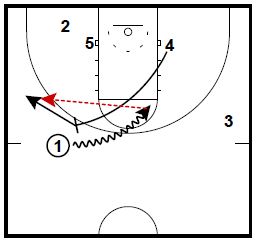
ballscreenreads2Read 1

  1. Do I see the Hedge?
  2. What am I hearing? (Trap, Switch, etc)

Read 2

  1. Did They Switch?
  2. Did the Hedge stay with me?
  3. Can I see the rim?
  4. Who is the help defender?

Read 3

  1. Is the Shooter open?

Read 4

  1. Finish
  2. Pass to Post
  3. Pass to Corner

Small Side Game

Here is a Small Side Game to use to teach the Slot Reads. This focuses on the spacing, reads and actions of the players involved.

You can come up with similar games or drills to teach the reads that you use in your system.

ballscreenreads3

1 comes off the slot screen and reads:

The hedge – did it stay?

The switch – Wait for Dive

The Help – Pitch to 2 for the shot
 

Coaching Basketball: Assistant Coach Qualities

By Brian Williams on March 10, 2015

These articles were written by Alan Stein on his Stronger Team Blog.

Assistant Coaches Code:

  1. Your #1 job is to make your head coach’s job easier. Be a servant leader. Find what your head coach needs you to do and do it!
  2. Act as if it is your team. You will have your own team one day. Act like it now.
  3. Do what you can, with what you have, where you are. No excuses.
  4. Add value to everything you do, every single day… on and off the court.
  5. Enforce the team’s culture and standards at all times. Protect the locker room.
  6. When you find a problem… find a solution. Your head coach has enough problems as it is.
  7. Be professional. Period.
  8. Encourage and motivate everyone in your program to buy in to what the head coach wants – from players, to managers to other assistants.
  9. Bring energy, enthusiasm and effort every day.
  10. When asked for your input, speak honestly. Don’t be a ‘yes’ man (or woman).

Coaching Absolutes:

  1. Don’t focus on winning (outcome); focus on preparation, effort and execution (process).
  2. Winning is a result of:
    The execution of the fundamentals
    The ability of 5 players to work in unison… every possession… both ends of the floor.
  3. A team can only reach it’s true potential if:
    The most talented player is also the hardest worker
    Everyone in the program buys in to the ‘We > Me’ concept
    Each player is in peak physical condition
  4. You either accept it or you correct it.
  5. You play the way you practice.
  6. Alan Stein

ABCs of Success

Here are the ABC’s of success:

A – Adapting, Asking

B – Believing

C – Caring, Challenging, Creating

D – Dreaming, Defusing

E – Engaging, Envisioning, Evaluating, Evolving, Educating

F – Failing, Focusing

G – Growing, Grinding

H – Helping

I – Innovating, Inspiring

J – Juking, Juggling

K – Knowing

L – Leading, Learning, Listening, Loving

M – Mentoring, Mending

N – Networking

O – Objecting, Outworking, Observing

P – Preparing, Pursuing, Pushing

Q – Questioning

R – Reaching, Reading, Resolving

S – Searching, Seeking, Serving, Sharing, Simplifying, Striving, Smiling

T – Thinking, Tweaking

U – Understanding

V – Viewing, Voicing, Valuing, Varying

W – Working

X – Xeroxing (‘copying’ – couldn’t leave X out!)

Y – Yearning

Z – Zigging and Zagging

Now you know your ABC’s… I hope you’ll do these things with me!

Hardwood Hustle Blog
http://www.About.me/AlanStein

Basketball Plays: 21 Zone Baseline Inbounds Plays

By Brian Williams on March 9, 2015

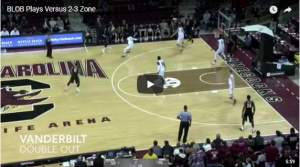
Army Men’s Assistant Coach Zak Boisvert has assembled some of his favorite baseline inbounds plays to run against a 2-3 zone defense.

His YouTube channel has several videos with various types of man-to-man plays, zone sets, and inbounds plays. You can subscribe to receive an update when he posts a new video Zak Boisvert You Tube Channel

You can follow him on Twitter at this link: @ZakBoisvert

Click the play arrow to see the plays.

Some plays are shown more than once.

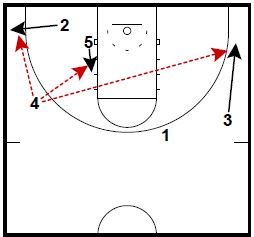
The teams don’t always score on the plays, but I hope that you can get some ideas for some cuts, screens, and movements that you might be able to use either in your Under out plays against a 2-3 zone, or adapt them to include in your system of attacking a 2-3 zone.

Coach Boisvert has put together a pdf download. You can download it from this link: 21 2-3 Zone Sets Diagrams

Download Diagrams created with FastDraw

Basketball Plays: Michigan Zone Attack

By Brian Williams on March 5, 2015

Two zone attack sets from John Beilein’s Michigan Playbook

I hope at the very least that you can take a wrinkle or two from these sets and use them to improve what you currently run against zones.

Diagrams created with FastDraw


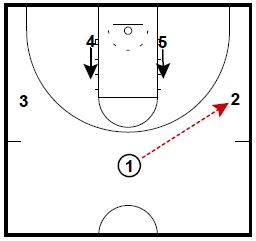
Michigan X

basketball-plays-x1

1 will pass the ball to 2

4 and 5 will move up the lane


basketball-plays-x2

2 will pass the ball back to 1

As 1 is swinging the ball to 3, 4 and 5 are coming up to screen

5 will screen the bottom/ouside defender of the zone

4 will screen the top/outside man of the zone


basketball-plays-x3

3 will either look to shot a pull up 3 or get into the lane


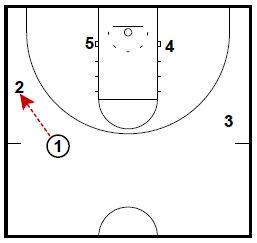
Michigan Hand

basketball-plays-hand1

1 will hit 2


basketball-plays-hand2

2 will pass the ball back to 1

2 will cut to the short corner


basketball-plays-hand3

4 will come up and set a ball screen for 1

4 will pop

1 will hit 4


basketball-plays-hand4

IF the bottom/outside defender comes out to cover 4, 4 will hit 2 for a shot

IF the top/outside defender takes 4 and the bottom/outside defender covers 2, 4 will look to hit 5 posting up the middle man of the zone

4 can throw a skip pass to 3 for a shot


Dribble, Dribble, Dribble, MISS!

By Brian Williams on March 4, 2015

This article was written by By Stephen Shea, Ph.D. You can find out more about Dr. Shea and his work in the field of Basketball Anayltics below the article.

Editor’s Note I don’t believe that this data is the only factor in determining what are and aren’t good shots in your system, but it is something to consider. It is also something to consider looking at on an individual basis for the players that take most of your shots.

On August 2, 2014, @ShaneBattier tweeted, “Kids, bottom line.  Don’t take dribble jumpers unless your last name is Nowitzki.  Thank me later.”

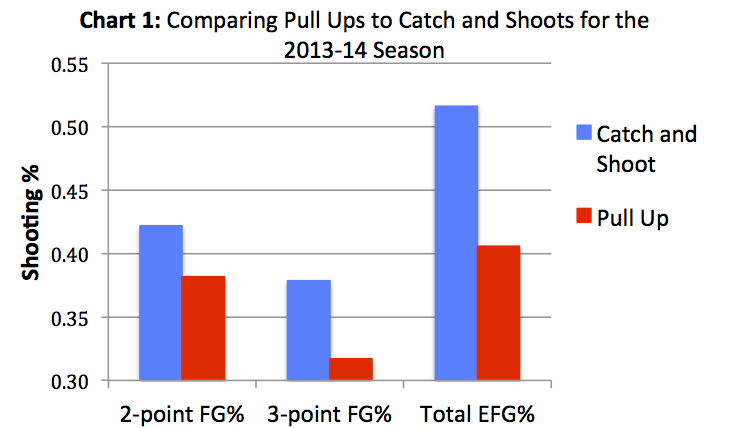
SportVU’s new spatial tracking statistics on NBA.com split jump shots by whether or not the shooter dribbled before the attempt.  If the shooter dribbled, the shot is a pull up jump shot.  Otherwise, it is called a catch and shoot.   Chart 1 below shows the FG% and EFG% for pull ups and catch and shoots for the 2013-14 regular season.   It appears that Battier was correct.  Individual anomalies (like Dirk) aside, pull up shots are quite inefficient in comparison to catch and shoot jump shots.

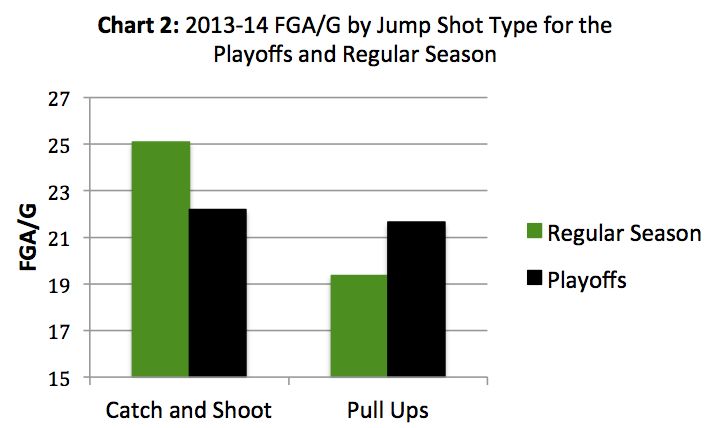
Not all minutes are equal in their importance for a team.  When a team is up 20 in the fourth quarter, it is unlikely that they will call their best plays or play their best players.  In contrast, playoff basketball is dense with meaningful minutes.  Partly due to the increased defensive intensity, teams up the number of pull ups relative to catch and shoots when the playoffs come around.  See Chart 2.  (Note that for Chart 2, we only used the 16 playoff teams in the calculation of regular season numbers.)

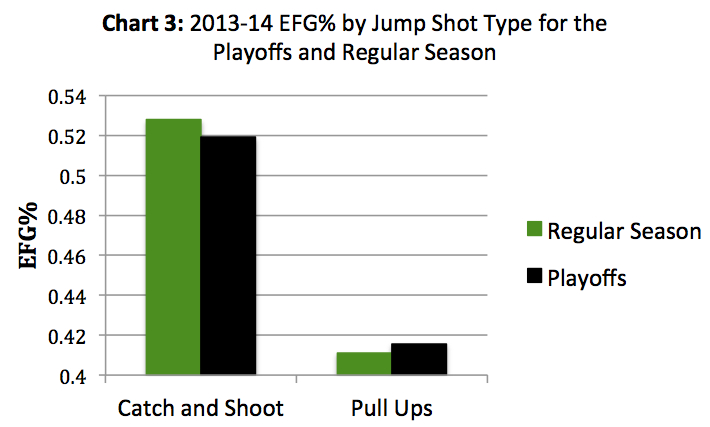
In the playoffs, teams take more pull ups, but these field goal attempts are still the far inferior shot.  Chart 3 displays the EFG% for each shot type in the 2013-14 regular season and playoffs.  (Again, regular season means only the regular season production of the 16 teams that made the playoffs.)

Charts 1 and 3 show that jump shots off the dribble are significantly less efficient than jump shots off the pass.  However, it is too simple to conclude that players need to stop taking dribble jump shots.

Players do not have equal opportunities to take high quality catch and shoot jumpers.  Yes, certain players are better at moving without the ball and putting themselves in position to catch and shoot.  Yes, other players tend to force dribble jumpers with plenty of time on the shot clock or when a teammate is in position to take a better shot.  Still, there are differences in opportunities.

Game situation and quality of teammates are contributing variables.  Players can be forced into dribble jumpers after a play breaks down and the shot clock is running out.  A player may benefit from more open looks on the perimeter because his teammate (such as LeBron) draws double teams.  Simply put, the specific percentage of shots a player gets off the pass in comparison to off the dribble is partly a reflection of the activity of the team around him.

On November 19, 2014, a match between the NBA champion Spurs and LeBron’s new Cleveland crew went down to the wire.  With 26 seconds on the clock and 15 seconds on the shot clock, Manu Ginobili stood out by half-court as the Spurs held a 1-point lead.  It was a pivotal possession—the type of possession where we would expect to see a star work in isolation.  This is the type of situation where Durant, LeBron or Carmelo might be given the ball in isolation and asked to work their magic.  Often, the star would dribble a few times make a move and try beat the opponent on the drive or step back to a jumper.  In either case, it would be a shot off the dribble.  The Spurs—the consummate team—showed that there are other (perhaps easier) ways to finish a game. 

Ginobili passed to Parker with 22 seconds on the clock.  Ginobili then moved to the block as Parker passed to Duncan (after no dribbles and with 20 seconds on the clock).  Ginobili faked like he was going to break to the perimeter.  His defender (rookie Joe Harris) bit, and Duncan dumped the ball to Ginobili for an uncontested layup with 19 seconds left on the clock.  Three passes in 3 seconds and Ginobili had an easy bucket.  Ginobili did not have to break down a defender and dribble to the hoop.  The great passing of the Spurs negated the need for moves with the ball.   It was a reminder of how experience, chemistry and passing ability can trump one-on-one skills.  The Spurs won the game 92-90.

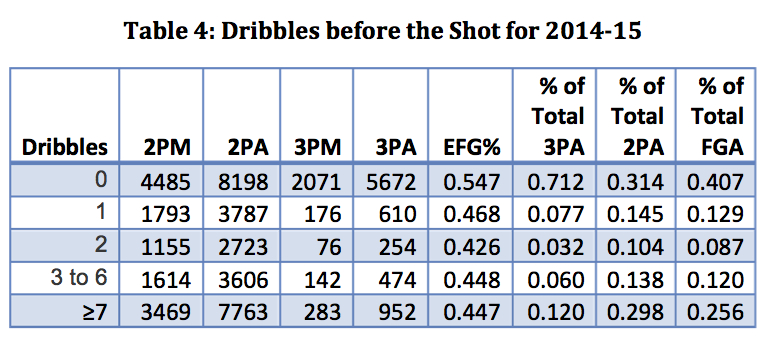
This season, NBA.com has added new sections to their stats pages.  Now, each team and player has dashboards.  One of these is a shots dashboard.  Among the new statistics on this page is dribbles before the shot (as captured by SportVU).  Here, all shots are included (not just jump shots).  So, the Ginobili layup would register as a shot with no dribbles.  Table 4 presents the league total splits of 2 and 3-pointers by number of dribbles for 2014-15 (prior to the games on Friday, November 21).  The table also splits EFG% by number of dribbles.  Shots after no dribbles tend to be more efficient.

The new dashboards on NBA.com provide another level of detail on player shot types.  Unfortunately, they are still not optimally split for certain types of analysis.  For example, it would be nice to see these numbers split by whether or not the shot occurred in transition.

Although not presented with an ideal level of detail, these new dashboard statistics are still interesting and provide information that was not previously available.

Our data on pull ups vs. catch and shoots shows that jump shots off the pass are far preferable to jump shots off the dribble.  Table 4 shows that this relationship persists when we include more than just jump shots.  But players and teams cannot simply wake up one day and decide to only take shots off the pass.   The play described above involved three players that are in their 13th season of playing together.  That type of ball movement, which was executed perfectly at a crucial moment in the game, comes with maturity and experience.  Or does it?

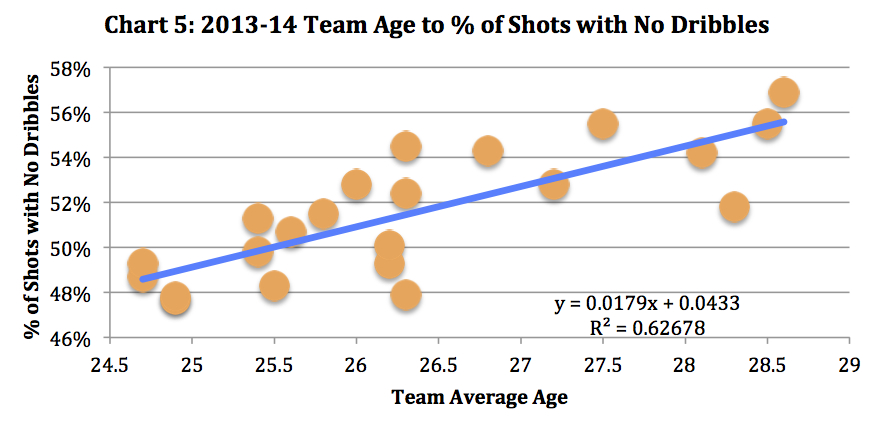
I went back and compared a team’s average age in the 2013-14 season to their % of FGA on no dribbles.  Ideally, one should weight the average age by playing time as many very good teams carry older veterans at the end of the bench and rebuilding squads fill those spots with young players that are more parts potential than production.   Instead, I’ll take the lazy way out and just exclude the 4 youngest and 4 oldest teams.  This had the added benefit of removing the Nets who added significant pieces in Garnett and Pierce in the offseason, had a first year coach and lost center Brook Lopez early in the season.  All of these could hinder the team’s ability to execute seamlessly on offense (at least early in the season).  At the younger end of the spectrum, we removed Philadelphia, a team that is …well…ummmm….planning for the future?

Chart 5 displays a surprisingly high correlation for this simple study.  It certainly appears as though players learn how to better set up teammates and players learn to look less for shots off the dribble as the team matures.

About the Author, Stephen Shea

Stephen Shea is an associate professor of mathematics at Saint Anselm College in Manchester, NH. He earned a Ph.D. in mathematics from Wesleyan University in Middletown, CT, and a B.A. in mathematics from The College of the Holy Cross in Worcester, MA. His mathematical expertise and publication record is in the areas of probability, statistics, dynamical systems, and combinatorics. For years, he has been applying his abilities in these areas to study professional and amateur sports. Stephen is a managing partner of Advanced Metrics, LLC, a consulting company that provides analytics solutions to basketball and hockey organizations. At Saint Anselm College, he runs a course on sports analytics. His sport writing has been featured in the Journal of Quantitative Analysis in Sports, Psych Journal, the Expert Series at WinthropIntelligence.com, and the Stat Geek Idol Competition for TeamRankings.com. In 2013, Stephen coauthored the book, Basketball Analytics: Objective and Efficient Strategies for Understanding How Teams Win, and co-created the accompanying blog BasketballAnalyticsBook.com. In 2014, he authored Basketball Analytics: Spatial Tracking.


Basketball Drills: Championship Toughness Shooting Drill

By Brian Williams on March 3, 2015

This video is one of the great resources available from basketballhq. They have several more videos as well as basketball coaching resource articles.

I like to end our Improvement Season Workouts with a drill that pushes players both mentally and physically. This is an example of one of those types of drills. I also think it is good to put players in a position to make a shot even if they have missed a few in a row.

Matthew Graves is the former Head Men’s Coach at South Alabama. He was an Assistant to Brad Stevens (during both of Butler’s National Runner Up Finishes) and a player at Butler prior to taking the job at South Alabama. He is currently an Assistant at Xavier.

Please make sure your sound is on to see the video.

Click the play arrow so see the drill. The drill is a You Tube video, so you will need to be able to access You Tube to see the drill.


Basketball Drills Champions Toughness Shooting Drill

You can add in different finishes or floaters to make the drill more game-like to suit your players. You can also adjust the time to complete the drill as you see what will challenge your players. Another way to run the drill would be to see how many shots a player can make in three minutes and stop the drill at that point.

  • « Go to Previous Page
  • Page 1
  • Interim pages omitted …
  • Page 161
  • Page 162
  • Page 163
  • Page 164
  • Page 165
  • Interim pages omitted …
  • Page 288
  • Go to Next Page »

Primary Sidebar

  • Twitter
  • Facebook
  • Linkedin
coachestoolbox
personaldevelopmenttoolbox
basketballplayerstoolbox
basketballtrainer
athleticperformancetoolbox
coachingbasketball

© Copyright 2026 Coaching Toolbox

Privacy Policy