• Skip to primary navigation
  • Skip to main content
  • Skip to primary sidebar

  • Basketball Plays
    • Ball Screen Sets
    • Horns Sets
    • Man to Man Post Up
    • Man to Man Isolations
    • Backdoor Plays
    • Man to Man 3 Point Shot Plays
    • 2-3 Zone Attack
    • Baseline Inbound Plays
    • Sideline Inbound Plays
    • Combination Defense Attack
  • Drills
    • Defensive Drills
    • Offensive Drills
    • Competitive Drills
    • Passing Drills
    • Rebounding Drills
    • Shooting and Scoring Drills
    • Toughness Drills
    • Transition & Conversion Drills
    • One on One Drills
  • Blueprint
  • Practice
  • Mental Toughness
  • Skill Development
  • Offense
  • Defense
  • Store

Program Blueprint

Coaching Basketball: When Players Need You Most

By Brian Williams on March 15, 2016

This post was written by Coach Mike Neighbors while he was an assistant as Xavier.

There are lessons for coaches at all levels in this article.

Have you ever wondered if you were supposed to be a coach?

Sacramento, California… ARCO Arena… March 29th, 2010… NCAA Elite 8… Stanford (34-1) vs. Xavier (30-3) Winner advances to the Final Four… Stanford had won their first three tourney games by a combined 98 points… Xavier attempting to be first non-BCS school to advance to Final Four in 11 years…

20.6 seconds to play… 51-51 tie game… Xavier ball on the side coming out of a timeout… Shot clock is off… Ball inbounded safely… All-American Amber Harris cuts off a high cross screen and draws a double team from Stanford All–Americans, Nneka Ogwumike and Kayla Pedersen… Harris finds a wide open Dee Dee Jernigan behind the defense… Amber fires a bullet pass to block… Dee Dee can’t convert the wide open two footer… Harris alertly scrambles for the rebound which she secures… As she dribbles to get space, she finds Dee Dee again even more open and closer to bucket than the first time with 9.5 to play…she misses again… and this time Stanford’s Kayla Pedersen re-bounds…

This was the moment I knew I was supposed to be a coach.

If you don’t remember the play or have never seen it, check out this link to hear Stuart Scott’s ESPN call of the action and also what followed in the final 4.4 seconds before you read on.

http://www.youtube.com/watch?v=M5Je0ludNqA&feature=related

So much of our daily routine as a coach is spent doing things in an office. We are on the computer researching opponents or recruits. We are manning a remote control watching film in preparation for an upcoming game or one of our own games/practices. We are on our phone chatting with other coaches about the latest gossip or news of the day. We are filing out paper work for an upcoming road trip. On top of that high school coaches are grading papers, filling out absentee forms, doing lunch duty, or meeting with a parent about a student’s generally poor attitude in your math class.

While vital to execution of our jobs, it is NOT what our players really need from us. If you as a coach can’t perform the necessary duties of your job without tiring out or burning out, you will never be there when your players truly need you.

I learned this one the hard way over the years. I found myself so wrapped up in “doing my job” that most times I wasn’t there to do my real job. Sure, I had some highlights. I was there at times, but wow did I miss out on so many more.

Over the last two years since that Stanford game, I have been trying to collect all the times I was there when a player needed me as well as the times I wasn’t. With help from other Newsletter group members and coaching colleagues input, I hope we can share a piece that will help young coaches from having to learn these lessons the hard way.

I can assure that your boss will never be upset if “your TPS reports are late” if you are tending to the welfare of one of your players. (Office Space reference for you non-movie buff basketball heads)

As with some previous Newsletter pieces, these are in no particular order of importance… just ramblings…

When they miss the game winning shot… We have all seen videos of coaches reacting to game winning shots running wildly around the floor looking for someone to high five or jump on. Most of the times there is no one there. You know why? It’s because the players don’t need you then!! They are mobbing each other and many times the cheerleaders and fans too.

Your player needs you the most, when they miss the game winning free throw and other people are afraid to be around them. They need you when they dribble the ball off their foot when they are driving for the win-ning basket. They need you when they get back-door cut on defense for the winning basket even though you told them during the timeout it was coming.

When they don’t play well…this is similar to the first one but not the same. This can be after a win or a loss. But your players need you when they don’t have a career night. Sure it’s fun and necessary to high five those kids and congratulate them on their success, but every coach does that. If you want to be different than most, seek out that player that didn’t play well and make sure they go home that night just as important to your team as the Player of Game. It’s a pet peeve of mine to especially to see a player who played poorly sulking after a team win and hope it is one of yours too. It’s always tempting to call that person out in front of team but only in certain situations would I recommend it. Be there for that player before they put themselves in that situation in front of their teammates… “shout praise/whisper criticism method”

When they don’t play at all… Here I am speaking to that player who has played in all your pre-season scrimmages. They had a role in some early non-conference games. But invariably, there comes a game, that for whatever the circumstance, their number isn’t called. This player needs you after the game. There certainly probably wasn’t a plan to NOT play them. It just happened. There surely wasn’t time to explain it as it was happening. But your player needs to hear from you before they leave the locker room that night. Maybe even before they go into the locker room. Even your “best team player” will need you. Apart from their own questions, they know they are going to be explaining it to family, friends, and others. Give them a few minutes of your time and help them through this situation.

When they are in a shooting slump… the very best shooters in the world have these. Your shooter needs you when they are in one. My experience that just the slightest mention of something technical whether it is true or not helps snap them out of it. A reminder of their overall shooting % sometimes put a short slump in perspective too. One thing, I have rarely seen work is ignoring it. Sure we want our shooters to have A.D.D. when it comes to misses in a game, when that slump continues, they need you. You know your player better than anyone and you can sense the proper time to approach them. Your ability to take players “out of the moment” will separate you from coaches who don’t have relationships with their players.

When they foul out…this is a situational one. We all have that player that fouls out routinely. Those kids probably can be handled with a tap on the head or a high five. But when that player that “never fouls out” does, she needs you. Most likely she has seldom not been on the floor late in games. She doesn’t even know where to sit much less how to act. Grab them and sit them with you. Don’t let them sit on the end with their head draped in a towel covering their frustration (or tears if it’s a tourney game). The players who are used to being on the bench at that time of a game don’t want them there anyway. It changes the way they act too. So, keep them with you. You still need them. If the game is still in question, they can still be a positive. If you are there when they need you most, they will at least not be a distraction.

When they are thrust into a leadership role… This isn’t necessarily something that happens during a game although it could be at times. It could be the day a senior leader graduates. It could be the day after a star player/leader quits because you took the “fun” out of the game. Whenever the time comes, your player needs you to be there. It’s not easy to be a leader on a team. It causes you to lose people you thought were your friends due to jealousy. It invests you deeper than ever. It is NOT easy. Your player needs your help. They need resources to help them navigate in the locker room. They need your support when they are forced to be a leader on the back of the bus. They need your time to talk because they don’t have as many people to talk to as they did before they became a leader. Check out Jeff Janssen’s book THE TEAM CAPTAIN’S LEADERSHIP MANUAL if you want to put a resource in their hand. Good for every coach to have in the arsenal as well.

When they call/text to ask you to shoot with them… this was one I failed at many times in my years. I can’t tell you how many times I made up excuses to not open the gym. It was inconvenient and almost never failed the call came when I was in the middle of an urgent project. It wasn’t long before players stopped asking me…mission accomplished!! Wrong…mission failure. What I learned was that 99.9% of players who ask you to shoot with them are actually saying “hey coach, I just want to talk to you about something and I am using getting some shots up as a way to break the ice.” They can shoot with anyone. In fact, what they are really saying is they want you to REBOUND/PASS for them. Some do it to prove to you that they are working extra. Fine. DO IT!! Get off your butt and work later on your project. I never miss a chance to “shoot” with players now. This request could also be disguised as “watch film”, “work on Free throws”, “improve ballhandling”.

When they lose a loved one …if this list were in order, this one would/should be #1. No basketball related situation trumps being there for a player when they lose someone they love. Outside of their loved one they just lost, there is a solid chance that you spend more time with them than anyone. And if they just lost that person, they need YOU!!

When they have a relationship go bad… This one can be touchy. Depending on the relationship you might be the LAST person they want to talk to. You don’t need details. You don’t need to offer a bunch of unsolicited advice. But, you do need them to let you know you are there for them IF they need you. Simply recognizing the situation is enough with this situation in most instances.

When they screw up…This is a broad encompassing one. It covers miss class, fail a test, late for bus, bomb a project, forget their shoes, pack the wrong uniform, break a team rule, get in trouble with law for being in wrong place at wrong time…etc. Again, your role is not necessarily to fix their problem. We tell our players all the time there is NOTHING we can do if you break the law or school policy. It doesn’t mean that we can’t be there for them though.

When they are injured… if a player plays this game long enough they will miss some time from practice or some games. It could be a sprained ankle that they need a couple of days to recover or an ACL that sidelines them for a year. They need you. They need to hear that you have a plan for them to recover and still contribute to the team while they are out. They need a role. They need to hear success stories about injured players returning better than ever. They also need to hear the reality of what happens to some players upon return that don’t properly rehab. Be there if they have surgery. Be there when they do some rehab. Be there when they can’t practice or play.

When they rehab…this is a goes with above. But needs to be said. Injured players want a plan to win their rehab just like a healthy player wants a plan to win the game. You need to get them with a trusted physician and a trusted athletic trainer to develop that plan. Not only will this help their rehab, it will strengthen your connection to that player when they return to the court. Go with them to a scheduled re-hab appointment. That small effort will have a ripple effect on your relationship with that player that will spread throughout your entire team/program.

When they are sitting out in red-shirt … This one probably pertains more to college players but more and more states are also forcing players to sit if they transfer districts. These players need you. While they are practicing with you daily, they can’t dress out and play in the games. On game days, we work our red-shirts out before the game. They come in 30 minutes before rest of players report and we get after em on the game court. The opponents are usually making their way to the court. There they are busting it!! I’ve seen opposing players literally stop their routine and watch our kid being worked out. While the purpose really isn’t to intimidate or distract an opponent, it is kinda fun. After they workout, then they have time to clean up while rest of team is warming up and join them for the game if allowed by rules. They need you throughout the year to keep them posted as they have no real way to gauge their improvement. They don’t have the chance to compete nightly, so you need to give them that outlet to keep them motivated.

When they have car trouble… Even though I am from Arkansas, I know NOTHING about cars. NOTHING!! But you can make a huge impact on players when you are there for them when they break down. I always hope for a flat tire because I do know how to change those. I can usually pull off a dead battery jump too. But after that, just being there is about all I can do. I can get them calmed down and pointed in the right direction. I have more “thank you” cards in my file for this one than any other. Just showing up is 95%!!

When they graduate…So many coaches lose contact with players after they are “done with them”. Rationalizers will say they “have a new group of players to be there for”. Wrong. You just have more. You must continue to be there for your players after they are “gone”. They might not reach out to you as often, so you actually have to do more work. You have to initiate the contact. You have to reach out. They will need you for recommendation letters. They will want to use you as a reference. I always write in our players graduation cards that they had better keep me posted so I CAN write those for them. Yes, you will spend more money on baby showers, wedding gifts, and the such. But for all they sacrificed for you, it’s a small price.

When they have a rumor going around about them… This one WILL happen, so be ready. It could be from in-side the team or just a general rumor going around. It might also involve a facebook stalker!! Don’t laugh, with social media like it is these days you better be prepared for the “someone posted a pic of me on facebook” dilemma.

When they visit a new place… I just added this one today because a player just left my office. She came in and said “coach, I know you travel a lot. My family is going to ______” what should we do? If your player comes to for non-basketball stuff/regular human being stuff, take the time to share your experiences. They may or may not even hear your feedback but them talking to you about LIFE stuff is a big step for many young people.

This is certainly not an inclusive list. Just like on the court, try to be prepared for as many situations as you can so you can properly handle the ones you haven’t prepared for.

Ideally this list sparked memories of times you have been there for your players. But if all you do is pat your-self on the back for those times, you are only getting half the benefit. You should also try to think about the opportunities you have missed out on. This is where true growth will occur. I caught myself feeling sorry for some of the players I had coached in the past. If you do to, reach out to them now. Explain that you weren’t a very good coach back then. They may not respond but they will appreciate it.

We can’t be there every time. Circumstances just don’t allow it. But the goal is to minimize the times we can’t be and maximize the times we can be. You and your program will experience a compounding effect for every time you can be.

Hopefully you’ll never have to be there for a player who misses critical shots. If you are, make her a video of all the plays she made in the game that helped put your team in a position to be there. Make a video of the critical plays she made in the Sweet 16 game to get you to that game. Have her team mates list ways her play got them to that point. Talk to her. Don’t let her go through it alone. Let her absorb the situation. NOTHING will seem like it helps at that very moment. NOTHING. You will feel helpless. But it in time, it will help her. In time, she will see the team going 1-17 from the three point line when they normally shot 35% from the arc or missing 5 free throws in last two minutes was a bigger reason for the loss.


Coaching Basketball Improvement Season Checklist

By Brian Williams on March 7, 2016

For high school coaches, regardless of whether or not your players will be moving into a spring activity, I think it is important to be there for them and for the coach to take the initiative to stay in touch and be available for them. I have always felt that players need us more when things are not going well than when they are going well.

It is also important to stay on top of all conference, all county, all state, etc… nominations and other paperwork. I think it is important to provide some positive closure to the season by spending some time thinking about and putting together a meaningful season ending banquet or informal get together.

When you are ready to start thinking about spring and summer, here is a list that was published on Bob Starkey’s Basketball Coaching Blog, hoopthoughts.blogspot.com. If you aren’t ready to move on any of these items, at least you can save it as a resource when you are ready!

Another great email newsletter from Coach Mitch Cole of our men’s basketball staff here at Texas A&M! I’ve posted a couple before but I strongly encourage anyone that has not signed up to get these monthly emails from Mitch to do so — everyone is packed with great information. Email Mitch and request to be on the list and you will regularly get stuff that will help your program.

SPRING/SUMMER THOUGHTS

More and more, coaches are finding that the spring and summer is when the most improvement can occur for our players and our teams. Every level from High School, to AAU, College, and the Pros, there are limits to what coaches can and cannot do regarding time spent with our athletes. Regardless of the limitations, coaches need to find the best approach within the rules to insure that the players are developing and improving throughout the summer.

Below are a few Categories with questions/ideas that staffs should consider regarding PROGRAM GROWTH in the spring/summer:

Skill Instruction
Do we have a plan for our players Development this summer?

If we can’t work with them, have we effectively communicated which areas they need to grow in and improve?

Is there a way we can get our older players to initiate time in the gym with the rest of our team?

Recognition, awards and charts can be a good way to provide incentive for improvement in the summer.

Strength and Conditioning
Are we measuring improvement from our athletes? Do we have checkpoints every 6-8 weeks? (Recognition for summer improvement could be a way to keep them motivated during the off-season.)

Are the methods we are using productive, but still interesting and fresh to avoid burnout?

Do our athletes understand the importance of rest, nutrition and safety in training?

Send them interesting articles on pro athletes and their testimonials on how they achieved greatness through hard work!

Open Gym
Is there a regular time for the players to shoot and play pick up games?

Are the pickup games competitive? (Lost are the days when you played in a packed gym of players dying to get on the court, but knowing if you lose, you may sit 3 or 4 games waiting to play again!) Can we create that environment?

Most pickup games hardly resemble a real game. How can we make open gym more game-like? Consider shooting Free Throws for fouls, starting possessions at half court, extra points for put-backs, etc.

Basketball Camps
Do our camps provide a healthy balance of fundamental skills teaching, shooting competitions, and 3v3 or 5v5 games?

Are our older players engaged in camps, willing to participate and impact the younger kids in the area?

Are we working to build our camps and promote the program in the community?

T-Shirts and gear are natural Billboards for your program. Buy T-Shirts in bulk and provide as many as possible!!!

Academics
Are we aware of the “at-risk” guys in our program that might need to recover classes or get ahead in the summer? Losing a player due to grades can be a program killer!

It’s been said that most students fall behind in the summer in Math and Reading. Can we incorporate a plan that might stimulate our players to read, write, or be engaged academically?

Weekly communication with links to articles, or book suggestions followed up with conversations could be useful.

Team Building
Is there a time in the summer to get together as a team and cast a vision for next season?

A short trip to a baseball game, a Team Camp, a mid-summer “Weekend of HOOPS,” a Sand Volleyball game, BBQ?

Weekly communication with positive messages or articles on TEAMWORK and STRONG RELATIONSHIPS

Are we thinking through how to eliminate distractions to our team’s growth?

Staff Development/Rest
Are we growing in knowledge as a staff each summer?

Challenge each coach to think through a few new ideas that might help in each of the above categories. Have someone on the staff take different categories like Motivation, Offensive and Defensive Concepts, new and improved Strength and Conditioning ideas, work a different basketball camp, or read a few books on leadership development, etc.

Lastly, is the staff taking time to get away? Sometimes great ideas begin to form when we have removed ourselves from the day to day activities. Recharge the batteries before the fall arrives!

Here’s How to Build a Stronger Team Culture

By Brian Williams on February 25, 2016

By Stephanie Zonars, Life Beyond Sport

Every coach I meet wants to make a difference in the lives of others. But not every coach maximizes that opportunity.

Every coach I meet takes time to define team and perhaps, personal goals. But not every coach invests time in defining his/her purpose.

There’s a big difference between goals and purpose.

Goals: shorter in duration; focused on the “what”; task-oriented; measurable

Purpose: spans longer time frame; focused on the “why”; relationship-driven; largely immeasurable

On the long highway of life, goals are the signposts and purpose is the road itself. As you move through your career, you will achieve goals. But if your identity is tied only to performance goals, you’ll always be looking backwards to find validation.

It’s why some pro athletes come out of retirement and why coaches oftentimes feel lost at the end of their careers—they don’t know their purpose apart from achieving performance goals.

But knowing your purpose—why you coach—sustains you for the whole journey. —Tweet that!

You will achieve lots of goals along the way, but your validation will come from your underlying purpose, not the goals themselves.

I can’t overstate the importance of taking the time to explore and understand your purpose as a coach or leader. The biggest reason people don’t?

Because they can’t figure it all out in an hour at Starbucks.

It takes time.

It requires slowing your pace and creating space in your brain so you can think.

It means asking yourself some tough, and sometimes uncomfortable, questions.

But here’s why it’s crucial:

If you’re a head coach, your team culture starts with you. It’s a reflection of you. And the more clarity you have about who you are and why you coach, the more clear you’ll be about the kind of culture you seek to create.

If you’re an assistant coach, you’re looking for a head coach and team culture that fits you. Nothing is more miserable than working for someone whose core purpose diametrically opposes yours. But you can’t determine what a good fit looks like if you don’t know who you are and why you coach.

Randy Hatch and Patrick Steele know why they coach the Lady Jags at Carroll Academy—to teach life skills.  Their team provides refuge, family and hope to girls who’ve experienced very little of those things in their lives.

Winning is not the main objective for Coach Hatch and Coach Steele—the Lady Jags have won 6 games in 14 years. But the record isn’t the most important thing to these coaches and players (just listen to the girls’ emotion in this ESPN video).

What matters? That they are a family. That the players learn responsibility, discipline and a whole list of other lessons.

Success to them is a team full of girls who are doing their schoolwork and not drugs.

“The losses give us the tools that we need to teach, to build self-esteem and courage.”

—Patrick Steele

These coaches are ultra clear on their purpose and fulfilling it fuels their satisfaction.

You may be familiar with Joe Ehrmann and his book InsideOut Coaching. He asks 4 poignant questions that will help get your brain working around this concept of your purpose.

If you’re serious about creating a culture where your staff and players thrive, schedule time to write down your answers to these questions. If you’ve answered them before, revisit your answers and evaluate your current season to see if they still hold true.

Why do I coach?

Why do I coach the way that I do?

What does it feel like to be coached by me?

What do I want to accomplish by my coaching?

If you’re not a coach, just replace that word with “lead.”

These questions will surface some concepts and words that will help you get closer to articulating your purpose—one of the most important steps in creating the best culture for your team.

About Stephanie Zonars

Stephanie Zonars helps coaches build and maintain winning team cultures through her business, Life Beyond Sport. Teams at Penn State, Notre Dame, West Point and over 60 other schools have built stronger trust, communication and teamwork through her workshops. Stephanie spent three years on staff with the Penn State women’s basketball team, assisting the team to back-to-back Big Ten Championships. She’s also the author of three books. For more tips on leadership and team culture, visit LifeBeyondSport

Powering Through the Dog Days of Winter

By Brian Williams on February 2, 2016

Powering Through the Dog Days of Winter

Scott Rosberg

While all sports seasons can have their mid-season “dog days,” it seems like they come on stronger during the winter season. It may feel that way because this season is in the dead of winter. The days are much shorter, the weather can be dreary and cold (depending upon where you live), and the beginning of the season seems like it was so long ago, last year in fact. So what can coaches and athletes do to help power their way through these “dog days”?

First, focus on the moment. Too often we tend to think about the past and the future, without focusing on what we are doing right now. If we live in the past, we stop finding ways to advance and grow. If we think only of the future, we forget to take care of all the things that we must take care of right now to create the future we are seeking. By focusing on this day, this hour, this minute, we zero in on what’s important now to make sure that we do all that we can to become our best.

Second, we need to make sure we are taking care of our health. For athletic teams, it seems like a no-brainer that they would be taking care of their health because they are training almost every day. And while training (exercise) is important to good health, let’s not forget some of the other keys to good health like eating a well-balanced diet, upping your intake of vitamins, and making sure you are getting enough rest, like getting 8 hours of sleep each night. Also, getting outside and enjoying nature can be very beneficial to helping one push through the dog days.

Another way to power through the dog days is to engage in mentally and emotionally stimulating exercises. Reading engaging content or literature that inspires you is a great way to get excited about living and becoming all that you can become. Many people find puzzles, board games, and various challenges to the mind and spirit to be extremely stimulating to their brains and their souls, and these can be great ways to help you deal with some of the monotony and drudgery that the dog days can bring.

One huge way to help get through the dog days is to make sure you add variety to your days. They say, “Variety is the spice of life,” and that certainly rings true when you are in a rut or feeling the monotony of the dog days. Change up the order in which you do things, or add something new and different to your routine. Anything to push you out of a rut and moving in a different direction can be truly beneficial at this time.

Another way to overcome and power through the dog days is to focus on all the positives you have going on. Positivity is a powerful force, and it can really help people get through times when they are feeling sluggish. Daily affirmations of all the good things you have going in your life can do wonders to help you feel good about yourself and your surroundings. Taking time to be thankful for what you do have and all the good people and good things you have in your life can really help to elevate your disposition and your attitude.

Finally, for those of you who have created Core Covenants (Team Standards, Guiding Principles) for your teams, the dog days are a very important time to stay focused on your covenants. Teams have a tendency to stray from the path of what they are supposed to do when the dog days start dragging them down. It’s easy to not focus as much, work as hard, and pay attention to the details that we have deemed important. By re-committing and re-focusing on the team’s covenants, you help keep the team on track to accomplishing what they set out to do. You need your covenants during the tough times more than any other time, and the dog days of your season are the perfect time to zero in on them and help your team stay the course of building the identity you seek.

The dog days can be a drain if you let them be. However, if you recognize them, address them, and work to power through them, you will soon find yourself not even feeling as if they exist at all. You will see the “light at the end of the tunnel,” and before you know it, the winter season will be coming to an end and all the excitement that time of the year brings will become your focus.

If you have any other ways that you power through the dog days of winter, I would love to hear them. Leave a comment on our Facebook page www.facebook.com/proactivecoach and let us know what you do to get through the dog days.

About the Author of this Article

Scott Rosberg has been a coach (basketball, soccer, & football) at the high school level for 30 years, an English teacher for 18 years, and an athletic director for 12 years. He has published seven booklets on coaching and youth/school athletics, two books of inspirational messages and quotes for graduates, and a newsletter for athletic directors and coaches. He also speaks to schools, teams, and businesses on a variety of team-building, leadership, and coaching topics. Scott has a blog and a variety of other materials about coaching and athletic topics on his website – www.coachwithcharacter.com. He can be reached by email at [email protected].

Scott is also a member of the Proactive Coaching speaking team. Proactive Coaching is dedicated to helping organizations create character and education-based team cultures, while providing a blueprint for team leadership. They help develop confident, tough-minded, fearless competitors and train coaches and leaders for excellence and significance. Proactive Coaching can be found on the web at www.proactivecoaching.info. Also, you can join the 200,000+ people who have “Liked” Proactive Coaching’s Facebook page at www.facebook.com/proactivecoach. Scott can also be reached through Proactive Coaching at [email protected].

Developing Leadership Capacity

By Brian Williams on January 26, 2016

Developing Leadership Capacity

The Context and Culture Make a Difference in Developing Your Team Leaders

By Cory Dobbs, Ed.D.

It didn’t dawn on me that there might be anxieties and risk involved in team learning until I put a few work teams at a Fortune 100 company under a microscope. To say the very least, what I observed was a wide-range of defensive and protective processes which ultimately closed off the team’s members from learning and instead created a variety of dysfunctions anchoring the team’s collective efforts in the harbor of mediocrity.

As a result of this work I decided to take a closer look at how student-athletes learn in a team setting, and in particular how the context influences the perceived risk involved in learning to lead one’s teammates. Upon closer inspection it became obvious that many of the risks involved in team learning in the corporate world are mirrored in the athletic world. Likewise, learning to lead in a team environment is risky business.

So, how do you get student-athletes to learn together? There are no simple answers. However, knowing that the context greatly affects learning is a step in the right direction if you’re serious about your players learning how to lead.

Leadership Development and Psychological Safety

When a student-athlete takes on a leadership role it’s important to understand that he or she will learn primarily through trial and error (which is why I firmly believe in deliberate practice—scrimmage—as a way to reduce perceived risks). If a student is learning physical geography he or she will learn in private with no one else aware of his or her mistakes. However, learning to lead in a team setting requires learning by trial and error in interpersonal interactions. Learning this way is certainly not learning in private and the consequences of actions always involve one’s teammates. Therefore, team leaders perceive risk in appearing ignorant and or incompetent in front of their peers.

Because most student-athletes have little experience at leading, which includes making mistakes in front of teammates, such fears as embarrassment and rejection are always present. And many student-athletes are reluctant to take actions or to speak up or speak out for fear that their actions may be held against them by teammates. To neutralize such fears it’s in your best interest to create a psychologically safe environment.

Let’s start with what I mean by psychological safety. It is a shared belief by all team members that the team is an environment where everyone has a sense of confidence that others will not embarrass, disrespect, disregard, or punish someone for taking action or speaking up or speaking out. All members understand that a supportive learning environment is necessary to build a psychologically safe team context.

The central idea is that a psychologically safe team environment will produce higher performing team learning and team leadership. Expressed as a formula it looks like this:

formula

At the heart of the growth of a team leader is the leader as a learner, the learning process, and the context which together form the cornerstone of leadership development. Always keep in mind that the team leader is engaging in learning a new mind-set as well as a new skill-set. That is, the student-athlete as a team leader is undergoing a tremendous transformation and that is why creating a psychologically safe environment is necessary.

Creating a Psychologically Safe Learning Environment

Years ago, during a seminar the late Peter Drucker asked an elite group of executives “How many of you have deadwood in your organization?” referring to those employees that had retired on the job. The hands of every one of the high-profile CEOs went skyward. He then asked “Were they that way when you brought them into your organization?” The implication was obvious, if they were then the leader was at fault for hiring them, and if they weren’t then something inside the organization “caused” the employee to basically give up on improving and become organizational deadwood. The point is that the context has a much more profound effect on how people behave than most leaders
realize.

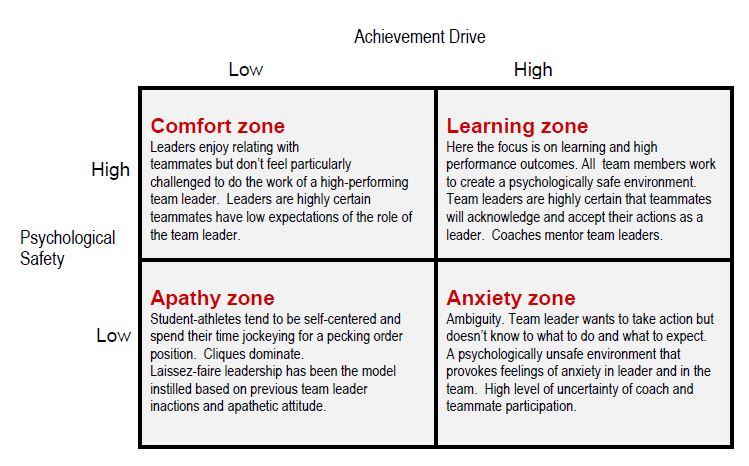
The question, then, is what can you do to create a psychologically safe environment for team leaders learning to lead? The first step is to understand your team environment as it is and how it interacts with the internal achievement drive of your team leaders. To do this, use the model below.

matrix

Hopefully the matrix above can provide a window into your current team context and how it is affecting the development of your team leaders. Psychological safety is an important component of creating an effective learning space for you and your team. The purpose of this brief article is to provide an introduction into the practice of developing a team leader’s capacity to lead through the process of team learning. When you involve all members of the team in the learning of leadership you’re more likely to create an effective learning environment.

Let me issue a quick reminder that leadership is a social influence process in which team leaders work to motivate or persuade teammates to achieve specific individual and team goals. As such, the norms, beliefs, and values that emerge from team member interactions will create team dynamics that will influence the social structure and social processes that will either enhance or inhibit team learning. Your goal as the chief architect of the environment should be to create a psychologically safe learning zone.

Ultimately, you have more to do with a team leader’s learning to lead—or not learning—than you probably thought you did. If you’re not growing team leaders, then it’s likely the problem is not the seed, it’s the soil.

“Tell me and I’ll forget. Show me and I may remember. Involve me and I will care.” -Your Student-Athlete The world of coaching is changing. In Coaching for Leadership you’ll discover the foundations for designing, building, and sustaining a leadership focused culture for building a high-performance team. To find out more about and order Sport Leadership Books authored by Dr. Dobbs including Coaching for Leadership, click this link: The Academy for Sport Leadership Books

About the Author

A former basketball coach, Cory’s coaching background includes experience at the NCAA DII, NJCAA, and high school levels of competition. While coaching, he researched and developed the transformative Becoming a Team Leader program for student-athletes. Cory has worked with professional athletes, collegiate athletic programs and high schools teaching leadership as a part of the sports experience and education process. Cory cut his teeth as a corporate leader with Fortune 500 member, The Dial Corp. As a consultant and trainer Dr. Dobbs has worked with such organizations as American Express, Honeywell, and Avnet.

Cory has taught a variety of courses on leadership and change for the following universities:

Northern Arizona University (Graduate Schools of Business and Education)

Ohio University (Graduate School of Education / Management and Leadership in Sport)

Grand Canyon University (Sports Marketing and Sports Management in the Colangelo School of Sports Business)

Coaching Basketball: Winning Priorities

By Brian Williams on December 7, 2015

This article was written and submitted by retired High School Coach Dave Millhollin.

I have included more information about his coaching career at the end of the article.

Caoch Millhollin has contributed several insightful articles to the site. You can find links to more of them at the bottom of this post under the “Related Posts” tab.

If you would like to contact Coach Millhollin, email me and I will put you in touch with him.

Authors notes about ‘Winning Priorities.’

It is not difficult for Coaches and Basketball Analyzers to come up with practical or philosophical lists or outlines like the one you are about to read. For each of the practical and philosophical priorities this article proposes; coaches must have numerous essential drills and activities to teach and reinforce each concept. In addition to drills and activities; coaches must dedicate time to explain, teach, re-teach and solidify each priority. Players must intellectually understand each concept.

Then comes the physical activity of teaching, drilling and reinforcing each priority in practice. After that comes the correction and re-teaching process and eventually the most important phase; team and individual player BUY IN. What you want is for your “Priorities or Philosophical” list to reflect how your players perform on the court. We used to call it “Philosophy in Action”. The process is not easy, but I believe the pursuit is worth it and it will help to infuse “purpose” and “identity” into your team.

WINNING PRIORITIES

  • HANDLE DEFENSIVE PRESSURE AND PRESSES
    • COMMIT NO TURNOVERS, ESPECIALLY LIVE BALL TURNOVERS
    • QUALITY OFFENSIVE EXECUTION AGAINST PRESSURE
  • DEFENSIVE CONVERSION:
    • MAKE OPPONENTS TAKE LOW % SHOTS
    • DEFENSIVE REBOUNDING
    • APPLY NECESSARY PRESSURE
    • PLAY GOOD “TEAM” AND “INDIVIDUAL” DEFENSE
    • DO NOT FOUL
  • OFFENSIVE CONVERSION
    • HIGH % SHOT SELECTION: +55FG%
    • GET THE OFFENSIVE REBOUND AND SCORE THE PUT-BACK
    • HIGH % FREE THROW CONVERSION: +75FT%
    • THE GOAL IS TO: SCORE EVERY OFFENSIVE POSSESSION!

The key is to get extremely good at the above priorities. 

Players need understand what each priority actually is; they need to understand how each priority will help to bring about winning and how important it is to become proficient in the execution of each priority. Players need to understand what their PERSONAL individual responsibilities are in relation to each priority. (THEY NEED TO UNDERSTAND THEIR ROLES)

Coaches need to learn what things they can do and say in order to train their teams to become good at each priority; this includes both physical and mental training with repetition and reinforcement.

Most coaches don’t realize that they may frequently say things and do things that actually reinforce poor execution of one or more of the above priorities, for example; allowing players to take bad shots or miss shots during a fast break drill without correction. 

Remember;

“In a player’s mind, anything that is not corrected is perceived as acceptable.”  As far at the priorities go, you must correct every thing that is not acceptable and reinforce every thing that is acceptable in order for your players and your team to become proficient at executing the priorities, therefore winning more games!

WINNING PRIORITIES (EXPANDED)

HANDLING PRESSURE AND PRESSES IS ESSENTIAL IN ORDER TO BE SUCCESSFUL.  SO THE FIRST PRIORITY IS FOR ALL PLAYERS TO HAVE THE INDIVIDUAL AND TEAM SKILLS NECESSARY TO DEAL WITH PRESSES AND PRESSURE IN ORDER TO GET THEIR TEAM INTO ITS OFFENSIVE SETS.  PLAYERS MUST ALSO HAVE THE SKILLS TO HANDLE HALF COURT DEFENSIVE PRESSURE.

THE NEXT PRIORITY IS DEFENSIVE REBOUNDING.  BECAUSE MOST TEAMS DO NOT TAKE GOOD SHOTS, IT IS ESSENTIAL THAT TEAMS TAKE ADVANTAGE OF REBOUNDING THEIR OPPONENTS MISSED SHOTS, THEREFORE GIVING THEIR OWN TEAM A POTENTIAL ADVANTAGE BY TAKING BETTER SHOTS WHEN IT IS THEIR TURN ON OFFENSE.  ALL PLAYERS MUST UNDERSTAND WHY DEFENSIVE REBOUNDS ARE SO IMPORTANT.  EACH PLAYER MUST POSSESS THE PROPER TECHNIQUES FOR DEFENSIVE REBOUNDING.

GOOD DEFENSIVE REBOUNDING TEAMS PLAY TEAM DEFENSE IN A MANNER THAT PRODUCES LOW % FIELD GOAL ATTEMPTS BY THEIR OPPONENTS; THEY DO NOT ALLOW OPPOSING TEAMS TO GET GOOD SHOTS.  THEY KEEP THEIR OPPONENTS OFF THE OFFENSIVE GLASS AND OFF FREE THROW LINE!

THE NEXT PRIORITY IS SHOT SELECTION.  THIS CAN BE THE SINGLE MOST IMPORTANT AREA OF THE GAME.

ALL PLAYERS NEED TO POSSESS THE ABILITY TO SCORE AND EACH PLAYER MUST UNDERSTAND HIS INDIVIDUAL SHOOTING ROLE; UNDERSTAND WHEN AND FROM WHERE SHOTS SHOULD BE TAKEN AND WHO THE COACH WANTS TAKING THOSE SHOTS – THIS IS ESSENTIAL FOR EACH PLAYER TO UNDERSTAND.

  HERE IS THE TYPICAL GAME SCENARIO FOR TEAMS THAT DO THE ABOVE THINGS WELL:

  • ON DEFENSE; THEY WORK HARD TO PLAY INTENSE DEFENSE WITHOUT FOULING, THEY DON’T GIVE THEIR OPPONENT GOOD SHOTS AND THEY REBOUND THEIR OPPONENT’S MISSED SHOTS
  • ON OFFENSE; THEY HANDLE THEIR OPPONENT’S DEFENSIVE PRESSURE AND GET INTO THEIR OFFENSES WITHOUT TURNING THE BALL OVER.  THEY GET THE SHOTS THEY WANT AND THEY SHOOT A SIGNIFICANTLY HIGHER FIELD GOAL % THAN THEIR OPPONENT
  • THEY WIN (AGAIN)

“WINNING” DOESN’T HAPPEN ACCIDENTLY!!

© Dave Millhollin 2018

About the author of this article, Coach Dave Millhollin In fourteen years at Ponderosa High School, Coach Dave’s teams won 260 games (.665). From 2000 through 2009 Ponderosa won 207 games over a ten year stretch which included four SVC Conference Championships and two CIF Section final four appearances. Over his 27 year Boys Varsity Coaching career, Coach Dave posted 391 wins, produced 20 college basketball players and was named SVC Coach of the Year four times. At Ponderosa, Coach Dave’s teams were #1 in California in team defense five times and in 2008 Ponderosa was the top defensive team in the Nation among shot clock states. Over Coach Millhollin’s last five seasons (2005-6 through 2009-2010; 136 games) Ponderosa averaged a composite 50% total field goal percentage, 58% two point field goal percentage and 32% three point field goal percentage. Since retiring from High School coaching in 2010, Coach Dave has been actively involved in coaching Jr High level School and AAU teams as well as and running instructional basketball clinics from the primary grades through the College level.

  • « Go to Previous Page
  • Page 1
  • Interim pages omitted …
  • Page 7
  • Page 8
  • Page 9
  • Page 10
  • Page 11
  • Interim pages omitted …
  • Page 15
  • Go to Next Page »

Primary Sidebar

  • Twitter
  • Facebook
  • Linkedin
coachestoolbox
personaldevelopmenttoolbox
basketballplayerstoolbox
basketballtrainer
athleticperformancetoolbox
coachingbasketball

© Copyright 2026 Coaching Toolbox

Privacy Policy