• Skip to primary navigation
  • Skip to main content
  • Skip to primary sidebar

  • Basketball Plays
    • Ball Screen Sets
    • Horns Sets
    • Man to Man Post Up
    • Man to Man Isolations
    • Backdoor Plays
    • Man to Man 3 Point Shot Plays
    • 2-3 Zone Attack
    • Baseline Inbound Plays
    • Sideline Inbound Plays
    • Combination Defense Attack
  • Drills
    • Defensive Drills
    • Offensive Drills
    • Competitive Drills
    • Passing Drills
    • Rebounding Drills
    • Shooting and Scoring Drills
    • Toughness Drills
    • Transition & Conversion Drills
    • One on One Drills
  • Blueprint
  • Practice
  • Mental Toughness
  • Skill Development
  • Offense
  • Defense
  • Store

Basketball Drills

Basketball Team Toughness Drill

By Brian Williams on May 14, 2014

This drill came from Drew Hanlen’s Pure Sweat Basketball Team Toughness Drill Book.

Drew is an NBA Strategic Skills Coach & Consultant that has helped over 50 NBA and NBA pre-draft players.

Drew is the founder and Head Skills Coach of Pure Sweat Basketball.

He has run his internationally renowned Elite Skills Clinics in over 30 states and 4 countries over the past four years.

Pure Sweat Combo Drill

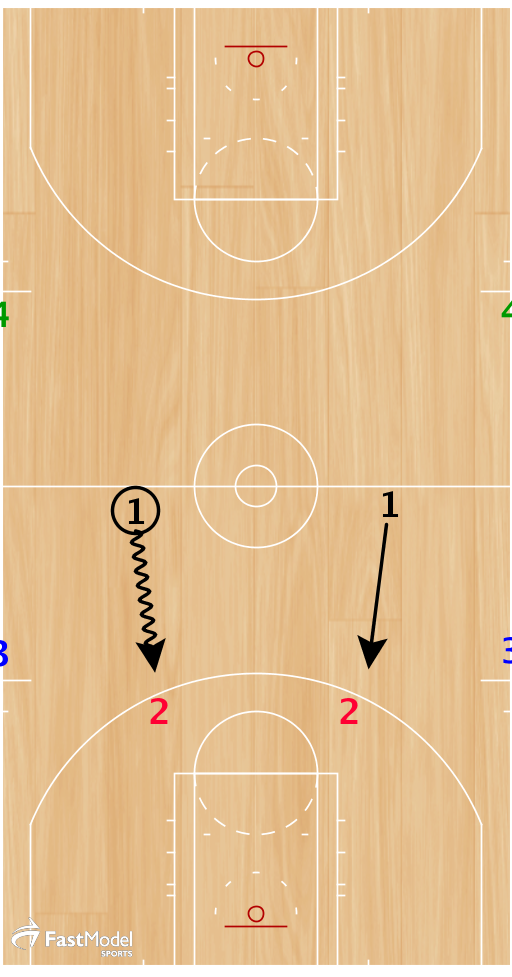
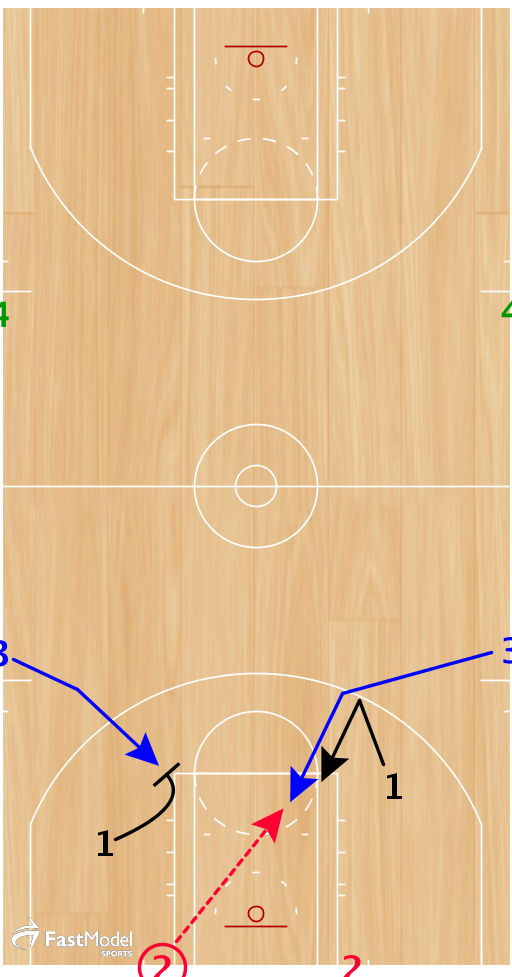
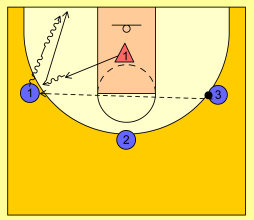
Set Up: Two ball handlers will start with basketballs near the 28-foot marks in adjacent corners. Two passers will start in adjacent corners opposite of the ball handlers.

Two defenders will start inside of each lane on both ends of the floor. All the additional players will start in lines behind the passers.

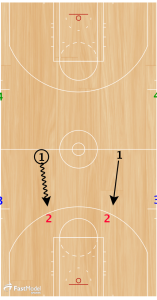
basketball-drills-pure-sweat-combo-drill

Step 1: Ball handlers will pass their balls ahead to the passer in front of them on the opposite end of the court then sprint to the elbow or three-point line on the opposite end of the court, depending on their shooting range. Passers will pass the balls back to the original ball handlers once they get to their shooting range for a jump shot.

Step 2: On the flight of the shot, the passer will crash the glass. while the defender will sprint and box out the crashing passer. Both players will pursue the rebound until one player secures the ball.

Step 3: Whoever secures the rebound will dribble outside of the three-point line then pass the ball ahead to the passer in front of them on the opposite end of the court, and then sprint to their range for a jump shot. while the player that did not get the rebound will stay in the lane as the next defender. The shooter wilt rotate to the back of the passing tine that they received the ball from.

This drill came from Drew Hanlen’s Pure Sweat Basketball Team Toughness Drill Book.

Coaching Basketball Building Great Teams

By Brian Williams on May 13, 2014

This article was written and submitted by retired High School Coach Dave Millhollin. Coach Millhollin is known throughout the Sacramento area for his Boys Varsity teams’ fundamental soundness, discipline, unselfishness, team defense and overachievement. Dave Coached for 27 seasons and compiled 391 wins. I have included more information about his coaching career at the end of the article.

If you would like to contact Coach Millhollin, email me and I will put you in touch with him.

I am always looking for good information to share. If you have an article, drill, play, or anything else that you would like to have posted on the Coaching Toolbox, feel free to contact me.

Building Great Teams

By Dave Millhollin; Retired High School Basketball Coach

Editor’s note: This is part One of Two parts for this article. I will be posting Part Two on Tuesday May 19.


Over the last two decades, much attention has been given to the concept of “Team Building” by private, public, and volunteer organizations. In all situations where groups of people are necessary to produce a product, generate revenue, or provide services, the groups that work best together and possess a sense of shared common purpose tend to be the most effective and efficient.

Our program’s approach to “Team Building”

We have established four fundamental reasons for team building:

• First, we want the experience of participating on the team to be the most satisfying and enjoyable experience it can possibly be for every individual member of the team.

• Secondly, we want each individual member of our team to experience as
much personal growth as possible in the context of being a member of our team.

• Thirdly, participating on a team affords the members of that team to form meaningful and lasting relationships. The relationships we develop while participating on teams can be wonderful and life-long.

• The fourth reason for team building is to ensure that our team is as competitive as it can possibly be; that we play the absolute best basketball that we are capable of playing, win as many games as we can, compete for championships and advance as far as we are capable of in post season play.

We promote the concept of “cause over self” and profess that individual achievement will be accomplished through the giving of one’s self to the goals and welfare of the team. Therefore, unselfishness and self sacrifice are two of our program’s core values.

Building the “Team”

Leadership by the coaching staff

As adult leaders we determine what kind of program we want to run. While at Ponderosa, we decided to involve our players in as much of the decision making as possible. We want to achieve the highest degree of “ownership” and commitment as possible and we want our players to be accountable to one another and to their coaches with regard to the standards we set for our program. As coaches we see our primary responsibility as that of helping our players establish realistic goals and expectations, then doing everything in our power to help them achieve those goals and expectations.

Collaboration, “Ownership”, and Commitment

Prior to and at the beginning of the season, we conduct a series of meetings where our players and coaches engage in discussions and come to agreements on almost every aspect of our program. We clarify our values and our behavioral expectations and we discuss and agree on consequences. We agree on the role of the coach and the role of the players. We also discuss and agree on what we want to accomplish during the season. These desired accomplishments are written in two areas; season goals and progressive benchmarks. The progressive benchmarks provide us with a checklist of things we want to accomplish as the season goes along, this helps us progressively evaluate our performance and identify necessary adjustments as the season moves along.

As the season gets underway we also develop an identity statement that epitomizes the kind of team we want to have for that season. One season our team decided on the slogan; “Belief, Trust, Discipline and Unselfishness”.
We want all of our actions to reflect our identity statement.

The overall purpose for the collaboration process is to bring about a sense of ownership and develop a strong sense of responsibility and commitment by the members of our team. We will then be better able to hold one another accountable during the course of the season

Players are accountable to each other, not just to their coach. They live up to a set of standards and attempt to accomplish goals that they help develop, not ones imposed upon them by authority figures.

Individual Roles

Once we have established our goals for the season and discover our team’s identity, our coaches then work with each individual player to establish individual player roles. We base these roles on the specific attributes each player has in relation to the team’s goals. We have each player answer a set of questions designed to help them recognize what they can do to help the team achieve its goals. This part of the team building process is critical. If we can get every player on our team to align his personal goals with the goals of the team and establish his role on the team accordingly, then we will have a much better chance of having a great team. This is where unselfishness and personal self sacrifice for the goals and welfare of the team comes in to play.

For a player who would like to have a different role, we allow him to work on the areas he would like to improve on in practice so he will have a chance to change his role. This comes with the understanding that first and foremost he must be focused on and be committed to his initial role. If his role is to change, he and his coach must agree on that change in order for the change to take place.

Once we establish individual player roles, we have each player write down three to five things they can personally commit to that will help the team achieve its goals. This commitment list is a reflection of each player’s individual role. We require all of our players to become familiar with all their teammates’ commitment lists. We want all our players to “Know and understand your self and your teammates”.

Communication and Reminders

Communication is an area that is essential for the effectiveness of all groups. In the area of team sports, teams that communicate on the field or court are normally the most effective at what they do. We encourage our players to communicate on and off the court. We have them constantly give each other “Reminders”. These reminders can range from players reminding each other to be on time for a meeting to getting their hands up on defense. We demand each other to communicate about every expectation of our program. During practice sessions we run many drills which reinforce communication and during games we have our players on the bench constantly communicating to their teammates on the court, giving them reminders and encouragement. This communication is critical to our team chemistry, accountability, and overall effectiveness. During our goal setting meetings the coaches discuss the importance of communication and guide the members of the team to set communication as one of our team goals. Once our players understand how important communication is, they normally buy in to it and take ownership for being good communicators.

Click here to read part 2 of this post

About the author of this article, Coach Dave Millhollin In fourteen years at Ponderosa High School, Coach Dave’s teams won 260 games (.665). From 2000 through 2009 Ponderosa won 207 games over a ten year stretch which included four SVC Conference Championships and two CIF Section final four appearances. Over his 27 year Boys Varsity Coaching career, Coach Dave posted 391 wins, produced 20 college basketball players and was named SVC Coach of the Year four times. At Ponderosa, Coach Dave’s teams were #1 in California in team defense five times and in 2008 Ponderosa was the top defensive team in the Nation among shot clock states. Over Coach Millhollin’s last five seasons (2005-6 through 2009-2010; 136 games) Ponderosa averaged a composite 50% total field goal percentage, 58% two point field goal percentage and 32% three point field goal percentage. Since retiring from High School coaching in 2010, Coach Dave has been actively involved in coaching Jr High level School and AAU teams as well as and running instructional basketball clinics from the primary grades through the College level.

High Volume Shooting Drill

By Brian Williams on May 8, 2014

Current Arkansas State and former Louisville Assistant Coach Mike Balado takes you through a shooting drill that he has used at the end of individual development workouts.

The video is 5 minutes long.

The goal in this drill is for players to make 80% of their shots in workouts when they are unguarded.

In this drill, that equates to making 10 of the 12 shots.

I don’t send out the resources to say that is how you should do it. I

send them out to stimulate thinking to take an idea or two and adapt it to what you do or to motivate you to think about what you are doing and how to do it better.

The video is one of the 1,000’s of basketball training videos for all levels of coaches, players, and parents that is offered by BasketballHQ.

You can access their entire library with a pro membership.

They offer a free 7 day trial for the membership. If you are interested, you can see more at this link: Basketball HQ

Make sure that your sound is on to hear the instruction and click the play arrow to start the video.

This is a YouTube video.

Basketball Drills Schrempf Shooting

By Brian Williams on April 29, 2014

This drill was posted by Coach Dan Murphy in FastModel Sports Plays and Drills Library

You can also find out more about their Play Diagramming software by clicking this link: FastDraw

I have also posted a You Tube video of Detlef Schrempf putting some players through the drill.

This drill works on players footwork and scoring around the basket.

In this drill, players work on positioning their body and feet for a drop step, hook, and up and under to improve scoring at the basket. You can add whatever moves are your players go to moves.

After getting the footwork down without defense then dummy defense should be applied.

The defense should over play to allow the offense player to get a feel for the reads.

As an offensive players skill and comfort level increases with the dummy defense, then the defense should increase their intensity.

Schrempf Shooting

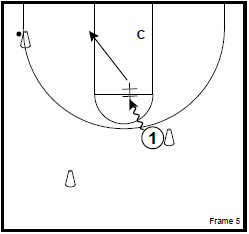
basketball-drills-schrempf

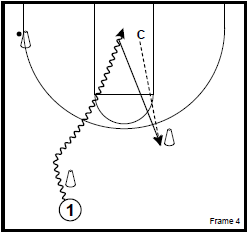
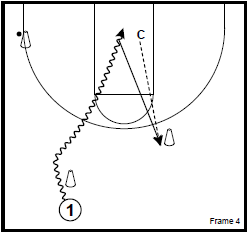
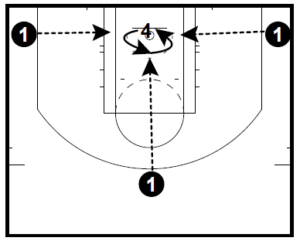
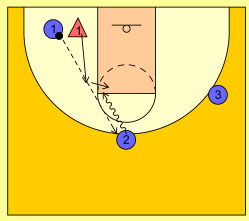
Player 1 curls around the cone and receives a pass from a coach.

Player 1 drop steps for the finish.


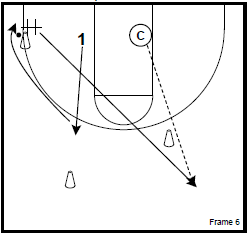
basketball-drills-schrempf2

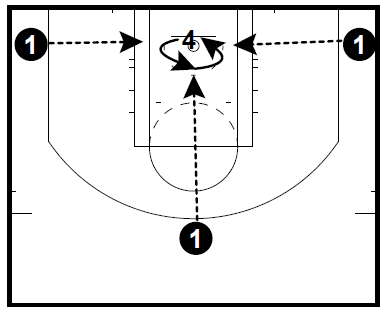
After catching and drop stepping, player 1 continues curling around the cone on the opposite side for another drop step.

The next shot is a catch and shoot hook.

The third shot is and up and under.


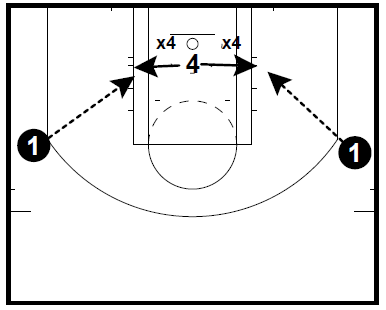
The fourth shot is if a player is denied a pass in the post they spins away from the defense for the lob pass.

Below is a short You Tube video with Detlef Schrempf putting some players through the drill.

Basketball Drills 4 Defensive Drills

By Brian Williams on April 24, 2014

These defense and rebounding basketball drills used by Bob Huggins and Larry Shyatt are from Coach Scott Peterman of the Men’s Basketball Hoopscoop Coaching site.

6 on 4 Screening

Bob Huggins–West Virginia

basketball-drills-3-screeners
Coaches are extra screeners.

4 & 5 are screening trying to get 2 & 3 open.

Defense has to get 4 stops to get out.

Really helps the defenders work on getting through screens.

Knick Drill

Larry Shyatt–Wyoming

This is a 5 on 4 drill. The 5 are on offense and try to score in the half court. When the 4 defenders finally get the ball, they will try to transition to score on the other end. They will have an immediate advantage because their center (a 5th player they now will have) will be stationed at the center court line. The offense has to get back, build a wall, keep the ball out of the middle, and force skip passes. Tell them to get their hands high and
their hips low.

When Coach Huggins plays 5 on 4, 5 on 4 they start with an unguarded offensive post player (who is live after the 1st pass). Defenders must help and recover, so the ball doesn’t get into the paint. Another way to play defense at a 5 on 4 disadvantage, leave the offensive point guard, unguarded to practice working on penetration and help and recover.

The final two drills are rebounding drills involving finding a player to block out. A defensive possession isn’t complete until the basketball is secured off a rebound, or getting a loose ball/steal. By starting rebounding drills with defensive slides or finishing defensive drills with blockouts and rebounding, players develop that connection.

Circle the Defenders

Larry Shyatt–Wyoming

This drill will teach our defenders to find their man first and then find the ball. They must rebound the ball and put it under their chin. Spread out 5 offensive players around the 3-point line. 5 defenders circle up in the lane and move in a clockwise direction, continually calling out the man they will block out. The offensive players do not move. On the coach’s shot the 5 offensive players crash hard. The defenders must find their man first and then go get the ball. They then fast break the other way and the offense must get back.

** if the offense gets a rebound here, you could give them 8 seconds to run a last-second play

You could change the drill to block out the closest man simulating a zone or blockouts out of a rotating or switching defense.

3 on 3 Rotate the Box

(1 ball, 6 players)

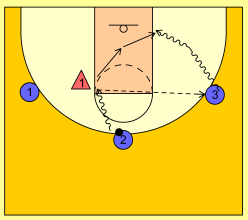
basketball-drills-rotate-box1

In any defense, zone or man, the person that you are supposed to block out will not be standing next to you.
This drill teaches you to find them, make contact and push them back. The defense blocks out and doesn’t go for the
ball until it touches the floor.


The defensive players have to block out someone that is not right next to them so they have to talk.

Offensive players are going straight to the rim.

basketball-drills-rotate-box2

In the diagram, X1 could block out number 3, X2 would block out number 1, X3 would block out number 2. The defense changes spots on each shot. You can also have them mix up their block out assignments on each shot.

A coach or player can shoot the ball.


If you are interested in adding to your Coaching Toolbox take look at what I believe is our best offer.

CLICK HERE to select from a list of more than 70 eBooks.


5 Ways Basketball Players Can Improve Immediately

By Brian Williams on April 23, 2014

I received this article from Mano Watsa from PGC Basketball.

I posted another article from PGC about helping players cope with season ending disappointment. Here is the link to that one. Players are probably past that now, but you will want to file it to use for coming seasons. Helping Players Through Season Ending Disappointment

5 Ways for Basketball Players to Improve Immediately

Like most people, a lot of basketball players are looking for that one thing that will create an immediate impact for themselves and their team. Let’s take a look at five things any player can do to gain immediate improvement:

1. Take Higher Percentage Shots

All basketball coaches love having a good shooter on their team. The way to instantly improve your shooting percentage is to eliminate shots that are difficult to make. If that seems simple, it is. It’s amazing how an athlete can appear to be a good (or better) shooter when they stop taking shots they don’t make very often.

To evaluate your shot, ask yourself these three key questions:
1. Was your shot on balance?
2. Was your shot within range?
3. Was your shot in rhythm?

If the answer is ‘no’ to any of these questions, you have attempted a shot that will make you a less efficient shooter. In addition, the shots you are taking will cause your teammates and coach to lose confidence in you. Earn your coach and teammate’s trust through your shot selection.

It’s been said that it doesn’t matter how beautiful a swing a baseball player has. If he always swing at bad pitches, his batting average will be embarrassingly low. The same applies in basketball. It doesn’t matter how sweet your stroke looks if you constantly shoot poor shots. Eliminating poor shots during a game can increase your shooting percentage significantly. Good coaches love that.

2. Increase your Activity on Defense

Imagine before your next defensive possession, you step into a tray of bright pink paint. How much of your team’s backcourt would be covered by your footprints? I have the pleasure of observing high school and college basketball players across North America. The vast majority might only sprinkle a few footprints across their side of the court.

It’s amazing how many more steals, leather touches (deflections), bothered passes, altered shots, and tipped rebounds basketball players could get if they would just ‘PAINT THE FLOOR.’ Paint the floor with your feet, always be moving, and cover the court with your activity. This is the universal sign of a good defender. Your defensive coverage is immediately adjustable. It requires no training or practice. It only requires a commitment of focused effort. Become pretty in pink.

3. Increase your Talk

Dale Carnegie has said, “Communication enhances every human experience.” Saying you’ll do something makes you more likely to actually do it. If I tell my check before a game that I won’t give them an easy shot all night, I’m more likely to be hell-bent on making their evening as difficult as possible. If you want to be a better help side defender, communicate emphatically that you have your teammate’s help on a dribble drive. If you want to make more lay-ups around the rim, run down the floor telling the ball-handler you have the finish. If you desire to achieve something, say it. You are more likely to hold yourself to the standard you set.

4. Hit Someone

“Honestly, you’re just too physical. You’re too tough. You box out too hard and screen too rough. You are so physical on defense that I think you need to back it off a little bit to be more effective.” NO ONE HAS EVER HEARD THESE WORDS! All athletes can find ways to be more physical. Tomorrow you can be a better defender, screener, driver of the basketball, and rebounder if you HIT SOMEONE. I don’t mean to haul off and punch anyone. I mean playing physical within the rules. Make contact with your hip, shoulder, forearms, and butt. Basketball players who excel in this game thrive by learning how to create contact to create advantages. Bump, nudge, check, shiver, and move your opponent the entire game – both on offense and defense. This will make you instantly tougher to guard, more difficult to box out, more challenging to post up on, more frustrating to play against, and completely indispensable to your coach.

5. Question Yourself

Few athletes constantly question themselves. Most just react to the situation or experience during a game. I will offer you – the motivated athlete – this challenge. At your next basketball practice question yourself each moment there’s a stoppage to breathe and think. Which question should you ask? “Is there anything more I can do?” You will always get the same answer: Yes! Then DO IT. Do it immediately. Do it again. Make it a habit. Average athletes are always satisfied with what they have done previously. Elite athletes live in a state where they are always asking themselves how they can increase their contribution. Become anxious and hold your feet to the fire. You will be amazed at how many things you recognize that you could be doing to improve your game. As you continue to perform better, the amazement will spread to your coach and teammates. Never fail to ask yourself this crucial question: “Is there anything more I can do?”

PGC Basketball Camp locations and enrollment are now open for the summer of 2018.

IS PGC FOR YOUR PLAYERS?

PGC offers intense 5-day, 4-night courses for junior high, high school, and college players.

Not just for point guards, PGC courses teach players of all positions to play smart basketball, to be playmakers, and to be coaches on the court.

Click here for information on this year’s camps.

PGC IS FOR COACHES TOO…

Over 500 coaches of all levels attend PGC each summer, as each course serves as an unparalleled, information-packed coaches clinic.

  • « Go to Previous Page
  • Page 1
  • Interim pages omitted …
  • Page 73
  • Page 74
  • Page 75
  • Page 76
  • Page 77
  • Interim pages omitted …
  • Page 96
  • Go to Next Page »

Primary Sidebar

  • Twitter
  • Facebook
  • Linkedin
coachestoolbox
personaldevelopmenttoolbox
basketballplayerstoolbox
basketballtrainer
athleticperformancetoolbox
coachingbasketball

© Copyright 2026 Coaching Toolbox

Privacy Policy