• Skip to primary navigation
  • Skip to main content
  • Skip to primary sidebar

  • Basketball Plays
    • Ball Screen Sets
    • Horns Sets
    • Man to Man Post Up
    • Man to Man Isolations
    • Backdoor Plays
    • Man to Man 3 Point Shot Plays
    • 2-3 Zone Attack
    • Baseline Inbound Plays
    • Sideline Inbound Plays
    • Combination Defense Attack
  • Drills
    • Defensive Drills
    • Offensive Drills
    • Competitive Drills
    • Passing Drills
    • Rebounding Drills
    • Shooting and Scoring Drills
    • Toughness Drills
    • Transition & Conversion Drills
    • One on One Drills
  • Blueprint
  • Practice
  • Mental Toughness
  • Skill Development
  • Offense
  • Defense
  • Store

Basketball Drills

Basketball Plays Down Ball Screen Counter Options

By Brian Williams on November 13, 2014

These counters are taken from the Basketball HoopScoop’s Comprehensive Ball Screen Playbook (written by Trey Watts).

It is a part of this week’s featured eBook bundle is the Princeton Hybrid Offense eBook along with the Comprehensive Ball Screen Playbook eBook. You can see their descriptions at this Link: Princeton Hybrid Offense and Ball Screen Playbooks

If you have any questions about the Playbooks, please feel free to email me or call/text me at (317) 721-1527.

These are some options to use to counter a defense that forces the dribbler of a ball screen down to the baseline.

I hope you can adapt to your system or take parts from to tweak what you do.

Diagrams created with FastDraw


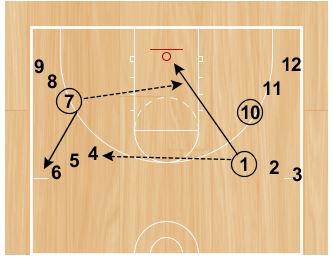
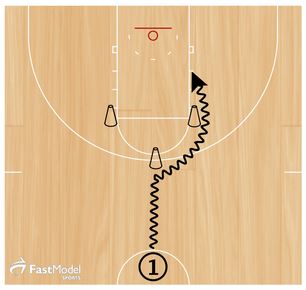
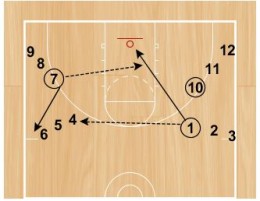
basketball-plays-down-counters1


Against teams that force the ball handler away from the ball screen and towards the baseline.

We want the ball handler to attack the big.


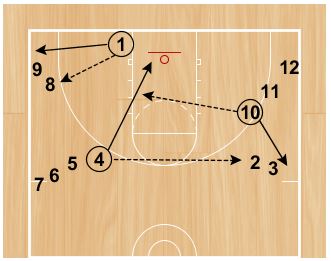
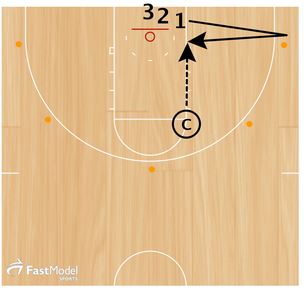
basketball-plays-down-counters2


If we kick to post he reverses the ball and sprints to next Ball Screen before his defender can recover.


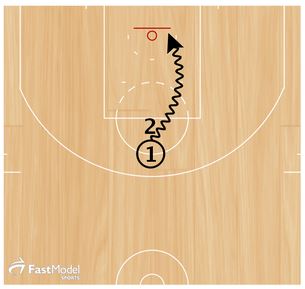
basketball-plays-down-counters3


If we don’t hit the post stepping out, we look to score with 4 getting a jumper or 1 beating the X4.

IF no shot is there we will run “TWIST” and set another screen on the ball.


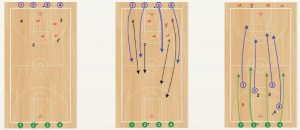
basketball-plays-down-counters4

VS DOWN DEFENSE ON A SHAKE OR LOADED SIDE

We will dribble handoff with the guard in the corner.

there is no hedge because post help is in the paint.

These counters are taken from the Basketball HoopScoop’s Comprehensive Ball Screen Playbook (written by Trey Watts).

It is a part of this week’s featured eBook bundle is the Princeton Hybrid Offense eBook along with the Comprehensive Ball Screen Playbook eBook. You can see their descriptions at this Link: Princeton Hybrid Offense and Ball Screen Playbooks

If you are interested in adding to your Coaching Toolbox take look at what I believe is our best offer.

CLICK HERE to select from a list of more than 70 eBooks.
 

If you have any questions about the Playbooks, please feel free to email me or call/text me at (317) 721-1527.

Coaching Basketball Jimmy Dykes Philosophy

By Brian Williams on November 11, 2014

These thoughts are from an old Xavier Men’s Program Basketball Coaching newsletter. If you are interested in seeing their archive or signing up for the newsletter, click this link: Xavier Basketball Newsletter

Blueprint for a successful coaching philosophy–Jimmy Dykes

Coach Dykes is the former Women’s Coach at Arkansas. Prior to taking the job this past spring, he has been an analyst for ESPN and has served as an Assistant for several D1 Men’s Programs. He also spent a year as a Scout for the NBA Seattle Sonics (now the OKC Thunder).

Even though you probably won’t agree with everything, I think that there are at least a few thoughts included that can be applied to your coaching and to your team.

1) Everyday guys will beat sometime guys every day.
– High talent guys that are sometime guys will be a year of frustration.
– Key areas of recruiting: evaluation of talent and evaluation of character.
– Everyday guys go every day, every possession.
– When evaluating a player, watch how they respond in a bad game.

2) If you are not tough, you will not win.
– Do not flinch on a loose ball.
– Blow up screens.
– Do not let one mistake become two.
– “Toughness is doing what is right when it is really really hard to do what is right.”

3) If you cannot talk it, you cannot execute it.
– Players must be able to talk the action.

4) Practice for 5-10 minutes without talking.
– Will drive home the importance of talking real quick.

5) If you aren’t talking loud enough in practice to be heard in a silent gym, you will not be heard in the loudest arena.

6) Where are we scoring from? 3 key areas:
– The free throw line should be a number one priority in an offense .
– Are you scoring off of rim shots?
– Clean 3’s.
– The quality of shots of us vs. them will 90% of the time determine who wins the game.

7) How hard are your cuts?
– Be in good enough shape to still be able to hard cut in the last 5-6 minutes of the game, not just for a half.
– Cut with purpose and passion.
– Hard cuts wear people down.

8) 24/24 last final four teams have shot 32% or higher from the 3pt line
– Who is shooting your 3’s? Has a lot to do with what you shoot as a team.
– Selection of the 3: are you open? Are you balanced? Are you shooting a bad pass? Quit shooting bad passes and shot percent will rise as a team. Good 3pt shooting teams and good passing have direct correlation.

9) it is not the number of plays you have but the number of plays you can run with perfection.

10) You cannot be a great player if you avoid contact.

Simple things to always keep your eyes on:

1) Guard your yard.

2) Average teams can defend the first on-ball action, good defensive teams can defend the second
action, but only elite level teams can defend the third on-ball action.

3) ANY FORM OF SELFISHNESS MUST BE ELIMINATED, CUT OUT.

4) Leadership is backwards now-a-days. The freshmen or first year guys are the ones that have to do
things last, carry stuff off the bus, get the leftovers, etc. The greatest leaders are those that are
servants.
– How can you serve others? Get your leaders to think that.

5) What is emphasized the last 10 minutes in the locker room before a game better be emphasized
every day in practice before that.

6) When you watch your team play, they have either been taught to do that or you have allowed them to do that.

7) Good coaches can see the problem but great coaches can fix the problem.
– Great teams fix the problem right now.

8) We all need a reference point because we are either going to be ready or be rattled.
– Why is that happening?
– What do you go back to when things get chaotic?

9) Do not get bored with the basics. Shot goes up, are all 5 guys in motion?

Things not seen enough in drills

1) Not enough one on one.

2) Tremendous need in just knowing how to play the game. Need more 4-on-4 or 5-on-5 halv court no dribble. Do we know how to screen to get people open?

3) In golf, every swing you ever take should have a specific purpose. Every single time. Do we teach that when it comes to shooting? The great shooters gear their practice shots toward what they are actually going to do in a game.

4) You cannot allow outside distractions to effect practice and locker room. We cannot demand things of players that we cannot also do as a coach, As a coach, if you have junk weighing on you from outside the job, you cannot perform as a coach at the level that you need to perform. You don’t want that from your players so why want that from you?

5) Very important to raise the bar in areas of your life. Do not settle for less.

Basketball Drills Defending Perfect Movement

By Brian Williams on November 7, 2014

This post contains two videos from Xavier practice with former Coach Chris Mack. The first video is a 5 on 5 defensive drill requiring the defense to play perfectly for 24 seconds. The final video is a two player drill working on help position and closeouts.

If you are interested in seeing more information about the DVD that the samples are taken from, click here: All Access Xavier Basketball Practice

Press the play arrow in the middle of each video to see each YouTube video. Make sure that your sound is on as you watch them.

Basketball Drills: Defending Perfect Movement :24

This basketball drill requires players to be in perfect position, communicating with teammates, seeing the basketball, and staying in their defensive stance for 24 seconds. Any breakdowns and the players must start the drill again for a full, consecutive 24 seconds. You can add any fundamentals that you want to the requirements or require that players execute for a longer period of time to win the drill. Make sure that your sound is on and click the play arrow to see the video.

Basketball Drills: 2 on 2 Gap Closeouts

Drill to work on getting in the defensive gap to see both the basketball and the player you are guarding, establishing help side position, and closing out. Make sure that your sound is on and click the play arrow to see the video.

If you are interested in seeing more information about the DVD that the samples are taken from, click here: All Access Xavier Basketball Practice

Basketball Drills 6 Shot Shooting

By Brian Williams on November 4, 2014

This drill is adapted from some competitive drills from the University of Kansas women’s team that were included in Mike Neighbors’ University of Arkansas women’s basketball coaching newsletter.

Let me know if you would like to be added to his newsletter.

Thought you might be able to use this drill to conclude your practices to do some conditioning with a basketball, work on scoring in transition, as well as force your players to shoot and compete when tired.

In the version from the newsletter, the passer at that top of the key is a coach and every player has a basketball.

I like the idea of having players work on making good passes to the shooter, so I have made some adjustments.

Split the squad into 2 teams–one at each end. In the diagram, red team and blue teams.

6shotshooting

Diagram created with FastDraw

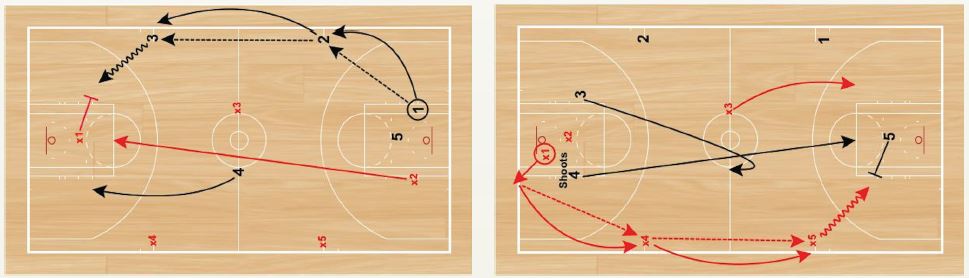
Players 1 and 2 have basketballs, player 3 is the rebounder, and 4 and 5 are the passers.

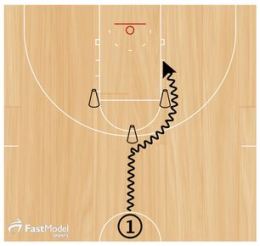
Player 1 passes to player 4, cuts to the basket, receives a pass back and takes the shot. Player 3 rebounds. After shooting, 1 goes to the end of the passing line. 3 rebounds and dribbles around the cones back to the back of the shooting line. 4 (who passed to 1) becomes the rebounder.

The first end to make 20 shots wins that round. The winning team must “verify the win.” One player from the winning team has to go to the free throw line immediately and make one free throw. If the player misses the free throw, the win for that round does not count. Verifying the drill is something you can use in many of your drills to force players to shoot some free throws under pressure.

First end to win 3 rounds (and verify them) is the overall winner. Every player shoots the same type shot for each set of 20 makes. Make sure to only shoot shots in this drill that you would consider to be a good shot in transition. Here are some ideas for shots to use:

1) 1 foot layup
2) 2 feett power layup
3) Catch and shoot mid range shot
4) Rip through one dribble pull up
5) Change of direction cut into a jump shot
6) Catch and shoot 3 point shot

Basketball Drills 1 vs. 2 Dribbling

By Brian Williams on November 3, 2014

Brian Williams, The Coaching Toolbox.

I have always felt that one of the best ways to evaluate ball handling is by having our perimeter players dribble against two defenders in practice.

I also think that it is important that if you use the 1 vs. 2 drill in practice that you emphasize that it is an overload drill for practice only. Every other time you are double teamed while dribbling , you don’t dribble against it, you look for an open players to pass to.

I developed a scoring system to make the drill competitive and I based it on what I value as the outcome for the offensive player. You might not agree with the scoring system because you might have a different philosophy of what you want the dribbler to do.

Diagram created with FastDraw

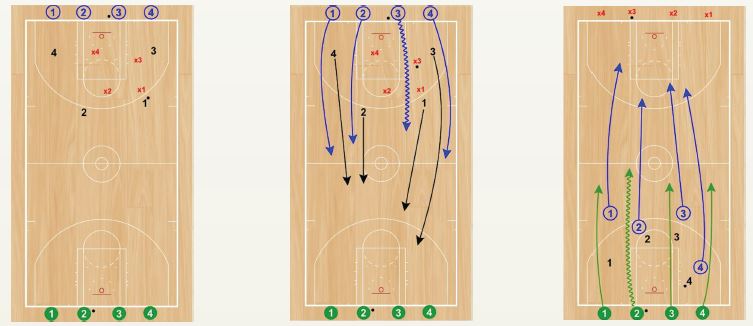
You can start the drill 2 different ways. If you want your players to work on getting open against a full court press and not catching the ball in a trap zone, you can begin the drill like the black players, offense 1 and X1 and X2.

The coach inbounds the basketball and the offensive player works to get open against X1.

If you want to put your player in a tough position and force them to get out of it, start them where the red players are O2 and X4 and X5.

Both groups from the diagram do not go at the same time, it is there to illustrate two ways to start the drill.

basketball-drills-1v2

Once the drill starts, the dribblers will go towards the opposite opposite basket from the end where they start, so it is a full court dribbling drill. If the defense steals the ball, they will attack the basket opposite from where the offense is looking to score.

Each possession lasts 20 seconds unless the ball handler loses the basketball.

You can allow the dribbler only half the floor or allow them to use the whole court. If you use the whole court, only have 1 group of 3 going at once. If you allow the to use only 1 side, you can have groups going both ways.

Here is what I think the best outcomes are for the dribbler: (5 being best outcome)

(5) Scores or is fouled shooting. For this drill, I don’t make a distinction between making a 2 point shot and making a 3 point shot, and we don’t shoot free throws. You can decide how to deal with non-shooting fouls. We handle them as no harm, no foul. I want the dribbler to be tough and not use contact as an excuse to lose the basketball.
(3) Retains dribble for the entire possession without losing the basketball and not picking it up.
(2) Picks up the dribble and can pivot without losing the ball. We don’t call 5 seconds since there are no other players to pass to. You could have a coach or another player be an outlet if you don’t like the idea of pivoting for more than 5 seconds.
(1) Commits a dead ball turnover (travel, offensive foul, 10 second violation, tied up by the defense, steps out of bounds, etc..) I would rather have a dead ball turnover than a live ball turnover because it allows us to set our defense.
(0) Misses a shot or commits a live ball turnover (loses dribble or is stripped while pivoting).

In order to motivate the defense to play hard, they can score if they make a steal. But it must be in transition. If they make a steal, they must go immediately and score in a 2 on 1 or 1 on 0. I don’t want them pulling it out. When we get a 2 on 1 in a game, I want to execution before more defenders retreat.

If the defense steals the ball and then scores or is fouled, both players get two points, even for a 3 point shot. I would rather they attack the basket on a 2 on 1 situation.

Again, these are the scoring rules that fit our system. Change your rules to fit your team.

Players compete in groups of 3 and rotate so that each player goes the same number of times on offense. Two or Three times is a good amount to have each one go. Once one possession is over, start on the opposite baseline and go full court the other way with a new dribbler.

I like to set the maximum length of a possession at 20 seconds, so we start the clock at 20 seconds when the player makes the first dribble.

Basketball Drills: Ball Screen Breakdowns

By Brian Williams on October 31, 2014

In keeping with a theme of providing drills for the start of practice, I am posting some ball screen breakdown drills that were sent to me by Nate Hill. He is the Assistant Boys Coach at Colonel Crawford High School in North Robinson, Ohio.

He provide a post where a few months ago where he outlined what he believes to be the strengths and weaknesses of five different methods of defending ball screens. Here is the link to that article on 5 options for defending pick and roll.

I think it is important for all coaches to put on paper what you believe the strength and weaknesses are for your specific team for various ways of defending ball screens and attacking those defensive strategies in your ball screen game.

That will help you to more clearly and effectively teach both the offensive and defensive ends of ball screens.

Ball Screen Breakdowns

Diagrams created with FastDraw

Start the drill with:

2 on 0 breakdown. Guards and bigs at separate baskets, working on the following ball screen reads: Hard Hedges,
soft hedges, jam and under, Switch, drops, refuse /ice, Blitz / double team.

Then move to:

2 on 2 Live: Coach chooses from under, hedge, switch, ice, drop, or trap. Offense must read the defense and make
the proper play. Offense goes for 2 minutes and switches spots on the court. Next defensive group comes in and
plays a different defense as instructed by the coach.

Here is a link to a post from a few weeks back for working on Attacking Hard Hedges

Defense Blitz

The defense gives up: pick and pops, slip pass, passes over top screen with bigger guards, slow rotations. Teams can make a pass out of the trap, and a quick extra pass to open players with good spacing.

Blitzing takes away: good shooters and drivers, forcing 1 to make solid pass, and 5 to make a shot / play. Forces players to make passes with weak hands

basketball-drills-ball-screen-breakdown1


Double team / Blitz = retreat dribble and pass: Coach/defender double teams the pick and roll. ball handler uses a retreat / pullback dribble and passes to coach. Coach can also incorporate slips.


basketball-drills-ball-screen-breakdown2


Double team = SLIP: Defense traps the ball screen, big needs to dive automatically to the rim. Posts vary the finishes at the rim


Under

x1 goes UNDER screen.

The defense gives up: pull up jumpers, turning corner on drives

The defense takes away: screener rolling / slips. force ballhandler to shoot off dribble

basketball-drills-ball-screen-breakdown3


Under Screen = race to rim, pull up, rescreen:
defender / coach goes under the screen. Ballhandler races defender to the rim, takes pull up jumper, and change directions for a rescreen. Vary your finishes, set up screen with jab or dribble move.


basketball-drills-ball-screen-breakdown4

Under Screen = RESCREEN: Defender goes under the screen, the big can RESCREEN and Roll

If you would like to see the remainder of the document and all 5 scenarios, Click Here for Ball Screen Breakdown 2.0


  • « Go to Previous Page
  • Page 1
  • Interim pages omitted …
  • Page 64
  • Page 65
  • Page 66
  • Page 67
  • Page 68
  • Interim pages omitted …
  • Page 96
  • Go to Next Page »

Primary Sidebar

  • Twitter
  • Facebook
  • Linkedin
coachestoolbox
personaldevelopmenttoolbox
basketballplayerstoolbox
basketballtrainer
athleticperformancetoolbox
coachingbasketball

© Copyright 2026 Coaching Toolbox

Privacy Policy