• Skip to primary navigation
  • Skip to main content
  • Skip to primary sidebar

  • Basketball Plays
    • Ball Screen Sets
    • Horns Sets
    • Man to Man Post Up
    • Man to Man Isolations
    • Backdoor Plays
    • Man to Man 3 Point Shot Plays
    • 2-3 Zone Attack
    • Baseline Inbound Plays
    • Sideline Inbound Plays
    • Combination Defense Attack
  • Drills
    • Defensive Drills
    • Offensive Drills
    • Competitive Drills
    • Passing Drills
    • Rebounding Drills
    • Shooting and Scoring Drills
    • Toughness Drills
    • Transition & Conversion Drills
    • One on One Drills
  • Blueprint
  • Practice
  • Mental Toughness
  • Skill Development
  • Offense
  • Defense
  • Store

The Three Most Important Things to Work with Your Post Players on Every Day.

The Three Most Important Things to Work with Your Post Players on Every Day.

By Brian Williams on February 11, 2018

This post was submitted by Coach Tom Kelsey.  Coach Kelsey has been a Head Coach at Belhaven University, Faulkner University, and Greater Atlanta Christian High School.  He has also been an assistant at LSU, Alabama, Murray State, and Lipscomb.  He played at Lipscomb under Coach Don Meyer.

Coaching Post Players can be frustrating and a challenge.

You are trying all the drills.

You try all the motivation techniques.

You try easy drills and hard drills.

Still not seeing improvement as you hoped?

Learning how to teach certain skills is also important for a coach.

The most important thing is to keep it simple for your Post Players.

Getting them to do a few things well will pay off more than trying to have them do a large variety of skills.

So what are the most important things to teach and how to teach them?

1. Footwork.

Having the proper footwork is the foundation to good post play.

Emphasize footwork during every workout, practice, and game.

Everything starts with running the floor. A Post Player who can run the floor is a tremendous asset to the team. The ability to get back and protect the paint gives a defense the right foundation.

Running the floor on offense and beating the defender down the floor puts them into position to get easy baskets.

2. Positioning

How well a Post Player establishes position on both ends will determine their effectiveness.

On defense getting around to front in the post, showing on ball screens, giving help on drives, blocking out all involve being in the right position.

Offensively understanding angles and how to post and seal the defender are critical to success in the paint.

Because of the physical nature of posting up, players need to understand how to use their body.

That means holding the defense off by using their rear end, hips, and quick feet.

3. Hands

One of the most significant areas to help your Post Players is in their hands. They have to keep their hands up constantly.

For rebounding, I tell our players all the time what John Wooden said, “When the shot goes up, hands go up.”

If you want to rebound your hands, have to be up.

On defense I want our players to have their hands up especially in the paint. I want the referee to see both hands of our players.

Both hands up allow there to be much less chance of a foul.  If an official who can only see one hand the likelihood of a foul increases.

On offense the reason we want hands up is to be ready for the pass, but also to be a threat to catch. If a Post Player stands with hands down two things happen:

  1. Their teammates are less likely to throw then the ball. We want our players to be available receivers at all times.
  2. They are not a threat to the defense. We feel having hands up puts more pressure on the defense because that is one more player the defense must give attention.

Emphasize these areas each day. If you get them to play with good footwork, proper position and active hands you will see tremendous improvement.

Here are some great drills to put in right away to your workouts and practices.

Diagrams created with FastDraw

Pitch Aheads
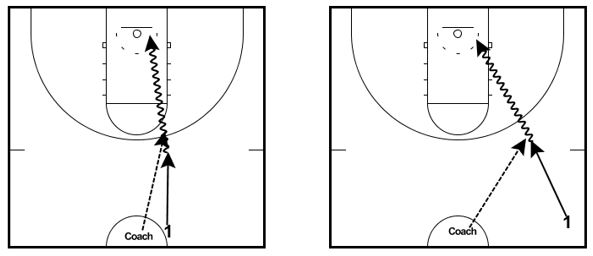


Drill teaches your players to run the floor, make the catch and finish with a made basket.

Players will gain confidence in running the floor full speed and being able to make the play.

Pitch ball ahead to player running to the basket.

Coach can make the pass hard to catch or easy to catch.

Throw it out in front of the player each time so they have to make an effort to go after the basketball.

Player has to catch the ball clean and lay the ball up at the rim.

Pitch Aheads Continued
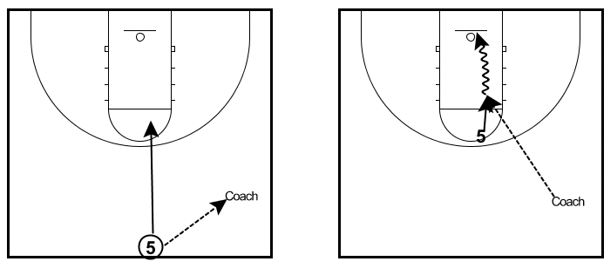


You can also have players make pass first then pass the ball back.

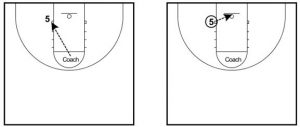
Catching off the Drive
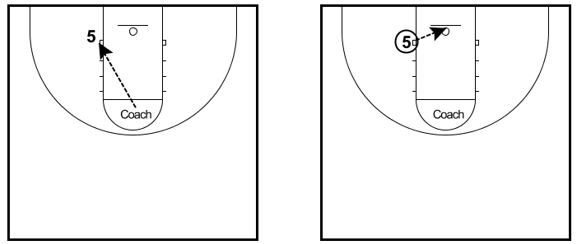


Post players working on the catch and finish. Coach has the ball at FT line. Each player goes three times. Coach makes pass difficult to catch (up high, down low, off the bounce, too fast).

After catch post player makes quick move to basket without dribbling the ball.

Power Lay in drill.
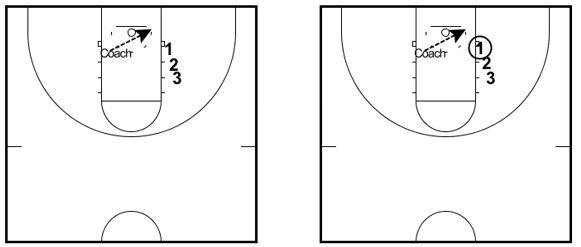


Coach throws ball to hit the opposite side of the backboard. Do not want ball to hit the rim. Players must have hands up and knees bent so they are ready for the ball. On the rebound go up as high as possible and chin the basketball so they are strong with the ball.

  1. Pogo. Keep the ball high on the rebound with arms extended and immediately go back up with the shot.
  2. Quick put back into the basket. Come down with rebound with wide base and chin the ball go back up with the shot.
  3. Shot fake and shot. Rebound and shot fake before going back up with shot. On the shot fake make sure to keep knees bent and the ball chinned. Teaching players to stay in basketball ready position.
  4. Shot fake come to the other side of the rim on one dribble. Keep shoulders parallel to the backboard.
  5. Catch in the air and put in back in (dunk or tip) Two hands.

Sprint to Block for Post Up
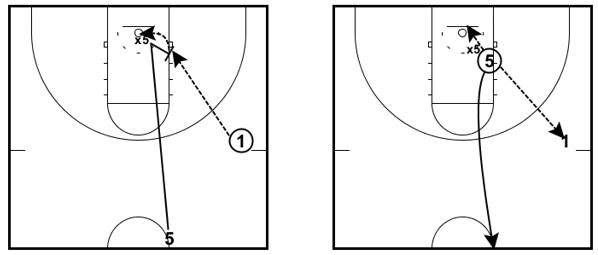


Sprint to the block post move. Use blocking dummy, coach or player to increase pressure defense. Post player works on position, sealing out the defender, catching the ball clean and making a move to the basket.

Put back any miss. Get the ball out quickly and make a good outlet pass. Sprint to half court.
Notre Dame Circle Wing Ball Screen

By Brian Williams on February 7, 2018

A play from Notre Dame to run against a packline style man to man defense with a couple of ways to finish.

The plays are from the “Attack the Pack Playbook” assembled by Chris Filios.

It is paired with the Encyclopedia of the Packline Defense, which was also compiled by Chris. Click here to see the Attack the pack and Packline Defense Bundle

If you need customer service, email me at [email protected] or call/text me at ‪317-721-1527.

The objective of this play is to create player screens and cuts that force the defense to concentrate more on defending those actions rather than being in a position to help on penetration.

Diagrams created with FastDraw

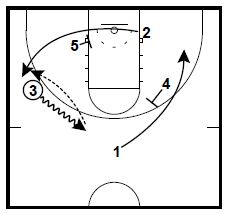
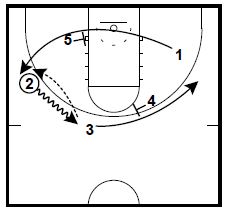
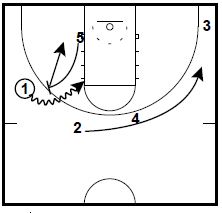
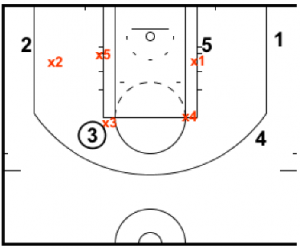
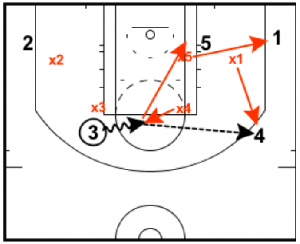
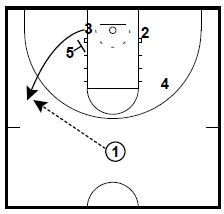
Notre Dame Circle Wing Ball Screen

5 pins for 3.

1 passes to 3.


3 dribbles up.

4 flares 1.

5 pins for 2.

3 passes to 2.


2 dribbles up.

4 flares 3.

5 pins for 1.

2 passes to 1.


4 flares 2.

5 sets wing Pick and Roll.


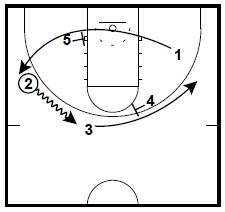
Notre Dame Circle Zero Action

This is another way to finish the play.

5 pins for 3.

1 passes to 3.


3 dribbles up.

4 flares 1.

5 pins for 2.

3 passes to 2.


2 dribbles up.

5 pins for 1.

4 flares for 3.


4 blur cuts.

2 drives off back off blur cut.


The plays are from the “Attack the Pack Playbook” assembled by Chris Filios. It is paired with the Encyclopedia of the Packline Defense, which was also compiled by Chris. Click here to see the Packline Attack and Defense Bundle

Progressive Fast Break Drill

By Brian Williams on February 6, 2018

This drill is from Mike Neighbors, Arkansas Women’s Basketball Coach. The drill is available on the Arkansas Women’s Basketball YouTube Channel

You probably run a similar drill in your program, but I think that this is worth watching to pick up some of his teaching points.

His purposes for running the drill are:

1) To work on transition offense and conversion defense. For Arkansas, that is 70% of their game. Even if yours is not that high, live ball transition is still a large part of every game, regardless of the style you play.
2) Improve Shot Selection
3) Reduce Turnovers
4) Conditioner

Please make sure your sound is on to see the video.

Click the play arrow to see the drill.

The drill is a YouTube video, so you will need to be on a server that allows you to access YouTube to see the drill.

How to Evaluate Players

By Brian Williams on February 3, 2018

This post was submitted by Coach Tom Kelsey.  Coach Kelsey has been a Head Coach at Belhaven University, Faulkner University, and Greater Atlanta Christian High School.  He has also been an assistant at LSU, Alabama, Murray State, and Lipscomb.  He played at Lipscomb under Coach Don Meyer.

Editor’s note from Brian.  Coach Kelsey has coached Men’s program and his list is written use the male gender, but the list is not gender specific.

Here are questions I have used when recruiting student-athletes. Not only for me but my staff.

This way when a coach comes back to tell a coach about the player there is more meat than, “He or She can really play.”

Use these for your end of the year evaluations. Makes those meetings more productive and gives players something tangible, instead of saying, “Well, you need to work harder.” Giving them drills and resources is a valuable way to help them improve.

The questions are also valuable for self-evaluation of the players on your current team.

Player Evaluation

Practice

  1. What time does player arrive for practice?
  2. What is his pre-practice routine?
  3. Where does he shoot the ball from when he begins his practice/workout?
  4. How soon does he get going full speed once practice starts?
  5. How does he work in breakdown drills?
  6. What is his competitive level? (does he go the same speed against each player on the team?)
  7. How is he on defensive fundamental drills?
  8. How is he on offensive fundamental drills?
  9. When working on shooting drills what is level of intensity (1-10)?
  10. When working on shell drills how well does he get into help position and communicate?
  11. On Zig-Zag drills how is his effort?
  12. When they work on transition drills how hard does he run the floor?
  13. When they work on 5-0 offense how hard does he move without the ball?
  14. Once they start playing/scrimmage how is level of intensity (1-10)?
  15. Does he communicate with the other players?
  16. When he is off the floor, what is his body language?
  17. Does he take coaching from the head coach?
  18. Does he take coaching from each member of the staff or only one member or two members?
  19. Does he play favorites on the team or get along with everyone?
  20. What does he do after practice?
  21. If he stays after practice, what is the routine? (Just playing or working on his game)

Games

  1. What time does he get on the floor compared to the rest of the team?
  2. Where does he take his shots from when they have free/open shooting during warm-ups?
  3. Does he shots from spots on the floor where he will get his shots?
  4. What is his effort like in warm-ups?
  5. Does he get the other player engaged?
  6. Is he self-focused or team-focused?
  7. When the game is going on where does he drift if the ball is not in his hands?
  8. Does he get back down the floor full speed, pick up his man, and talk to his teammates?
  9. Does he deny the ball?
  10. Does he get into help side?
  11. Does he get to help early or just there to block the shot?
  12. Does he block out?
  13. Does he cover down when helping?
  14. When he helps does he find the closest man to block out?
  15. Is he hungry to block out or hungry to rebound the ball?
  16. Does he secure the ball?
  17. How well does he run the floor on the offensive end?
  18. Will he fill the lane and get out in front of the ball?
  19. Does he move efficiently without the ball?
  20. Does he screen well when the play is not called for him?
  21. Does he go to rebound on the offensive end? When is away from the ball? When he is the lane? When he gets blocked out initially?
  22. Does he get upset if he doesn’t get the ball when open?
  23. Will he fight for a loose ball? Does he watch others fight for the ball?
  24. How aggressive is he on FT block outs (both ends)?
  25. How does he participate in timeouts?
  26. What does he do immediately after a timeout? (does he talk with his teammates or go off on his own)
  27. When coming out of the game, does he stay in the game mentally?
  28. When on the bench does he encourage the players on the floor?
  29. Does he take coaching during the game?

Defending a Great Player

By Brian Williams on February 1, 2018

Army Assistant Men’s Basketball Coach Zak Boisvert has these notes on his tremendous resource site for coaches. PickandPop.net

Coach Boisvert has posted several videos of some of the better schemes he has seen. His You Tube channel is: Zak Boisvert You Tube Channel

He also is also very active on Twitter: @ZakBoisvert

Editor’s Note from Brian.  The post is provided as food for thought, not to imply that you should implement all of these tactics. I realize that both the rules and the abilities of players vary greatly at different levels of play.

Diagrams created with FastDraw

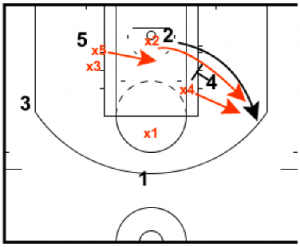
Notes from Mike Longabardi. Assistant Coach Cleveland Cavaliers

-It’s in transition where great players are most dangerous. We have to be alert with our antenna up.

-Whenever a great player is isolated, we have to shrink the floor (no gaps; make the lane as tight as possible).

Versus the great point guard:

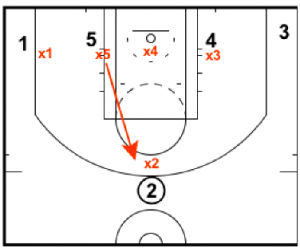
“Load to the Ball”

Below the ball and in this gap. If the great point guard sees this gap, they’re attacking this every time. If he doesn’t see a gap, he might be more likely to pass the ball—which is what we want. On the pass, we can deny it back.

“LOAD – LOAD – LOAD”

If we load correctly, we take away this guy’s seam.

“Load to Touch”

Get the ball out of his hands. Come all the way over and make him pass the ball. On the weak side, we have to zone
up. We’re not going to rush up at 5 if the pass is made there. We’re going to stunt from the weakside as x5 sprints
back into the play.

“Face to Face”

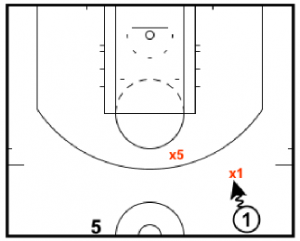
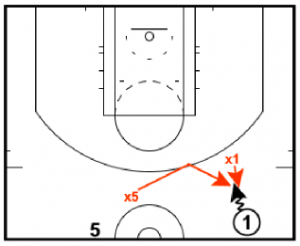
After a free throw, we don’t want to let Stephen Curry touch the ball. Whichever big for the other team is taking the ball out, we take his defender and play in front of the point guard (x1 plays behind) to deny him the ball. In an ideal situation, we’d like the opponent have to bring someone else up the court to catch the ball and initiate the offense. We would continue denying the point guard the ball (with just x1; x5 would return to his man).

“Hit”

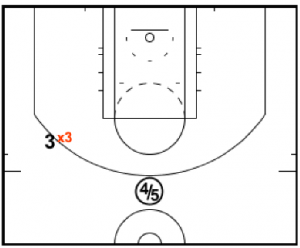
After a free throw, the inbounder’s defender plays on the ball. The ball is inbounded to the great point guard. As the inbounder begins to head down the court after passing, his man (say x4) stops and runs at the ball for a soft trap (“Your guy goes away and then you start to come up”). We’re not going to run at him and leave us susceptible to him blowing by us. We’re trying to cause indecision and break his rhythm.

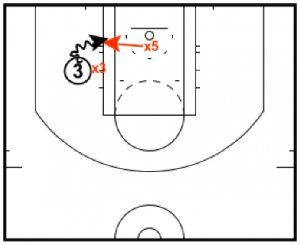
Versus Wing Isolation:

“Big Above”

The big has the ball above the free throw line and is the trigger man. The big having the ball on the free throw line is going to dictate us denying on the wing. We don’t do the traditional denial stance that your high school coach taught you. We “contact deny” with an arm bar into his oblique with one foot behind and one foot in front. Defender is underneath the offensive player (in between the great player and the basket) where if the offensive player were to cut, he would have to run the defender over. We want to push his catch out away from the rim.

“Fist Up”

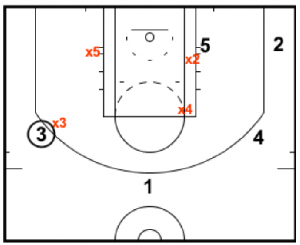
The low big comes all the way over to the ball-side block. That great player is holding the ball on the wing knowing that if he’s going to drive, we’re going to bring early help. We’re into the ball, making him go baseline and trace the ball (we can’t let him scan). X2 has to sit on 5’s legs and x4 needs to be ready to fly out at 2 on a skip pass (x2 and x4 would x-out with x2 taking 4).

“Fire”

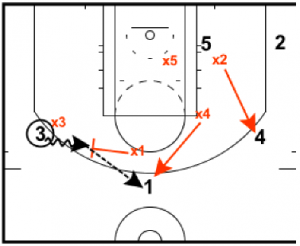
Rather than making the ball-handler go baseline, the on-ball defender sends him to the middle and we’re going to double with full rotation. We love to do this with around 7-8 seconds left on the shot clock. We will full rotate with x4 moving up to take 1, x2 moving up to 4. We would prefer the guard (x1) to rotate through the big to the corner (2), but if they’re moving it quick and x5 needs to closeout on 2 in the corner, we’re prepared to do that. If that were to happen, x1 is instructed to face box-out 5.

Versus Elbow Isolation:

-First off: make the catch hard. Push it out as far as possible

“Fist Up”

X5 comes over. X3 provides ball pressure and makes him go to the baseline. X1 sits on 5’s leg with x4 ready to x-out on a skip.


“Fire”

X4 goes. X1 sprints up to take 4. We probably won’t be able to rotate through the big so X5 will need to get out to the corner with x4 taking 5.


Versus High Post Isolation:

-Drive the catch out. One step makes a difference.

“Hit”

We’re going to come with the big to the weak hand of the isolated offensive player. X4 needs to come over. X3 pinches in to sit on 4’s leg. We’re going to dare him to throw the pass to the corner across his body.

Catch-and-shoot (shooter coming off a screen):

“Top Lock”

Don’t allow the great shooter to use the screen. We’ll play him on the high side and force him to cut to the baseline. The big needs to open up and see the ball (can’t give up a lob). The better the shooter the big is, the closer you are to him. If the screening big isn’t a good shooter, we can play way off.

“Blitz”

Shooter’s defender locks and trails. Screener’s defender traps right away on the catch. The other big defender pulls over. It is very important that we are quick with this. We are putting 2 on the ball and our rotation needs to be quick and early.

-We’ll often go “top lock” and if the shooter goes under the rim and comes out the other side, we’ll go “Blitz”

Versus the post-up (wing player):

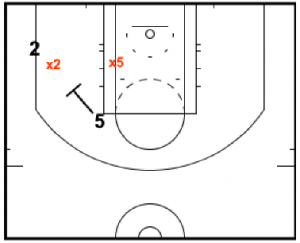
“Red”

Dead front – sitting right on the post player’s thighs (good to spin into the front) and push him back. Driving him back shrinks the window that the passer has to make the pass. Ball pressure on the wing is critical. If the pass is made, the guy fronting should jump and attempt a steal (maddening how few times this guy tries to get the steal).

On the catch, we come with the low man on the weakside and we seal him into a trap with the 2 defenders.

-We will try to “Red,” but if we don’t “Red” it becomes “Gray.”

“Gray”

We’re coming from the baseline to double-team on the dribble. We’re not allowing the offensive player to go middle. Our baseline arm is on his body and our high arm is poking at the ball. You’re going to make sure he spins baseline.

Versus the post-up (post player):

“GOLD”

We start with one foot in front and one foot behind with the player’s chest leaning on the offensive player’s shoulder. Our double-team will be “Gray” (coming from the baseline) just like against the wing posting. We come for the double with whoever is the lowest man. On the catch, our baseline arm is on his body and our high arm is poking at the ball. You’re going to make sure he spins baseline. On the double, we form a T with our feet (no splits – body up). On the weak side, we form an I.

Miscellaneous:

-You have to give the great player different looks. They can’t see the same thing over and over. They’ll pick you apart.

-Whenever you double-team, you’ll be susceptible to the second shot. It’s very important that the guy that came for the double-team

You can see the original article and download the pdf at: Mike Longabardi Clinic Notes

What Does “All in” Look Like?

By Brian Williams on January 29, 2018

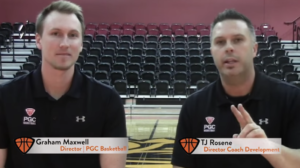
This video is with PGC Basketball Directors TJ Rosene and Graham Maxwell.

Tj (Head Men’s Basketball Coach) and Graham (Assistant Men’s Basketball Coach) coach at Emmanuel College in Franklin Springs, Georgia.

In addition to the All In the portion of the video, the second part describes the concept of “Fixing from the Point of Mistake.”

This video is a part of the 20 Week PGC Coaches Circle. You can sign up for free at this link: PGC Coaches Circle

You might want to apply the “What Does All In Look Like” exercise to other areas for your team such as:

1) Playing Hard
2) Playing Smart
3) Being Unselfish
4) BeingTough
5) Or anything else that you want to emphasize and get buy-in from your players.

You can see more drills and posts from PGC Basketball by visiting their Basketball Blog

Please make sure that your sound is on and click on the video to play.

Click the play arrow to view the video.

The video is a YouTube video, so you need to be on a network that does not block YouTube access.

  • « Go to Previous Page
  • Page 1
  • Interim pages omitted …
  • Page 73
  • Page 74
  • Page 75
  • Page 76
  • Page 77
  • Interim pages omitted …
  • Page 288
  • Go to Next Page »

Primary Sidebar

  • Twitter
  • Facebook
  • Linkedin
coachestoolbox
personaldevelopmenttoolbox
basketballplayerstoolbox
basketballtrainer
athleticperformancetoolbox
coachingbasketball

© Copyright 2026 Coaching Toolbox

Privacy Policy