• Skip to primary navigation
  • Skip to main content
  • Skip to primary sidebar

  • Basketball Plays
    • Ball Screen Sets
    • Horns Sets
    • Man to Man Post Up
    • Man to Man Isolations
    • Backdoor Plays
    • Man to Man 3 Point Shot Plays
    • 2-3 Zone Attack
    • Baseline Inbound Plays
    • Sideline Inbound Plays
    • Combination Defense Attack
  • Drills
    • Defensive Drills
    • Offensive Drills
    • Competitive Drills
    • Passing Drills
    • Rebounding Drills
    • Shooting and Scoring Drills
    • Toughness Drills
    • Transition & Conversion Drills
    • One on One Drills
  • Blueprint
  • Practice
  • Mental Toughness
  • Skill Development
  • Offense
  • Defense
  • Store

Stunt and Go Defensive Drill

Stunt and Go Defensive Drill

By Brian Williams on September 26, 2019

Coach Dan Muller provides a short philosophy on why he teaches stunting to the basketball as well as a drill he uses to practice the technique.

The clip is 4 minutes and 11 seconds long.

The video is hosted on YouTube.

You will need to be on a network that allows you to access YouTube.

Click the play arrow to view the video.

There is narration with the video, so please make sure that your sound is on.

You can find out more about the Championship Productions video that this clip is from at this link: Dan Muller: Foundations for Man-to-Man Defense

Basketball’s “Red Zone”

By Brian Williams on September 20, 2019

This article is republished with permission. It was written by DoSicko and originally appeared on HoopCoach.org.

Football coaches have long analyzed their team’s offensive and defensive efficiencies inside the red zones.  The thinking is simple, “We got inside the 20; we better damn well score.”  Teams have special red zone plays and red zone practice time.  And well they should; the effort to move the ball there and the relatively low number of possessions makes it incumbent on teams to come away with points once the ball is that deep in enemy territory.

Speaking of possessions, one of the inherent difficulties of coaching basketball is getting players to understand the value of a possession.  The high number of possessions in a basketball game at any level lends itself to thinking like this, “Big deal, we’ve got a zillion more possessions in this game; who cares if we turned it over or took a bad shot?”  This lack of understanding is not restricted to young players but is certainly more prevalent among lesser experienced players.  I remember asking players at camps how many possessions there were in a game.  Of course, the number depends on the playing tempo of both teams.  But many campers didn’t even have a clue.  Getting these players to first realize that possessions are finite is a start.

With that said, any device one can use to break the game down into smaller pieces for teaching purposes is extremely valuable.  One such breakdown is an analysis of how one’s team performs in basketball’s “red zone”.

It shouldn’t be difficult to designate a basketball red zone.  For me, it would clearly start with the key and most likely include the low blocks and the high post.  One could add the elbows and the mid-post areas, if one so chooses.  No matter.  It’s your analysis, so you make the call.

Before we get ahead of ourselves, it’s probably wise to dispel the importance of the concept of “points in paint”.  For years, this stat has been quoted like it’s totally conclusive.  Nothing could be farther from the truth.  It merely indicates the number of points scored on field goals in the paint and ignores several other important types of points scored in addition to just field goals:

  1. It does not include free throws scored directly on shooting fouls in the paint or at the low block.  For example, over the course of a game, if Team A makes 9 FT’s on shooting fouls “in the paint”, those points need to be added to the “points in the paint” tally.
  2. It does not account for the FT’s made after the one-and-one kicks in-that were directly the result of a foul made before the bonus because of offensive penetration in the paint off the bounce or by pass.  For example, let’s say that 3 non-shooting fouls were committed because the ball entered the “red-zone” before the one-and-one kicked in and that the bonus kicked in at 7 fouls.  Theoretically, every “points in the paint” FT scored after the bonus is 3/7 or 42.9% attributable to fouls in the paint before the bonus.  If 12 FT’s were made after the bonus, then 12 X 42.9% is 5 points that needs to be added to the “points in the paint” tally.

So, let’s say that a game stat sheet said Team A scored 24 points in the paint.  If one adds the 9 FT’s scored on “in the paint shooting fouls” and the 5 FT’s scored on one and one FT’s scored after the bonus kicked in, the ACTUAL points in the point tally is 38 points (24+9+5).

Now, let’s go back to “red zone” analysis.  To accurately analyze red-zone efficiency, one must also add 2 and 3 point FG’s that were scored as a result of getting the ball into the “red zone”, as the defense adjusted to the penetration and the offense kicked the ball back out to the perimeter for a shot.  Let’s say that Team A makes 4- 2 point FG’s (8 points) and 5-3 point FG’s (15 points) attributable to red zone penetration, the total number of “red zone” points for Team A is 61 (24+9+5+8+15).

It’s obvious that the points in the paint total of 24 points on the stat sheet and the 61 “red zone” points tell two completely different stories and that “red zone” points is a far more telling stat than “points in the paint”.

To analyze “red zone” efficiency then, one needs to compute “red zone” penetrations and divide the points by penetrations. (perhaps in our hypothetical example 61 points divided by 47 penetrations or 1.290.  Obviously, this number, in of itself, only tells us something when compared to other games.  But the biggest advantage is that it helps coaches first understand patterns of success and failure. The bottom line is that the coach is constantly assessing these two questions, “How and why did we score when we get the ball in red zone and how and why didn’t we score?”  But, perhaps just as important as the success/failure ratio of red zone efficiency is just the simple concept of getting the ball there.  If players are totally cognizant of the importance of getting the ball there, their notion of the importance of each possession will also improve.

Then too, one can assess defensive “red zone” efficiency and the questions become, “How and why did we stop our opponent from scoring or how and why did our opponents score when they get the ball into the red zone.  The simple concept of preventing opponents from getting the ball in the red zone will also serve to help players realize the importance of each defensive possession.

International Screen the Screener Sets

By Brian Williams on September 19, 2019

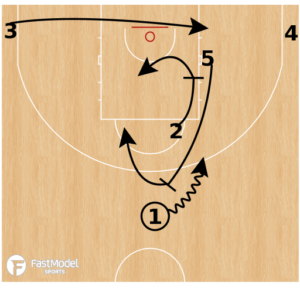
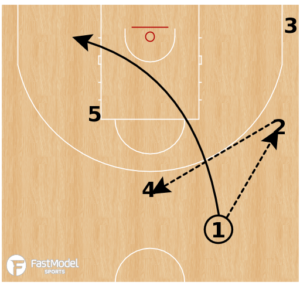
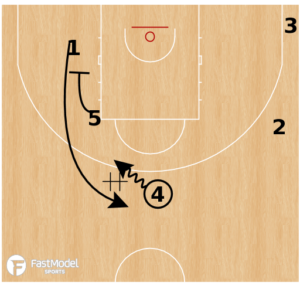
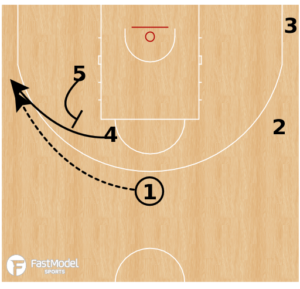
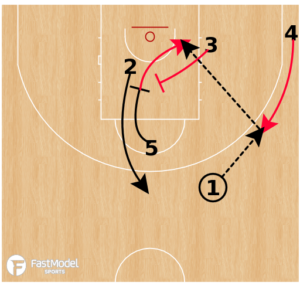
Two screen the screener plays that came from the following pages of the FastModel Sports Plays and Drills Library:

Argentina–Ram Decoy Rip–FastModel Sports.

Argentina–Thru Chicago Flare–FastModel Sports.

You can also find out more about FastModel Play Diagramming software by clicking this link: FastDraw

The plays were contributed by Sergey Tkachenko.

He is based in Perm, Russia and is currently a first assistant coach for BC Parma U18 team. He also played for U16 and U18 Russian National Teams.

Ram Decoy Rip

Set from the 2019 FIBA World Cup. Argentina won the silver medal.


Thru Chicago Flare


Boomerang vs. Ball Screen Switch

By Brian Williams on September 18, 2019

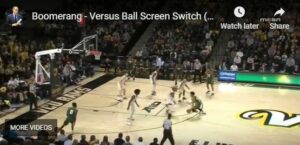
Army Men’s Assistant Coach Zak Boisvert has assembled some clips of the boomerang technique vs a ball screen switch.

I have also included a second video of Kelvin Sampson’s “Beat them off the catch drill” to work on practicing the skill of catching the basketball on the run and not traveling.

Zak has an outstanding site with posts on various coaching topics at www.pickandpop.net

His YouTube channel has several videos with various types of man-to-man plays, zone sets, and inbounds plays as well as clips on various defensive coverages.

You can subscribe to receive an update when he posts a new video Zak Boisvert You Tube Channel

You can follow him on Twitter at this link: @ZakBoisvert

Click play to see the video

There is narration with the video, so you will want to make sure that you do not have your volume on mute

This is a YouTube video, so you will need to be on a server that allows YouTube access.

Kelvin Sampson Beat Them off the Catch Drill

You can see more about and purchase (in both DVD and streaming format) this video at this link: Kelvin Sampson: Spacing and Relocation

Press Offense Sets: 2 Up, 3 Up, & Replace

By Brian Williams on September 16, 2019

This video of Kelly Wells, Head Coach University of Pikeville (Kentucky)

The content is located on the Glazier Coaching Vault at this link: Press Offense Sets: 2 U, 3 Up, & Replace

All of the basketball content in the Glazier Vault at this link: Basketball Glazier Vault Access

You will need to click on the image of the video to start it.

This is a Vimeo video, so you will need to be able to access Vimeo in order to view it.

PUT YOUR CURSOR OVER THE LOWER RIGHT CORNER OF THE VIDEO AND CLICK (IMAGE LOOKS LIKE THIS) TO WATCH THE VIDEO ON FULL SCREEN TO BE ABLE SEE LARGER DIAGRAMS AND VIDEOS
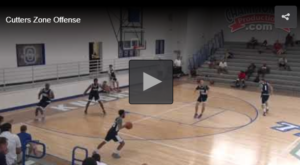


Cutters Zone Action Dribble Up Ryan Odom (UMBC)

By Brian Williams on September 13, 2019

University of Maryland Baltimore County Head Coach Ryan Odom takes you through some of the movements that are a part of his zone offense.

The video is a little over 3 minutes long and hopefully will give you some ideas that you can incorporate in the way that you attack 2-3 zone defenses.

The video is hosted on YouTube.

You will need to be on a network that allows you to access YouTube.

Click the play arrow to view the video.

There is narration with the video, so please make sure that your sound is on.

You can find out more about the Championship Productions video that this clip is from at this link: Cutters Zone Offense

  • « Go to Previous Page
  • Page 1
  • Interim pages omitted …
  • Page 46
  • Page 47
  • Page 48
  • Page 49
  • Page 50
  • Interim pages omitted …
  • Page 288
  • Go to Next Page »

Primary Sidebar

  • Twitter
  • Facebook
  • Linkedin
coachestoolbox
personaldevelopmenttoolbox
basketballplayerstoolbox
basketballtrainer
athleticperformancetoolbox
coachingbasketball

© Copyright 2026 Coaching Toolbox

Privacy Policy