• Skip to primary navigation
  • Skip to main content
  • Skip to primary sidebar

  • Basketball Plays
    • Ball Screen Sets
    • Horns Sets
    • Man to Man Post Up
    • Man to Man Isolations
    • Backdoor Plays
    • Man to Man 3 Point Shot Plays
    • 2-3 Zone Attack
    • Baseline Inbound Plays
    • Sideline Inbound Plays
    • Combination Defense Attack
  • Drills
    • Defensive Drills
    • Offensive Drills
    • Competitive Drills
    • Passing Drills
    • Rebounding Drills
    • Shooting and Scoring Drills
    • Toughness Drills
    • Transition & Conversion Drills
    • One on One Drills
  • Blueprint
  • Practice
  • Mental Toughness
  • Skill Development
  • Offense
  • Defense
  • Store

Basketball Drills Cycle Shooting

Basketball Drills Cycle Shooting

By Brian Williams on August 2, 2012

These drills were submitted to the FastModel Sports Basketball Plays and Drills Library by Coach Kyle Gilreath.

The site has thousands of drills and plays that have been submitted by basketball coaches from around the world.

Diagrams created with FastDraw

Below his two drills, I have posted links to some other shooting drills that are posted here on the Coaching Toolbox.


Cycle Shooting
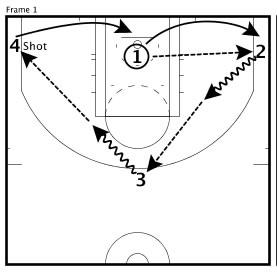
Basketball Shooting Drills

I really like this drill. I think it is worth experimenting with timing the drill to force the players to go at game pace.

This is a great shooting drill that will get your players working under pressure.

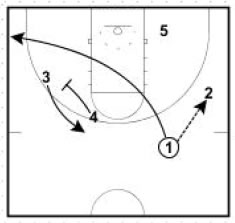
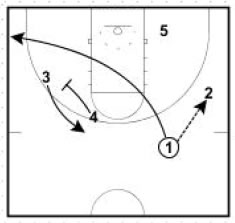
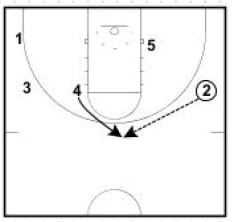
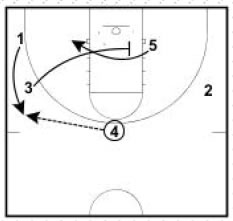
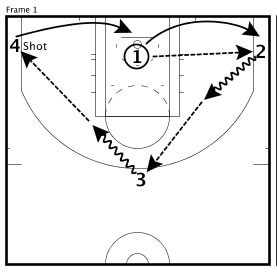
1 passes to 2, 2 takes two hard dribbles and kicks to 3, 3 takes two hard dribbles and kicks to 4, 4 shoots.

To make the drill competitive, time it to see how quickly the group can hit a specific number of shots and compete against the highest score you have for the year on your team.
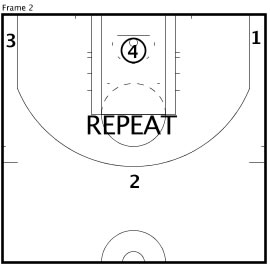
Basketball Shooting Drills

Follow pass to next pass.Repeat the cycle until you make 8 before you miss 8.


50 Point Shooting Drill

Player shoots a three point shot and a two point shot. They will follow this pattern on different areas of the court until they reach 25 or 50 points. One rebounder is needed. Shooter must catch every pass behind the three point line for ALL shots.

Here is the scoring system for the drill:

25 Point Game Goal:

-Pro (:40)

-College (:50)

-HS (1:00)

Adjust time accordingly to reach 50 points.
Tubby Smith on Defense

By Brian Williams on August 1, 2012

These defensive principles are from Tubby Smith.  I received them in Creighton Burns’ Newsletter.  I have also posted some links at the bottom of this page to other articles on defense.

1. Wherever the ball is, be on the ball.

2. Contest every shot.

 3. Apply Constant Pressure.

 4. Quickly retreat to the ball line.

 5. Overplay/Deny penetrating passes.

 6. Allow non-penetration passes.

 7. Always see ball and man.

 8. Play up the court as close to the ball as possible.

 9. Attempt to intercept all lobs and bounce passes. Go for a steal with hand closest to the defender.

10. Say Ball and always pressure the ball. Pressuring the ball means to be one arms length away. Communicate with the correct terminology.

 11. Drives must always be stopped

 12. Defending the ball off a pass: when in the passing lane go for a steal with hand closest to the receiver—it leads to less grabbing. Passes away are defended  with one foot in the paint, sprint to the ball, sprint to the help. On pass from top—wing, get butt to baseline.

Other Posts on Defense:

Lawrence Frank Defensive Concepts–some defensive philosophy from Detroit Pistons Head Coach Lawrence Frank.

Brad Stevens Defensive Concepts–more defensive philosophy from Butler’s Brad Stevens

Defensive Conversion Concepts–some thoughts on forcing your opponent to play against your half court defense.

Larry Brown Defense–some drills and concepts from the new coach at Southern Methodist

The Coaching Toolbox has hundreds of resources for coaching basketball including basketball practice, basketball plays, basketball drills, basketball quotes, basketball workouts, basketball poems, and more!

Momentum Killers Momentum Getters

By Brian Williams on July 31, 2012

You probably have a few to add to both lists and you probably disagree with some of our choices. My purpose in adding this post is to get you thinking about how to gain momentum for your team and how to stop it when it favors your opponent.

I believe that you can come up with ideas and systems to practice to teach your team to avoid momentum killers, and to work at developing the mental toughness necessary to withstand momentum killers when they do happen in games.

Have a plan, make your players aware of what they are, and work at it during basketball practice. Part of understanding how to play basketball is knowing how to control or shift the momentum.

Momentum in basketball is a great thing to have on your side. Of course, you can attempt to control momentum with timeouts, but you need those for the end of the game. This article has some thoughts on what types of plays can shift the momentum in a game. Raising your players’ “basketball IQ” by teaching them to spot those momentum shifting plays and then working with their skill levels and your team’s schemes in order to do something about them, will allow you to work at getting the momentum of the game on your side.

Momentum Killers

  1. Bad shot selection
    We have a suggested way to rate shots on a scale of 1 to 4 that will help with consistency on teaching our players what a good and a bad shot are.

    4. Layups and Power Shots
    3. Wide open three point shot
    2. average shot such as a 2 point jump shot with hand in face
    1. Pull up 2 point shot with hand in face, shots close to but insided the arc.

  2. Missed free throws
    Especially in pressure situations. Here are some links to some posts with some drills for improving shooting free throws under pressure:Two Minute Drill
    Finish the Game Pressure Free Throws Drill
    Consecutive Free Throws Drill
  3. Giving up second shot baskets
    To emphasize block outs, chart it as a stat in basketball practice and in games. Give each player his or her stats. “Steve, you had 19 block out chances on defense, and only made contact on 12.” It will make a difference in performance.
  4. Allowing opponent to score the last basket of a quarter
    I believe in holding the ball for the last shot as the clock is running down to end a quarter when there is no shot clock to have an opportunity to have 3 more possessions (1st, 2nd, and 3rd quarters). The 4th quarter depends on score. If there is a shot clock, at least give some thought to playing 2 for 1. Regardless of what you decide to do from a strategy standpoint, the most important piece is that you have practiced short clock situations so much that your players can execute automatically without the coach having to call anything from the bench.
  5. Giving up three point baskets in the fourth quarter
    As Dick Bennett says, “You must be tough enough to outlast your opponents.” Work in basketball practice to be physically and mentally tough enough to defend with everything you have for the entire game.
  6. Turnovers that lead to scores
    Your team must be able to defend the shots you take and the turnovers you make. A five second or travel turnover is better than throwing a pass up for grabs because with those turnovers, you can at least set your defense.
  7. Unnecessary fouls
    Playing hard and with discipline on defense is crucial. Rick Pitino says, “Fouling negates hustle.” Preach that to your team. If you play hard, you will get in position and be less likely to foul. If you play smart, you won’t take chances that have low payoff potential and high risk for picking up a foul.
  8. Loss of poise
    We have a section on mental toughness and focusing on the task at hand and not on the distractions.
  9. Scoring to end a quarter/half
    Again, we feel that it is imperative to have a plan and practice it daily to get the last shot of each quarter.
  10. Negating a basket by taking a charge
    Emphasize how to and when to take charges in basketball practice and reward and praise it when it happens in practice or in a game.
  11. Making a shot to take the lead in the 4th quarter
    The right player shooting with great shooting technique, great shot selection, and repetitive pressurized success in your practices doesn’t guarantee success in games, but it does increase your odds of making those shots in games.
  12. Scoring against a press
    We believe in attacking a press to beat it with a basket or a foul, not just to get the basketball across the timeline without losing it.
  13. Diving on a loose ball to gain/save a possession
    Always grab loose balls with two hands and chin them. I saw an example in this year’s NCAA tournament where a player who had a great game tried to dribble a loose ball rather than grabbing it, lost possession, and ended up losing the game on a last second shot. I am not saying that play lost the game, but those plays are the kinds of plays that you need to make throughout the course of a game to win the close ones.
  14. Answer a momentum getter by the other team.
    Work with your players in practice to understand what those plays are and what your plan is to answer them.

This is my list of Momentum Getters and that I use with our teams. It is a part of my 130 Situations eBook. Click this link to read a sample of the ebook.

Basketball Plays Corner Cut Cross

By Brian Williams on July 30, 2012

This play is from the Arizona Basketball Newsletter.

It is designed to run against a man to man defense.

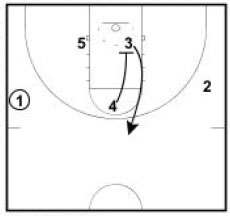
This play starts out of 4 around 1 Set.

The play has 2 options to use to finish it.

If you would like to be added to their monthly basketball coaching newsletter. I need your name, coaching position, and school and I will forward it on to their Director of Basketball Operations.


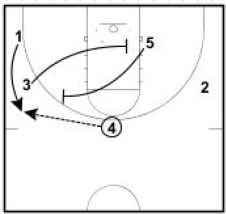
1 passes to 2 and cuts to the opposite corner as 4 screens for 3


2 reverses the ball to 4


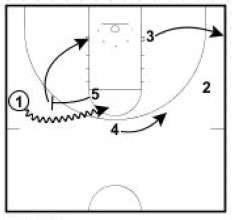
As 4 hits 1, 3 screens for 5


Two Possible finishes

Screen the screener with 4 screening for 3


OR

3 cuts Backdoor into a cross screen for 5


Then into a 5 for 1 ball screen


Average Teams and Great Teams

By Brian Williams on July 20, 2012

MOST BASKETBALL PLAYERS CHOOSE THE EASY WAY!

AVERAGE TEAMS:

always show up physically …but mentally?

have individuals…

make excuses…

do not work any harder than they have to …

are inconsistent –up for one game, down
for the next …

rarely seem to win the big game …

live on past accomplishments or future fantasies …

always think they know more than their coach …

always think they are better players than they are given credit for …

are a dime a dozen …

GREAT TEAMS:

are self-motivated …

are intelligent …

are consistent …

execute …

are fundamentally sound …

out hustle opponets …

play together …
do not worry about individual accomplishments. The team is always first …

win the games they are supposed to …

can accept constructive criticism …

believe in their teammates and help motive them by being a positive complimentary player …

are not just satisfied with a win, but also with how well they played…

have players who have sacrificed many hours by themselves in the cold, at night, when they could’ve been
somewhere else, in order to become a better skilled individual in order to better help the team…

are not just born, but are developed by hard work, cooperation, and a common goal …

unfortunately are seldom found because most choose the easy way …

THE BEST THING IS, IT IS YOUR CHOICE!

Coaching Basketball Preparing to Win

By Brian Williams on July 18, 2012

This article was contributed by Kyle Ohlman of basketballhq.com The site is a workout resources for coaches and players with hundreds of videos for ideas for skill development workouts.

Being a coach requires you to have many different jobs; developing your players, teaching character, etc. but the main job is to win games. A coach carries around his/her win loss record for their entire career. A coach of mine in college used to say, “This win or loss isn’t going to go on your record as a player, but it will go on mine as the head coach.” Since winning is the main objective I think it is worth figuring out the best way and the right way to prepare your team to win games.

Basketball is a game of details and there are so many little details that can add up to a win or a loss. For example having high hands on defense may not be a huge deal, but if you add that with communicating, being in the right position, rotating, hedging on a ball screen, etc. it can be the difference between a good team and a bad team. The small details are usually the hardest parts of the game for players to learn and master. Most of them have never been taught the right way to do things, and there isn’t any glory for being in the gap or help side on defense. As a coach it is your job to explain the right way to do things and also create a culture that values the details of the game.

Once you have explained the right way to do things you must be consistent. It doesn’t matter whether it is your best player or your worst player they need to be held to the same standard. Sure there will be times to show grace but if you are inconsistent then your players will not truly buy into what you are trying to do. Just like any habit good or bad it takes time and repetition to learn. Believe in the process and be willing to stick with it for the return on the back end.

Come to practice with the same intensity everyday. Whether you have won or lost the last few games believe in your system, players, and style. A lot of coaches will start relaxing after they have won a few games in a row and this sets the team up to not be ready for the next game. On the other hand I have seen coaches lose a close game and just like Chicken Little come in thinking the world is ending and that everything needs to be demolished and started over. Come into practice ready to work and get your team better everyday regardless of whether you are winning games or losing them.

I was fortunate to have some really good coaches in my playing career that I could learn from and grow as a player. My coaches knew that it was important to invest in your players and that better players make better teams. Take the time to improve your players skill sets as well as their basketball IQ’s. It doesn’t matter how great the plays are that you draw up if your players miss the shot at the end of every play. Not only will player development help your team to become better, it will also give your players a better chance to play at the next level.

Players can tell if a coach really has their back or not and when a player knows that the coach is behind them they will give everything they have on the floor. Take the time to invest in your players and build real lasting relationships with them. Be hard on them and hold them accountable but be fair and invest in them off of the floor as well. This will take more time out of your schedule, but you will realize that you are usually the one that benefits the most from investing in your players lives.

One of my coaches used to always say this one line during practice, “You are winning or losing the game right now.” When you think about it, it makes so much sense. You don’t beat a test when you show up to the test; you beat it when you spend the hours of study time in preparation for it. This is the true difference between the great teams and the teams who are average. They understand the importance of practice and preparing for games the right way. Make sure that your team is bought in and takes advantage of practice the way that they should. Believe in the process and even though it may be hard at first it will be worth it down the line.

Here are Basketball HQ’s Social Media links:

Twitter: https://twitter.com/BasketballHQ
Facebook: http://www.facebook.com/Basketballhq

  • « Go to Previous Page
  • Page 1
  • Interim pages omitted …
  • Page 254
  • Page 255
  • Page 256
  • Page 257
  • Page 258
  • Interim pages omitted …
  • Page 288
  • Go to Next Page »

Primary Sidebar

  • Twitter
  • Facebook
  • Linkedin
coachestoolbox
personaldevelopmenttoolbox
basketballplayerstoolbox
basketballtrainer
athleticperformancetoolbox
coachingbasketball

© Copyright 2026 Coaching Toolbox

Privacy Policy