• Skip to primary navigation
  • Skip to main content
  • Skip to primary sidebar

  • Basketball Plays
    • Ball Screen Sets
    • Horns Sets
    • Man to Man Post Up
    • Man to Man Isolations
    • Backdoor Plays
    • Man to Man 3 Point Shot Plays
    • 2-3 Zone Attack
    • Baseline Inbound Plays
    • Sideline Inbound Plays
    • Combination Defense Attack
  • Drills
    • Defensive Drills
    • Offensive Drills
    • Competitive Drills
    • Passing Drills
    • Rebounding Drills
    • Shooting and Scoring Drills
    • Toughness Drills
    • Transition & Conversion Drills
    • One on One Drills
  • Blueprint
  • Practice
  • Mental Toughness
  • Skill Development
  • Offense
  • Defense
  • Store

Basketball Plays 1 2 2 Zone Attack

Basketball Plays 1 2 2 Zone Attack

By Brian Williams on August 20, 2012

This 1-2-2 Zone Attack came from Coach Creighton Burns.

Below the diagrams are some more posts with ideas for attacking zone defenses.

Other resources on this site for attacking zones are listed on this page:

Diagrams created with FastDraw
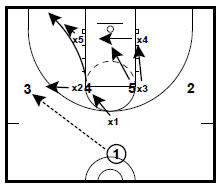


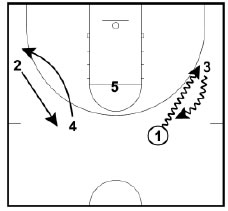
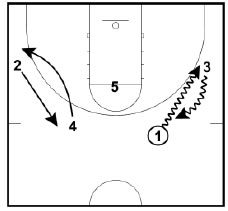
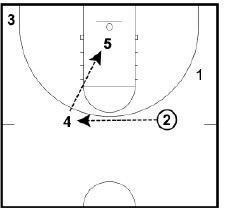
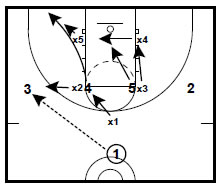
Start in a 1-4 high alignment

PG should enter the ball to the opposite side of your best post player

Ball side post dives to the short corner

This should force the ball side post defender to match with the 4 man
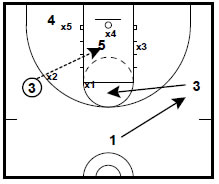
From the wing position, you are looking to the short corner, the post who is pinning the middle of the zone, and the high post flash from the opposite wing

1 fills opposite wing

Note: Whoever is diving to the middle of the zone, needs to work very hard at pinning the middle of zone, even if you are not getting the ball.

(Short Corner Entry)
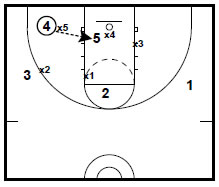
If the ball goes to the short corner, he should:

* Look to score if the post defender stays in the lane to pinch the offensive post player in the middle of the lane


* Enter the ball to the low post if his defender comes out to guard

Note: It is important that post in the middle of the lane be aware of the 3 second count. He needs to leave the lane at any time to avoid this violation

(Short Corner High Post Look)
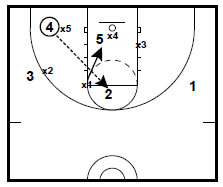
If the high post (X1) starts to dig in the post because you are getting good low post feeds from the wing and the short corner, the short corner should look to pass to the high post 2, which is probably a good shooting guard, can shoot the 15 foot jump shot, or give a high low feed if X1 closes out hard on the shot

(Ball Reversal)
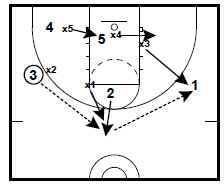
The high post steps out for a reversal pass


(Rotations)
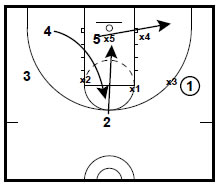
Middle post cuts to the ball side short corner

High post dives to pin the middle of the zone

Weak side short corner flashes to the high post

You now have the same looks as you did on the other side
Free Throw Attack

By Brian Williams on August 17, 2012

This came from the Xavier Basketball Newsletter

By Mike Dunlap – former HEAD COACH, CHARLOTTE BOBCATS, currently Head Coach at Loyola Marymount.

Let’s go to work!

First, understand that in any given game free throws make up 25% of the total score.

Do you spend an equivalent amount of practice time on free throws?

If not, you can expect to see your team shoot under 70%, an unacceptable standard.

The following suggestions might assist in your team’s improvement with free throw shooting:

1. Get a philosophy.

a. Know how you want your players to shoot free throws and insist that they shoot them a particular way (i.e. if they shoot over 80% then leave them alone).

b. Points of emphasis physically

1) Legs: You shoot with your legs (i.e. every shot finished with player on tip toes).
2) Follow Through: Elbow points to rim and hold gooseneck for count of two EVERY TIME.
3) Eyes: On target at all times.

c. Points of emphasis mentally

1) Breathing: Teach your players that breathing is an important vehicle in relaxation.
2 ) Visualization: The player should see himself making the shot before he steps to the line.

2. Get a system that you can incorporate into your daily practice.

a. Post a list of your players in the gym weekly. Require them to make a minimum of 25 free throws before and after each practice. Each player must record how many shots it took him to make 25 shots; the players begin to take responsibility right from the first practice; the players can all quickly see the progress they are making; certain players will ultimately realize that they need your assistance.

3. Practice time allotment to freethrows must remain consistent.

a. Be committed to shooting freethrows for a certain time each practice; be committed to demanding absolute concentration as players and coaches have a tendency to relax during freethrow segm ent sin practice; be committed to varying your freethrows, constantly competing against others and thems elves, and have some freethrow games thrown in there so that your players have some fun.

4. Make a big deal out of free throws.

a. Pick times during practice to stop everything and put a player at the free throw line. Tell the team that there is no time on the dock, one and one, and your team needs to hit both in order to beat your biggest rival. If he should miss, make the whole team run a suicide. The team quickly understands that a missed free throw huts the entire squad.

b. Occasionally bring in a reward for the best free throw shooter of the day. The point here is to spice up free throw shooting while stressing importance.

c. In your locker room you can post previous outstanding free throw shooters as free throw shooting should become part of your tradition. We all have our own ideas about how a free throw should be shot. All I am suggesting is that it is an area we can improve on with a little more thought, and certainly, the rewards will be worth the toil. Regardless of your talent, this is an area where a coach can have a tremendous influence and can steal a few extra wins.

Free Throw Drills

As a coach, you must teach your players how to concentrate and constantly challenge them. Hence, we set up drills that put them at a disadvantage or pressure situation.

Drill #1

5 point game

a. 5 points for a swish (no rim).
b. 4 points when ball hits any part of the rim.
c. 3 points when ball hits both sides of rim.
d. 2 points when ball its nm three times, rattles, etc.
e. I point when ball rolls around rim or hits backboard.
f. 0 points for a miss.

* Now the shooter must concentrate not only on making the shot but also on how he puts the ball through the cylinder.

Drill #2

The Lap Game

a. Divide your team into two, three, four, etc. groups.
b. Each player gets one shot.
c. If the first player makes his shot and the second player misses, then the player who misses must sprint a lap.
d. If the first two players make their shots but the third misses then he runs two lap and so forth,

* A good game because pressure steadily increases on the players as shots are made.

Drill #3

The Basket Game

a. Each player must make a free throw at each basket in the gym consecutively or he must start over b. You can name any number you want).

* Breaks the routine of the shooter and force the players to adjust.

Basketball Pressure Defense

By Brian Williams on August 14, 2012

These rules that Coach Don Showalter uses for his pressure defense came from Creighton Burns’ newsletter

Creighton also credits Championship Productions.

If you are interested in subscribing to Creighton’s newsletter, email me and I will forward it on to Creighon.

Coach Showalter’s teams start out and press regardless of personnel. Here are some ideas, rules, and tips for how you can implement this system effectively with your team.

Deflections Are Huge – Chart deflections in practices and games. It doesn’t have to be a steal, just a deflection (even if it’s with a fingernail). Aim for 20 deflections or more in a game. This number will tell you whether or not the press is working pretty well. For Coach Showalter, deflections are more important than steals. While your team may not have a ton of steals one game, they may get a lot of deflections. This tells you that the other team has been thrown off a bit.

Ball Pressure is Crucial – “Press” means ball pressure. Be Patient – The press may work for long or short spurts, but it will work. You must be patient with it and if you are, kids will understand that they won’t get out of it. If your team thinks they will be getting out of a press as soon as a basket is given up, then they are done. You can’t press with that team. Coach Showalter’s teams are going to press regardless of what happens. Overall, they will play harder and adjust.

Stay With It – If ball pressure is constant all game long, you’ll have many intangibles in your favor if you stick with it. For instance, the constant pressure forces your kids to play hard. So how exactly do you get them to play hard? Well, they are pressing, and if they don’t play hard, they will get embarrassed.

Set Good Traps and Don’t Reach – Remember, you aren’t going to steal the ball on the trap, but rather out of your trap. The players who are trapping are often not the ones going to steal it. Also, keep in mind that fouling negates hustle. Therefore, keep your hands up and don’t reach. Always run to your teammate when trapping and sprint to the trap (hands up, hands off).

You Must Sprint Out of Traps – Turn the shoulders and hips to the area where you want to run to. It’s not as simple as it sounds, so coaches must watch their players to ensure they are doing this effectively.

Look to Tip From Behind – You can get 3 or 4 baskets a game just from doing this.

Anticipate the Next Move of the Opponent
– Don’t let the offensive team break the press the same way two times in a row. This should be your mindset. Keep the opposition off balance and uncomfortable.

Be Aware – This is said a ton in practice. Be aware of where your man is and what’s going to happen.

Make Opponents Take Jump Shots – Be there when they shoot it and be there when they miss it.

Basketball Plays 1 Up

By Brian Williams on August 13, 2012

This play is from an older Arizona Basketball Newsletter..

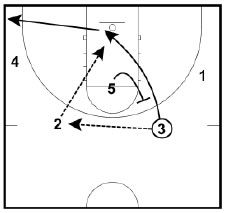
This play is designed to be run against a man to man defense. It features three opportunities to get the ball inside.

If you are interested in subscribing to the Arizona newsletter, email your

email me your

1) name
2 School/Team
3) Coaching position


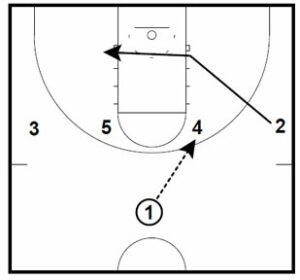
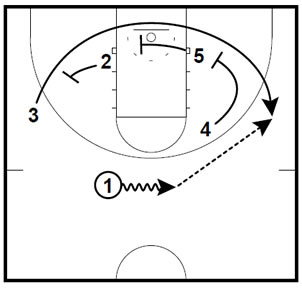
1 dribble hadoffs to 3. 3 sprints the ball toward the inital set. 4 and 2 interchange.


3 passes to 2, 5 backscreens for 3. 2 looks for 3. If that is not there, 3 clears to wide corner.


5 sprints into a ballscreen for 2. 5 rolls to the rim. 4 comes high to the opposite elbow.


If 5 is not open on the roll, 2 passes to 4 and 4 then looks for 5 on a duck in.


Your Worth to the Team

By Brian Williams on August 8, 2012

Some good questions for basketball coaches to ask their players.

To check you value to our basketball team, ask yourself these questions:

  1. Am I mature enough to work at things seriously?
  2. Do I observe the rules of basketball?
  3. Do I expect and respect authority?
  4. Do I conform to all training rules?
  5. Am I willing to sacrifice for the team? And for myself?
  6. Do I work hard in prepractice to improve my fundamentals?
  7. Do I recognize correction from the coaches as an effort to help me to improve rather than as a criticism of my performance?
  8. Do I help and encourage my teammates when they are striving to improve?
  9. Do I stand up for the team or a teammate when I hear criticism?
  10. Do I tell a teammate to stop complaining?
  11. Do I report any dissension among players to the coaches?
  12. Am I dedicated to the point where I’m willing to make any sacrifice which will improve our team, improve myself, or improve the image of our team?
  13. Do I recognize the fact that while on or off the basketball floor my actions and performances are a reflection on my family and on the team?
  14. Do I take pride in my actions, dress, and speech on and off the basketball floor?
  15. Do I have a spirit of cooperation with other team members and the coaches?
  16. Do I have a burning desire to win?
  17. Do I continually work to improve—never being satisfied with my present development?
  18. Do I have the self-discipline and mental toughness to fight back when the chips are down?
  19. Am I all business before and during the game?
  20. Am I a hard loser? That is do I profit from my mistakes by thinking and talking over the cause of defeat and make sure the same cause never defeats me again? (There is a great difference between a hard loser and a poor loser)
  21. Do I recognize the privilege and honor of making the team?
  22. Am I eager to learn more?
  23. Do I spread enthusiasm to others through my enthusiasm and eagerness?
  24. Do I set an example for younger players which will make them eager to become the same kind of player and person as I am?

Basketball Plays Elbow Bone

By Brian Williams on August 6, 2012

Coach Vonn Read has submitted several plays from his playbook series The Basketball Encyclopedia of Plays to the Coaching Toolbox.

He has also served as an assistant coach in the WNBA with the Phoenix Mercury, Orlando Miracle, and San Antonio Silver Stars. He was an advanced scout for the Orlando Magic as well as The Charlotte Sting.

Please like this page or use the Twitter button to share!


Basketball Plays


1-4 High Set

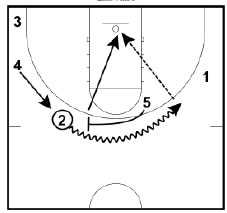
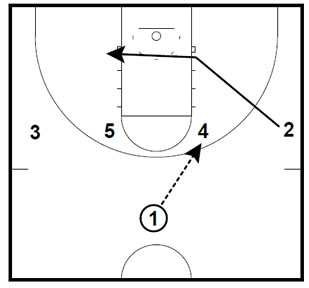
1 Passes to 4 at the Elbow.

2 cuts hard for the backdoor layup if available.


Basketball Plays


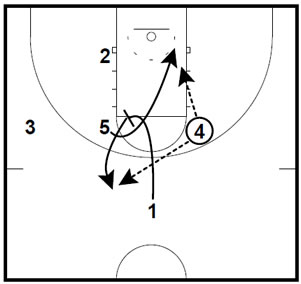
1 fakes the hard cut to the basket and sets a brush screen for 5 curling to the basket for the quick layup

If 1’s defender helps on the screen, 1 should be open for the 3 point shot popping back.


Basketball Plays


3 comes off of a Triple screen low.

Option – 2 could come off the double screen low if he is the better shooter!!


Coach Read has also put together The Basketball Encyclopedia of plays. You can check them out here: The Basketball Encyclopedia of Plays or read more about the books:

Any coach looking for the latest and innovative plays from the Professional, College, or High School levels can stop looking. With a compilation of over 7,700 different plays, you will never need to purchase another basketball playbook again. These playbooks can be used as a great reference tool for years to come. This 2 Volume Book includes plays from 19 different play categories, and they are the most extensive playbooks on the market.

The Basketball Encyclopedia of Plays (Platinum Series) contains over 7,700 Plays (Both Volumes combined) from the NBA, WNBA, USBL, and College levels from someone who has worked as an Advanced Scout or Coach on each level!!! This book has been intensely compiled over the last 21 years, with plays taken from a lot of NBA Coaches (past and present), WNBA coaches, and College coaches (Men’s and Women’s) from around the country.

Any coach that is serious about improving their knowledge of the game from an X and O standpoint will benefit tremendously from these books. These Books can be used to discover New Quick hitters, add a New Package to your playbook, or develop an entire Offensive System. There are a lot of new ideas and concepts in these books to study, and the Basketball Encyclopedia of Plays can be a great resource for coaches on all levels!!! This book is definitely for those X and O junkies who are always looking to improve as a Coach.

“THE GAME IS ALWAYS CHANGING? ARE YOU?” Vonn Read

Here is the link: The Basketball Encyclopedia of Plays

  • « Go to Previous Page
  • Page 1
  • Interim pages omitted …
  • Page 253
  • Page 254
  • Page 255
  • Page 256
  • Page 257
  • Interim pages omitted …
  • Page 288
  • Go to Next Page »

Primary Sidebar

  • Twitter
  • Facebook
  • Linkedin
coachestoolbox
personaldevelopmenttoolbox
basketballplayerstoolbox
basketballtrainer
athleticperformancetoolbox
coachingbasketball

© Copyright 2026 Coaching Toolbox

Privacy Policy