• Skip to primary navigation
  • Skip to main content
  • Skip to primary sidebar

  • Basketball Plays
    • Ball Screen Sets
    • Horns Sets
    • Man to Man Post Up
    • Man to Man Isolations
    • Backdoor Plays
    • Man to Man 3 Point Shot Plays
    • 2-3 Zone Attack
    • Baseline Inbound Plays
    • Sideline Inbound Plays
    • Combination Defense Attack
  • Drills
    • Defensive Drills
    • Offensive Drills
    • Competitive Drills
    • Passing Drills
    • Rebounding Drills
    • Shooting and Scoring Drills
    • Toughness Drills
    • Transition & Conversion Drills
    • One on One Drills
  • Blueprint
  • Practice
  • Mental Toughness
  • Skill Development
  • Offense
  • Defense
  • Store

Mental Toughness and Excuses

Mental Toughness and Excuses

By Brian Williams on December 20, 2012

I have always felt that the four areas that a coach can affect with players in their basketball and that players should concentrate on improving are:

1) Toughness (both mental and physical)
2) Basketball Skills
3) Executing the team’s offensive and defensive schemes
4) The program culture (intangibles such as teamwork, unselfishness, trust, daily improvement, and bonding)

IMO, one of the skills involved in mental toughness is not making excuses. I have assembled some quotes in this article that I hope will help as you work with your players to develop and improve their mental toughness.

Excuses are the nails used to build a house of failure. ~Don Wilder and Bill Rechin

Don’t make excuses – make good. ~Elbert Hubbard

He who excuses himself accuses himself. ~Gabriel Meurier


Several excuses are always less convincing than one. ~Aldous Huxley

Maybe you don’t like your job, maybe you didn’t get enough sleep, well nobody likes their job, nobody got enough sleep. Maybe you just had the worst day of your life, but you know, there’s no escape, there’s no excuse, so just suck up and be nice. ~Ani Difranco

How strange to use “You only live once” as an excuse to throw it away. ~Bill Copeland

Don’t do what you’ll have to find an excuse for. ~Proverb

No one ever excused his way to success. ~Dave Del Dotto

Excuses are the tools with which persons with no purpose in view build for themselves great monuments of nothing. ~Steven Grayhm

And oftentimes excusing of a fault. Doth make the fault the worse by the excuse. ~William Shakespeare

A lie is an excuse guarded. ~Jonathan Swift

Hold yourself responsible for a higher standard than anyone else expects of you. Never excuse yourself. ~Henry Ward Beecher

Whoever wants to be a judge of human nature should study people’s excuses. ~Hebbel

130 Great Ideas to Make Your
Basketball Team More Mentally Tough”
basketball practice

Click here for 12 ideas from the e-book

“This is great information that will help any coach to make their team more mentally tough and focused. I found sections 6 and 7 to be helpful to me as well as to our team. “

Brandon Sorrell
Assistant Girls Basketball Coach
Lawrence North (Indianapolis) High School

There is no such thing as a list of reasons. There is either one sufficient reason or a list of excuses. ~Robert Brault,

We have more ability than will power, and it is often an excuse to ourselves that we imagine that things are impossible. ~François de la Rochefoucauld

Difficulty is the excuse history never accepts. ~Edward R. Murrow

Pessimism is an excuse for not trying and a guarantee to a personal failure. ~Bill Clinton

I attribute my success to this: I never gave or took an excuse. ~Florence Nightingale

We are all manufacturers – some make good, others make trouble, and still others make excuses. ~Author Unknown

One of the most important tasks of a manager is to eliminate his people’s excuses for failure. ~Robert Townsend

Success is a tale of obstacles overcome, and for every obstacle overcome, an excuse not used. ~Robert Brault

An excuse is a skin of a reason stuffed with a lie. ~Billy Sunday

Bad men excuse their faults; good men abandon them. ~Author Unknown

He that is good for making excuses is seldom good for anything else. ~Benjamin Franklin

It is wise to direct your anger towards problems – not people, to focus your energies on answers – not excuses. ~William Arthur Ward

It is better to offer no excuse than a bad one. ~George Washington

We have forty million reasons for failure, but not a single excuse. ~Rudyard Kipling

The person who really wants to do something finds a way; the other person finds an excuse. ~Author Unknown

If you always make excuses to not follow through you deserve the weight of anxiety on your chest. ~Author Unknown

Justifying a fault doubles it. ~French Proverb

A man can fail many times, but he isn’t a failure until he begins to blame somebody else. ~John Burroughs

The best day of your life is the one on which you decide your life is your own. No apologies or excuses. No one to lean on, rely on, or blame. The gift is yours – it is an amazing journey – and you alone are responsible for the quality of it. This is the day your life really begins. ~Bob Moawa

Never ruin an apology with an excuse. ~Kimberly Johnson
Basketball Coaching Offensive Phases

By Brian Williams on December 19, 2012

I believe that the defensive and offensive systems and styles that a basketball team employs must be complimentary.

In this post, I am going to concentrate on what I call the 6 phases of an offensive possession.

The following is the system that I use to organize, teach, and evaluate each possession as it cycles from offense to defense.

My hope is that you can get a couple of ideas to adapt to your program.

Here is a link to the 6 defensive cycle of a possession.


Basketball Offensive Phases

Offensive Phase #1 Transition after made baskets and missed baskets. Never be surprised by a trap or full court press–we inbound the ball in our press offense every time after our opponent scores. Our principles in our press offense are to put one player back as a finisher at the basket. Throw the ball over the top of the press as a pressure release. One reversal and then cut through. Do not throw the ball back to the side from where it came. 3 x15 foot receivers in the backcourt. Pass fakes to move the defense.(10 sec better than bad pass). Man to man clear out for primary ballhandler, but be prepared for a run and jump. Click here for more on press offense.

All eyes on the ball as it crosses half court. If we do get trapped, we automatically go into rotation–our half court trap alignment.

Long lead pass is thrown to ft line

Offensive Phase #2 Establish and maintain spacing spots

Just as in the defensive phases, it is important not only to establish spacing, but it is important to maintain it during ball and player movement.

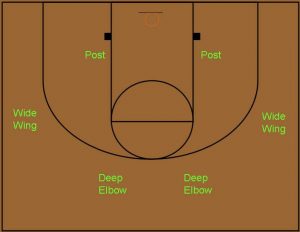
Our perimeter spots are one step behind the 3 point arc.Wide wings, deep elbows, deep corners are suggested spacing spots. Only throw to a player in the deep corner who has an immediate shot to avoid putting the ball in a trap situation. Too high and too wide is better than too close for deep elbow and wide wing.

A critical concept in spacing is that if the ball is in the post, the short corner (halfway between the post and the deep corner), or in the deep corner, there MUST

be someone at the ballside wide wing to give the ballhandler an outlet if s/he is trapped.

At all times we have 4 players without the ball, screening, cutting, spacing, slipping, or posting

Offensive Phase #3 Handle the basketball with sureness (This is a continuation of my entry on avoiding turnovers. Click this link for that post: Avoiding turnovers

Catch triple threat–eyes on the net. Make the easy pass. The best Use Pass Fakes. Use bounce passes to throw out of traps or trouble. Don’t pass to the offense-pass away from the defense which usually means the outside hand. Meet every pass. Attacking too fast or forcing drives or passes that are not available Catching and dribbling rather than catching in triple threat leads to turnovers.

Passing-push with outside hand to outside hand of receiver. Contact is never an excuse to loose the ball Fake a pass to make a pass.

Do not fake backdoor. If you start a cut backdoor, you go all the way to the basket.

Offensive Phase #4 PUT THE BALL IN THE LANE AGAINST ALL DEFENSES Put the ball in the lane to score, to collapse the defense, and to get to the free throw line. We want an inside out attack.

Do not settle for outside shots against a zone or a trap—go inside.

Dribble drives, Post feeds, passes to cutters, and offensive rebounds are the ways that we get the ball in the lane.

Offensive Goals: 2/3 possessions ball in lane. We chart this in practice and games.

Offensive Phase #5 Shot selection—Don’t settle for anything less than who, what, when, and where we want

Shot rating system and the order in which we look to score

4. Layups and Power Shots
Free Throws
3. Wide open three point shot
2. 2 point jump shot with hand in face
1. Pull up 2 point shot with hand in face, shots off the arc

Offensive Phase #6 Fill rebound spots when the ball is shot (where the defensive cycle starts)

When we shoot the ball, we go to the spots diagrammed at the left to give us offensive rebound coverage and to prepare to convert to defense.

if #1 or #2 Shoot the ball, they do not follow their shot in our system. #2 (We call him our halfback) slows the ball as it is beirng advanced on the dribble. #1 (we call him our fullback) retreats to cover the basket.

If 3, 4, and 5 can’t grab an offensive rebound, look to tip out to 1 and 2

Here is a link to the 6 defensive cycle of a possession.

Basketball Coaching 12 Phases of a Basketball Possession

By Brian Williams on December 18, 2012

I believe that in coaching basketball, the defensive and offensive systems and styles that a basketball team employs must be complimentary.

In this post, I am going to concentrate on what I call the 6 phases of a defensive possession. I do have the 6 offensive phases posted as well. Here is a link to the 6 phases of offense.

The following is the system that I use to organize, teach, and evaluate each possession as it cycles from offense to defense.

My hope is that you can get a couple of ideas to apply to your team defense.


Basketball Defensive Phases

Phase #1 Defensive Conversion (Goal: no conversion points and force the ofther team to play against our halfcourt defense.)

When we shoot the ball, we go to the spots diagrammed at the left to give us offensive rebound coverage and to prepare to convert to defense.

So if #1 or #2 Shoot the ball, they do not follow their shot in our system. #2 (We call him our halfback) slows the ball as it is beirng advanced on the dribble. #1 (we call him our fullback) retreats to cover the basket.

Coaching Basketball

The numbers are for explanation only, #1 is not necessarily the point guard. #3, #4, and #5 are our best three offensive rebounders, but 5 does not always go to the front of the rim. Our objective is to cover the block, block, and front of the rim for offensive rebounding. The players go to the first available.

Players 3, 4, and 5 inside fight for offensive rebound position. If the other team retrieves the rebound, those players SPRINT inside our defensive three point arc and match up. Our rule is that if you pick up the ball (#2s responsibility) you keep it, even if that is not who you are assigned to guard, until you are called off by the player who is guarding him.

Defensive Phase #2 Establish and maintain defensive spacing
to be ready to help. This includes guarding the post. Our defense is a pack style man to man, so our players play more in gaps and help postion, but the same can be applied to a pressuring man to man or to a zone. The idea is to have all 5 players working and never relaxing.

The “establish'” part is our effort to get into initial help and post defense positions.

The “maintain” is the adjusting part as we defend the player movement and ball movement of the offense. We drill that by using the shell drill with various types of player movement in addition to the traditional stationary offense and position check shell drill.

When the ball is passed, we run on the air time of the pass to our new spots. Our expectation is that the player picking up the ball arrive Recovering applies to all 5 players, not just the player recovering to the ball. The other four are recovering to their post defense and gap positions.

Defensive Phase #3 Pressure the ball without giving up penetration and without fouling.
We pressure the ball on the dribble one step off the arc and the passer when the ball is picked up. We chart deflections as a measure of how we are doing, but do not reach in for the ball. Our rule on taking the ball is to take it with two hands only and never reach with one.

Our defense is a helping defense, but we do not want to rely on help and continually get beat on the dribble. We work to keep the dribbler in front of us. “Guard your yard”–you need to guard the ball 3 feet in either direction without relying on help.

An important part of our pressure is great technique and intensity on our closeouts.

Defensive Phase #4 Keep the ball out of the lane It takes 5 players pressuring and contianing the basketball, defending post passes, and getting in their gaps to discourage penetrating dribbles. We start of in help position to keep the ball out of the paint, rather than deny, help, and recover. We do not deny non penetrating passes.

If the ball goes in the lane, trap it and force it to be thrown to the perimeter, then sprint to new defensive spacing spots, closeout on the ball and contain penetration. Keeping the ball out of the lane keeps us out of foul trouble and keeps the opponent from being able to take inside out shots.

It takes a continual effort to keep the bal out of the lane and I often paraphrase Dick Bennett when he said to one of his Wisconsin teams,: “We Must OUTLAST the offense on every possession! Great defense takes consistent effort and commitment to excellence, every second of every practice and every game. It is not good enough to just go through the motions, to give the impression that you are trying, that you care. You must take PRIDE in your defense, in your effort, and be committed to OUTLASTING your opponent. You have to believe that! Anything less gives our opponents the edge. Gentlemen, we must OUTLAST the offense on every possession. That must be our foundation.”

Defensive Phase #5 Contest every shot with mirror hand. That is, if it is a right handed shooter, we contest with our left hand, if it is a left handed shooter we contest with our right hand. The objective of our defense is to force contestd jump shots and then complet the possession with a rebound.

Cardinal rule do not foul a jump shooter. To emphasize contesting shots In practice, if a starter does not contest a shot, it is 2 points (or 3 if it is behind the arc) for the second team if the shot misses. If the shot goes in, we count it and add the extra 2 points or 3 points as well.

In a game, we chart contested shots. On a players second shot he doesn’t contest, he comes out of the game temporarily. Not for the rest of the game, but long enough to send a message.

Defensive Phase #6 Block out, pursue the ball, chin the rebound or dive on or chin all loose balls.

Finishing the possession is key. We don’t consider rebounding as a separate phase, we consider it as a part of the offensive or defensive possession. It is the part that concludes all of the hard work.

We don’t want to work relentlessly in the first five phases and then waste all of that work by not blocking out then going after the ball tenaciously.

We chart block out percentage from our game videos. We reward those with 90% for a game with a sticker on their locker.

We also give a sticker for collecting 8 or more rebounds. We take playing time away from players with consistently low percentages.

I also believe it is key to teach players to grab a loose ball with two hands and chin it rather than trying to dribble it. Chart and reward who gets the 50/50 balls and who is on the floor after them. There aren’t as many loose balls as rebounds per game, but each one is as important as a rebound because it can finish the possession on defense or continue the possession on offense.

Offensive Phases

I will be adding more description to these tomorrow

Offensive Phase #1 Presss Offense, Halfcourt Trap Offense, Transition. Never be surprised by a trap or full court press–always be prepared for them.

Offensive Phase #2 Spacing. Fill our spacing spots.

Offensive Phase #3 Sureness—catch triple threat, use bounce passes. Passing-push with outside hand to outside hand of receiver. Contact is never an excuse to loose the ball Fake a pass to make a pass.

Offensive Phase #4 Put the ball in the lane to score, to collapse the defense, and to get to the free throw line.

Offensive Phase #5 Shot selection—Who, what, when, where.

Offensive Phase #6 Fill rebound spots when the ball is shot (and the cycle starts over)

Here is a link to a more in depth discussion of the 6 phases of offense.

Basketball Plays Double Triple

By Brian Williams on December 17, 2012

This play is run against man to man defenses.

It features a staggered double screen for a shooter, then finishes with a staggered triple screen for a second shooter.

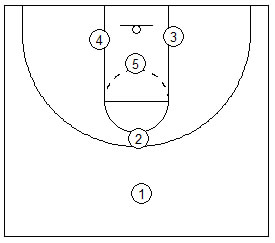
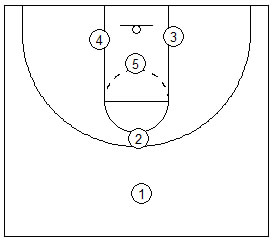
The play starts in a 1-4 high set.

I have also included links to other plays below the play.


Basketball Plays

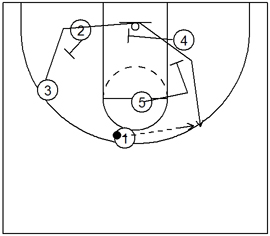
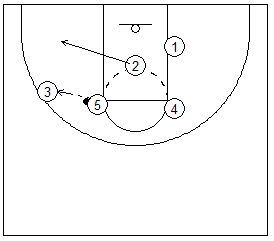
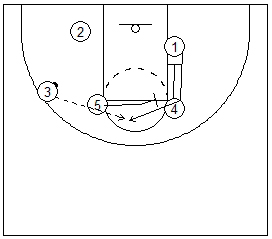
#1 hits #5 at the elbow and then uses a backscreen from #4.

#2 cuts across to the opposite block.

#3 jabs to get open


Basketball Plays

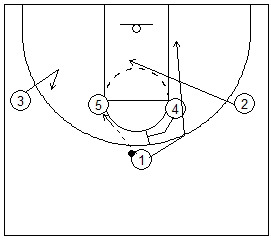
#5 hits #3 as #2 cuts to the low post or short corner–whichever spot he is more effective from.


Basketball Plays

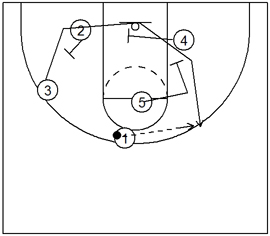
#3 can feed #2 or can hit #1 who is coming off the staggered double from #4 and #5.


Basketball Plays

To complete the play, #2, #4, and #5 set a staggered triple screen for #3.


Basketball Plays Blob vs Zone

By Brian Williams on December 14, 2012

This play is from the Arizona Basketball Coaching Newsletter.

It is an inbounds play to run against a 2-3 zone.

If you would like to be added to their monthly basketball coaching newsletter.

I need your name, coaching position, and school and I will forward it on to their Director of Basketball Operations.

I have also listed some links to other under out and side out inbounds plays at the end of this post.

I have several playbooks available in bundles of 4 for $35. You can make your selections here: eBook bundle pricing

Basketball Plays


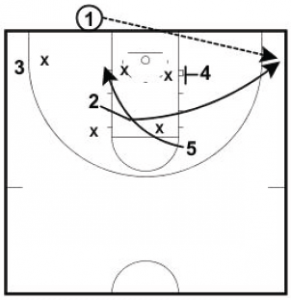
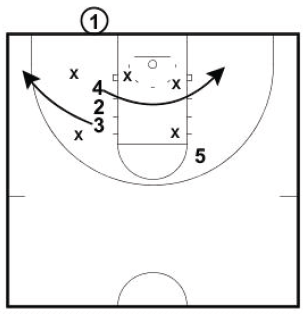
When the official gives the basketball #1 , #3 goes beyond the arc in the ballside corner.

#4 goes to short corner opposite the basketball


Basketball Plays


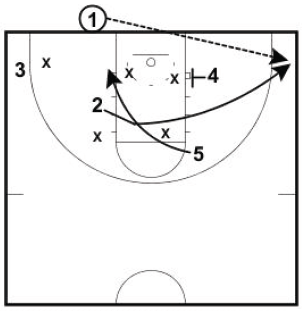
#4 screens in for #2 who cuts to the corner opposite the ball

#5 cuts to the block in front of the ball.


Basketball Coaching Reducing Turnovers

By Brian Williams on December 13, 2012

Today’s items are ideas to help your coaching staff and players identify why turnovers happen. In my opinion, identifying things that cause turnovers is the first step to avoiding them and correcting them when they do happen. If you have anything to add as I go, please send it to me!

I hope that there are a couple of ideas in here that get you thinking about improving how your team takes care of the basketball.

The first step to cutting down on turnovers is for the players to understand the cause of their turnovers. The second step is then to develop a plan of action to eliminate the problem areas. It is also essential that the players understand the significance of each turnover. An average team scores around a point per possession, so every turnover is essentially giving away one point.

I have listed (in no particular order) some of my thoughts about recognizing why turnovers are made and then some things I look to do to improve upon taking care of the basketball. This list is not all inclusive, so if you have any thoughts to add, please email them to me!


I have categorized them. The categories are in bold. The parenthesis are my thoughts on some ideas to avoid and correct the type of turnover listed.

Poor recognition or lack of concentration

  1. Player doesn’t recognize the type of defense, what the objective of the defense is, and what is the best way to beat that particular defense. For example doesn’t recognize and distinguish a half court trap as opposed to a man to man defense. (Coach helps recognize defenses from bench in games and works against changing defenses in practice)
  2. Three second violation due to a player being unaware that he is in the lane. (Call all violations in practice scrimmage and in drills.).
  3. Just because there is no defender around a teammate, does not mean she is open. Other helping defenders deflect and steal passes–not just the defender guarding the receiver. Players must be aware and have vision of all defenders.
  4. Throwing the ball to where you think a teammate should be rather than seeing that he is there before throwing the pass

Poor Execution

  1. Picks up dribble without a pass. (Every time a player picks up the dribble in practice, other than to avoid a 5 second count, without a pass–it is an automatic turnover or an automatic 2 points for the other team in a practice scrimmage,. I believe in keeping score every time we scrimmage with special rules that work to even the talent level between the first and second units or that discourage plays that will be turnovers in games against equal or superior talent, but not always in practice against the second unit.
  2. Make the easy pass The best pass is one that is caught—every pass cannot be an assist pass.
  3. Player catches in or dribbles to a coffin corner. (Intersection of timeline and sideline, or sideline and baseline)
  4. Lack of pass fakes to move the defense to an area that is advantageous for the offense. (Pass fakes put the defense on their heels!–I like the term fake a pass to make a pass)
  5. Putting the ball above your head and losing leverage (keep the ball in triple threat)
  6. Feet too close together when holding or pivoting with the ball leading to poor balance
  7. Not making a jump or 2 foot stop and losing balance
  8. Not catching a pass with two hands
  9. Not meeting a pass
  10. Going to fast and being out of control on the dribble
  11. Not passing the ball away from the defense.
  12. Not getting set or leaning into the defense when setting a screen.
  13. Being too far away from the defensive man who is guarding you when passing. You have to get the ball by the defense before releasing it to make a pass. If the man guarding a passer is a couple of feet off, he has time to react and deflect the pass. Ed Schilling says “break the glass on the pass” That is think of the plane of the defender as a sheet of glass and put the ball through the glass (your hand and the ball by the defender).

Lack of Toughness (Both Physical Toughness and Mental Toughness)

  1. Contact by the defense is NEVER an excuse to lose the basketball We do not ever blame the official for a player losing the ball. Rather have an offensive foul protecting the ball rather than getting stripped for a layup. Rather have the player get knocked down and called for traveling than to lose the ball. Getting stripped for a layup by the other team is one of the worst plays a player can make.
  2. Being flustered mentally and loss of poise leads to bad decisions and turnovers.
  3. Being afraid to make a play leads to indecision and turnovers

Poor Skills (Skills can be improved during the season, but it takes a lot of work daily. If these are weak areas, players must be willing to work in skills The best time to improve skills is out of the games season)

  1. Player can’t hold, pivot, the ball with your head up
  2. Player can’t dribble the ball going full speed
  3. Player can’t dribble or pass with weak hand
  4. Can’t catch a game speed pass

Team turnovers

  1. Teammates not getting open causing a five second count.
  2. Poor spacing
  3. Poor timing on cuts

Physical superiority by defense.

  1. Strength
  2. Quickness
  3. Height
  4. Weight

Bad decision making

  1. A bad shot that has very little chance of going in and that no one on our team is prepared to rebound is the same as a turnover because it leads to a fast break by our opponent
  2. Forcing a pass into a crowded area
  3. Dribbling into a crowd
  4. Jumping in the air to pass
  5. Attempting a pass that has to be thrown too far giving the defense time to adjust
  6. Missing a player who is open and then trying to pass him the ball to make up for it after the defense has recovered.

What we can do to improve

  1. Don’t Put a player in a position that she is not able to handle.
  2. Set reasonable, but demanding goals for turnovers in games. In a 32 minute game, our goal is single digit turnovers.
  3. Keep stats on turnovers in practice just like you do in a game.
  4. Blow the whistle to teach in practice when a play happens that usually results in a turnover in a game–even if it doesn’t result in a turnover in practice. Examples–not making a jump stop, catching a pass with one hand, not meeting passes.
  5. Call traveling tight in practice. Don’t allow players to get away with anything that would draw a whistle in practice.
  6. Emphasize turnovers in practice by more than talk. Have penalties for turnovers—points for the other team in scrimmages when the first team makes a turnover, making plays that would be a turnover in a game against comparable talent (ex: dribbling to the corner and picking the ball up) a turnover against the second unit in practice–even if a turnover doesn’t occur, blow the whistle and give the basketball to the other team.
  7. Make practices tougher than games so that players can carry over skills from practice to games. Examples: Allow the second unit to handcheck the dribler, put 2 defenders on dribblers in zig zag dribbling, 2 on 1 split the trap drills–allowing clean but physical fouling.
  8. Teach players the rules and also to play the game the way it is called. For example don’t mess around with the ball on the 10 second lines. I have seen many over and back calls that were wrong, but the player should not be making a move with the ball at the line, get it across)
  9. Discusss what can be learned for the future for every turnover made in a game. I don’t believe in having the players watch and entire game video, but you can cut out the turnovers and teach how to avoid them in the future.

Dead ball turnovers (travel, 10 seconds, holding for a five count) are better than a bad pass because we can set our defense on a dead ball, but it is hard to defend when chasing the ball from behind. We’ll take a shot that we have a 50% chance to make. We don’t throw a pass that has a 50% chance of being caught.

Some of my least favorite turnovers

  1. Lobbing the ball to the post from the baseline
  2. Putting the ball above our head on the catch and being stripped
  3. Throwing the ball in front of the defense in a 2 on 1 situation
  4. Not making a two foot stop and traveling
  5. Trying to dribble a loose ball and not grabbing it with two hands
  6. Not chinning a defensive rebound and getting stripped
  7. Not meeting a pass and having it stolen

As I stated earlier, I will be adding to this post over the course of the next couple of weeks.

Comments from Readers

(to add a comment, send me an email)

Great article on turnovers. I do have a question about your statement about not liking the pass in front of the defense on a 2 on 1. Unless I am interpreting your statement incorrectly, we teach, in fact, to pass the ball in front of the defense in a 2 on 1 situation.

We follow this rule on a 2 on 1. It is a rule that picked from Rick Pitino back in the 80’s at a clinic in Sidney, NY believe it or not. We do not pass the ball back & forth while in transition. We tell the player with the ball that he is a scorer and will not give up the ball UNLESS the middle of the defender’s chest is in his driving line. At that moment that the chest is in the driving line, we make a bounce pass to a teammate who scores. That bounce pass is always in front of the defense. In addition, we use this rule with all our players in mini 2 on 1 situations to “read” the defense when we are driving to the basket within our set offense whether to continue to drive & score OR to pass/kick to open teammates on the arc for 3’s. It has been a hallmark rule for 30+years for us and has led us to numerous open scoring chances.

One other addition that we have added over the years is we have drilled our players to use the inside hand to dribble in transition enabling the driver to make a pass with that hand rather than dribbling with the outside hand then transferring the ball across the body to pass to the teammate. I got this concept from John Beilein from Michigan who is also a friend of mine.

Bill

Bill Hopkins
Elmira Notre Dame Boys Basketball Coach
Director, Shoot the Lights Out Basketball Academy

  • « Go to Previous Page
  • Page 1
  • Interim pages omitted …
  • Page 244
  • Page 245
  • Page 246
  • Page 247
  • Page 248
  • Interim pages omitted …
  • Page 288
  • Go to Next Page »

Primary Sidebar

  • Twitter
  • Facebook
  • Linkedin
coachestoolbox
personaldevelopmenttoolbox
basketballplayerstoolbox
basketballtrainer
athleticperformancetoolbox
coachingbasketball

© Copyright 2026 Coaching Toolbox

Privacy Policy