• Skip to primary navigation
  • Skip to main content
  • Skip to primary sidebar

  • Basketball Plays
    • Ball Screen Sets
    • Horns Sets
    • Man to Man Post Up
    • Man to Man Isolations
    • Backdoor Plays
    • Man to Man 3 Point Shot Plays
    • 2-3 Zone Attack
    • Baseline Inbound Plays
    • Sideline Inbound Plays
    • Combination Defense Attack
  • Drills
    • Defensive Drills
    • Offensive Drills
    • Competitive Drills
    • Passing Drills
    • Rebounding Drills
    • Shooting and Scoring Drills
    • Toughness Drills
    • Transition & Conversion Drills
    • One on One Drills
  • Blueprint
  • Practice
  • Mental Toughness
  • Skill Development
  • Offense
  • Defense
  • Store

Basketball Plays Rub Cut

Basketball Plays Rub Cut

By Brian Williams on May 27, 2013

Basketball Plays

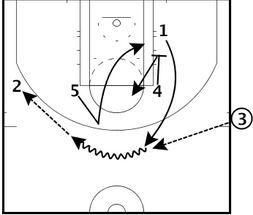
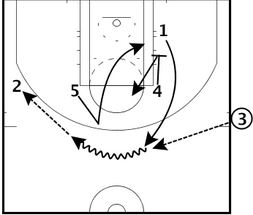
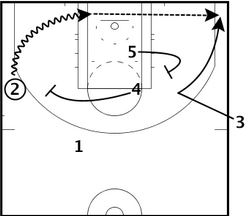
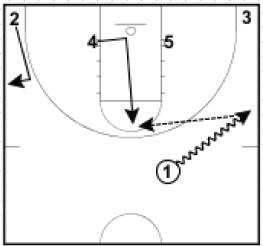
1 dribbles to the free throw line

4 makes an L cut to the top of the key.

2 cuts toward the top, then breaks off at the ft line extended.

5 shapes up in the post.
Basketball Plays

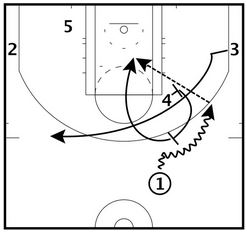
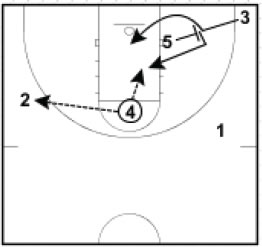
3 cuts off 5 to rim

5 steps in

4 looks hi-low

4 reverses to 2
 

Basketball Plays

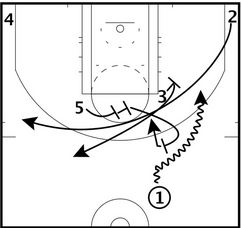
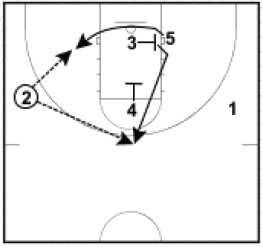
3 cross screens for 5

2 looks for 5

4 pins down for 3

2 reverses to 3
 

Basketball Plays

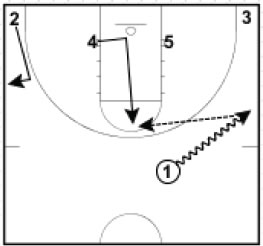
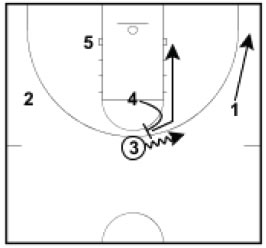
1 slides to corner

4 sets pick and roll for 3

4 rolls
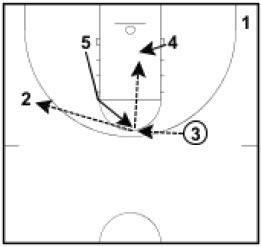


Basketball Plays

5 replaces 4

3 throws back to 5

4 steps in

5 looks hi-low

5 reverses to 2
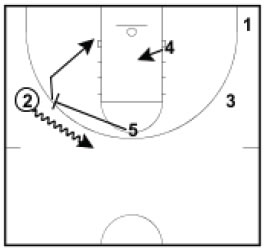
Basketball Plays

5 follows pass for side pick and roll


Basketball Finishing Moves Euro Step

By Brian Williams on May 24, 2013

In my opinion, the Euro Step is a good finishing move in both transition and in the half court.

I believe that it is important for players to develop moves to finish at the basket against a good or a large (or both) defender they they have practiced and are confident in. The more confidence a player has in his or her ability and moves to finish at the basket, the more they can be the aggressor rather than being dicated to by the defense.

I have posted a couple of videos below that show a couple of ways to teach the move.

Make sure your speakers are on to see and hear the youtube videos These are youtube videos, so please make sure that you are on a server that allows youtube access.

The euro step is a good way for a player to avoid picking up a charging foul and also to get a clean look at a layup against a good defender.

In addition to working attacking the basket from straight on, I think it is important to also work on finishing coming from both the left and right side.

Even if you don’t like this move, I hope you will find what works for your players and develop a system to teach then and implement them in you scoring drills in practice and in summer workouts.

Press the play arrow to see the YouTube videos.

Coaching Basketball Best Laid Plans

By Brian Williams on May 23, 2013

I have just completed the book “The Best-Laid Plans of a High School Basketball CEO”- A Coach’s Guide to Seeking & Securing, Building & Maintaining a Successful Program by Matt Kramer & Randy Montgomery. Both Matt and Randy are successful high school coaches in Ohio. Randy also has experience as a college assistant on Bob Huggins’ Staff.

In this post, I am listing some of my takeaways from the first half of the book and will follow up next week with part 2 of this post. If you are interested in more information about the book, you can find it at the link below. The site also has a blog with several interesting coaching articles:

www.beyondthehardwood.com

Matt believes that “winning is If one of the biggest liars in sports. He had several 15 plus wins seasons as a JV coach. He learned that when a young coach wins games, that coach often begins to believe everything he or she is doing is on point. Nothing could be further from the truth. His worst seasons, in terms of wins, were the seasons in which he came the closest to reaching his potential.

Matt encourages every coach to start or update your coaching portfolio now even if you are not looking for a new job at this time. It is a lot of work but if you write a little bit of the time it helps with your gross process as a coach. It is a great tool to market yourself in an interview but it also helps you self-evaluate and reflect on your evolving philosophy.

Taking a job where there is tradition, but no players, gets a coach fired.

Randy has a big game board in the locker room. It lists all of the big wins that the programs has had over the years. The players take pride in adding to it. They also have a framed color action picture of every senior that is played for him at Hoover.

Matt creates scouting guides to help his assistants scout. It is a report he gives them each time they have a scouting assignment. It is a preview of what they are likely to see. The scout then checks off the things on the report that he sees and to add anything else that needs to be included in the report.

Randy’s top traits he looks for in assistants are loyalty and a willingness to work hard and learn. An assistant needs to be totally on board and if he isn’t, he senses it and replaces them immediately.

Randy feels that former players make the best assistants because they believe in his system and their loyalty runs very deep.

Many coaches do not understand the amount of hard work and time that is required to be a good assistant. So, work ethic is a close second in qualities that an assistant coach needs.

Randy will not hire an assistant coach who is not willing to scout. He feels that having middle school coaches scout not only helps in preparation for upcoming opponents, but also helps them learn the game.

Make sure you like the person before you hire them. Loyalty isn’t going to develop unless there is at least a professional friendship.

Public high school programs do not recruit from around the country, but do need to recruit schools from within their high schools. Promoting and having a first class program make being on the team more important to kids in the school.

Work at connecting all levels of the program (elementary, middle school high school) to keep interest high. Have a game where you introduce younger players at halftime. In addition to the recognition, families can see what it is like in your gym on game night.

Matt on rebuilding a program–Losing games is not a bad thing–as long as it serves as a means towards a successful future.

Coaching is a people business.

Randy’s objective for every practice is to develop players who are physically and mentally prepared for every situation.

Like all fundamentals, becoming a good passing team does not happen by accident and must be constantly mastered.

One of the most important jobs of a coach is to carefully plan each practice to help the team to achieve the most success possible.

Matt believes in reducing the amount of practice time as the season goes on to keep players energized on game nights.

Key question to ask when planning practice: “What do I want us to be good at doing?”

Deal with discipline issues in a way that is both fair to the team and to teaches the individual the lesson that they need to learn.

Randy–“Discipline is about love and love isn’t about always saying yes.”

Matt–“Never allow helping a player to turn into enabling that player.”

Coaching is leading. Leaders sell people on their vision, build relationships and get people to follow their best-laid plans, to work hard, and to stay true to the task. No matter how long you have been in your position, you must pursue that process anew each new season.

As a coach, focusing on the important aspects of leadership, improvement, and teaching the game can be overshadowed at times by urgent matters such as getting time-sensitive information out to your team. There are team management apps that allow you to have immediate access to player and parent contact information on your desktop workstation, tablet, or phone. However, there are other ways to make the job of managing the team easier as well. Team management tools, like TeamSnap, automate a lot of these processes for you. In addition to letting you create, update and store a team roster, tools like TeamSnap let you see players’ availability for games and practices, assign responsibilities such as post game food or snacks, and keep track of who has paid their equipment fees, and completed their paperwork.

Basketball Drills Toughener

By Brian Williams on May 22, 2013

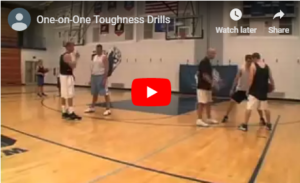
I am posting this video to give you a visual idea of a drill that I saw  Coach Ed Schilling who is an assistant coach for the Grand Canyon Antelopes use in one of his practices. At the time, he was the head coach at two time Indiana High School 2A State Champion Park Tudor. I did not video the drill when I saw Coach Schilling lead it, so I am using this video as an example that is similar to what he did.

Before being hired at Indiana, Coach Schilling was an assistant for Steve Alford at UCLA and the Executive Director at Champions Academy where he did skill development workouts

Make sure your speakers are on to see and hear the You Tube videos This is a You Tube video, so please make sure that you are on a server that allows You Tube access.

This is not Coach Schilling, but I like a lot of what the coach in this video says and does. The only thing I would improve in the video is that in order for the offense to become tougher with the ball, the defense should foul more frequently in the drill than they do in the video.

Make sure that there are no fouls to the head or face and that all fouls are to make the ballhandler tougher. The offense cannot get back at the defense by fouling. That would eliminate the purpose of becoming tougher to keep from turning the ball over.

Ed also did a moving toughner where he used the old one on one zig zag drill with a dribbler and a defender (offense must stay on one third of the floor and dribble baseline to baseline) while the defender is fouling and hand checking.

This is a simple drill, but effective if done in the right spirit and with the purpose of making each other tougher. The expectation in our program is that contact is never an excuse to lose the ball.

Press the play arrow to see the video.

Basketball Coaching Players Understanding

By Brian Williams on May 21, 2013

This article was written by Coach Randy Brown. He is a former D1 Assistant Coach at Iowas State and Arizona. His 18 years in college basketball highlights a successful 23-year career. Mentored by Basketball Hall of Fame coach Lute Olson at Arizona.

He has passion for the game of basketball and works as a basketball consultant and mentor for coaches. Click on the link below to subscribe to his daily email that includes links to his blog posts, plays, videos and other free resources:

Randy’s coaching resume includes positions at Arizona, Iowa State, Marquette, Drake, and Miami of Ohio, 5 Conference Championships and 5 NCAA appearances. His efforts have helped develop 12 NBA players including Steve Kerr, Sean Elliott, and Jaamal Tinsley.

You can visit his website at coachrb.com

IHave you ever been in the doctor’s office listening to him rattle off and endless stream of words you don’t understand? If you are like many, you nod your head as if you understand, but have no clue what is being said. The same scenario is taking place on your practice floor and you probably don’t even realize it!

At a clinic a few years ago I was asked this question, “How do you know for sure that your players understand you and exactly what you want?” A pause was followed by a cocky response like, “Of course they know what I want. They don’t ask questions, they take notes in film sessions, and they seem to understand what we are trying to do.” I moved on as if I had answered that question hundreds of times. In reality, my lack of confidence in the response I offered really bothered me. Here are some ideas that I addressed in my own coaching to make me a better communicator and coach.

1. Ask specific questions to your players. Instead of open ended questions such as, “So does everyone understand why our help side defense is crucial to our half court defense?” This question will get about 10 head nods “yes”, 3 silent responses and 2 “deer in headlights” looks. Amazingly, as coaches we take that as a yes and move on.

The correct way to check for players comprehension and understanding is to ask, “Jake, tell me why our help side defense is so important in the half court? Stated another way I could ask, “Without help side defense, John, what would our defense look like? Another good question would be, “Travis, if you were coaching, how would you explain the proper way to get through a screen one pass away from the ball.”

These questions are excellent because they illicit specific answers that leave no room for guessing or vagueness. The other benefit is that the attention level in the room will always be high because each player knows he may be next!

2. Terminology. Coaches need much improvement in this area. One downfall is that consistency in terminology is crucial, though many coaches are inconsistent in their use of terms. A coach may use the term screen one time and pick the next time. The player may think the coaches is talking about two different things because the words are different. Consistency in using terms is very important to developing clear, consistent communication between coaches and players.

3. The Ultimate Test. Do your players know exactly how to answer these two questions? If they do, you have 90% of all basketball coaches beat and can expect success on a consistent basis.

Question 1–Do you know what I expect from you as a player? If so, tell me exactly what it takes for you to get in the game. Playing time is at stake here, and many players think they know what they coach wants, but are often way off! Convince them that those who can answer this question will receive the playing time, and watch them pay attention! Player that understand your system and communication style can hit the bulls eye on this question with no problem. Could your players pass this test?

Question 2–Once in the game, do your players know how to stay in the game? As a coach, when a player earns the right to play, you want them to think and execute on the floor. A players’ understanding of your system and execution on both ends always shows on game night. The player that knows exactly what his coach wants AND can execute it, will be on the floor all night. How many of your players can answer Questions #2?

Failure is the greatest classroom according to all of the world’s great achievers. I learned a tough lesson about my communication as a coach. Fortunately I took that failure and turned into a way to improve my coaching drastically by asking the right questions and listening to my players. This article is written for you, so that you don’t make that same mistake.

CoachRB’s Q & A Collection

TOPIC: Building a Culture in High School
This question comes from a girl’s high school basketball coach in Iowa regarding building a culture of winning.

QUESTION:

Coach,

I will be working on skill development this summer with my team.  My team is not very good at shooting, penetration and passing.  Do you have a skill development packet, workout or something I could look at and possibly tweak?  We work on passing under pressure, getting trapped, and monkey in the middle to develop passing.  We shoot off of screens, from pivots, drop steps, slips off of screens and penetration to finish.  We develop our guards to explode around a chair with 1 and 2 dribble pull ups to crossovers and finish.  We also shoot on the Gun.

These are a few of the things we work on but we finished 9-14 this year with apathetic kids.  It turns into the coach’s fault and I hate it.  I have some talented freshman and I want to make sure we don’t lose anymore.  I offered developmental stuff like this last year and nobody showed up.  Any help or advice would be appreciated.

CoachRB ANSWER—

Coach–
Thanks for the email.

  1.  Go to CoachRB.com and search the Video Library. Select the Library you would like information on—shooting, ball handling, toughness drills, etc. You can spend a lot of time in the Library.
  2.  Spend time in the Skill Development section.

It seems your obstacle is a “buy in” so a change of culture is key.
It’s slow and painful, but starts by the kids having a reason to be in the gym. It must be “FUN” for them to be there.
Once you get them there, you have them and can work to help them improve.

My suggestions—-create a 3 on 3 league/program so kids/parents have the idea they are “playing” so you and the kids win. You can teach everything out of 3 on 3. It is the best use of your time possible as you continue to work on individual ball skill improvement. You will be amazed at the power of 3 on 3.

Basketball has to be important to kids before they will supply the action. They have to have a reason to get to the gym and so it has to be challenging, fun, and they must know they gained something by being there.

I hope some of that helps…RB

Basketball Plays NBA Playoffs

By Brian Williams on May 20, 2013

These three basketball plays from the NBA playoffs.

They were submitted by Coach Kyle Gilreath. Kyle is a current high school coach and is a former graduate assistant at Florida.

Kyle has written an eBook called “Championship Execution.”

He donates a portion of the proceed to the V Cancer Research Foundation:

You can find out more here: Championship Execution

Also, if you are interested in more offensive sets from the Spurs and Heat, I have information about the Spurs and Heat Playbook bundle from Coach Scott Peterman of the Basketball HoopScoop site. They contain 116 set plays (including several pick and roll sets) 18 secondary break actions, zone sets, and out of bounds plays. You can see more information at this link: Spurs and Heat Playbooks Information

San Antonio Spurs: Zipper Twist Special (Frame 1)

Basketball Plays

1 zippered off a screen from 4. 3 inbounded to 1.

5 slipped a middle pick & roll and 1 then passed to 2.

By slipping 5 to the rim, it forced the weak side defenders to help in the lane a little more.
 

San Antonio Spurs: Zipper Twist Special (Frame 2)

Basketball Plays

4 then sprinted into a side pick & roll. 2 turned it down and at the same time 5 flared 3 to the corner for an open 3-pointer from the corner.
With the defense already shifted in the lane, as (4) sprinted out into the pick the Warriors’ defense helped high which opened up a driving lane for 2.

With the defense focused on 2 and 5 this opened up the flare in the corner for the knock down 3-pointer.

Oklahoma City Thunder Slide Punch

Basketball Plays

3 cut off a screen from 4. By moving 3 over top, X4 had to respect the cut for a moment which forced the defense to be a tad late on the pick & roll.

4 then stepped out and set a pick & roll for 1. 1 came off and found 4 rolling to the rim. The defense decided to stay home on 2 which allowed 4 to be open on the roll.

Throughout the game the Thunder continued to put Memphis into pick & roll situations with a shooter spaced away to force the defense to make a decision to help or to stay home

Heat vs. Bulls Rhodie Punch

Basketball Plays

2 cut off a stagger from 3 and 5. 5 then flared 3. The Bulls had to respect the fact that 2 and 3 both came off screens.

This allowed 5 to quickly step out for the pick & roll for 1. The defense on 5 was a tad late helping.due to the original scrreening action on 2 and 3.

Screening players into picks OR setting screening which puts the defense in a bind and using the initial screener as a picker makes it very difficult for the on ball screeners defender to effectively defend the screen and roll.

If you are interested in more offensive sets from the Spurs and Heat, I have information about the Spurs and Heat Playbook bundle from Coach Scott Peterman of the Basketball HoopScoop site. They contain 116 set plays (including several pick and roll sets) 18 secondary break actions, zone sets, and out of bounds plays. You can see more information at this link: Spurs and Heat Playbooks Information

If you are interested in adding to your Coaching Toolbox take look at what I believe is our best offer.

CLICK HERE to select from a list of more than 70 eBooks.


  • « Go to Previous Page
  • Page 1
  • Interim pages omitted …
  • Page 229
  • Page 230
  • Page 231
  • Page 232
  • Page 233
  • Interim pages omitted …
  • Page 288
  • Go to Next Page »

Primary Sidebar

  • Twitter
  • Facebook
  • Linkedin
coachestoolbox
personaldevelopmenttoolbox
basketballplayerstoolbox
basketballtrainer
athleticperformancetoolbox
coachingbasketball

© Copyright 2026 Coaching Toolbox

Privacy Policy