• Skip to primary navigation
  • Skip to main content
  • Skip to primary sidebar

  • Basketball Plays
    • Ball Screen Sets
    • Horns Sets
    • Man to Man Post Up
    • Man to Man Isolations
    • Backdoor Plays
    • Man to Man 3 Point Shot Plays
    • 2-3 Zone Attack
    • Baseline Inbound Plays
    • Sideline Inbound Plays
    • Combination Defense Attack
  • Drills
    • Defensive Drills
    • Offensive Drills
    • Competitive Drills
    • Passing Drills
    • Rebounding Drills
    • Shooting and Scoring Drills
    • Toughness Drills
    • Transition & Conversion Drills
    • One on One Drills
  • Blueprint
  • Practice
  • Mental Toughness
  • Skill Development
  • Offense
  • Defense
  • Store

Basketball Drills Closeouts Blackhawk

Basketball Drills Closeouts Blackhawk

By Brian Williams on June 13, 2013

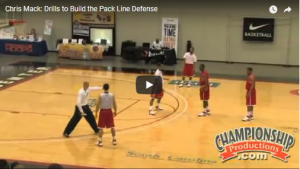
The video below features current Louisville and former Xavier Men’s Coach Chris Mack teaching one of the key drills to their packline style man to man defense.

Make sure your sound is on as you watch.

The video is a YouTube video.

Please make sure that you are on a server that grants access to YouTube.

Click the play arrow on the video icon to start the drill.


There is nothing to purchase to see the drill, however, if you are interested in purchasing this DVD, you can use this link:

Chris Mack: Drills to Build the Pack Line Defense

Make sure your sound is on as there is narration with the video.
Basketball Drills Xavier Shooting Part 2

By Brian Williams on June 12, 2013

These basketball shooting drills are from the Xavier Men’s Basketball Newsletter.

If you are interested in seeing the archive of their newsletters, click this link:

Xavier Newsletter Archives

32s Shooting Drill

From: Xavier Assistant Coach James Whitford

32s is a shooting dnll incorporating 15 shots finished up with 2 FT’s at the end.
We will shoot from 5 beginning spots.

3 shots will be attempted from each spot.

1st shot-drive to the basket to finish I point
2nd shot is a 15 ft. spot up jumper 2 points
3rd shot is from beyond arc 3 points

This is repeated at all five spots for a maximum total of 30 points. Shooter finishes the drill with a I and 1 FT oppotunity. each worth 1 point. Giving you a total of 32.

This can be varied for TIME/MAKES and by adding defense.

Can be done easily as a team drill with each shooter attempting the series of shots before moving to the next spot.

You can then total a team score as well as individual.

Our players like to do this on game days to reach a TEAM GOAL. Then they prefer to compete head-to- head in practice situations.

The current champion gets to keep until dethroned,

I have never seen a 32 in my coaching career.

One 31… shooter missed the second end of me 1 and 1!!!

Move Shooting Drill

“MOVE” is another basic drill with a number of variations to allow it to be a single player drill or a team drill.

Using our 5 Spots (left corner, left wing ,top, righ wing, right corner)

Shooter begins in left corner and stays until they score a total of 6 points:

15 footer = 2 points
19’9″ + = 3 points
Lay-up = 1 point

A Lay-up can only be attempted when the shooter needs 1 point to achieve their desired score.

EXAMPLE SCORING:
First shooter makes a 2 point, next shooter misses, next shooter makes a 3, team has a total of 5 SO next shooter is allowed to drive it for a lay-up to achieve the score of 6.

At the next spot the first shooter makes a 3, the next shooter makes a 3… we MOVE

Player completes six points at each spot

Now we go 8 points. Then 10 points. Then 12 points. Etc

This drill can be done for a certain amount of time. For example, put 5:00 on clock and see how many spots a shooter can complete. It can also be done just as a simple goal based drill.

When shooting in groups, this drill is great to teach time/score situations as in “knowing”what you need to achieve the MOVE.

It creates a very competitive drill when going on both ends with each team equally divided. We shoot in classes, by position, allow them to pick teams, etc.

Coaching Basketball Winning Principles

By Brian Williams on June 11, 2013

This article was written by Eric Musselman. Eric is currently the Assoicate Head Coach to Herb Sendek at Arizona State.

He has been an assistant for several NBA teams and is a former head coach of the Sacremento Kings and Golden State Warriors.

He has coached in the NBA D-League and was the 2011-2012 D-League Coach of the Year.

Eric has a blog (which he no longer updates) where he has posted many of his thoughts on coaching: emuss.blogspot.com


26 Winning Basketball Principles

  1. Protect the ball. Bad passes and low-percentage shots are the trademarks of a poor team.
  2. Be careful on a lay-up. More games are won on lay-up shots than on any other, and more games are lost because of poor lay-up shots than by any other shot.
  3. Basketball is a game in motion. Motion on the court is vital. Too many players stand still and beg for the ball. Players should always pass and move. This action will take their defenders away from the ball and open up the court for a teammate
  4. Always fake direction. Faking is important because it tricks opponents into making mistakes
  5. Move to meet the pass. Moving and meeting the pass is the stamp of a good ballplayer. Players who move and meet passes make it easy for teammates to get them the ball.
  6. When in trouble, make a V-cut (i.e., “clear out”). A player in the wrong position on the floor should make a V-cut. This will open up the floor.
  7. Don’t think for the opponents — be yourself. Play your game and do not spend time trying to figure out what your opponents are thinking.
  8. One player cuts at a time. Always remember — only one cutter at a time. Two players cutting at the same time allows the defense to be in a position to either double-team the ball or stop the play.
  9. Grab it — don’t tap it. Effective rebounders grab and secure the ball rather than tapping it.
  10. Never force a shot. Never shoot a shot if closely defended. Before attempting a shot, make sure that you have teammates in rebounding positions.
  11. Dribbling is an emergency measure. Nine out of 10 players dribble or bounce the ball before they do anything else. This is a bad habit because it limits a player’s opportunities.
  12. Talk to your teammates. Talking on offense and defense builds team play. Talking encourages teammates. Talking on defense is vital when picking up loose opponents.
  13. Never turn your head on defense. Players should never turn their heads to watch the ball when playing man-to-man defense. When players change from offense to defense, they should backpedal so that they can locate their personal opponent or help in case of a fast break.
  14. Don’t cross your feet on defense. Successful defensive players move their feet in short steps when playing defense.
  15. Hands up on defense. Tight-rope walkers use their hands for defense, and the good defensive player does likewise. Movement of the hands and feet discourages passing and shooting and shows that the defensive player is on the ball.
  16. Watch your opponent’s belly-button. We like our defensive players to keep their eyes glued to a part of the offensive ball-player that can’t fool them — the belly-button.
  17. Pick up the first man. When you are back or coming down the floor ahead of the rest of your teammates, pick up the first offensive player down the court, whether it’s your assigned player or not.
  18. Don’t leave your feet on defense. Good defensive players keep their head up and their feet on the ground.
  19. Get position for rebounds. Instinct and sensing the direction of the shot and the angle of the rebound enables players to move into the correct rebounding position.
  20. If you can’t rebound, you can’t win. Good rebounding limits the opponents’ shots and this is the key to winning basketball games.
  21. The first fast-break pass must be perfect. The fast break must get started with a quick outlet pass. If the first pass is a good one, the fast break is underway. After it’s started, it’s hard to stop.
  22. You must make 70 percent of your free throws. There is no excuse for being a poor free-throw shooter. Practice, confidence, and the proper technique are the keys.
  23. Keep the defense busy. If all five offensive players keep moving, their opponents cannot afford to sag or float. Moving with or without the ball forces the defense into making mistakes.
  24. Don’t cross the backboard to shoot. A player should learn to shoot from both sides of the basket and with both hands.
  25. Never underrate an opponent. Be ready to play every game. Overconfidence can affect a team’s play. It is wise to remember that it is only the underdog who can do the upsetting.
  26. Practice does not always make perfect — if you practice the wrong thing. Players often work long and hard and make little progress because they are practicing incorrectly.

Basketball Plays Iverson Cut

By Brian Williams on June 10, 2013

This play is from the Arizona Basketball Newsletter.

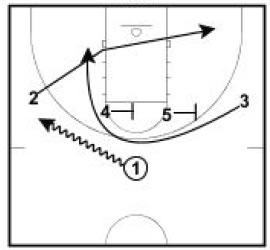
It is a very good way to give a good player 3 looks to score before you get into your offense.

If you are interested in joining their email database to receive their monthly newsletter, please email me the following information:

1) Your Name
2) Your School or Team
3) Your Coaching Position

If you like this play, please help me let others know about this site by using the like or tweet buttons at the right.


Basketball Plays

#1 dribbles at #2

#2 goes through to the short corner

#3 comes off #4 and #5 staggers to post up


Basketball Plays

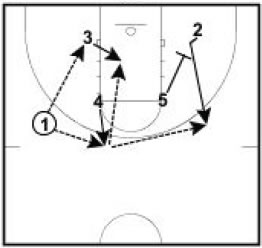
#1 looks at #3 in the post

#4 steps out

#1 reverses to #4 and #3 steps in

#4 looks high low to #3

#5 pins down for #2

#4 hits #2

Basketball Plays

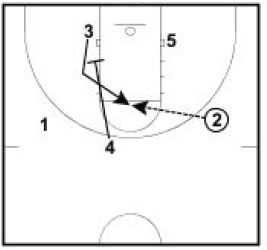
#4 pins down for #3

#2 looks for #3 on a curl


Basketball Drills Circle Trap

By Brian Williams on June 7, 2013

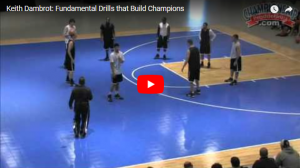
This basketball drill to work on both trapping the basketball and passing out of a trap is being demonstrated by Keith Dambrot, Head Coach at Duquesne.

In the video, Coach Dambrot credits Shaka Smart as the coach he learned the drill from.

If you like to make your drills competitive, one way to make this drill competitive is to score deflections and turnovers.

The video is a YouTube video.

The Circle Trap drill can be used by college teams all the way down to youth camps and clinics to teach passing skills.

I have a list of links below to other skill development drills that are posted on the site.

Make sure your sound is on. The video is three and a half minutes long.

Click the play arrow to watch the video.

If you are interested in more information about the DVD that this sample came from. click here: Fundamental Drills That Build Champions

Point Guard Characteristics

By Brian Williams on June 6, 2013

This article was written by Coach Randy Brown. He is a former D1 Assistant Coach at Iowas State and Arizona. His 18 years in college basketball highlights a successful 23-year career. Mentored by Basketball Hall of Fame coach Lute Olson at Arizona.

Randy’s coaching resume includes positions at Arizona, Iowa State, Marquette, Drake, and Miami of Ohio, His efforts have helped develop 12 NBA players including Steve Kerr, Sean Elliott, and Jaamal Tinsley.

Developing the skills of the point guard is a tedious, careful, and slow process. Coaches can cultivate excellent point guards if they take the right approach to the mental aspect of the game first. Great point guards are tough, un-selfish, understand the game, and mentally strong. A winning point guard is in command when the game is on the line and makes all other players better by his presence.

Players are never too young to begin learning the truths of the game. Starting with the fundamentals, a young player must become comfortable with dribbling, passing, shooting, and playing defense. As players develop physically, they also gain knowledge of how to play the game. This development is a key for point guards because their position is the most important on the floor. A good point guard makes the team go.

The following eight skills are necessary for great point guards:

Study and understand your teammates – The point guard more than anyone of the floor knows each of his teammates inside and out. He knows all roles on the team and makes it a priority to enhance each of their strengths. He knows how to put them into situations where each player can be successful. For example, a post player is instructed to post up on the blocks and not float out to the perimeter. His skills and ability will impact the team most by playing around the basket. Roles are crucial to good teams and the point guard can solidify the team unit with good leadership skills.

Be the coach on the floor and in the locker room – A good point guard embraces his coach’s philosophy of the game and instills it on the floor. Knowing what the coach wants and does not want is a rare trait among players. For example, it a team’s philosophy is to shoot as many three point shots as possible, the point guard needs to get the ball in the shooter’s hands in scoring areas often. If the style of play is to push the ball up the floor, then the point guard needs to organize the break, push it hard, and attack the defense. The term “coach on the floor” belongs to great point guards

Earn the players trust – For a team to follow a leader, they must believe that he would do anything for them. Not only must he play extremely hard, but he can motivate teammates to do the same. Without confidence in your floor general, a team is left vulnerable.

Set the tone in practice – Your point guard must understand how a successful practice is run and what the goal of practice is. By serving as a model, he can set the pace for a good practice. Conversely, when a leader is not willing to give it his all, the team will suffer by having a bad practice.

Knowledge of each possible situation – Understanding what to do in every situation is the duty of a great point guard. He must know who is in the game and how he can set up teammates to be successful. Offensively, the game plan must be played out to perfection. Good shots, smart passes, and good screening are a must and can be dictated by the point guard. Point guards are responsible for knowing the time and score at all times, the importance of each possession, and control the tempo. He need to be aware of what is taking place and what needs to be accomplished on both ends of the floor. A good test is to watch a leader take over a game at winning time. When his team is out of time outs, the great players take over the does what it takes to win.

Unselfishness – Many coaches interpret this to mean the point guard should not look to score. This is not the case, especially if scoring is one of the strengths of your point guard. Unselfishness means that he will sacrifice his game at times to find better opportunities for teammates. Great point guards always make others on the floor better because of his presence.

Defensive leadership – A great assist to a teammate for a layup is great, but can’t match the impact of solid defensive play. Defense wins games and by taking a charge or forcing a turnover, any player helps his team win. It is more difficult to inspire teams to play defense at times. Players love offense and tolerate defense. A great point guard can lead a team to take ownership of the defensive end of the floor.

Handle success and defeat in perspective – Athletic competition is a constant flow of highs and lows. Young players are often greatly affected by the outcome of games. By developing a solid point guard, you will provide your team with a peer who can keep them grounded. Winning often breeds complacency in a team and a good point guard can keep success in perspective. Conversely, a loss can be tough on a team. Good point guards are able to pick up the team with his toughness and work ethic. This characteristic is the foundation of all great point guards.

  • « Go to Previous Page
  • Page 1
  • Interim pages omitted …
  • Page 227
  • Page 228
  • Page 229
  • Page 230
  • Page 231
  • Interim pages omitted …
  • Page 288
  • Go to Next Page »

Primary Sidebar

  • Twitter
  • Facebook
  • Linkedin
coachestoolbox
personaldevelopmenttoolbox
basketballplayerstoolbox
basketballtrainer
athleticperformancetoolbox
coachingbasketball

© Copyright 2026 Coaching Toolbox

Privacy Policy