• Skip to primary navigation
  • Skip to main content
  • Skip to primary sidebar

  • Basketball Plays
    • Ball Screen Sets
    • Horns Sets
    • Man to Man Post Up
    • Man to Man Isolations
    • Backdoor Plays
    • Man to Man 3 Point Shot Plays
    • 2-3 Zone Attack
    • Baseline Inbound Plays
    • Sideline Inbound Plays
    • Combination Defense Attack
  • Drills
    • Defensive Drills
    • Offensive Drills
    • Competitive Drills
    • Passing Drills
    • Rebounding Drills
    • Shooting and Scoring Drills
    • Toughness Drills
    • Transition & Conversion Drills
    • One on One Drills
  • Blueprint
  • Practice
  • Mental Toughness
  • Skill Development
  • Offense
  • Defense
  • Store

Basketball Coaching 5 Keys to Maximizing Talent

Basketball Coaching 5 Keys to Maximizing Talent

By Brian Williams on September 20, 2013

Originally posted by Alan Stein on his Stronger Team Blog (re-posted with permission)

Something to share with your players.
Written by: J.P. Clark
@CoachJPClark
LA Clippers: Assistant Skill Development Coach

“I don’t want to be any good.”

“I don’t feel like being the best.”

“I want to be mediocre.”

Have you ever heard someone actually say (out loud) those things? Nope. Neither have I.

But do you know players (and coaches) that have habits and behaviors that ‘scream’ those things? Yep. They are a dime a dozen.

Which is weird because human beings have an innate desire to be great and to become special. Deep down, we all want to live to our greatest potential and to become the best at what we do. The question is; how do we fully maximize our talents? How do we live to our full potential on and off the court?

The reason I have selected this topic is because I have seen so many players unable to fully maximize their talent. I’ve seen it at every level – from high school to the NBA. I would like to share a few suggestions that I’ve learned and observed from working with some of the best players and coaches in the world.

I will start off by saying, when it comes to fully maximizing your talent; everyone has a different starting point. Some folks were simply born with more ‘advantages’ and raw talent. LeBron James was born with more ‘tools’ than the average person!
[adinserter name=”Basketball in article display ad 2 rebecca”]
However, being able to fully maximize your own potential has very little to do with your initial level of raw talent. There are countless stories of players with incredible talent and potential who never amounted to much because of poor work habits, character issues, and lack of discipline.

The Talent Code Author Daniel Coyle sums it up perfectly, “Talent is determined far less by our genes and far more by our actions.”

Here are 5 Keys to Maximizing Your Talent:

1. Great Players Have a Well Defined Why
Great players have a specific purpose and a personal mission. Great players know who they are and they know exactly what they want. Great players have a clear vision and have already set up their goals to make their dreams a reality. The best know why they play the game. The best know why they get out of bed every morning. Simon Sinek is the author of the book, Start with WHY. He commented in his book, “People who work with a clear sense of why are less prone to giving up after a few failures because they understand the greater cause.” Or as author Jon Gordon commented, “Our purpose is our ultimate guidance system that provides us with direction for our lives. Purpose fuels us with passion, and this passion gives us confidence to go after our dreams.” Great players know their why! Do you?

2. Great Players Have a Plan of Action

Once you know your personal why, then the only question you have to ask is, how? How will I achieve my goals? How will I live up to my why? How will I go from good to great? Great players understand that whatever got them here will not get them there. Great players come up with a detailed plan of how they will improve upon their strengths and weaknesses in order to achieve their goals. Remember, great ideas without a plan is merely a delusion. Just like in a real game, we have to be able to execute the game plan to be successful! We must have a detailed game plan mapping out our road to success. Great players have their goals written down and a plan of action to achieve them! Do you?

3. Great Players Outwork the Competition

When you talk about work ethic, one of the greatest examples our game has ever seen is former Boston Celtic, Kevin Garnett. Despite having compiled a Hall of Fame career that spans almost two decades long, KG is still fanatical about his daily routine. He gives 100% every single day. As you can imagine, KG works extremely hard at all times. KG outworks everyone, every time. Doesn’t matter if it is a pre-game shoot-a-round, a mid-season practice, or Game 7 of the NBA Finals – he goes hard no matter what. Coach Doc Rivers commented on KG when he first got to Boston, “I knew KG had great intensity. But I didn’t know he had it full time, on and off the floor. His intensity in practice spread to our entire team. He set the team’s tone with his own effort.” Great players outwork their competition. Do you?

4. Great Players Believe in Themselves

I have this listed at #4, but it may be the most important. Great players believe in themselves. They expect to perform at a high level because they have put in the work. Kobe Bryant once said, “The best believe in themselves. I have a determination where I don’t think anybody I line up against, on any given night, will be able to out-will me, I just refuse to believe that.”

Great players have a disciplined mind that allows them to believe in themselves even as negativity begins to set in. Great players understand the importance of controlling their attitude and effort. Great players believe in themselves. Do you?

5. Great Players are Lifelong Learners
Great players know they can’t reach their full potential alone. They know they need constant help along the way from teammates, coaches, trainers, etc. One of my favorite Doc Rivers phrases is, “If you want to go fast go alone. If you want to go far go together.” Great players understand the value of seeking wisdom and direction from their mentors and coaches and players with more experience. Great players understand greatness is a lifelong mission. Great players understand they can’t do it alone. Do you?

A long-time friend and colleague, J.P. Clark of the LA Clippers, was kind enough to submit this blog post (I only did some slight editing). Coach Clark is someone I had the pleasure of meeting years ago and I have a tremendous amount of respect for his passion, commitment to excellence, and keen basketball acumen. He is a first class guy on and off the court and I appreciate him submitting this piece.

I plan to use these 5 keys in my own life and coaching career.

Do you?

Alan Stein
Hardwood Hustle Blog
http://www.About.me/AlanStein
Basketball Drills Shooting Drills

By Brian Williams on September 18, 2013

These two shooting drills come from Coach Mike Neighbors newsletter.

Coach Neighbors took the women’s job at Arkansas in April 2017 after four years at Washington where he guided the team to the 2016 Final Four.

If you are interested in receiving his newsletter, please email me and I will pass along your email address to him.

The first drill is “Green Light Shooting,” the second is “Prove It”

Coach Neighbors teaching point is “Early preparation/Same shot every time”


Green Light Shooting

Basketball Drills

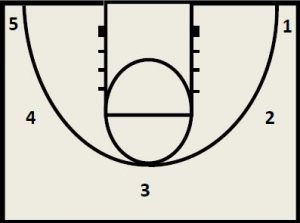
4:00 Shooting Drill. Shooter will use our usual 5 spots for each attempt.

1st trip around (1 thru 5 spots): shooter must make 3 shots at spot 1 before moving to Spot 2. Shooter progresses to each of the 5 spots after making 3 shots.

2nd trip (back around spots 5 thru 1): Shooter must make 2 shots in a row at each spot before moving to the next.

FINISH: Shooter moves around the five spots make or miss until she makes 5 consecutive 3’s… ** must move make or miss.

We record total time to complete. If the 4:00 time limit expires, we record the total number of made shots.

Drill #2 “Prove It”

Shooter must make 8 shots at spot 1. When she has made the 8th shot,

She must then make 3 in a row to “prove it”.

Repeat at each of the 5 spots.

Record total time it takes to PROVE IT at all 5 spots.

Basketball Drills Conditioning Drills

By Brian Williams on September 17, 2013

I have included a couple of different conditioning concepts in this post.

The first two drills are a couple of change of pace drills if you are not allowed to use basketballs at this point in time. You could also use them as a change to your traditional running drills once practice starts.

The second pair of drills involve a basketball and could be used in your conditioning and or toughness segments of in-season practice.

These drills were originally posted on FastModel Sports Plays and Drills Library

These first two conditioning drills with a basketball are from Alan Stein


Basketball Drills

Select one player as it. The other players have to stay in-bounds on half court.

Have a player (1) be “IT” for a desired time [:15, :20, :30] or until he tags everyone. (Be cautious with this choice. You want productive, practical work)

As soon as the time is up, immediately call out another player.

Option: give players a ball to dribble.

You’ll see the benefit of 3:00-5:00 of Tag vs 5 triple-nickels. (3 sets of 5 down and backs)

Basketball Drills


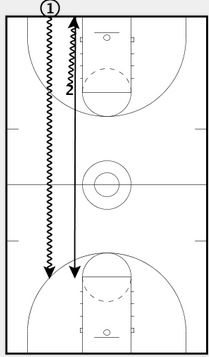
On the start command, 1 backpedals toward the other FT Line. 2 backpedals from FT line to Baseline then Sprints to try and beat 1.

Switch roles on the way back


The next two drills were contributed by Coach Greg White

2 on 2 Volleyball

Basketball Drills

Players play 2 on 2 inside a volleyball square.

Set a number of passes to be completed (Ex. 10, 20)

Players cannot dribble.

Players must stay inbounds (their square)

Steal and the opposite team takes possession.

2-5 minutes

Paint Game

Basketball Drills

You need 1 basketball. There will be no shots!! Each player will keep their own score. Game is to (whatever you decide. 8,10 or time. Most wins)

The drill starts with player 1 passing to 2 and closing out. As soon as 1 moves player 5 needs to move directly under the basket (This is why there are no shots.)

The objective of the drill is for the offensive player to get 2 feet into the paint using 2 dribbles or less.

Basketball Drills

Here Player 1 successfully stops player 2. Player 2 will pivot and pass to player 3.

IT IS IMPORTANT TO MAKE SURE PLAYERS DON’T “DRILL” BUT PLAY!


When the ball is in the air, 5 should sprint into a closeout on player 3.

Rotation: 1 replaces 2 on the wing, 2 goes to the back of the line.

Basketball Drills

In this Frame 3 beat the defense (5) into the lane.

3 would yell out “1” to signal his scoring.

3 would pass to 4. 6 would close out and 5 would take 3’s spot. 3 would go to the back of the line.

Adjustments:

Since 3 scored, you could let him stay and 5 return to line.

Allow 3 to pass back to 1instead of passing to 4 to force help defender to be game ready vs drill repped.

Basketball Plays Billy

By Brian Williams on September 16, 2013

This play is run against man to man defense.

I got it from a Creighton Burns’ newsletter.

If you are interested in receiving his newsletter, contact us and I will put you in touch with Coach Burns.

This play features 2 staggered double screens.

I also partner with Coach Burns on a website where we have posted several of his plays. The URL is: www.coachingbasketball.org


Basketball Plays

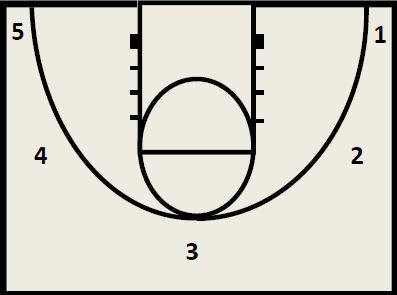
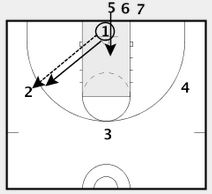
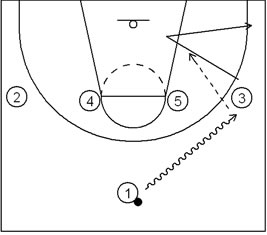
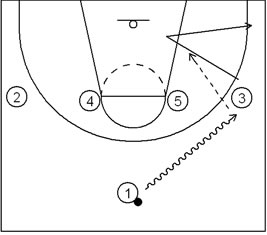
#1 dribble chases #3.

#3 runs a back door cut and if he does not get the ball he will move back to the ball side corner.


Basketball Plays

As #1 reaches the wing position (free throw line extended) #4 will set his defender and fill the point.

#1 will make the pass to #4 and #4 will complete the ball reversal by passing to #2.

On the pass from #4 to #2, #1 will run a shuffle cut off a back screen set by #5.

If #1 is open, #2 should get him the ball.

Basketball Plays

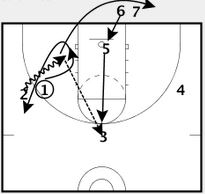
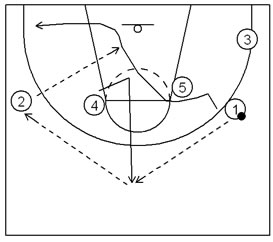
As soon as #1 cuts past #5, #4 and #5 will set a staggered double screen for #3.

#3 will act as if he is going to fill the point, but instead he will curl round the screen and cut down the middle.

If #3 is open on this cut, he should get the ball from #2.


#4 sets his screen and then replaces himself at the point.

Basketball Plays

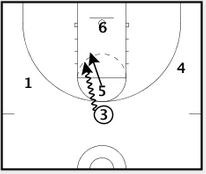
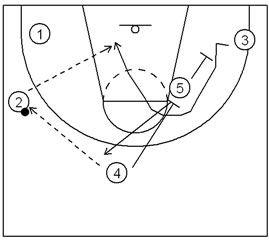
On the pass from #2 out to #4, #5 will screen into the lane, and #3 will use the screen to free himself on
the back side wing.

#5 will set the screen into the lane, and then post hard.

#4 and #2 will set a staggered double for #1 who will use the screens to try and free himself at the point.

#3 may have a shot, drive, a post feed to #5, or a pass out to #1 cutting to the point.

Basketball Plays

If #1 does not have an offensive move or a shot, the players are in position to repeat the play entry, or #1 can call out another play entry.


Coaching Basketball End of Game Checklist

By Brian Williams on September 13, 2013

These 3 end of game checklists were sent to me by Steve Smiley.

They were assembled by former long time NBA Assistant Gordon Chiesa.

He spent 16 seasons with the Jazz and also had a tenure with the Grizzlies.

He also served as a college assistant at Dartmouth and Providence. He was the head coach at both Manhattan and Providence.

He was an assistant with team that reached both the NBA Finals (1997 and 98 with the Jazz) and the NCAA Final Four (1987 with Providence)


OFFENSIVE QUESTIONS/CONCEPTS

  • Best offensive team when our team is losing.
  • Best foul shooting team when our team is winning.
  • Best ball handling team when protecting a lead.
  • Best three point shooting team when our team needs a “Three.”
  • Best individual match-up to score a basket/create a foul.
  • Which opposing player is in deep foul trouble, and our offense can go directly at him?
  • Who is our best inbound passer? Who is our 2nd best inbound passer?
  • What side of the floor, when inbounding from the sideline do we prefer?
  • Know/Understand with how much time left on the game clock, and the score is tied, when should the offensive player take the shot?
  • Know/Understand  that the defense is going to switch-out of any screening action regardless of size The sceener should look for a slip move as he starts setting the screen. The passer has to be ready to “Read and Pass.”
  • Know/Understand that when the opponent has a foul to give and our team has used our last time out, the Head Coach, during that time out, has to give our team two offensive plays to execute.

DEFENSIVE QUESTIONS/CONCEPTS

  • Best defensive team when our team needs one defensive stop (under 7 seconds on game clock)?
  • Best defensive team to contain dribble penetration
  • Best rebounding team when the opponent goes big?
  • Best “Comeback” Defensive Team by trapping/presses creating havoc defensively?
  • Best zone defensive team to take away the opposition set offensive plays?
  • Be ready to match-up small to defend the opponent’s 4 or 5 man who can make three point shots,
  • Know and understand the concept of staying home on 3-point shooters on dribble penetration.
  • Know and understand how to foul on the catch before the shooter goes into his shooting motion
  • Be ready to sub out a key offensive scoring player who has four fouls and ‘sub In” a “designated fouler.” Teach the designated fouler that he is making a positive contribution towards winning. We are not trying to embarrass him.
  • Know/Understand that when the score is even or our team Is up one or two, we will early double team or create a running trap situation against the “star perimeter player” in the scoring area. Philosophically we are not going to let the star perimeter player beat us with a basket or create a foul. We are going to make him pass the bail to a lesser offensive threat. Also,as an alternative, we could play a zone defense on the last possession against the star player.

END OF GAME CHECKLIST

  • Know the score of the game and the time left on the shot clock and game clock.
  • Know the timeout situation for both teams
  • The Head Coach will tell the players the team foul penalty situation from both an offensive and defensive standpoint. The players will always know if we have a foul to give.
  • Know/Understand when to call timeout by a Player who is not involved with the ball when his teammate is in a bad disadvantage.
  • Who are the worst foul shooters in the game?
  • Who are the worst foul shooters not in the game in case of an injury situation. and the opposing team can choose the new shooter?

You can also download 13 of my 130 Situations eBook. Click this link to read a sample of the ebook.

Basketball Drills Rebounding Hit and Git

By Brian Williams on September 12, 2013

This rebounding drill is from University of Arkansas women’s coach Mike Neighbors.

If you would like to subscribe to his newsletter, email me and I will forward your interest on to Coach Neighbors

This rebounding drill and the philosophies incorporated are taken from what Tom Izzo has done at Michigan State


Hit and Git

Basketball Drills

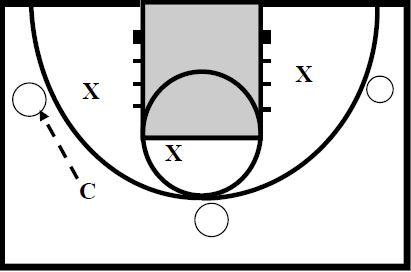
We start the drill with three offensive players outside the 3 point arc.

Defensive players are in their GAP positions. Coach passes to one player who attempts shot…

Defensive players must HIT then GIT the rebound
before the ball bounces on the floor. Initially we don’t allow offense to crash.

Basketball Drills

When we go live and allow offense to crash, one of the offensive player at the top of the key is not allowed to rebound and the free X player has LOGO area responsibility.

This helps simulate teams with a player back in transition Can build up to 4 or 5 by adding a post player on the block to work on wedging out!!!

POINTS OF EMPHASIS

Starting the players in their GAP positions is more game-like than having them hugged up on defense.
There are three perimeter techniques each player should work on:

1) blocking out a shooter
2) blocking out on the ballside (not allowing a player a free run at the board)
3) wedging out on the weakside (not getting pushed too far under the basket on weakside)

Our HIT terminology refers to us making a solid, aggressive HIT on every offensive rebounder. In five years of using this technique we have been called for exactly ZERO fouls for being overly aggressive.

GIT is really GET, but since my players make fun of my accent its become GIT and has stuck. GIT the ball is something that I don’t feel most coaches drill enough. Going for the ball can be instinctual but it can also be learned and if you emphasize/ reward it you’ll have a great rebounding team.

Make it competitive by assigning points for each time the ball hits the floor on a rebound to each team.

When going live go plus and minus for offensive and defensive rebounds.

  • « Go to Previous Page
  • Page 1
  • Interim pages omitted …
  • Page 216
  • Page 217
  • Page 218
  • Page 219
  • Page 220
  • Interim pages omitted …
  • Page 288
  • Go to Next Page »

Primary Sidebar

  • Twitter
  • Facebook
  • Linkedin
coachestoolbox
personaldevelopmenttoolbox
basketballplayerstoolbox
basketballtrainer
athleticperformancetoolbox
coachingbasketball

© Copyright 2026 Coaching Toolbox

Privacy Policy