• Skip to primary navigation
  • Skip to main content
  • Skip to primary sidebar

  • Basketball Plays
    • Ball Screen Sets
    • Horns Sets
    • Man to Man Post Up
    • Man to Man Isolations
    • Backdoor Plays
    • Man to Man 3 Point Shot Plays
    • 2-3 Zone Attack
    • Baseline Inbound Plays
    • Sideline Inbound Plays
    • Combination Defense Attack
  • Drills
    • Defensive Drills
    • Offensive Drills
    • Competitive Drills
    • Passing Drills
    • Rebounding Drills
    • Shooting and Scoring Drills
    • Toughness Drills
    • Transition & Conversion Drills
    • One on One Drills
  • Blueprint
  • Practice
  • Mental Toughness
  • Skill Development
  • Offense
  • Defense
  • Store

Basketball Drills 10 Up Shooting

Basketball Drills 10 Up Shooting

By Brian Williams on April 8, 2014

Today’s post is another great competitive basketball drill from Coach Mike Neighbors Washington basketball coaching newsletter. He sends it out each week. If you are interested in being added to his list, please email me and I will pass it along to him.

Here are his thoughts on what makes a TEAM Drill Competitive:

1) YOU DO!! Or another coach who has passion for the drill to keep it energized.

2) CHART IT… Must have a time/score with a winner/loser to keep most competitive players engaged.

3) ENVIORNMENT of COMPETITIVENESS if not consistent in all areas of your program… NONE of these drills will make an impact


10 Up Basketball Shooting Drill

Diagrams created with FastDraw
basketball-drills-1up1

This has become our day before the game shoot around “contest” drill.

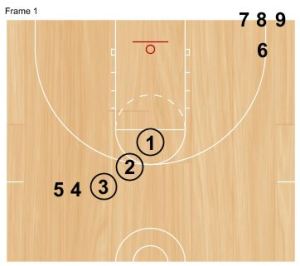
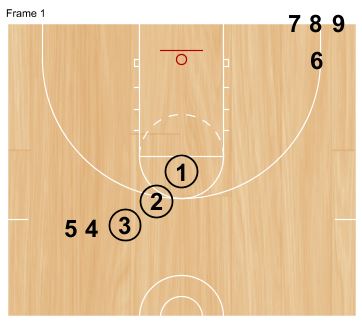
Passing line with three balls in the key. Shooters coming off the baseline.

In this diagram players 1-5 are the passing line. Players 1, 2, and 3 have basketballs. 6 is the first shooter up and 7-9 are waiting in line.

This drill can be done with any number of players/coaches. We always jump in to loosen things up from time to time.

The overall goal of this game is to have the FEWEST points possible. So like GOLF, low score wins.

First shooter attempts a 2 or 3 point shot. If shot is made that puts 2/3 points “UP”. The next shooter attempts a 2/3. If made that total is added to the number of points “UP”. So if shooter one made a 3 there are 3 points “UP”. Now, if shooter two makes a 2, there would be 5 points “UP”. If missed shooter two would take the 3 points that we “UP” and we’d begin a new string.

We stay at spot 1 until someone accumulates 10 points and is eliminated.

Once you have UP points you have them for the remainder of the drill. It is similar to H-O-R-S-E. Once you accumulate 10 or more points, you are out of the drill and can shoot free throws or work on other skills.
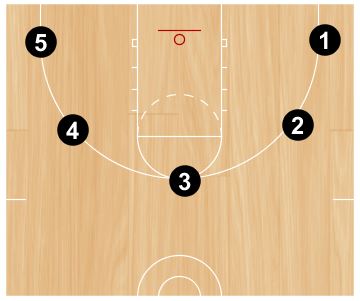
basketball-drills-1up2

This diagram illustrates the 5 shooting spots for the drill with black circles. Each spot is on the arc because the players have a choice of shooting a 2 or 3 point shot.

After one shooter gets 10 UP and is eliminated, we move to spot #2. All shooters points carry over.

We repeat this until we are left with only one shooter with less than 10 points!!

You’ll be shocked at how few times your “best” shooter will win this drill.

It puts you in pressure situations. It forces you to understand score. And most importantly focus on making shots.

I have been eliminated in this drill many times after having ZERO total points through 5 or 6 spots only to miss at the end of one long string and go from ZERO to OUT!!!!

One year we took an old weight belt and had a manager dress it up to look like a World Championship Wrestling belt for the reigning 10UP Champ to wear out to the floor on COMPETITION
DAY.

While this drill is light and fun, you can keep it competitive. We made this drill optional for a while but noticed our best shooters sometimes were afraid to jump in at the risk of not winning.

You WILL find your pressure shooters here!!!!
Basketball Plays Attacking Traps and Mismatches

By Brian Williams on April 7, 2014

A couple of plays from the Arizona Men’s Basketball Coaching Newsletter.

One of the actions is a way to deal with teams that double team your low post player.

The second action is a way to attack perimeter switches that are mismatches that you can take advantage of.

Even if these sets don’t work for your personnel, I hope it gives you some inspiration as to how you can take advantage of these situations when they occur against you.

If you are interested in joining their monthly newsletter list, please email me your:

1) Name
2) email address
3) Coaching Position
4) School or team

and I will pass it on to their staff.

The newsletter comes out once each month at the beginning of the month.

Diagrams created with FastDraw

Attacking a Post Trap

baskteball-plays-post-trap1

Run this and similar actions when you face teams that trap the post or if you have an exceptional post player who is trapped.

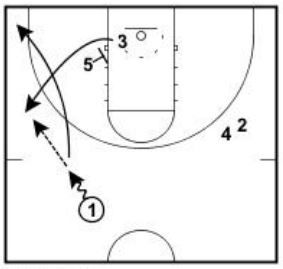
5 screens 3 to the wing.

1 hits 3 and cuts to the corner.

4 and 2 are spaced on the opposite side wing.

baskteball-plays-post-trap2

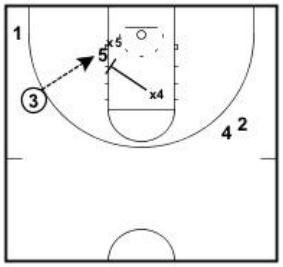
As the ball is fed to the post and the defense traps the post, utilize the player being guarded by the trapper (#4) to screen the defender guarding the shooter (X2)


baskteball-plays-post-trap3

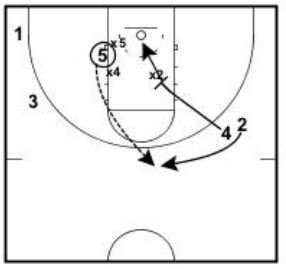
2 moves to a spot where 5 can get him the ball by throwing out of the trap.


Attacking a Perimeter Switch/Mismatch

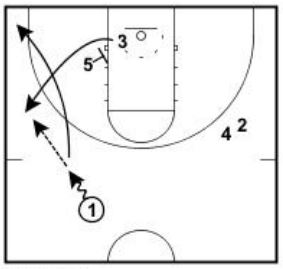
basketball-plays-perimeter-switch1

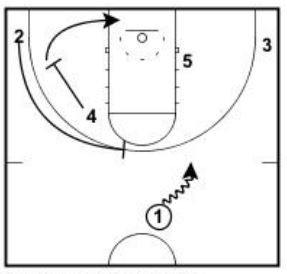
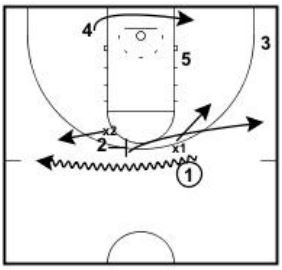
#1 dribbles to the right side deep elbow.

#4 screens #2 into an on ball screen for #1


basketball-plays-perimeter-switch2

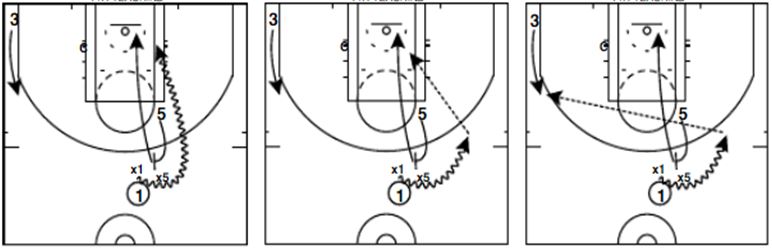
The purpose of the ball screen is to create a switch betwwen X2 and X1

2 quickly sprints out of the screen.


basketball-plays-perimeter-switch3


5 ballscreens for 2.

The left side of the floor is clear if 2 rejects the screen.


Coaching Basketball Winner’s Mentality

By Brian Williams on April 3, 2014

Winner’s Mentality

By Alan Stein of Pure Sweat Basketball A great resource for basketball coaches and to share with your players.

A winner’s mentality is a focused form of confidence. And confidence must be earned through demonstrated performance, discipline, effort, and consistency. A winner’s mentality comes from a daily commitment to excellence. You can’t just wake up and have a winner’s mentality, you have to earn it.

The fascinating part is, confidence is contagious. Unfortunately so is a lack of confidence. You work hard, smart, and consistently… and you win more often than not. The more you win, the higher your confidence. The winner’s mentality feeds itself.

A winner’s mentality also means that you are more focused on what you do than on what your opponent does. Winners focus on what they can control:

• Effort
• Attitude
• Preparation
• Execution

As Coach John Wooden once said, “Don’t worry about them, let them worry about you.” That my friends, is a winner’s mentality!

Being a winner is believing that on any given night, you can beat anyone. But it is also being humble enough to admit that on any given night, anyone can beat you.

Most importantly, teams with a winner’s mentality only care about one thing – winning. No personal agendas. The team always comes first. Every player (and coach) on the team knows their role, accepts their role, takes pride in their role, and fulfills their role to the best of their ability – no exceptions.

Play Through Adversity

Do you want the good news or the bad news?

The bad news? Every team will experience some form of adversity… every game. It’s inevitable.

The good news? “If handled correctly, adversity can be the prerequisite to great things.”

You must embrace adversity. Don’t expect anything to be easy. Assume the other team will go on runs, that’s part of the game. Expect that your team will go through shooting slumps, that’s part of the game as well. You obviously want to do your best to prevent both, but just know they will happen!

Do you think a boxer goes into the ring thinking he’s not going to get hit? Of course not. He knows he’s going to get punched. Same is true in hoops. Expect the ‘punch.’ And keep fighting!

Now, when the other team goes on a run or your team goes in a slump, follow this simple advice:

“When you find yourself in a hole, the first thing you need to do is stop digging.”

Opponents’ runs and your slumps are often caused because you stop doing the little things. Every player needs to immediately focus on being solid:

• Making the right play on both ends of the floor.
• Making the easy pass.
• Boxing out on every shot.
• Setting solid screens.
• Running the floor in both directions.
• Hustling on and off the floor during time-outs.
• Having good body language and eye contact with your coach.
• Contesting all shots.

In many instances, a recommitment to being solid will end the adversity and turn things back around!

Lastly, the key to both the winner’s mentality and to playing through adversity is mental toughness. Many coaches define mental toughness as the ability to tolerate physical discomfort or screaming expletives. But I disagree.

Mental toughness is simply the ability to Play Present. To focus on what you have 100% control over – your effort and
your attitude. To focus on the next play. To focus on the process of winning, not the outcome. When you Play Present, you maximize your potential.

Coaching Basketball Player Attributes

By Brian Williams on April 2, 2014

Both of these resources came from old Xavier Men’s Basketball Newsletters.

Here is a link to their archives: Xavier Men’s Basketball Newsletter.

I like to file these kinds of list for players notebooks.

This first list is what one NBA team “On the Court Player Attributes” they look for when evaluating players. There are some points that can be modified and adapted for the college and high school levels:

1. Does he “Fight Back” or have resiliency as a competitor?
2. Does he come from a winning background or culture?
3. Can he defend multiple positions?
4. Does he cut hard?
5. How does he take a screen? How does he set a screen?
6. Basketball IQ: Feel and understanding of the game?
7. How does he attack a close-out off the dribble?
8. Is he consistent and reliable night-in and night-out?

9. How does he bounce back from a poor performance?
10. Is he “comfortable being uncomfortable?” A pressure player?
11. Is he a quality teammate?
12. How does he impact and affect winning?
13. Can he remember plays and take instruction?
14. Is he around the ball? Does he try to rebound defensively?
15. Does he shy away from contact?
16. Is he a whiner and complainer?
17. Can he “Pull and Kick?”
18. Does he have an edge? Have something to prove?
19. Does he approach the game as a professional?
20. Can he play his game at a top speed?

Pat Riley on The Disease of Me

The Disease of Me = The Defeat of Us

6 Danger Signals of the Disease of ME:

1. Chronic feelings of underappeciation–focus on oneself.
2. Paranoia over being cheated out of one’s rightful share.
3. Leadership vacuum resulting from formation of cliques and rivalries.
4. Feelings of frustration even when the team performs successfully
5. Personal effort mustered solely to outshine one’s teammate.
6. Resentment of the competence of another.

“The most DIFFICULT thing for individuals to do when they become part of a team is to sacrifice, it is much EASIER to be selfish.” Pat Riley

I have included links to similar articles below.

Basketball Plays Box 53 Vandy Razor

By Brian Williams on March 31, 2014

Today’s play is a way to get the ball to a big at the basket.

Coach Vonn Read has submitted several plays from his playbook series The Basketball Encyclopedia of Plays to the Coaching Toolbox.

Vonn is the Associate Head Coach for the Women’s program at Syracuse.

Coach Read has also served as an assistant coach in the WNBA with the Phoenix Mercury, Orlando Miracle, and San Antonio Silver Stars. He was an advanced scout for the Orlando Magic as well as The Charlotte Sting.


basketball-plays-vandy-razor1


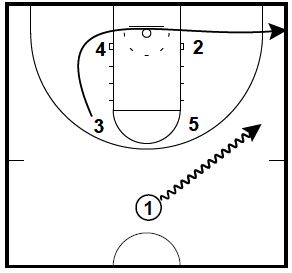
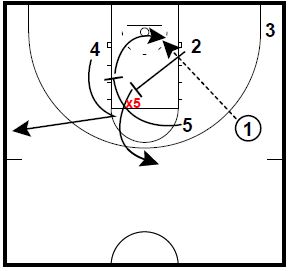
1 dribbles to the wing. 3 curls around 4 and 2 cutting to the corner.


basketball-plays-vandy-razor2

5 will turn and set the fake screen for 4.

At the same time, 2 sets the screen for 5 for the slip layup.

If X5 helps on the screen on 4, 5 should be open.

If X2 helps, 2 should be open popping to the top.


Coach Read has also put together The Basketball Encyclopedia of plays. You can check them out here: The Basketball Encyclopedia of Plays or read more about the books:

Any coach looking for the latest and innovative plays from the Professional, College, or High School levels can stop looking. With a compilation of over 7,700 different plays, you will never need to purchase another basketball playbook again. These playbooks can be used as a great reference tool for years to come. This 2 Volume Book includes plays from 19 different play categories, and they are the most extensive playbooks on the market.

The Basketball Encyclopedia of Plays (Platinum Series) contains over 7,700 Plays (Both Volumes combined) from the NBA, WNBA, USBL, and College levels from someone who has worked as an Advanced Scout or Coach on each level!!! This book has been intensely compiled over the last 21 years, with plays taken from a lot of NBA Coaches (past and present), WNBA coaches, and College coaches (Men’s and Women’s) from around the country.

Any coach that is serious about improving their knowledge of the game from an X and O standpoint will benefit tremendously from these books. These Books can be used to discover New Quick hitters, add a New Package to your playbook, or develop an entire Offensive System. There are a lot of new ideas and concepts in these books to study, and the Basketball Encyclopedia of Plays can be a great resource for coaches on all levels!!! This book is definitely for those X and O junkies who are always looking to improve as a Coach.

“THE GAME IS ALWAYS CHANGING? ARE YOU?” Vonn Read

Here is the link: The Basketball Encyclopedia of Plays

Teaching Basketball Pick and Roll Decision Making

By Brian Williams on March 28, 2014

By Mike Dunlap (former Charlotte Bobcats Head Coach and current Loyola Marymount Head Coach) and currently Men’s Basketball Coach at Colorado Mesa.

The development and decision making process of the pick and roll game covers a lot of ground.

I will give you a couple ideas and leave it there.

One of the most important points that I can make is teaching to the advantage of the drill.

For example. play 3 offense versus 2 defenders. You can guard the ball and the screen, while putting a coach on the replace or fill man.

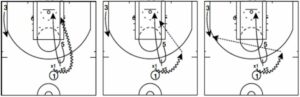
The coach is there to instruct only while giving the ballhandler different verbal cues as he takes his second dribble off the screener, like pass to replace man using the verbal “3” ….or making a bounce pass to the roll man using the verbal “5” or calling out “1” which means the ballhandler attacks rim or shoots a pull up jumper.

Diagram of the 3 scenarios just described

The set would be: ballhandler in middle alley, screener on either elbow, and replace man in the corner opposite side ballhandler dribbles for throwback pass. The idea here is to give all 3 offensive players verbal cues and use different types of situations so they must read and react.

pnrteaching

Offensive basketball is nothing more than move and countermove. We teach different situations or types of pick and roll defenses and show the offense how to attack that particular scheme. For instance, if the defense is using a traditional hard hedge against the hallhandler, we tell him use at least 2/3 dribbles to get separation from screener so that passing windows are much bigger.

Additionally, we tell the point guard that there is an order to our progressions: “you attack rim first, look for roll man second, and find replace man third.” We also know that people remember things in threes so we tell the ballhandler to be aware of the 3 S’s: start point, set up (fake opposite the screen) and the separation rule of at least 2 dribbles before passing the ball.

The biggest problem I continually see with the p/r game is that the ballhandler leaves before the screener gets to his defender…WAIT…fake away….and once the ballhandler hears both feet of the screener hit the ground, he takes off…..The next most prevalent mistake lies with the screener because he does not sprint into his pick….sprint. sit, separate….there it is again, the 3 Ss…

  • « Go to Previous Page
  • Page 1
  • Interim pages omitted …
  • Page 195
  • Page 196
  • Page 197
  • Page 198
  • Page 199
  • Interim pages omitted …
  • Page 288
  • Go to Next Page »

Primary Sidebar

  • Twitter
  • Facebook
  • Linkedin
coachestoolbox
personaldevelopmenttoolbox
basketballplayerstoolbox
basketballtrainer
athleticperformancetoolbox
coachingbasketball

© Copyright 2026 Coaching Toolbox

Privacy Policy