• Skip to primary navigation
  • Skip to main content
  • Skip to primary sidebar

  • Basketball Plays
    • Ball Screen Sets
    • Horns Sets
    • Man to Man Post Up
    • Man to Man Isolations
    • Backdoor Plays
    • Man to Man 3 Point Shot Plays
    • 2-3 Zone Attack
    • Baseline Inbound Plays
    • Sideline Inbound Plays
    • Combination Defense Attack
  • Drills
    • Defensive Drills
    • Offensive Drills
    • Competitive Drills
    • Passing Drills
    • Rebounding Drills
    • Shooting and Scoring Drills
    • Toughness Drills
    • Transition & Conversion Drills
    • One on One Drills
  • Blueprint
  • Practice
  • Mental Toughness
  • Skill Development
  • Offense
  • Defense
  • Store

Subtraction Season

Subtraction Season

By Brian Williams on April 23, 2021

Article Provided by Randy Sherman of Radius Athletics

You can follow him on Twitter @RadiusAthletics

I ran across an article that caught my attention this week. The author, Leidy Klotz, is an engineer and professor at the University of Virginia and his new book Subtract: The Untapped Science of Less seems right up my alley!

In Subtract, Klotz writes that “in our striving to improve our lives, our work, and our society, we overwhelmingly add. We overlook the option to subtract from what is already there.”

Followers of this newsletter and my tweets know that I am a proponent of simplification as it pertains to coaching. In an age of information abundance, it takes great power to focus when new ideas are all around you. Most coaches are adding; few coaches are subtracting. Why?

According to Klotz, “we neglect subtraction. Compared to changes that add, those that subtract are harder to think of. Even when we do manage to think of it, subtracting can be harder to implement.” So adding is easy, subtracting is hard.

It seems the coaching offseason is when this is at its apex for coaches. Inspired by Klotz’s book and its thesis I want to pose some questions for coaches to consider this offseason. These questions serve as sort of a challenge to coaches as they evaluate their season and prepare for the next one.

When faced with a tactical problem, do I tend to solve it by adding a fix or simplifying?

Is my knee jerk after a loss to add or subtract?

Are we adding solution after solution to address problems we could just avoid altogether?

Are our players given too many options? Which options could be removed to make their decisions faster and easier?

Are there cuts, screens, actions in our offense that could be getting in the way?

Are our defensive tactics lean and repeatable? Or are we constantly adding in response to different scenarios?

Are we adding drills that just work on the same thing a different way?

When we do add, are we advancing or deepening our players knowledge? Or are we just giving them something else to memorize?

When we do add, are we also subtracting? Is what we add replacing anything? Or are we just lumping on?

What is in our physical space that we can subtract? Is our locker room cluttered? Is my coaching office (drawers, cabinets) cluttered? Is our equipment closet cluttered with junk? Is my computer/phone full of stuff?

Is what we are adding better? Or just something else?

Have I convinced myself that “good coaches” and “good teams” have a thick, complex and intricate playbook?

If we add something in response to a problem, do it solve the underlying issue? Or is it just a workaround that allows the underlying issue to fester?

Can we realistically expect our additions to be executed in game play?

Can I pause for a moment before adding and consider subtraction as an alternative?
[adinserter name=”Block 3″]
Have I asked the players I coach if they want me to add or subtract?

On offense, if we made an acceptable percentage of good shot opportunities our tactics generated would I still be considering adding?

The offseason is hailed as improvement season for coaches. It certainly can be. The questions raised here are not anti-improvement; quite the opposite. The purpose is to consider the power of subtraction when the reflex to add seems to be our default. My hope is that these questions guide your offseason and prevent you from some of the pitfalls Klotz writes about.

Subtracting has to do with doing less, not thinking and studying less. Study deeper. Learn many, but commit to few.

Continue the conversation:

For help with guidance and leadership during your coaching journey join our community for basketball coaches!

Enjoy all our basketball coaching resources.

Any questions, contact us! Happy to talk hoops any time day or night!
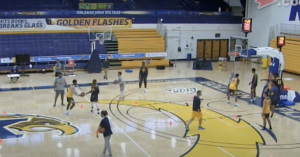
1 on 1 Lane Drill

By Brian Williams on April 23, 2021

1 on 1 Lane Drill with Rob Senderoff, Kent State Head Coach;

Open basketball practices are always a great way for coaches to expand their knowledge and rejuvenate their creativity. Coach Rob Senderoff’s teams are known for their offensive execution and late game efficiency (Coach Senderoff has a 64% winning percentage in games decided by five points or less). This video will be a great addition to your library as you get to see Coach Senderoff put his team through a mid-season practice and see how they prepare for game day!

We are providing this drill to give you ideas on how to enhance your current practice drills. The idea is not to implement it exactly as is, but rather to tweak it to make it fit your system.

There is sound with the video, so please make sure that your sound is on.

This is a YouTube video, so you will need to be on a network that does not block YouTube videos.

For more information about NABC On the Court Open Practice with Rob Senderoff: Drills to Develop Every Area of the Game, click here: NABC On the Court Open Practice with Rob Senderoff: Drills to Develop Every Area of the Game – Basketball — Championship Productions, Inc.

Defensive Conversion Drills

By Brian Williams on April 16, 2021

Defensive Conversion Drills with Sasha Anderson, Women’s Basketball Assistant Coach at Seattle Pacific University

Anderson is beginning her 16th season on the Falcons’ staff following six seasons at the high school level.

Anderson took Snohomish County Christian to the postseason four times in six years, including a state Class B tournament appearance in 2004 and an unbeaten regular season in ‘05. She also coached volleyball at the high school level.

Coach Sasha Anderson shares a variety of defensive drills designed to teach and reinforce defensive fundamentals in this clinic presentation for the WSGBCA. Coach Anderson also covers rebounding, defensive transition, and mental toughness drills.

We are providing this drill to give you ideas on how to enhance your current practice drills. The idea is not to implement it exactly as is, but rather to tweak it to make it fit your system.

There is sound with the video, so please make sure that your sound is on.

This is a Vimeo video, so you will need to be on a network that does not block Vimeo videos.

If you would like to see more information about Coach Anderson’s entire presentation, click this link:
Sasha Anderson: Everyday Defensive Drills

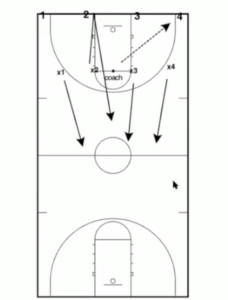
4 on 5 Rotation Defensive Drill

By Brian Williams on April 16, 2021

4 on 5 Rotation Defensive Drill with Michael Huger, Associate Men’s Head Coach at Temple.

His emphasis is on playing fast in transition, coupled with a hard-nose defense.

We are providing this drill to give you ideas on how to enhance your current practice drills.

The idea is not to implement it exactly as is, but rather to tweak it to make it fit your system.

There is sound with the video, so please make sure that your sound is on.

This is a YouTube video, so you will need to be on a network that does not block YouTube videos.

For more information about NABC On the Court Open Practice with Michael Huger: Defense, Transition Offense & Positional Breakdowns, click here: NABC On the Court Open Practice with Michael Huger: Defense, Transition Offense & Positional Breakdowns – Basketball — Championship Productions, Inc.

The Formula for High Performance Team Building

By Brian Williams on April 16, 2021

THE FORMULA FOR HIGH PERFORMANCE TEAM BUILDING

Dr. Cory Dobbs
The Academy for Sport Leadership

“Tell me and I will forget. Show me and I may remember. Involve me and I will care.” -Your Student-Athlete

Here’s a simple formula that should provide you a clear way to grasp high performance in the area of team leadership. High involvement plus high commitment equals high performance.

So, what does all this mean for you? Well, high involvement means you need to nurture the involvement of every team member. Did you get that—every team member. Each and every team member needs to engage with the leadership development process by bringing a high level of energy and focus. Only when you have high involvement can you entertain the idea of high commitment. Simply put, if you don’t have high involvement you can’t have high commitment, and if you don’t have high commitment you’ll never see high performance.
[thrive_leads id=’3019′]
If you select only a few team captains you’ve willingly and knowingly chosen low involvement. Those student-athletes not selected to develop as leaders will not care much about the process of leadership development of their peers. They’ll clearly say by actions and non-actions, “Why bother, there’s nothing in it for me.” You’ve chosen not to get them directly involved and commitment comes from being involved.

Those student-athletes you’ve chosen as team leaders might show high commitment to leadership and leadership development. Why not, it benefits them. But you are still left with the reality that you don’t—and logically can’t have—high involvement with only a few chosen participants. Thus, you’ll never achieve high commitment nor high performance.
[thrive_leads id=’36827′]
However, if you choose to involve everyone on the team—a leader in every locker—you have a chance to attain high commitment. By placing leadership practice and opportunities in the hands of every team member, you involve everyone. And depending on the quality of programmatic development you have a chance at achieving high commitment. Ahhh, once you get high commitment it is very likely you’ll get high performance.

This isn’t some mystical process. By deploying a leader in every locker approach your players are highly involved with an opportunity to become highly committed. Your challenge is to get them to willingly invest their minds and heart into the team leadership development process, building skills and competencies that lead to high performance. So, to wrap up this leadership bite here’s the formula once again: High Involvement + High Commitment = High Performance.

Agility Pressure Shooting

By Brian Williams on April 9, 2021

These drills were submitted by Coach Mason Waters.

Mason Waters has coached at multiple levels of basketball including the NCAA Division 2 level at Flagler College, the high school level at West Forsyth High School in Georgia, and at the middle school level.

You can download his entire Drill Book here: Coach Mason Waters Drill Book

PURPOSE:
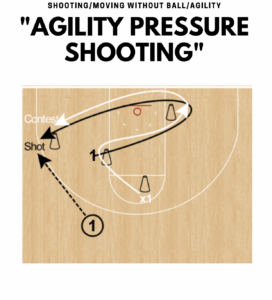
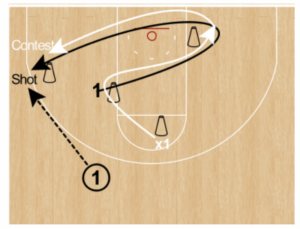
The purpose of this drill is to emphasize cutting off the ball at full speed, getting a shot attempt at a high speed, and to make a proper read of a closing defender. Defensively, this drill is practicing on trailing the shooter.

SETUP /INSTRUCTIONS:
Setup 4 cones as diagrammed on the court from the previous page. There will be 1 offensive player and 1 defensive player. The action will begin when 1 starts cutting. Xl reacts immediately and trails 1 around each cone. As 1 approaches the final cone, they will receive the basketball. They will catch to shoot. If the defender is very close, the drill turns into lvl live.

TEACHING POINTS:
1) Offense: Cut fast AND when you catch, you are definitely shooting. Only stop your shot if the defender is right there.
2) Do not allow cutting at full speed to create poor shooting form/ keep good shooting form.

VARIATIONS TO THIS DRILL:
The primary principle behind this drill is to reward sprinting throughout a cut and to also reward a fast shot release. Therefore, change the cones and cutting patterns to however you like.

# OF BASKETBALLS: 1

  • « Go to Previous Page
  • Page 1
  • Interim pages omitted …
  • Page 16
  • Page 17
  • Page 18
  • Page 19
  • Page 20
  • Interim pages omitted …
  • Page 288
  • Go to Next Page »

Primary Sidebar

  • Twitter
  • Facebook
  • Linkedin
coachestoolbox
personaldevelopmenttoolbox
basketballplayerstoolbox
basketballtrainer
athleticperformancetoolbox
coachingbasketball

© Copyright 2026 Coaching Toolbox

Privacy Policy